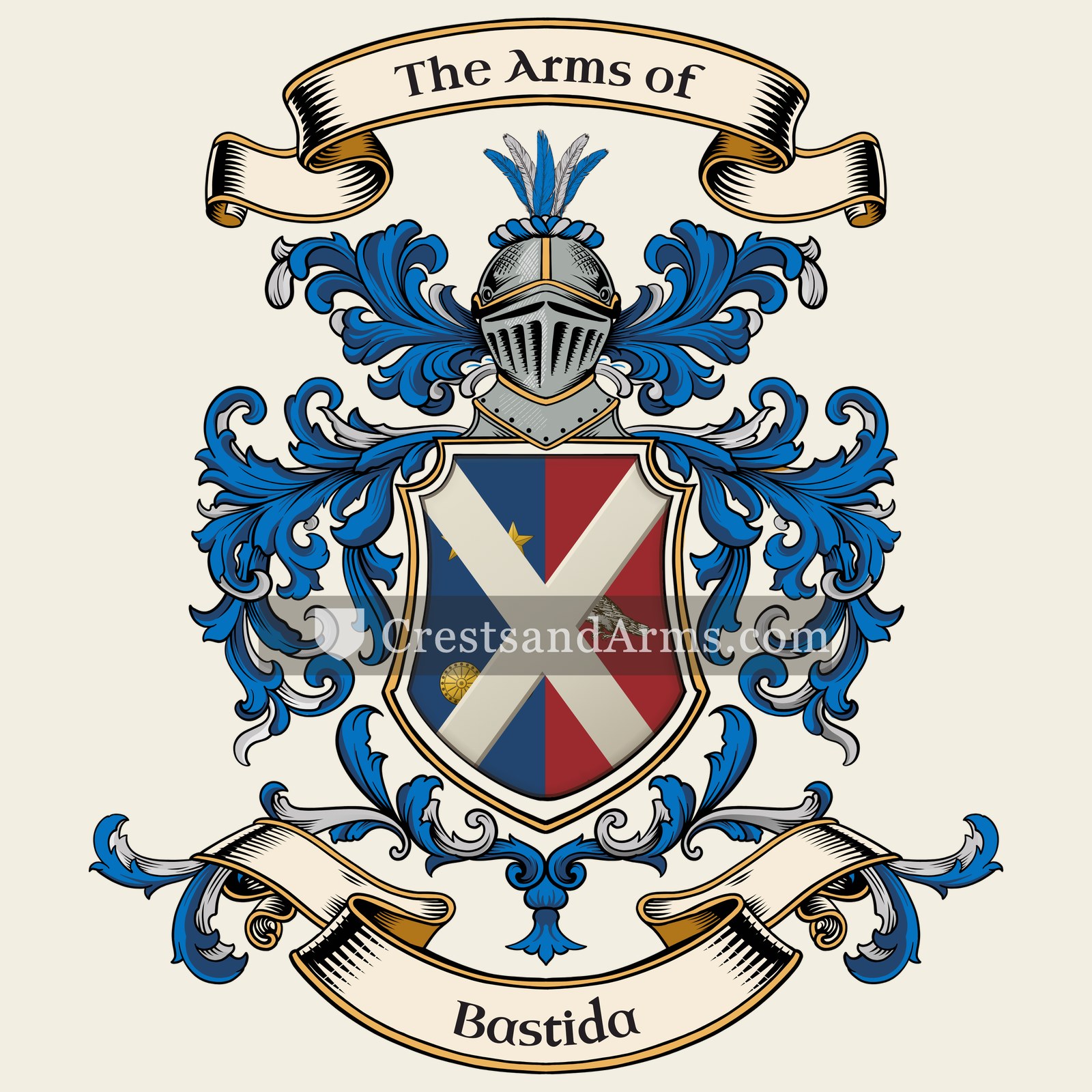
A record of documented arms, meaning and origin, researched for the Bastida family of Switzerland.
Reg. 2579 · Swiss, A–C
Coat of Arms & Family Crest Details
Symbols on this shield
saltireResolution, and St Andrew's cross
mulletThe third son, and a divine quality from above
roundelA coin, and one who has been to the crusades
dovePeace, love and the Holy Spirit
Colours
Blue (Azure)Means: Loyalty and truth
Red (Gules)Means: Military strength
Silver (Argent)Means: Peace and sincerity
Gold (Or)Means: Generosity
Historical info
Source
J. B. Rietstap, Armorial Général, Gouda: G. B. van Goor Zonen, 1884–87
Blazon (the actual original written record)
“Parti: au 1 d'azur au saut. d'arg., acc. de deux étoiles (6) d'or, 1 en chef et 1 en p., et de deux bes. d'or, 1 à dextre et 1 à sen.; au 2 de gu. à une colombe d'arg., et une fasce de gu., bordée d'arg., ch. de deux bandes d'or et br. sur la colombe.”
SwitzerlandValais, c. 1745
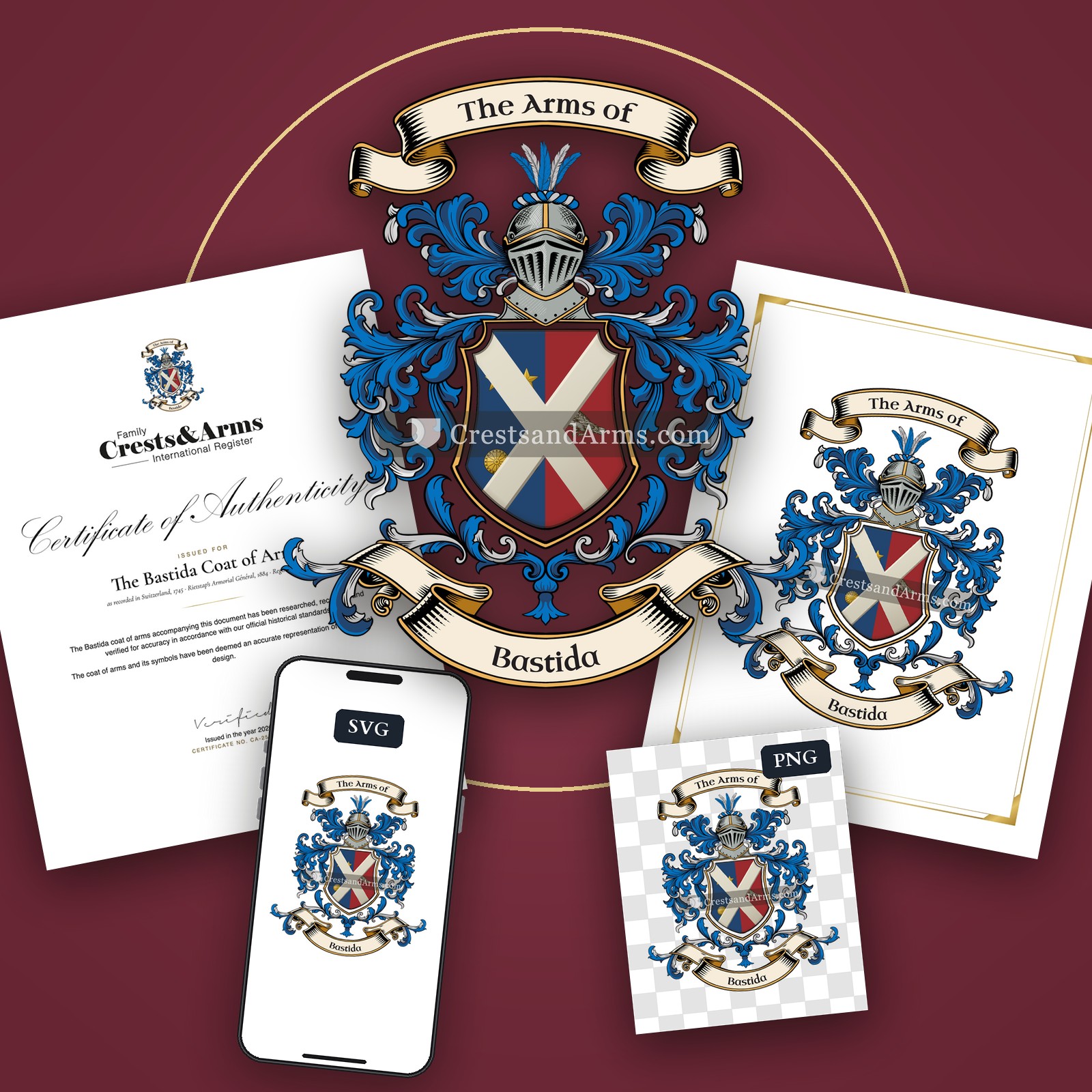
Digital archive packCoat of arms PNG, gold border print PDF, vector SVG and the certificate of authenticity. Sent to your email in minutes.
Map of Switzerland showing where the Bastida arms are recorded
The Bastida arms were recorded in Valais, c. 1745.
This is where the arms were entered in the register. Families often moved to other parts of the country, so the same name can turn up in more than one region.
The body that granted and recorded arms in Switzerland in this period.
How Arms Worked in Switzerland
In Switzerland, coats of arms were not restricted to the nobility and were often adopted by common citizens and families. These symbols were passed down through generations to show family identity. When branches of a family grew, they often changed small details of the design to distinguish their own line from the original group.
Granting authority
Cantonal and civic authorities managed the use of coats of arms within their specific regions and local jurisdictions.
How they got arms
Families typically assumed their own coats of arms based on local custom rather than receiving them from a central monarch.
Where arms were recorded
Arms were recorded in various cantonal and civic registers starting from the fourteenth century throughout the Swiss region.
The family's standing
Recorded among the armigerous families of Switzerland.
Origin & History of the Bastida Family in Switzerland
The surname Bastida originates from the Occitan and Catalan word "bastida," which historically referred to a fortified building or a newly established settlement. In the Middle Ages, the term was often used to describe planned towns built for defensive purposes or agricultural development in Southern Europe. Families carrying this name were typically associated with these structured communities, often serving as builders, landowners, or administrators. By the mid-18th century, the family had established a notable presence in the Valais region of Switzerland. Records from 1745 confirm that members of the Bastida family were integrated into the local social and economic fabric of this alpine area, likely having migrated from neighboring regions to participate in the trade and agricultural life of the Swiss valleys. Their history reflects a transition from the fortified landscapes of the Mediterranean to the rugged, independent mountain communities of the Alps.
Bastida Meaning & Related Branches
Root word
bastida
A Latin term referring to a fortified building or defensive structure.
This name
BastidaRefers to someone who lived near or worked at a fortified settlement or castle.
also spelled
Bastydas
Bastydah
Vastida
Documented Sources
J. B. Rietstap, Armorial Général, Gouda: G. B. van Goor Zonen, 1884–87
Dauzat, Albert. Dictionnaire étymologique des noms et prénoms de France. 1951
Morlet, Marie-Thérèse. Dictionnaire étymologique des noms de famille. 1991
Archives de l'État du Valais. Registres paroissiaux et état civil. 1745
Digital archive packCoat of arms PNG, gold border print PDF, vector SVG and the certificate of authenticity. Sent to your email in minutes.


 saltireResolution, and St Andrew's cross
 mulletThe third son, and a divine quality from above
 roundelA coin, and one who has been to the crusades
 dovePeace, love and the Holy Spirit
 saltireResolution, and St Andrew's cross
 mulletThe third son, and a divine quality from above
 roundelA coin, and one who has been to the crusades
 dovePeace, love and the Holy Spirit