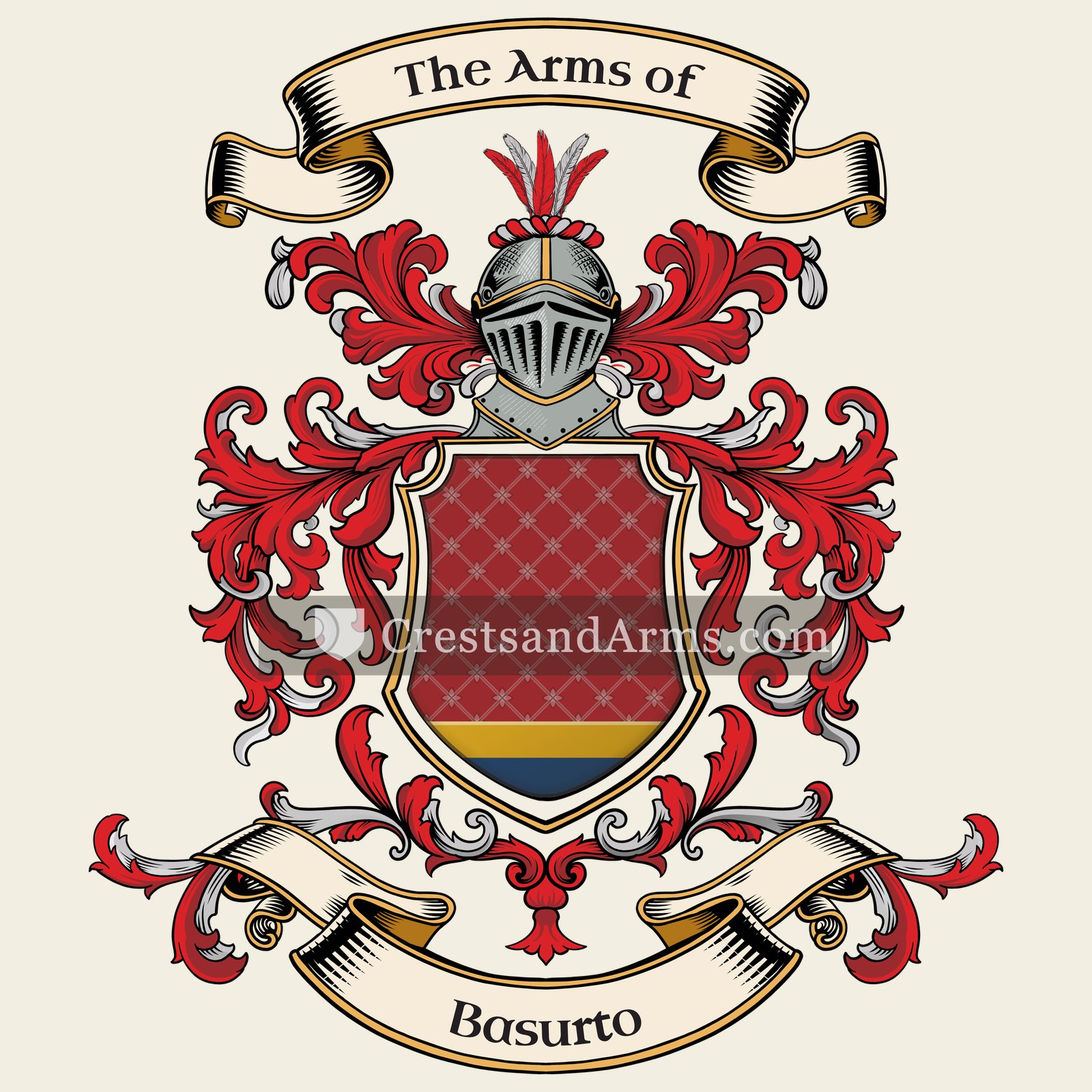
A record of documented arms, meaning and origin, researched for the Basurto family of Spain.
Reg. 6482 · Spanish, A–C
Coat of Arms & Family Crest Details
Colours
Red (Gules)Means: Military strength
Gold (Or)Means: Generosity
Blue (Azure)Means: Loyalty and truth
Historical info
Source
J. B. Rietstap, Armorial Général, Gouda: G. B. van Goor Zonen, 1884–87
Blazon (the actual original written record)
“De gu. à cinq panelles d'or, les tiges en haut, 2, 1 et 2; à la champagne fascée-ondée d'arg. et d'azur de six pièces [La branche de Castille porte, au lieu de la champagne fascée-ondée, une mer d'azur agitée d'arg.]”
AndalusiaAndalusia, c. 1722
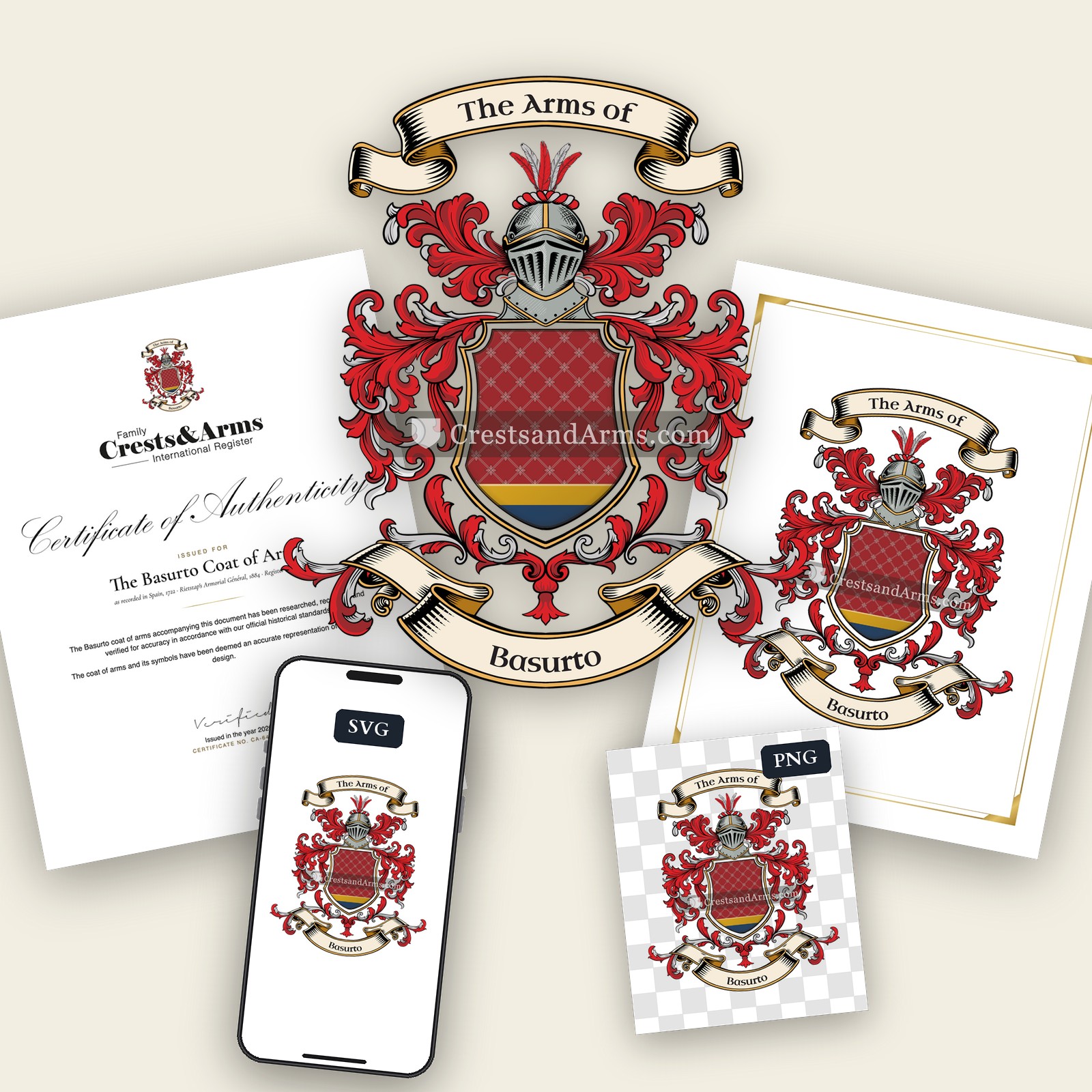
Digital archive packCoat of arms PNG, gold border print PDF, vector SVG and the certificate of authenticity. Sent to your email in minutes.
Map of Spain showing where the Basurto arms are recorded
The Basurto arms were recorded in Andalusia, c. 1722.
Andalusia was the last part of Spain taken back from the Moors, and the land was shared out among the men who took it. A grant of land came with a grant of arms, so the region produced a great many.
This is where the arms were entered in the register. Families often moved to other parts of the country, so the same name can turn up in more than one region.
The body that granted and recorded arms in Spain in this period.
Philip V of Spain
Sovereign of the period
Philip V of Spain
1714–1724
Reigning in Spain when the Basurto arms are first recorded.
How Arms Worked in Spain
In Spain, a coat of arms was considered a form of property that belonged to the entire family line. These arms were passed down from a father to all his children equally. Younger branches of the family usually kept the original design without needing to add any special marks to distinguish their specific line.
Granting authority
The Cronista Rey de Armas was the official body that regulated and granted coats of arms throughout Spain.
How they got arms
Families often obtained their arms through royal grants or by proving their noble status to the official heraldic authority.
Where arms were recorded
Coats of arms were officially recorded in the registers of the Cronista Rey de Armas starting in 1496.
The family's standing
Recorded among the armigerous families of Andalusia.
Origin & History of the Basurto Family in Spain
The family name Basurto originates from the Basque region of northern Spain, where it was historically linked to specific geographic locations. The name is derived from the Basque words "baso," meaning forest, and "urto," which refers to a place or a settlement. This suggests that the earliest ancestors were likely people who lived near or managed wooded areas. By the early 18th century, the family had established a notable presence in Andalusia, particularly by 1722. During this period, the movement of families from the northern provinces to the southern regions of Spain was often driven by administrative appointments, military service, or the pursuit of new agricultural opportunities. As the family settled in Andalusia, they integrated into the local social and economic structures of the time, helping to preserve their ancestral name while adapting to the unique cultural landscape of the south.
Basurto Meaning & Related Branches
Root word
Baso-urto
Basque words for forest and edge or border.
This name
BasurtoRefers to a settlement located at the edge of a forest.
also spelled
Bazurto
Basurtoo
Basurt
Documented Sources
J. B. Rietstap, Armorial Général, Gouda: G. B. van Goor Zonen, 1884–87
Mikeldi, Alfonso. Diccionario etimológico de apellidos vascos. 1958
Archivo General de Simancas. Registro del Sello de Corte. 1722
Caro Baroja, Julio. Los vascos. 1971
Digital archive packCoat of arms PNG, gold border print PDF, vector SVG and the certificate of authenticity. Sent to your email in minutes.