A record of documented arms, meaning and origin, researched for the Bat family lines. Documented in 2 countries.
Reg. 3755 · Swedish, A–C
Coat of Arms & Family Crest Details
Symbols on this shield
saltireResolution, and St Andrew's cross
branchPeace, and new growth
crownSovereignty, authority and just reward
riverThe bounds of a land, and life carried through it
lionCourage, strength and royalty
Colours
Red (Gules)Means: Military strength
Blue (Azure)Means: Loyalty and truth
Gold (Or)Means: Generosity
Historical info
Source
J. B. Rietstap, Armorial Général, Gouda: G. B. van Goor Zonen, 1884–87
Blazon (the actual original written record)
“Ec.: aux 1 et 4 de gu. à deux rameaux de laurier d'or, passés en saut. dans une couronne du sec.; aux 2 et 3 d'azur à une rivière au nat. en barre, et un lion naiss. d'or, cour. du même, lamp. de gu., mouv. de la rivière. Sur le tout d'or à un canot de gu., la proue et la poupe sommées chacune de trois plumes de paon au nat. Deux cq. cour. C.: 1º les meubles du 1, entre un vol de sa.; 2º le lion du 2, iss.”
Swedenc. 1650
Digital archive packCoat of arms PNG, gold border print PDF, vector SVG and the certificate of authenticity. Sent to your email in minutes.
Map of Sweden showing where the Bat arms are recorded
The Bat arms were recorded in Sweden, c. 1650.
Arms such as these were typically recorded in Stockholm.
Stockholm held the Swedish court and the House of Nobility, where every noble family's arms were entered and kept. Families ennobled for service registered there, which is why so many are recorded around the city.
This is where the arms were entered in the register. Families often moved to other parts of the country, so the same name can turn up in more than one region.
The body that granted and recorded arms in Sweden in this period.
Christina of Sweden
Sovereign of the period
Christina of Sweden
1632–1654
Reigning in Sweden when the Bat arms are first recorded.
How Arms Worked in Sweden
In Sweden, a coat of arms belonged to a noble family as a whole rather than just one individual. These arms were passed down through the generations to all legitimate descendants. Younger branches of the family used the same shield without needing to change it. This system ensured that the entire lineage shared the same identity and status under the law.
Granting authority
The Riddarhuset, or House of Nobility, regulated all noble coats of arms in Sweden under royal authority.
How they got arms
Families received their coats of arms through royal grants of nobility which were then officially registered with the House.
Where arms were recorded
Coats of arms were officially recorded in the Swedish House of Nobility register starting in the year 1626.
The family's standing
Recorded among the armigerous families of Sweden.
Origin & History of the Bat Family in Sweden
The family name Bat first appears in the historical record of Stockholm around 1650, a time when the city was rapidly expanding as the heart of the Swedish Empire. During the seventeenth century, Sweden was undergoing a major transition in how people identified themselves, as the use of fixed surnames began to spread beyond the nobility to the growing class of urban merchants and tradespeople. The name Bat likely originated as a descriptive nickname or a shortened form of a longer occupational title, which was a common practice in the bustling markets of the capital. As the family established their presence in Stockholm, they became part of the city’s social fabric during a period of significant economic growth and cultural change. By settling in the capital during this era, the early members of the Bat family participated in the development of a modern society where individuals were increasingly defined by their family heritage and their contributions to the city’s trade and administration.
Coat of Arms & Family Crest Details
Symbols on this shield
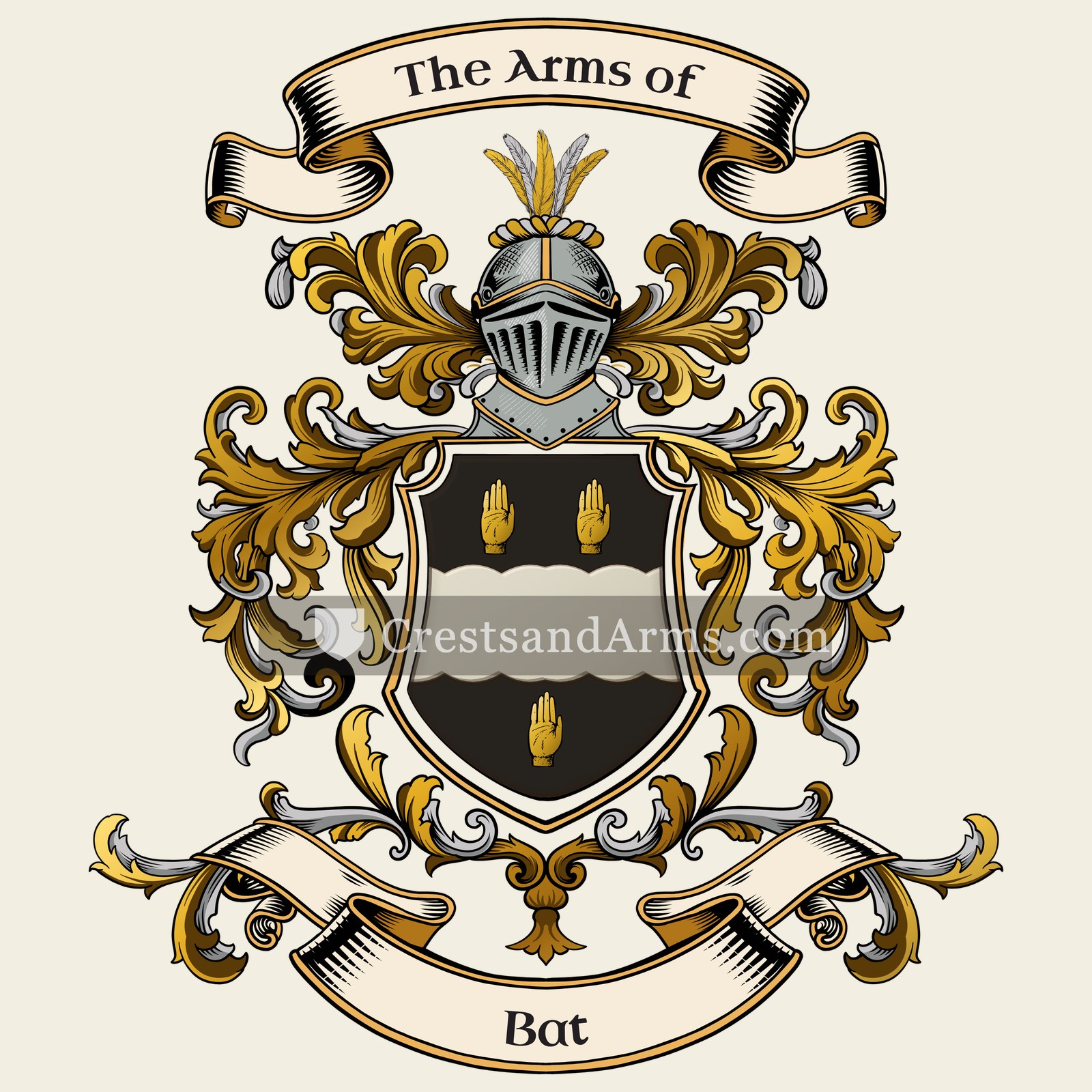
fessThe military belt, and readiness to serve
handFaith, sincerity and justice
Colours
Black (Sable)Means: Constancy
Silver (Argent)Means: Peace and sincerity
Gold (Or)Means: Generosity
Historical info
Source
Sir Bernard Burke, The General Armory of England, Scotland, Ireland and Wales, London: Harrison & Sons, 1884
Blazon (the actual original written record)
“Sa. a fesse engr. ar. betw. three dexter hands couped at the wrist or”
BerkshireBerkshire, c. 1620
Digital archive packCoat of arms PNG, gold border print PDF, vector SVG and the certificate of authenticity. Sent to your email in minutes.
Map of England showing where the Bat arms are recorded
The Bat arms were recorded in Berkshire, c. 1620.
This is where the arms were entered in the register. Families often moved to other parts of the country, so the same name can turn up in more than one region.
The body that granted and recorded arms in England in this period.
James VI and I
Sovereign of the period
James VI and I
1603–1625
Reigning in Sweden when the Bat arms are first recorded.
How Arms Worked in England
English heraldry allowed arms to be shared by all legitimate descendants of the original owner. These symbols were treated as personal property that moved through the generations to all children. While the eldest son kept the original design, other family members could use the same shield without needing to change it or register their own unique versions.
Granting authority
The College of Arms in London has regulated the use of coats of arms throughout England and Wales since 1484.
How they got arms
Families typically obtained their coats of arms through a formal grant from the Crown or by proving their ancient right to them.
Where arms were recorded
All official coats of arms are recorded in the registers kept at the College of Arms, which date back to the fifteenth century.
The family's standing
Recorded among the armigerous families of Berkshire.
Origin & History of the Bat Family in England
The surname Bat has deep roots in the English landscape, appearing in historical records long before the seventeenth century. While the family established a notable presence in Berkshire by 1620, the name itself likely originated as a nickname or a shortened version of personal names like Bartholomew. In medieval England, surnames were often adopted based on a person’s trade, physical traits, or local surroundings. The name Bat may have been used to describe someone with a quick or nocturnal nature, or it could have served as a simple identifier for a person living in a specific village. By the time the family settled in Berkshire, they were part of a long tradition of families who helped shape the rural economy and local governance of the English countryside. Their migration and settlement patterns reflect the broader movement of people across England as they sought land and stability during a period of significant social change.
Bat Meaning & Related Branches
Root word
Båt
A small vessel used for water transportation.
This name
BatAn occupational name for a boatman or a topographic name for someone living near a boat landing.
also spelled
Batt
Batte
Batth
Related arms
Baatvariant spelling
Documented Sources
J. B. Rietstap, Armorial Général, Gouda: G. B. van Goor Zonen, 1884–87
Andersson, Ingvar. Sveriges historia. 1943
Lundkvist, Sven. Sturetidens Sverige. 1970
Riksarkivet (National Archives of Sweden), Stockholms stadsarkivs samlingar (Stockholm City Archives Collections)
Riksarkivet (National Archives of Sweden), Mantalslängder för Stockholms stad (Tax census records for the city of Stockholm)
Digital archive packCoat of arms PNG, gold border print PDF, vector SVG and the certificate of authenticity. Sent to your email in minutes.


 saltireResolution, and St Andrew's cross
 branchPeace, and new growth
 crownSovereignty, authority and just reward
 riverThe bounds of a land, and life carried through it
 lionCourage, strength and royalty
 saltireResolution, and St Andrew's cross
 branchPeace, and new growth
 crownSovereignty, authority and just reward
 riverThe bounds of a land, and life carried through it
 lionCourage, strength and royalty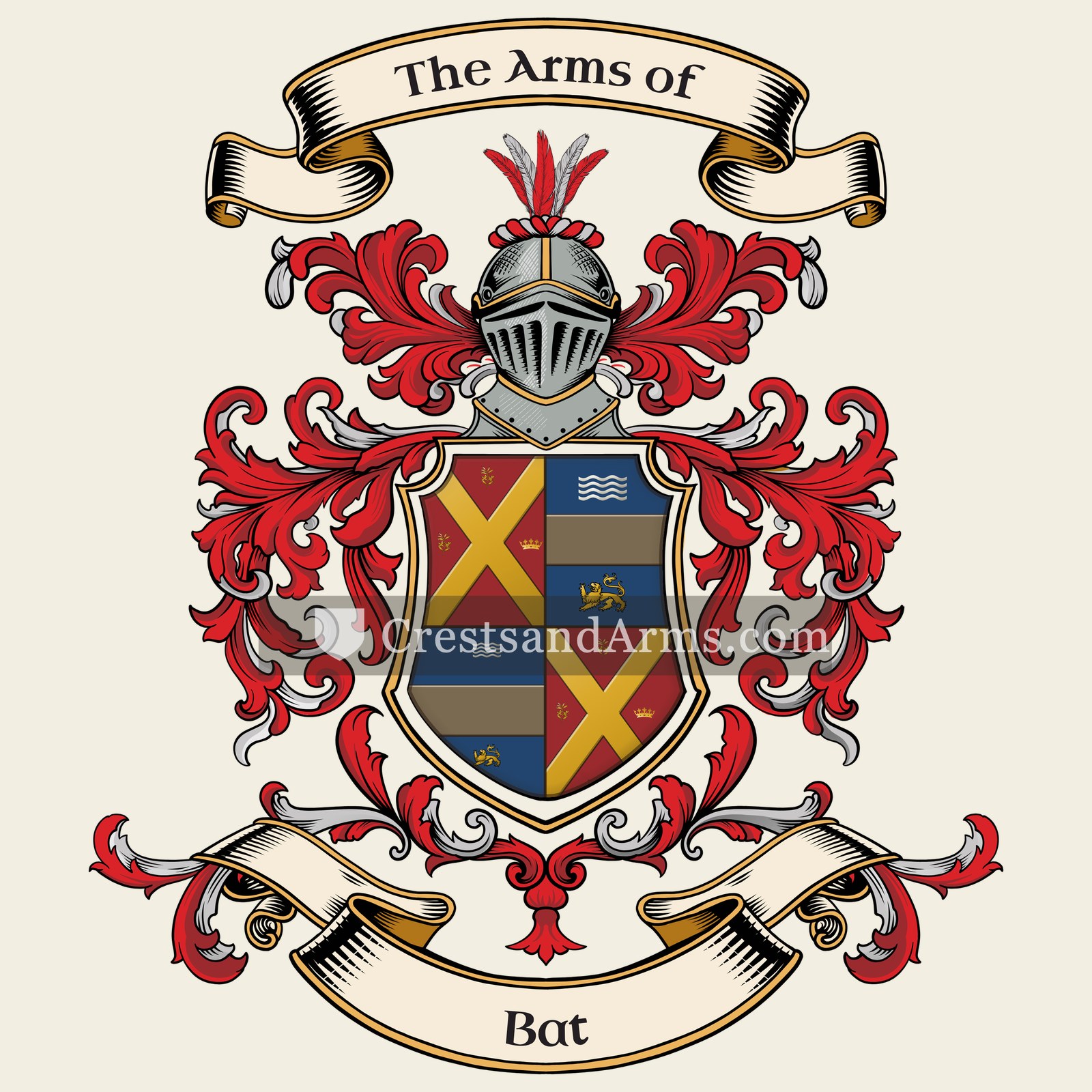


 fessThe military belt, and readiness to serve
 handFaith, sincerity and justice