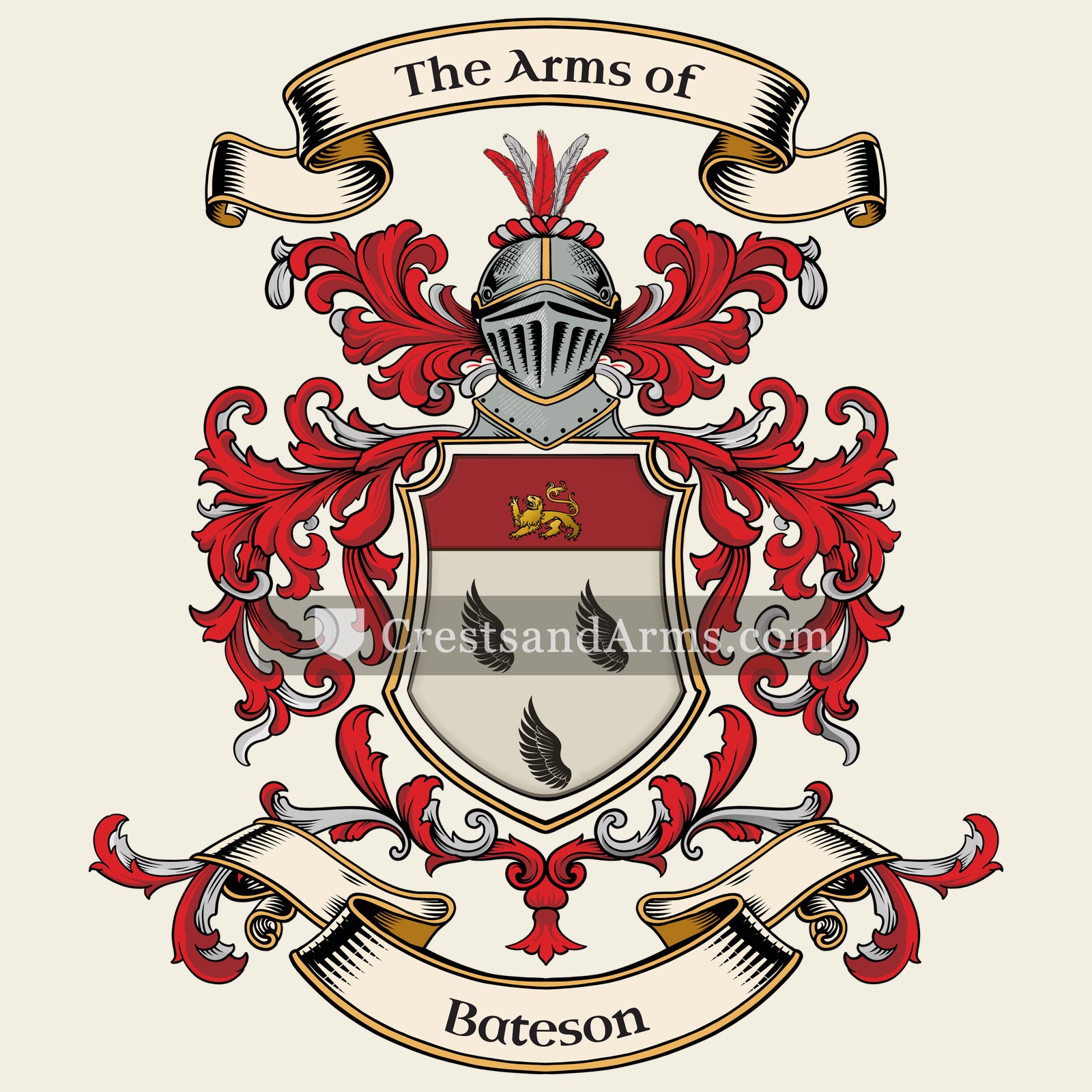
A record of documented arms, meaning and origin, researched for the Bateson family of Ireland.
Reg. 9968 · Irish, A–C
Coat of Arms & Family Crest Details
Symbols on this shield
chiefAuthority, wisdom and dominion
wingSwiftness, and protection under a raised wing
lionCourage, strength and royalty
Colours
Silver (Argent)Means: Peace and sincerity
Red (Gules)Means: Military strength
Black (Sable)Means: Constancy
Gold (Or)Means: Generosity
Historical info
Source
Sir Bernard Burke, The General Armory of England, Scotland, Ireland and Wales, London: Harrison & Sons, 1884
Blazon (the actual original written record)
“Ar. three bats' wings sa. on a chief gu. a lion pass. or”
DownBelvoir Park · Down, c. 1645
Where the Bateson Arms Were Recorded
Down
Map of Ireland showing where the Bateson arms are recorded
The Bateson arms were recorded in Down, c. 1645.
Down was north-eastern Irish country settled from Scotland in the seventeenth century. The new landowners took grants and had them recorded, which is why so many Down families carry documented shields.
This is where the arms were entered in the register. Families often moved to other parts of the country, so the same name can turn up in more than one region.
The body that granted and recorded arms in Ireland in this period.
Charles I of England
Sovereign of the period
Charles I of England
1625–1649
Reigning in Ireland when the Bateson arms are first recorded.
How Arms Worked in Ireland
The Ulster King of Arms granted coats of arms to individuals who proved their social standing and good character. These symbols were typically inherited by all legitimate descendants of the original holder. If a family branch wanted a unique look, they could apply for a specific change to their design through the office to ensure their identity remained distinct.
Granting authority
The Ulster King of Arms acted as the official body that regulated and issued all coats of arms throughout Ireland.
How they got arms
Families obtained their arms through formal grants issued by the office after proving their eligibility and paying the required fees.
Where arms were recorded
All official grants were recorded in the registers held by the Ulster King of Arms starting from the year 1552.
The family's standing
Recorded among the armigerous families of Down.
Origin & History of the Bateson Family in Ireland
The surname Bateson is a patronymic name, which means it was originally created to identify a person as the son of someone named Bate. Bate was a common medieval nickname for Bartholomew, a name that grew popular across England and the British Isles during the Middle Ages. By the time the family established a presence in County Down in 1645, the name had already been in use for several generations. The Batesons in Ireland were part of a period of significant migration and settlement during the seventeenth century. As they settled into the landscape of County Down, they transitioned from being identified by their father’s name to using Bateson as a permanent family surname. This pattern of naming was a standard way for families to track their lineage and establish their identity within their local communities.
Related Branches & Arms
Root word
Bartholomew
Son of Talmai, meaning abounding in furrows or rich in land.
This name
BatesonA patronymic surname denoting the son of a man named Bate, a diminutive of Bartholomew.
also spelled
Batesone
Batson
Batesun
Related arms
Batesvariant spelling
Batsonvariant spelling
Documented Sources
Sir Bernard Burke, The General Armory of England, Scotland, Ireland and Wales, London: Harrison & Sons, 1884
Black, George Fraser. The Surnames of Scotland: Their Origin, Meaning, and History, 1946
MacLysaght, Edward. The Surnames of Ireland, 1985
Public Record Office of Northern Ireland, Hearth Money Rolls for County Down, 1663
Digital archive packCoat of arms PNG, gold border print PDF, vector SVG and the certificate of authenticity. Sent to your email in minutes.


 chiefAuthority, wisdom and dominion
 wingSwiftness, and protection under a raised wing
 lionCourage, strength and royalty
 chiefAuthority, wisdom and dominion
 wingSwiftness, and protection under a raised wing
 lionCourage, strength and royalty