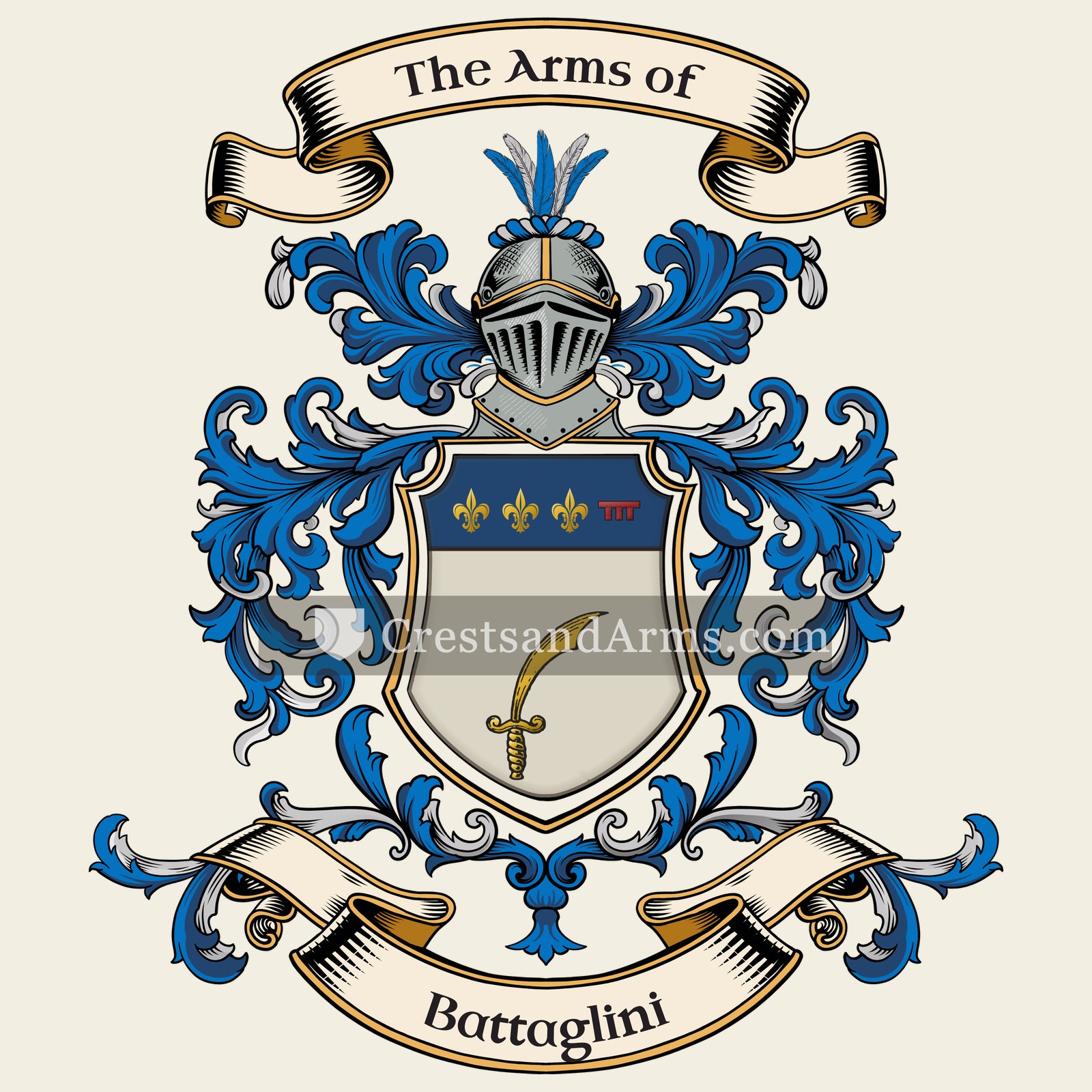
A record of documented arms, meaning and origin, researched for the Battaglini family of Italy.
Reg. 9843 · Italian, A–C
Coat of Arms & Family Crest Details
Symbols on this shield
chiefAuthority, wisdom and dominion
labelThe eldest son, during his father's life
swordJustice, and military honour
fleur de lisPurity, light, and the sixth son
Colours
Silver (Argent)Means: Peace and sincerity
Blue (Azure)Means: Loyalty and truth
Gold (Or)Means: Generosity
Red (Gules)Means: Military strength
Historical info
Source
J. B. Rietstap, Armorial Général, Gouda: G. B. van Goor Zonen, 1884–87
Blazon (the actual original written record)
“D'arg. à un B d'or, br. sur une épée du même, posée en bande; au chef d'azur, ch. de trois fleurs-de-lis d'or, rangées entre les quatre pendants d'un lambel de gu.”
ItalyBologne, c. 1775
Digital archive packCoat of arms PNG, gold border print PDF, vector SVG and the certificate of authenticity. Sent to your email in minutes.
Map of Italy showing where the Battaglini arms are recorded
The Battaglini arms were recorded in Bologne, c. 1775.
This is where the arms were entered in the register. Families often moved to other parts of the country, so the same name can turn up in more than one region.
The body that granted and recorded arms in Italy in this period.
Alvise Giovanni Mocenigo
Sovereign of the period
Alvise Giovanni Mocenigo
1763–1778
Reigning in Italy when the Battaglini arms are first recorded.
How Arms Worked in Italy
In the Italian states, coats of arms were often used by noble families to show their status and history. These symbols were passed down through the generations to all legitimate male descendants. Younger branches of a family usually kept the original design but sometimes added small changes to distinguish their specific line from the main branch.
Granting authority
Various local rulers and city governments controlled the use of coats of arms across the different Italian states.
How they got arms
Families often assumed their own arms or received them as official grants from local lords, popes, or city councils.
Where arms were recorded
Arms were recorded in local city archives or private family books rather than in one single national register.
The family's standing
Recorded among the armigerous families of Italy.
Origin & History of the Battaglini Family in Italy
The Battaglini family name is deeply rooted in the historical landscape of the Emilia-Romagna region, with significant documentation confirming their presence in the city of Bologna by 1775. The name itself is derived from the Italian word "battaglia," which translates to battle or combat. In the context of medieval naming conventions, this suggests that the earliest ancestors likely earned the name through their roles as soldiers, guards, or individuals known for their spirited and assertive personalities. By the late 18th century, the family had established themselves within the urban fabric of Bologna, a city renowned at the time for its prestigious university and its role as a center for trade and legal scholarship. As residents of this influential city, the Battaglini family would have lived through a period of great political transition, witnessing the shift from local aristocratic rule to the broader changes brought about by the Napoleonic era. Their history reflects the broader experience of many Italian families who transitioned from local prominence into the structured civic life of the modern era.
Battaglini Meaning & Related Branches
Root word
battaglia
A conflict or military engagement between opposing forces.
This name
BattagliniDerived from a nickname for a soldier or a person who frequently fought.
also spelled
Bataglini
Battaglin
Battaglyni
Batalini
Documented Sources
J. B. Rietstap, Armorial Général, Gouda: G. B. van Goor Zonen, 1884–87
Archivio di Stato di Bologna, Stato civile della Restaurazione
Archivio di Stato di Bologna, Anagrafe della popolazione
Emidio De Felice, Dizionario dei cognomi italiani, 1978
Vittorio Angius, Sulle famiglie nobili della monarchia di Savoia, 1841
Digital archive packCoat of arms PNG, gold border print PDF, vector SVG and the certificate of authenticity. Sent to your email in minutes.


 chiefAuthority, wisdom and dominion
 labelThe eldest son, during his father's life
 swordJustice, and military honour
 fleur de lisPurity, light, and the sixth son
 chiefAuthority, wisdom and dominion
 labelThe eldest son, during his father's life
 swordJustice, and military honour
 fleur de lisPurity, light, and the sixth son