Map of France showing where the Bauduin arms are recorded
The Bauduin arms were recorded in Artois, c. 1663.
Artois lay on the disputed ground between France and the Low Countries and was fought over for centuries. Families there held their land under arms, and a shield was how a fighting household was known.
This is where the arms were entered in the register. Families often moved to other parts of the country, so the same name can turn up in more than one region.
The body that granted and recorded arms in France in this period.
Louis XIV of France
Sovereign of the period
Louis XIV of France
1643–1715
Reigning in France when the Bauduin arms are first recorded.
How Arms Worked in France
In France, a coat of arms was a mark of honor that passed down through the male line to all legitimate descendants. Families often used the same shield without changes to show their shared heritage. If a branch wanted to stand out, they could add a small mark to their shield to show their specific place in the family tree.
Granting authority
The Juge d'armes de France acted as the official authority that regulated and verified coats of arms across the country.
How they got arms
Families typically inherited their arms from ancestors, though they could also receive them through royal grants or by proving their noble status.
Where arms were recorded
Coats of arms were officially recorded in the Armorial Général de France, which began its main collection in the year 1696.
The family's standing
Recorded among the armigerous families of Artois.
Origin & History of the Bauduin Family in France
The family name Bauduin is a variation of the ancient Germanic name Baldwin, which translates to brave friend. By the middle of the seventeenth century, the family was well established in the province of Artois, a region in northern France known for its strategic importance and complex history of shifting borders. During this period, the people of Artois lived through a time of transition as the territory moved from Spanish control back to the French crown under the reign of King Louis XIV. Families like the Bauduins often served as local pillars of the community, likely working as farmers, artisans, or minor officials who helped maintain the social order in the rural landscape. Because Artois was a crossroads for trade and military movement, the family name became deeply rooted in the local records of the region, reflecting the resilience and stability of the people who called this northern frontier their home.
Coat of Arms & Family Crest Details
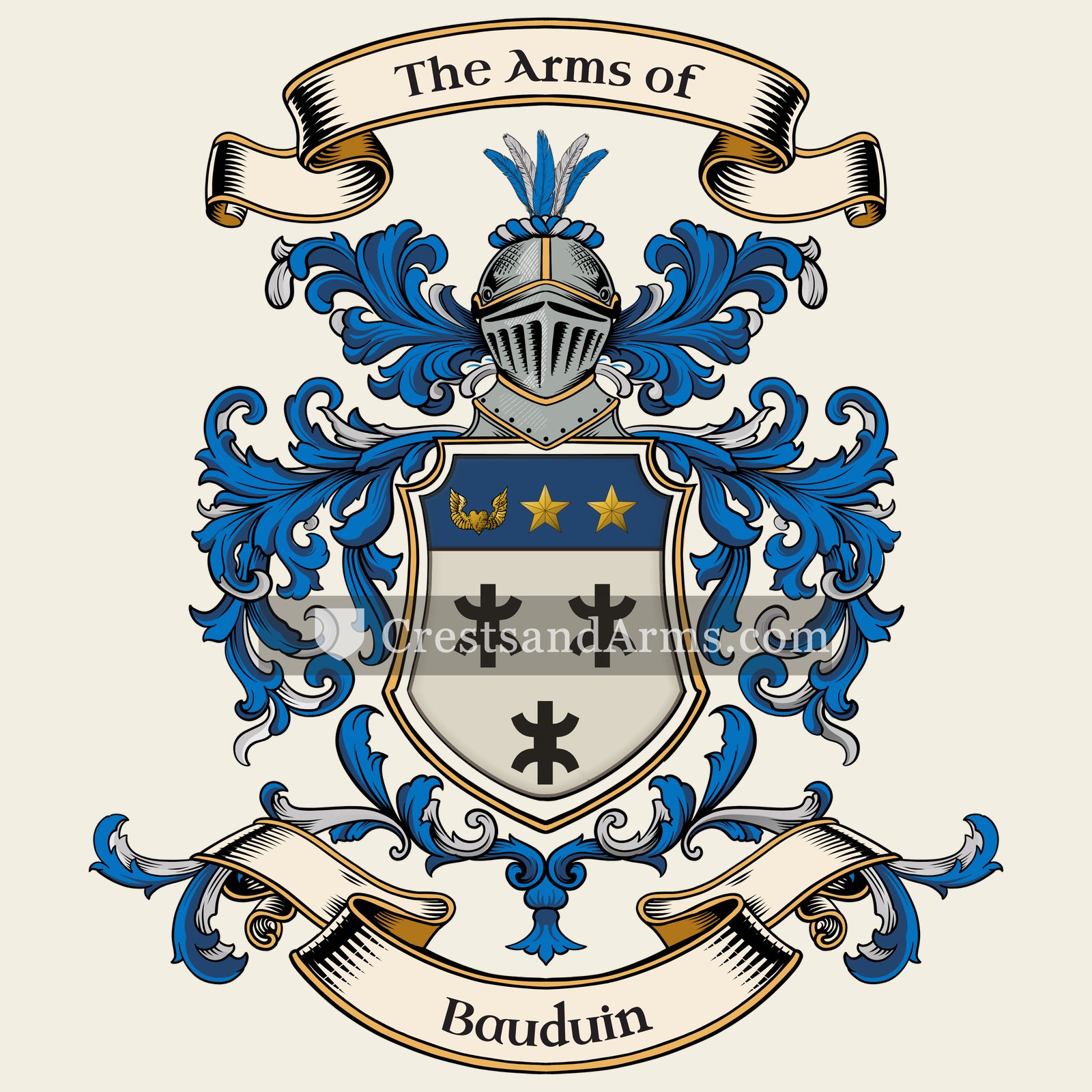
Symbols on this shield
chiefAuthority, wisdom and dominion
millrind / fer de molineThe mill's iron, and the grinding of grain
heartSincerity, charity and true affection
mulletThe third son, and a divine quality from above
Colours
Silver (Argent)Means: Peace and sincerity
Blue (Azure)Means: Loyalty and truth
Black (Sable)Means: Constancy
Gold (Or)Means: Generosity
Historical info
Source
J. B. Rietstap, Armorial Général, Gouda: G. B. van Goor Zonen, 1884–87
Blazon (the actual original written record)
“D'arg. à trois anilles de sa., n'ayant chacune qu'une seule traverse; au chef d'azur, ch. d'un coeur d'or entre deux étoiles du même. C.: un coeur d'or. L. d'or et d'azur.”
LiegeLiege, c. 1737
Digital archive packCoat of arms PNG, gold border print PDF, vector SVG and the certificate of authenticity. Sent to your email in minutes.
Map of Belgium showing where the Bauduin arms are recorded
The Bauduin arms were recorded in Liege, c. 1737.
Liege was a prosperous town and its surrounding country, living on metalworking and trade. Merchant families grew rich, bought land outside the walls, and took arms as landowners rather than tradesmen.
This is where the arms were entered in the register. Families often moved to other parts of the country, so the same name can turn up in more than one region.
The body that granted and recorded arms in Belgium in this period.
Charles VI, Holy Roman Emperor
Sovereign of the period
Charles VI, Holy Roman Emperor
1711–1740
Reigning in France when the Bauduin arms are first recorded.
How Arms Worked in Belgium
In Belgium, a coat of arms is considered personal property that is passed down through the male line to legitimate descendants. Families often use the same shield design across generations to show their shared heritage. If a branch of the family wants to change the design, they must apply for an official update to their specific version of the arms.
Granting authority
The Conseil héraldique is the official body that regulates and approves all coats of arms in Belgium.
How they got arms
Families obtain their coats of arms through formal royal grants or by confirming their historical right to use existing designs.
Where arms were recorded
All approved coats of arms are officially recorded in the public registers of the Conseil héraldique since 1844.
The family's standing
Recorded among the armigerous families of Liege.
Origin & History of the Bauduin Family in Belgium
The family name Bauduin has deep roots in the region of Liège, where records confirm members of the family were established by 1737. The name itself is a variation of Baldwin, which originated from Germanic roots meaning brave friend. During the eighteenth century, Liège was a bustling center of industry and trade under the rule of the Prince-Bishop. Families like the Bauduins often lived in close-knit urban communities where they participated in the local craft guilds or merchant networks that defined the economy of the Meuse valley. As the family grew, they became part of the social fabric of the region, navigating the complex political changes that occurred as the area transitioned through various European conflicts. By settling in this historic city, the early Bauduin family helped shape the local culture and contributed to the long history of the Belgian people.
Bauduin Meaning & Related Branches
Root word
Baldwin
Derived from Germanic elements meaning bold or brave friend.
This name
BauduinA French variant of a Germanic name signifying a courageous and loyal protector.
also spelled
Bauduyn
Baudouin
Bodan
Bodeen
Baldwin
Related arms
Baudouinvariant spelling
Clootsrecorded with Bauduin, same area
Donet, Doncktrecorded with Bauduin, same area
Lamberts de Cortenbachrecorded with Bauduin, same area
Documented Sources
J. B. Rietstap, Armorial Général, Gouda: G. B. van Goor Zonen, 1884–87
Archives départementales du Pas-de-Calais, État civil et registres paroissiaux de la province d'Artois
Gauvard, Claude, La France au Moyen Âge du Ve au XVe siècle, 1996
Lottin, Alain, Histoire des provinces françaises du Nord: Artois, Cambrésis, Flandre, Hainaut, 1989
Digital archive packCoat of arms PNG, gold border print PDF, vector SVG and the certificate of authenticity. Sent to your email in minutes.


 stagPeace and harmony, and one who will not fight unprovoked
 boars headA fierce fighter who battles to the end
 stagPeace and harmony, and one who will not fight unprovoked
 boars headA fierce fighter who battles to the end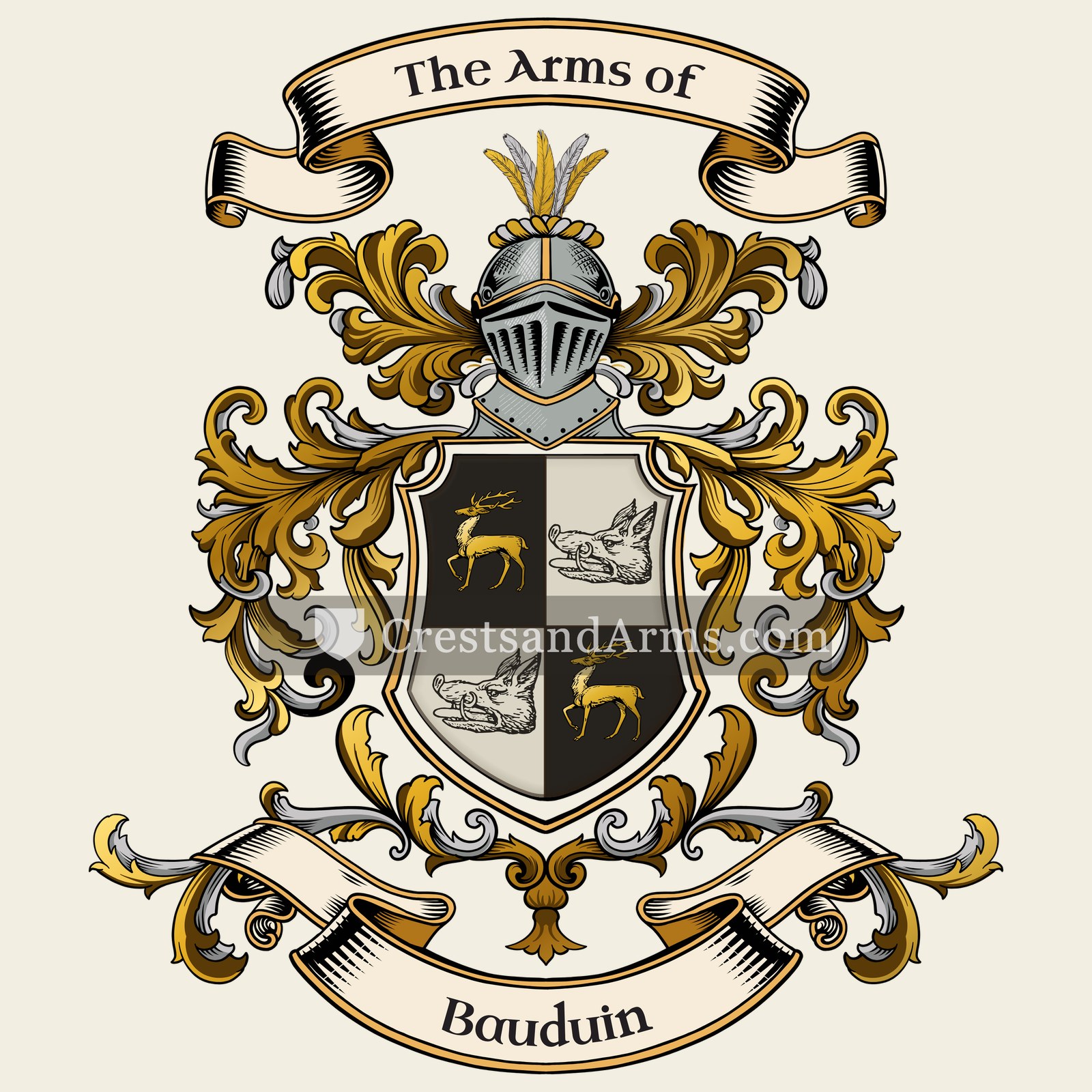


 chiefAuthority, wisdom and dominion
 millrind / fer de molineThe mill's iron, and the grinding of grain
 heartSincerity, charity and true affection
 mulletThe third son, and a divine quality from above