Map of France showing where the Baur arms are recorded
The Baur arms were recorded in France, c. 1663.
Arms such as these were typically recorded in Bretagne.
More families held coats of arms in Bretagne than anywhere else in France. The land was divided into many small estates rather than a few large ones, so far more households counted as gentry, and each needed a shield of its own to be told apart.
This is where the arms were entered in the register. Families often moved to other parts of the country, so the same name can turn up in more than one region.
The body that granted and recorded arms in France in this period.
Louis XIV of France
Sovereign of the period
Louis XIV of France
1643–1715
Reigning in France when the Baur arms are first recorded.
How Arms Worked in France
In France, a coat of arms was a mark of honor that passed down through the male line to all legitimate descendants. Families often used the same shield without changes to show their shared heritage. If a branch wanted to stand out, they could add a small mark to their shield to show their specific place in the family tree.
Granting authority
The Juge d'armes de France acted as the official authority that regulated and verified coats of arms across the country.
How they got arms
Families typically inherited their arms from ancestors, though they could also receive them through royal grants or by proving their noble status.
Where arms were recorded
Coats of arms were officially recorded in the Armorial Général de France, which began its main collection in the year 1696.
The family's standing
Recorded among the armigerous families of France.
Origin & History of the Baur Family in France
The family name Baur has deep roots in the historical landscape of France, particularly within the region of Brittany. By the year 1663, records confirm that members of the Baur family were already established in this coastal area, living during a time when the region was transitioning into a more centralized part of the French kingdom. The name itself is often linked to old Germanic terms for a farmer or a country dweller, suggesting that the earliest ancestors were likely people who worked the land and maintained strong ties to their local communities. As these families settled in Brittany, they became part of the complex social fabric of the seventeenth century, navigating the agricultural traditions and regional customs that defined life in western France. Over time, the Baur family integrated into the local population, contributing to the growth and development of their parishes while preserving their unique identity through generations of change.
Coat of Arms & Family Crest Details
Symbols on this shield
mulletThe third son, and a divine quality from above
towerGrandeur and solidity, and a stronghold defended
Colours
Red (Gules)Means: Military strength
Blue (Azure)Means: Loyalty and truth
Gold (Or)Means: Generosity
Historical info
Source
J. B. Rietstap, Armorial Général, Gouda: G. B. van Goor Zonen, 1884–87
Blazon (the actual original written record)
“Coupé, de gu. sur un mur crén. d'azur, maçonné de sa., le gu. ch. d'une étoile d'or. C.: une étoile d'or, entre un vol, de gu. et d'azur. L.: à dextre d'or et d'azur, à sen. d'or et de gu.”
FranconiaFranconia, c. 1765
Digital archive packCoat of arms PNG, gold border print PDF, vector SVG and the certificate of authenticity. Sent to your email in minutes.
Map of Germany showing where the Baur arms are recorded
The Baur arms were recorded in Franconia, c. 1765.
Franconia was a patchwork of small territories in central Germany, full of minor landowners and prosperous market towns. So many separate households held land there that the region produced a great many coats of arms.
This is where the arms were entered in the register. Families often moved to other parts of the country, so the same name can turn up in more than one region.
The body that granted and recorded arms in Germany in this period.
Francis I, Holy Roman Emperor
Sovereign of the period
Francis I, Holy Roman Emperor
1745–1765
Reigning in France when the Baur arms are first recorded.
How Arms Worked in Germany
In the Holy Roman Empire, coats of arms were often granted to individuals by the Emperor or his representatives. These arms were then passed down through the generations to all legitimate descendants of the original holder. Younger branches of a family usually kept the same shield design without needing to change it, as the arms belonged to the entire lineage.
Granting authority
The Holy Roman Emperor held the sole power to grant new coats of arms throughout his vast imperial territories.
How they got arms
Families typically obtained their coats of arms through a formal imperial grant or by proving their noble status to the authorities.
Where arms were recorded
These grants were officially recorded in the Imperial Chancery registers, which began keeping formal records of such honors during the Middle Ages.
The family's standing
Recorded among the armigerous families of Franconia.
Origin & History of the Baur Family in Germany
The surname Baur is a classic example of a name derived from a person’s occupation in medieval Germany. It originates from the Middle High German word *bur*, which translates to a farmer or a peasant who worked the land. During the Middle Ages, people often adopted names based on their trade to distinguish themselves within growing village communities. By the time members of the Baur family were documented in the Franconia region in 1765, the name had been established for centuries as a common identifier for families deeply rooted in agricultural life. Because Franconia was a central hub for trade and farming in the Holy Roman Empire, families with this name were often essential members of their local rural economies. Over many generations, the name spread across various German states, evolving slightly in spelling but always maintaining its connection to the hardworking people who cultivated the German countryside.
Coat of Arms & Family Crest Details
Symbols on this shield
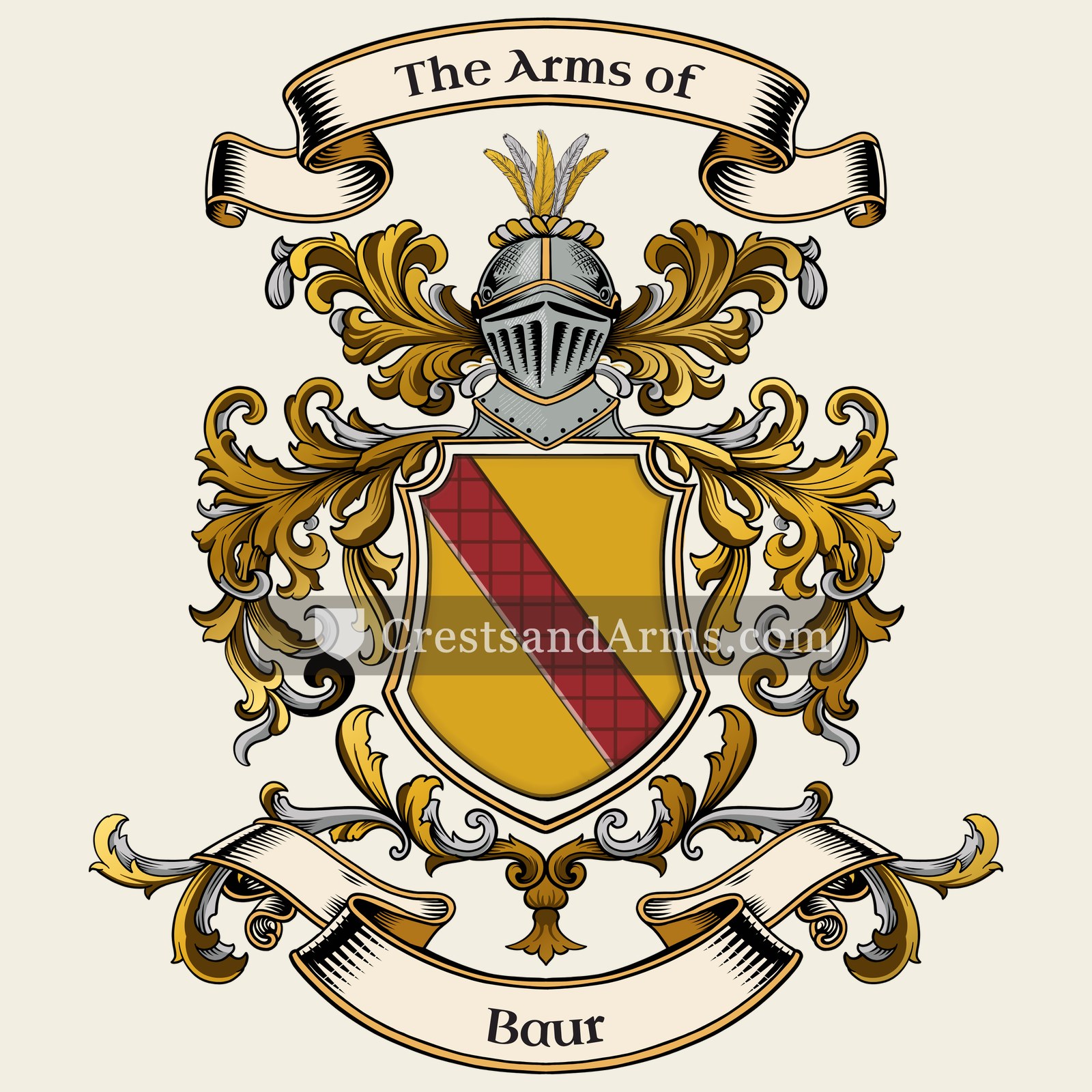
bendDefence, and the scarf of a commander
Colours
Gold (Or)Means: Generosity
Red (Gules)Means: Military strength
Historical info
Source
J. B. Rietstap, Armorial Général, Gouda: G. B. van Goor Zonen, 1884–87
Blazon (the actual original written record)
“D'or à la bande de gu. C.: une tête et col de chien braque d'or, ch. d'une bande de gu.”
SwitzerlandBâle, c. 1745
Digital archive packCoat of arms PNG, gold border print PDF, vector SVG and the certificate of authenticity. Sent to your email in minutes.
Map of Switzerland showing where the Baur arms are recorded
The Baur arms were recorded in Bâle, c. 1745.
This is where the arms were entered in the register. Families often moved to other parts of the country, so the same name can turn up in more than one region.
The body that granted and recorded arms in Switzerland in this period.
How Arms Worked in Switzerland
In Switzerland, coats of arms were not restricted to the nobility and were often adopted by common citizens and families. These symbols were passed down through generations to show family identity. When branches of a family grew, they often changed small details of the design to distinguish their own line from the original group.
Granting authority
Cantonal and civic authorities managed the use of coats of arms within their specific regions and local jurisdictions.
How they got arms
Families typically assumed their own coats of arms based on local custom rather than receiving them from a central monarch.
Where arms were recorded
Arms were recorded in various cantonal and civic registers starting from the fourteenth century throughout the Swiss region.
The family's standing
Recorded among the armigerous families of Switzerland.
Origin & History of the Baur Family in Switzerland
The surname Baur has deep roots in the German-speaking regions of Switzerland, where it originally functioned as an occupational name. In the Middle Ages, the term referred to a farmer or a peasant who worked the land. By the time members of the family were documented in Bâle in 1745, the name had already become a well-established identifier for families living in the Rhine valley. During this era, the Baur family was part of the growing urban middle class that helped shape the economic life of the city. As trade and craftsmanship flourished in Bâle, individuals with this name often worked as skilled laborers or merchants. Their presence in the city records during the mid-eighteenth century reflects a period of stability and social integration for the family within the Swiss Confederation.
Baur Meaning & Related Branches
Root word
bur
Old High German term referring to a small dwelling or cottage.
This name
BaurOccupational name for a peasant, farmer, or someone who lived in a small house.
also spelled
Baurr
Baure
Bower
Related arms
Allisimilar arms
Hess de Hessenthalsimilar arms
Plonskisimilar arms
Bauervariant spelling
Documented Sources
J. B. Rietstap, Armorial Général, Gouda: G. B. van Goor Zonen, 1884–87
Archives Départementales d’Ille-et-Vilaine, Registres paroissiaux et d'état civil
Dauzat, Albert, Dictionnaire étymologique des noms de famille et prénoms de France, 1951
Morvan, Françoise, Bretagne est une province, 2007
Digital archive packCoat of arms PNG, gold border print PDF, vector SVG and the certificate of authenticity. Sent to your email in minutes.


 swordJustice, and military honour
 mulletThe third son, and a divine quality from above
 swordJustice, and military honour
 mulletThe third son, and a divine quality from above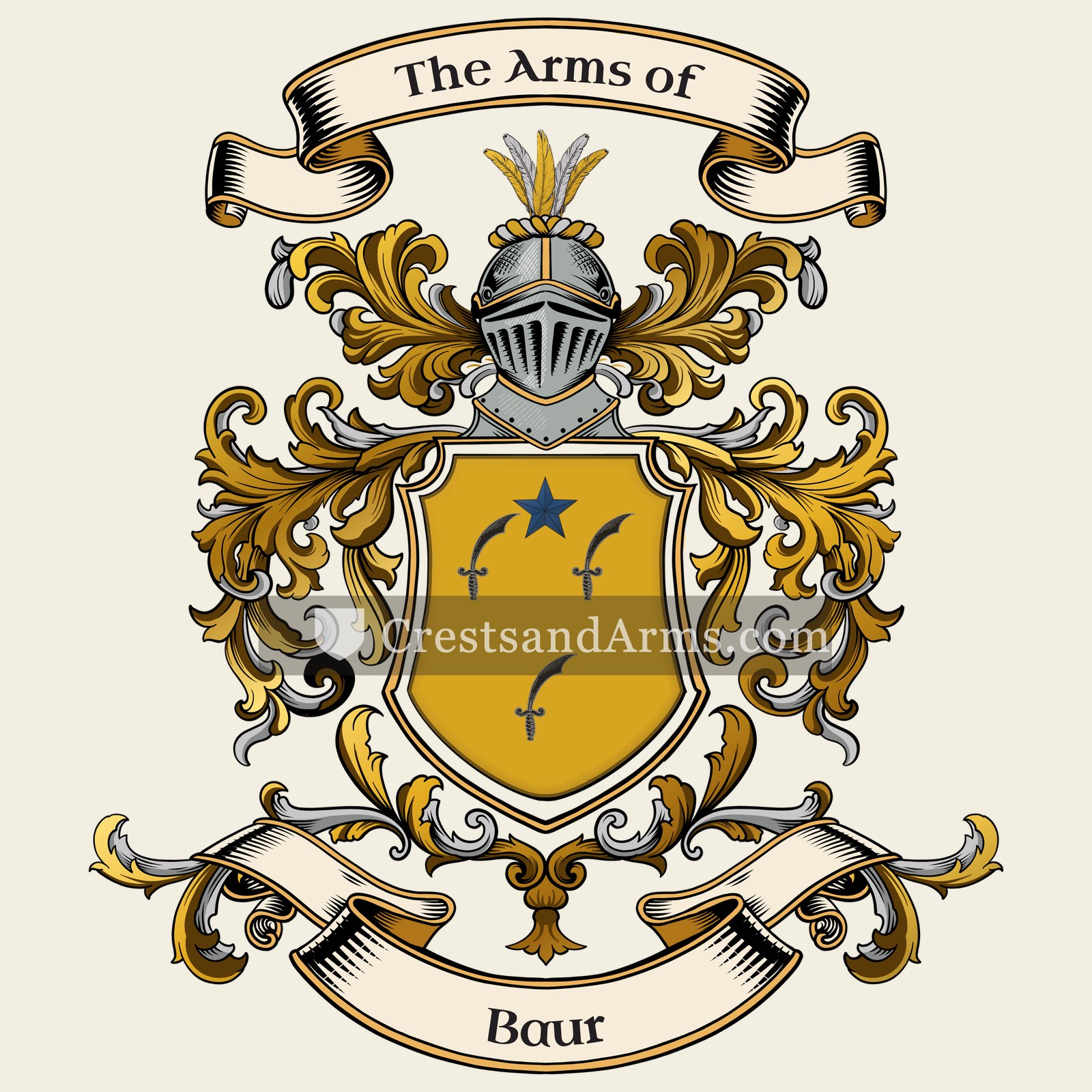


 towerGrandeur and solidity, and a stronghold defended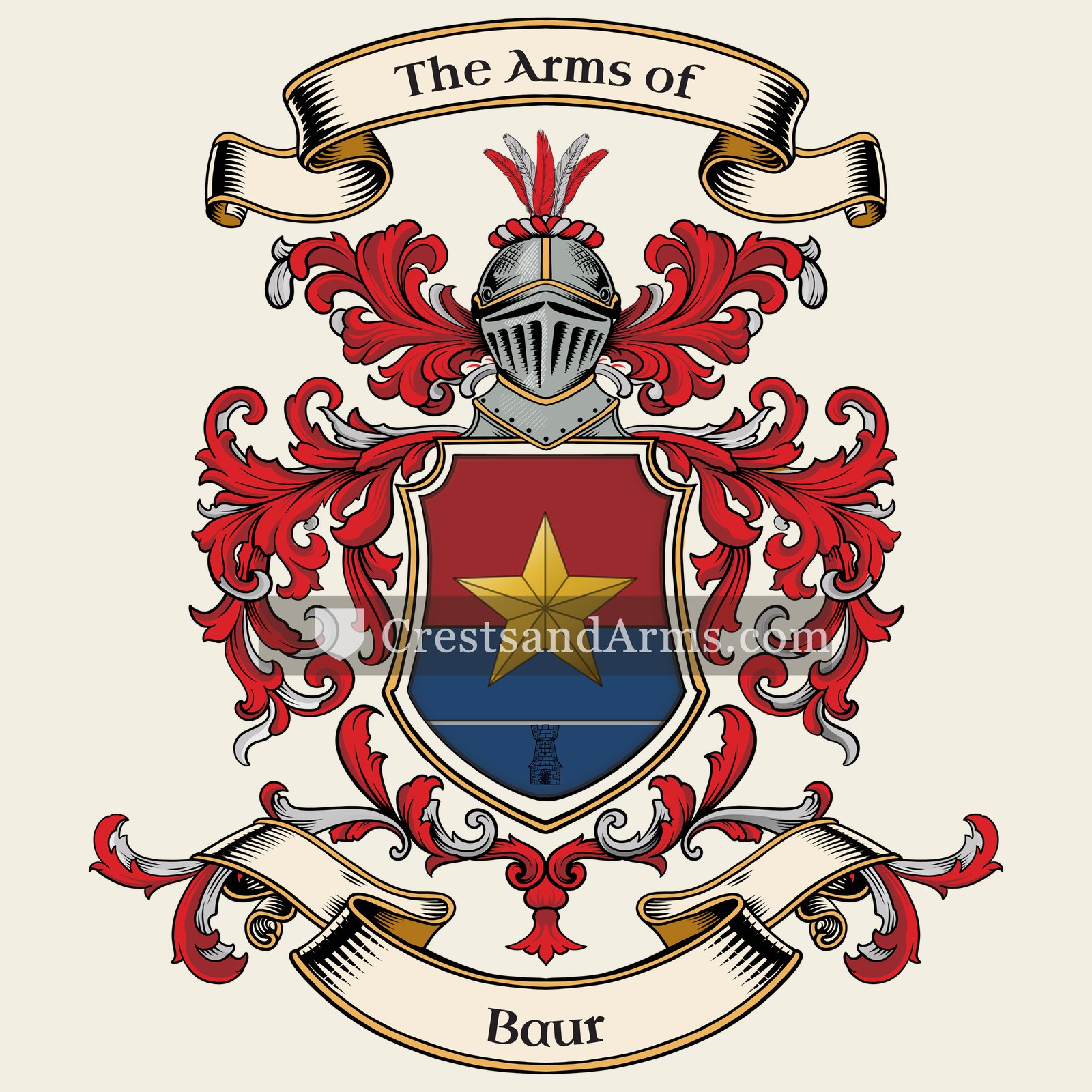


 bendDefence, and the scarf of a commander