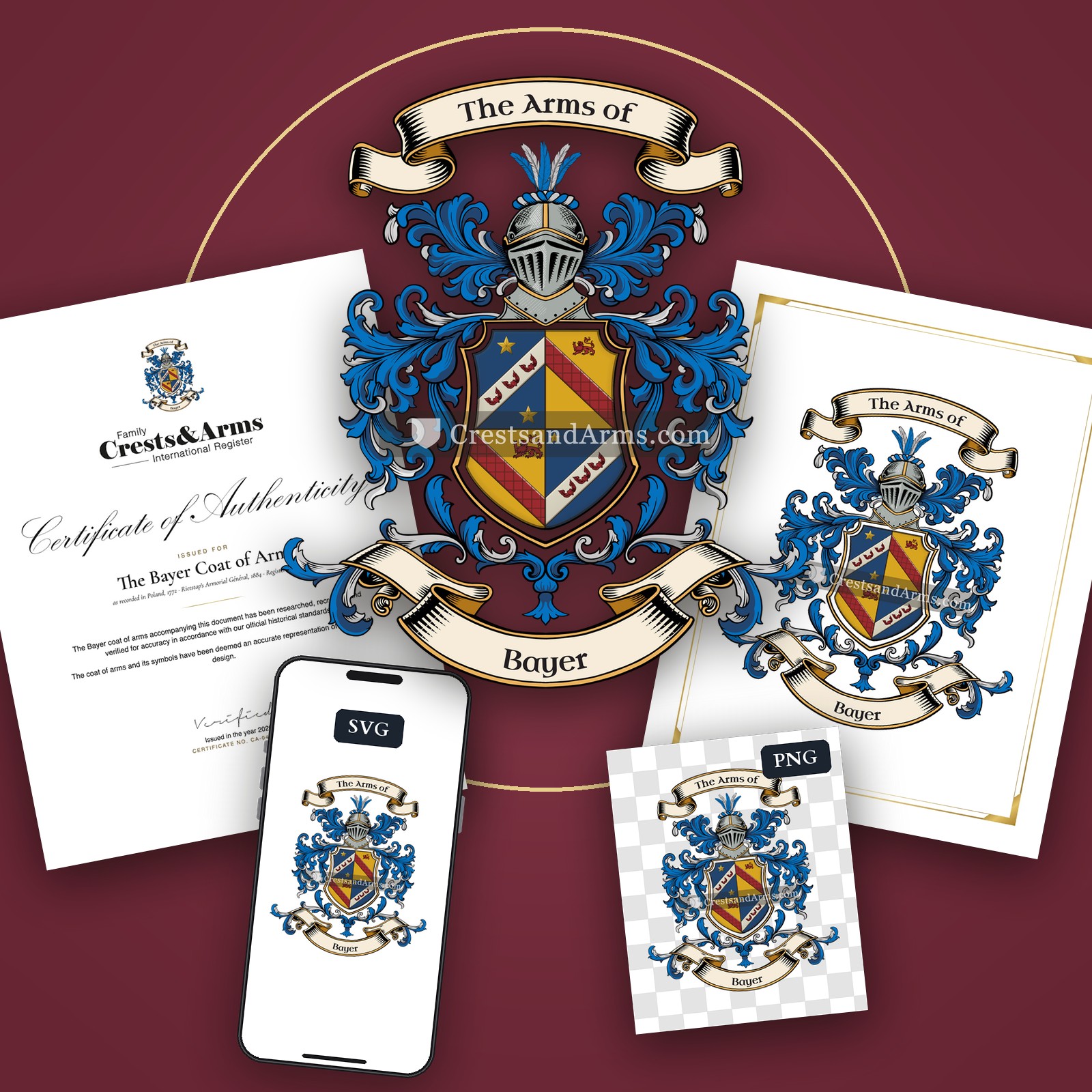
A record of documented arms, meaning and origin, researched for the Bayer family lines. Documented in 2 countries.
Reg. 0426 · Polish, A–C
Coat of Arms & Family Crest Details
Symbols on this shield
mulletThe third son, and a divine quality from above
heartSincerity, charity and true affection
lionCourage, strength and royalty
Colours
Blue (Azure)Means: Loyalty and truth
Gold (Or)Means: Generosity
Silver (Argent)Means: Peace and sincerity
Red (Gules)Means: Military strength
Historical info
Source
J. B. Rietstap, Armorial Général, Gouda: G. B. van Goor Zonen, 1884–87
Blazon (the actual original written record)
“Ec.: aux 1 et 4 d'azur à la barre d'arg., acc. de deux étoiles d'or et ch. de trois coeurs de gu., chaque coeur posé en bande; aux 2 et 3 d'or au lion de gu., celui du 3 cont. Deux cq. cour. C.: 1º une queue de paon, au nat., entre un vol coupé alt. d'azur et d'or; l. d'arg et de gu.; 2º un bras, arm. d'arg., gantelé du même, posé en pal, tenant une étoile d'or; le tout entre deux prob., coupées alt. d'arg. et de gu.; l. d'or et d'azur.”
LivoniaLivonia, c. 1772
Digital archive packCoat of arms PNG, gold border print PDF, vector SVG and the certificate of authenticity. Sent to your email in minutes.
Map of Poland showing where the Bayer arms are recorded
The Bayer arms were recorded in Livonia, c. 1772.
Livonia was Baltic country held by a small number of landed families who kept their estates for centuries. Land there passed down whole rather than being divided, and long unbroken tenure is what fills a register.
This is where the arms were entered in the register. Families often moved to other parts of the country, so the same name can turn up in more than one region.
Region
Livonia
First recorded
1772
Granting Authority for the Bayer Arms
Ennoblement by the Sejm
Author: Olek Remesz · CC BY-SA 3.0
The body that granted and recorded arms in Poland in this period.
Stanisław August Poniatowski
Sovereign of the period
Stanisław August Poniatowski
1764–1795
Reigning in Poland when the Bayer arms are first recorded.
How Arms Worked in Poland
Polish noble families shared a single coat of arms across many different surnames, creating large clans rather than individual designs. These symbols were held collectively by all members of the clan regardless of their specific family name. When a new family joined the nobility, they were adopted into an existing clan and began using that group's established shield.
Granting authority
The Sejm, which was the Polish parliament, held the power to grant noble status and the right to bear arms.
How they got arms
Families typically received their coat of arms through a formal act of ennoblement granted by the Sejm for distinguished service.
Where arms were recorded
These grants were officially recorded in the Crown Metrica, which served as the central archive for state documents starting in the sixteenth century.
The family's standing
Recorded among the armigerous families of Livonia.
Origin & History of the Bayer Family in Poland
The name Bayer originated as a descriptive term for people who migrated from the region of Bavaria in southern Germany. By the late eighteenth century, members of the family had established a significant presence in the territory of Livonia, which was then part of the Russian Empire and bordered the Polish-Lithuanian Commonwealth. During this period, the movement of families across these borders was common due to shifting political boundaries and the expansion of trade networks. As the family settled in these eastern regions, they integrated into the local administrative and social structures of the Baltic and Polish borderlands. This migration pattern reflects the broader historical trend of German-speaking families moving eastward to seek new opportunities in agriculture, commerce, and civil service. Over time, the name became firmly rooted in the region, serving as a link between the family's central European origins and their long-term development in the territories that later became part of modern Poland and the surrounding Baltic states.
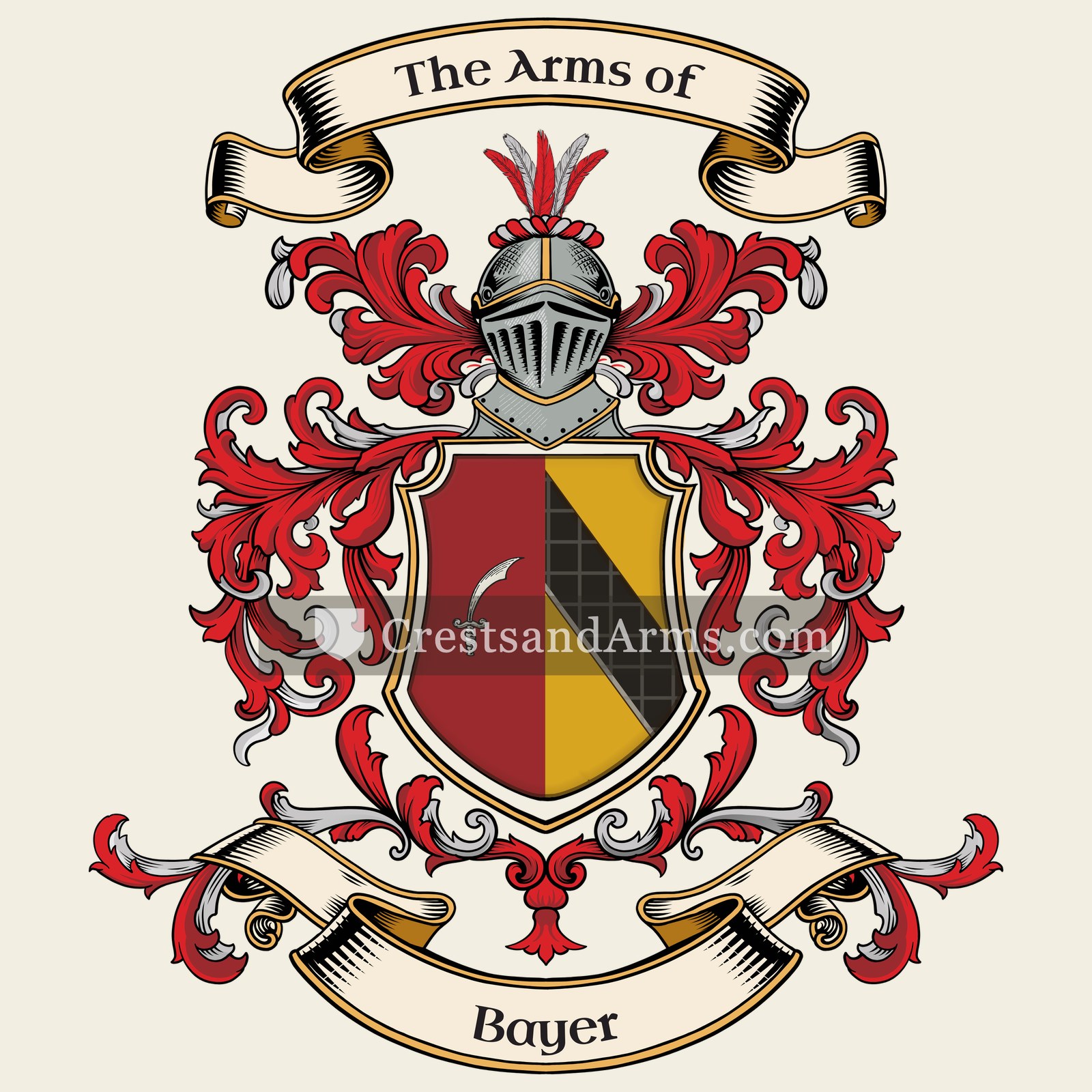
Coat of Arms & Family Crest Details
Symbols on this shield
bendDefence, and the scarf of a commander
swordJustice, and military honour
Colours
Red (Gules)Means: Military strength
Gold (Or)Means: Generosity
Black (Sable)Means: Constancy
Silver (Argent)Means: Peace and sincerity
Historical info
Source
J. B. Rietstap, Armorial Général, Gouda: G. B. van Goor Zonen, 1884–87
Blazon (the actual original written record)
“Parti: au 1 de gu. à une épée d'arg, garnie d'or; au 2 d'or à trois bandes de sa. C.: un senestrochère arm., tenant une épée, le tout au nat. L.: à dextre d'arg. et de gu., à sen. d'or et de sa.”
AustriaVienne, c. 1883
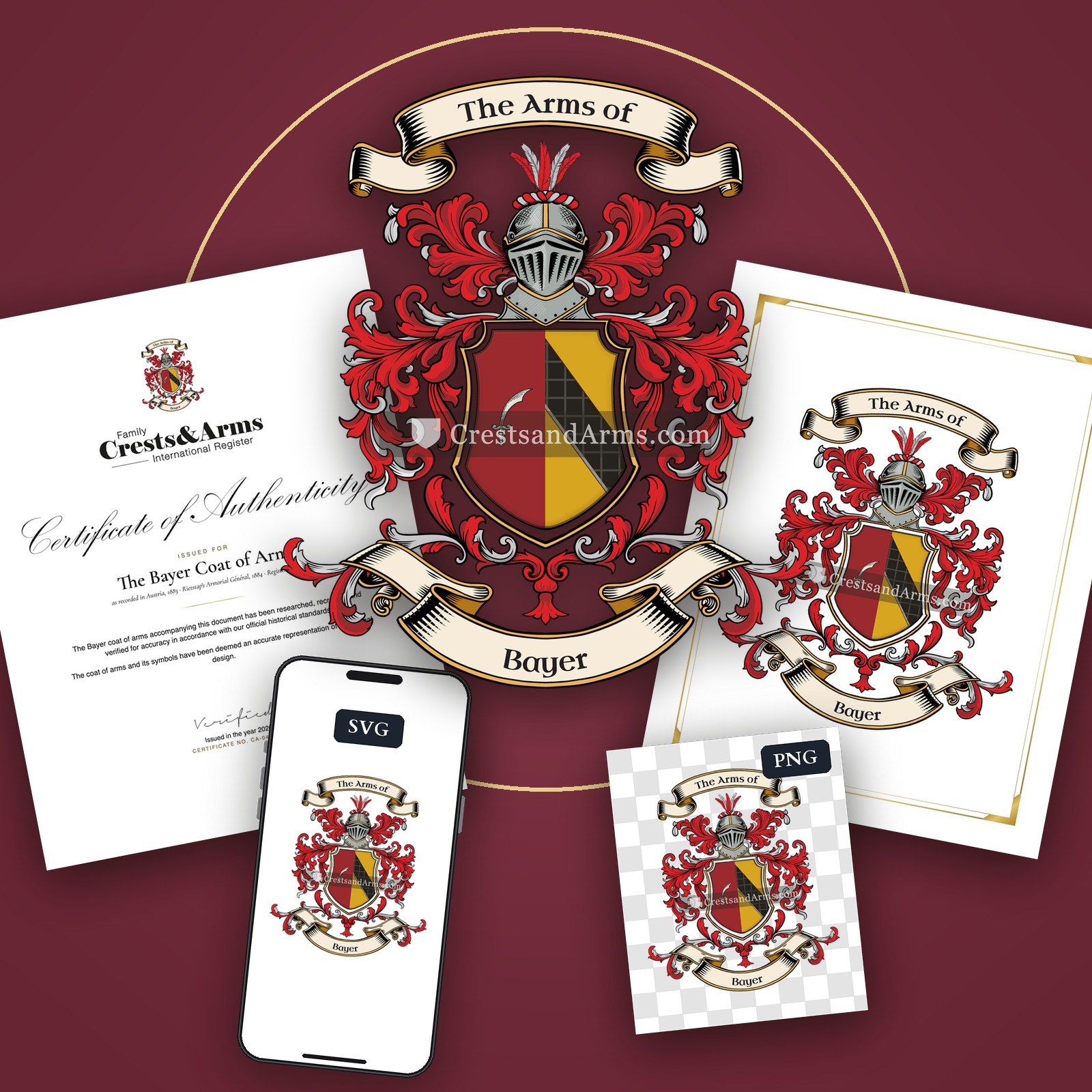
Digital archive packCoat of arms PNG, gold border print PDF, vector SVG and the certificate of authenticity. Sent to your email in minutes.
Map of Austria showing where the Bayer arms are recorded
The Bayer arms were recorded in Vienne, c. 1883.
This is where the arms were entered in the register. Families often moved to other parts of the country, so the same name can turn up in more than one region.
Region
Vienne
Town
Vienne
First recorded
1883
Granting Authority for the Bayer Arms
Imperial and Royal chancery
Sodacan · CC BY-SA 3.0
The body that granted and recorded arms in Austria in this period.
Franz Joseph I of Austria
Sovereign of the period
Franz Joseph I of Austria
1848–1916
Reigning in Poland when the Bayer arms are first recorded.
How Arms Worked in Austria
Austrian coats of arms were often linked directly to noble titles granted by the Emperor. These symbols belonged to the entire family line rather than just one individual. When a family grew, new branches kept the original design without needing to change it. This system allowed all members of a noble house to share the same identity across many generations.
Granting authority
The Imperial and Royal chancery managed all heraldic matters and controlled the official granting of arms throughout the Austrian lands.
How they got arms
Families typically received their arms through a formal imperial decree that often accompanied the elevation of a person to noble status.
Where arms were recorded
Official records of these grants were kept in the Imperial Register of Nobility which began its formal documentation process in 1453.
The family's standing
Recorded among the armigerous families of Austria.
Origin & History of the Bayer Family in Austria
The surname Bayer is a classic example of an occupational or regional name that emerged during the Middle Ages in the German-speaking lands. Historically, the name functioned as a descriptor for someone who originated from Bavaria, known as Bayern in German, or for a person who had significant trade connections with that region. As families migrated across the borders of the Holy Roman Empire, the name became established in various urban centers, including the imperial capital of Vienna. By the time the family was documented in Vienna in 1883, the name had long been integrated into the social fabric of the Austro-Hungarian Empire. During this period, families named Bayer often held roles in the growing administrative, commercial, and professional sectors of the city. This helped them transition from their ancestral roots in rural or provincial areas into the bustling, multicultural environment of late nineteenth-century Vienna.
Bayer Meaning & Related Branches
Root word
Bair
Old High German word for a person from Bavaria.
This name
BayerAn occupational or habitational surname denoting someone who originated from the region of Bavaria.
also spelled
Bayerr
Bayere
Related arms
Baiervariant spelling
Bayrvariant spelling
Documented Sources
J. B. Rietstap, Armorial Général, Gouda: G. B. van Goor Zonen, 1884–87
Bunge, Friedrich Georg von, Die Quellen des Revaler Stadtrechts, 1842
Manteuffel, Gustav, Geschichte der polnisch-livländischen Gebiete in der Zeit der polnischen Herrschaft, 1906
Schwartz, Philipp, Die deutsche Einwanderung in das Baltikum und ihre Auswirkungen auf die lokale Verwaltung, 1912
Latvian State Historical Archives (Latvijas Valsts vēstures arhīvs), Fond 214: Livonian Nobility and Landed Estates
State Archives in Poznań (Archiwum Państwowe w Poznaniu), Collection of German-Polish Borderland Records
Digital archive packCoat of arms PNG, gold border print PDF, vector SVG and the certificate of authenticity. Sent to your email in minutes.


 mulletThe third son, and a divine quality from above
 heartSincerity, charity and true affection
 lionCourage, strength and royalty
 mulletThe third son, and a divine quality from above
 heartSincerity, charity and true affection
 lionCourage, strength and royalty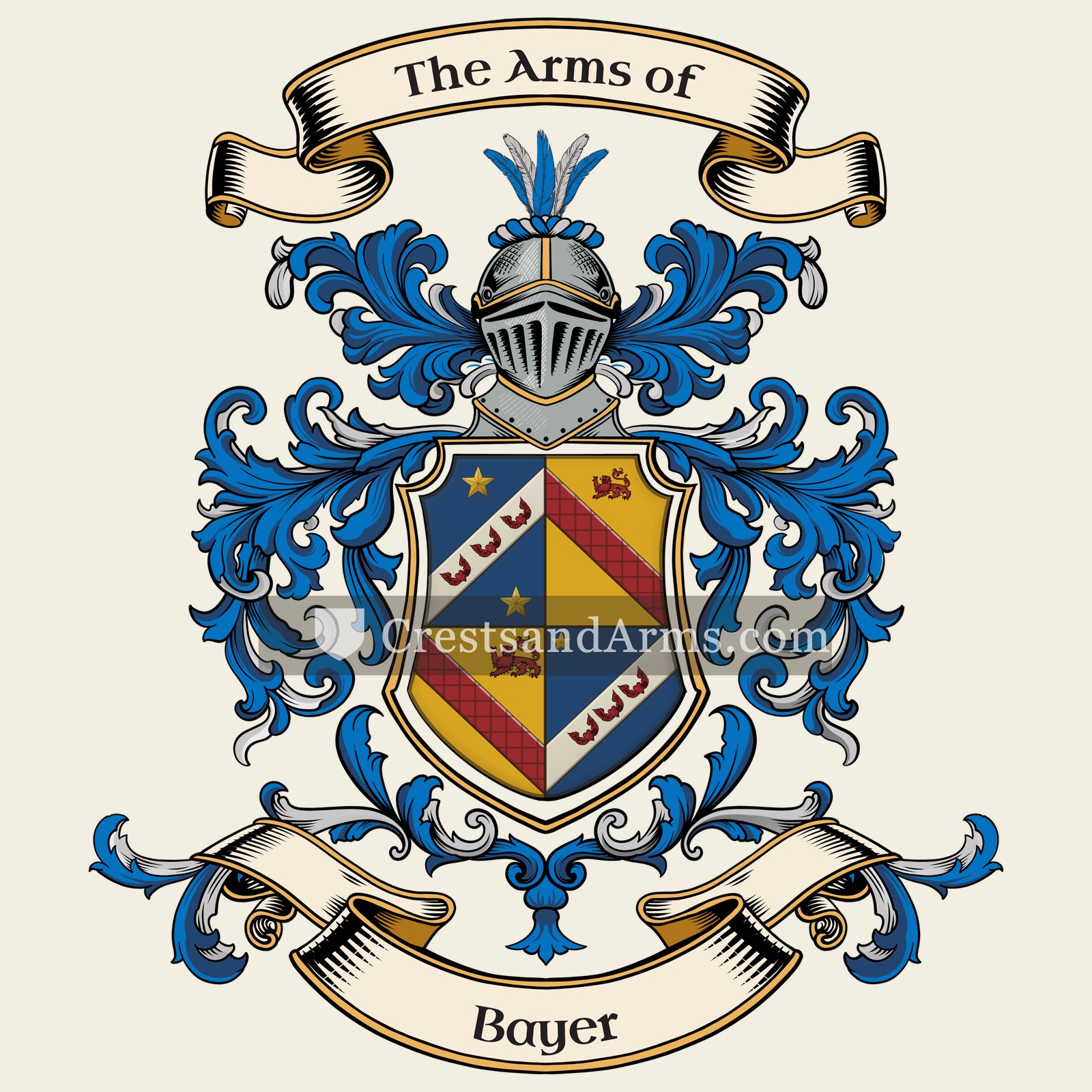


 bendDefence, and the scarf of a commander
 swordJustice, and military honour