Map of France showing where the Bayly arms are recorded
The Bayly arms were recorded in Perigord, c. 1663.
Perigord was wooded upland country in south-western France, thick with small castles. Its gentry were numerous and mostly poor, and even a modest holding justified a shield of one's own.
This is where the arms were entered in the register. Families often moved to other parts of the country, so the same name can turn up in more than one region.
The body that granted and recorded arms in France in this period.
Louis XIV of France
Sovereign of the period
Louis XIV of France
1643–1715
Reigning in France when the Bayly arms are first recorded.
How Arms Worked in France
In France, a coat of arms was a mark of honor that passed down through the male line to all legitimate descendants. Families often used the same shield without changes to show their shared heritage. If a branch wanted to stand out, they could add a small mark to their shield to show their specific place in the family tree.
Granting authority
The Juge d'armes de France acted as the official authority that regulated and verified coats of arms across the country.
How they got arms
Families typically inherited their arms from ancestors, though they could also receive them through royal grants or by proving their noble status.
Where arms were recorded
Coats of arms were officially recorded in the Armorial Général de France, which began its main collection in the year 1696.
The family's standing
Recorded among the armigerous families of Perigord.
Origin & History of the Bayly Family in France
The roots of the Bayly name in France are deeply connected to the historical region of Périgord, where family members were documented as early as 1663. During this period, the name was often associated with individuals who served as local administrators or stewards, as the term itself is thought to derive from the Old French word for a bailiff or a legal officer. Living in the lush, river-carved landscape of Périgord, these early family members were part of a provincial society defined by its agricultural wealth and its complex network of local land management. As they navigated the social structures of the seventeenth century, the family became integrated into the regional fabric of southwestern France. Their presence in official records from this era highlights their role as established citizens who helped maintain order and oversee property within their community long before the name spread further across Europe.
Coat of Arms & Family Crest Details
Symbols on this shield
fessThe military belt, and readiness to serve
vairProtection, and the winter fur
mulletThe third son, and a divine quality from above
heartSincerity, charity and true affection
Colours
Red (Gules)Means: Military strength
Gold (Or)Means: Generosity
Historical info
Source
Sir Bernard Burke, The General Armory of England, Scotland, Ireland and Wales, London: Harrison & Sons, 1884
Blazon (the actual original written record)
“Gu. a fesse vair betw. two mullets of six points in chief, and a heart in base or”
EnglandLondon, c. 1620
Digital archive packCoat of arms PNG, gold border print PDF, vector SVG and the certificate of authenticity. Sent to your email in minutes.
Map of England showing where the Bayly arms are recorded
The Bayly arms were recorded in London, c. 1620.
This is where the arms were entered in the register. Families often moved to other parts of the country, so the same name can turn up in more than one region.
The body that granted and recorded arms in England in this period.
James VI and I
Sovereign of the period
James VI and I
1603–1625
Reigning in France when the Bayly arms are first recorded.
How Arms Worked in England
English heraldry allowed arms to be shared by all legitimate descendants of the original owner. These symbols were treated as personal property that moved through the generations to all children. While the eldest son kept the original design, other family members could use the same shield without needing to change it or register their own unique versions.
Granting authority
The College of Arms in London has regulated the use of coats of arms throughout England and Wales since 1484.
How they got arms
Families typically obtained their coats of arms through a formal grant from the Crown or by proving their ancient right to them.
Where arms were recorded
All official coats of arms are recorded in the registers kept at the College of Arms, which date back to the fifteenth century.
The family's standing
Recorded among the armigerous families of England.
Origin & History of the Bayly Family in England
The family name Bayly originated as an occupational surname, derived from the Middle English word "baili," which referred to a person who acted as a steward or an official responsible for managing a manor or a legal district. By the time members of the family were documented in London in 1620, the name had become well-established across various regions of England, reflecting the essential role these individuals played in local administration and land management. During this period, the name appeared in diverse social contexts, ranging from merchants and tradespeople in the bustling capital to landowners in the countryside. Because the name was tied to a specific job rather than a single geographic location, it emerged independently in several different areas, meaning that many families bearing the name share a common professional heritage rather than a single common ancestor. This widespread use of the term in legal and manorial records highlights how the family name grew alongside the development of English local government and the expansion of the middle class in the early seventeenth century.
Coat of Arms & Family Crest Details
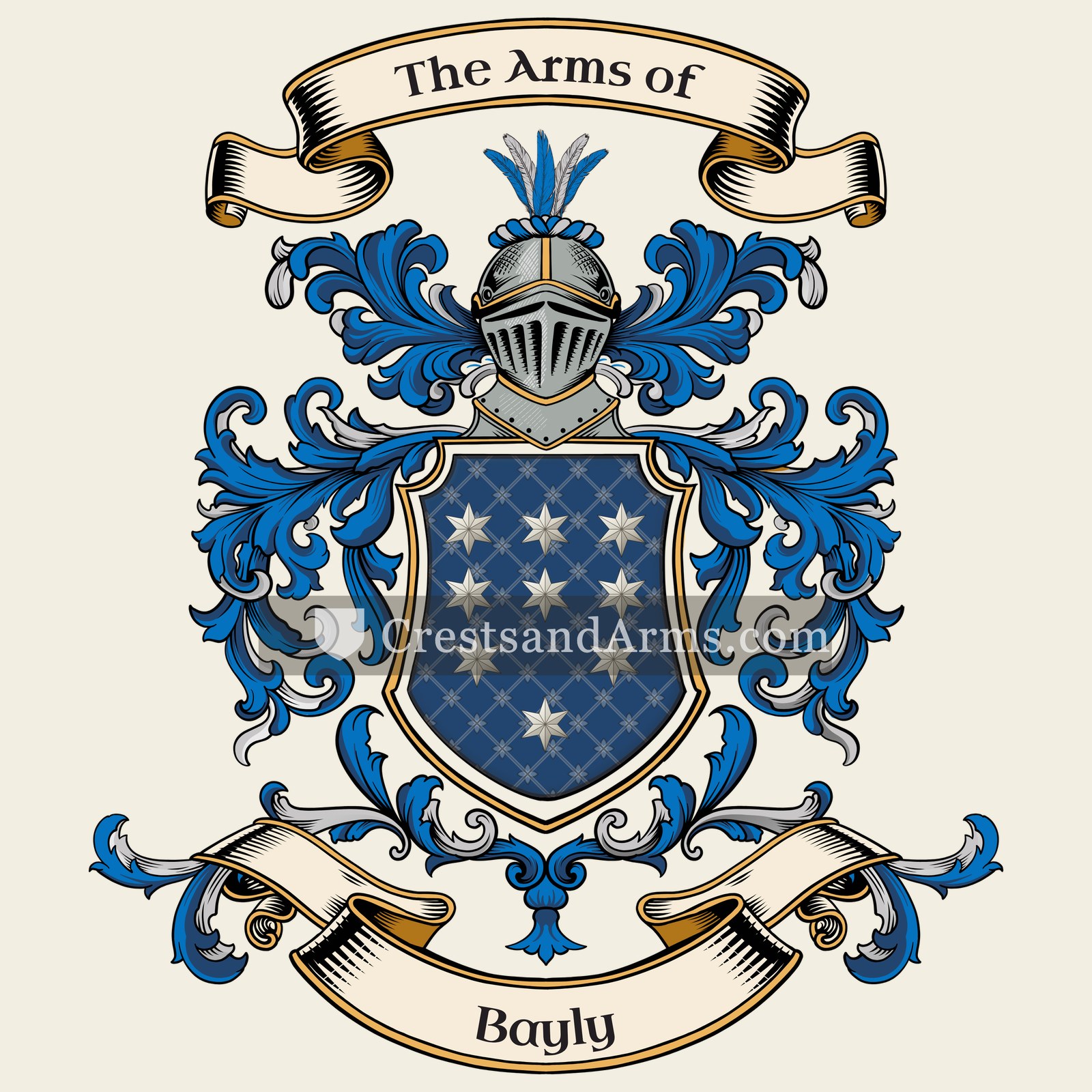
Symbols on this shield
starThe celestial goddess, and nobility
Colours
Blue (Azure)Means: Loyalty and truth
Silver (Argent)Means: Peace and sincerity
Historical info
Source
Sir Bernard Burke, The General Armory of England, Scotland, Ireland and Wales, London: Harrison & Sons, 1884
Blazon (the actual original written record)
“Az. nine estoiles, three, three, two, and one, ar”
AngleseyPlas Newydd · Anglesey, c. 1647
Digital archive packCoat of arms PNG, gold border print PDF, vector SVG and the certificate of authenticity. Sent to your email in minutes.
Map of Wales showing where the Bayly arms are recorded
The Bayly arms were recorded in Anglesey, c. 1647.
Anglesey was the flat, fertile island off north Wales, farmed for centuries by the same families. Good land kept them in place, and staying put is what puts a name in the records.
This is where the arms were entered in the register. Families often moved to other parts of the country, so the same name can turn up in more than one region.
The body that granted and recorded arms in Wales in this period.
Charles I of England
Sovereign of the period
Charles I of England
1625–1649
Reigning in France when the Bayly arms are first recorded.
How Arms Worked in Wales
English heraldry allowed arms to be shared by all legitimate descendants of the original owner. These symbols were treated as personal property that moved through the generations to all children. While the eldest son kept the original design, other family members could use the same shield without needing to change it or register their own unique versions.
Granting authority
The College of Arms in London has regulated the use of coats of arms throughout England and Wales since 1484.
How they got arms
Families typically obtained their coats of arms through a formal grant from the Crown or by proving their ancient right to them.
Where arms were recorded
All official coats of arms are recorded in the registers kept at the College of Arms, which date back to the fifteenth century.
The family's standing
Recorded among the armigerous families of Anglesey.
Origin & History of the Bayly Family in Wales
The Bayly family name has deep roots in the history of Wales, particularly within the coastal landscapes of Anglesey. By the middle of the seventeenth century, the family had established a significant presence on the island, with records confirming their residence there by 1647. During this era, families like the Baylys often integrated into the local social structure by managing land and participating in the administrative life of the region. Their arrival and settlement in Anglesey reflect the broader patterns of migration and social mobility that defined Welsh life during the turbulent mid-1600s. As they became part of the local community, the Baylys helped shape the development of the area through their involvement in regional affairs and their connection to the unique cultural identity of North Wales.
Bayly Meaning & Related Branches
Root word
baillif
an official or administrative agent acting on behalf of a superior
This name
Baylya surname denoting an individual who held the office of a bailiff or local administrator
also spelled
Bayley
Baylee
Bayle
Baylie
Bailie
Related arms
Bailysimilar arms
Bailievariant spelling
Baillievariant spelling
Baylevariant spelling
Documented Sources
J. B. Rietstap, Armorial Général, Gouda: G. B. van Goor Zonen, 1884–87
Archives départementales de la Dordogne, Série E: Familles et seigneuries
Galy, Elie, Dictionnaire biographique du Périgord, 1876
Lachiver, Marcel, Dictionnaire du monde rural: Les mots du passé, 1997
Digital archive packCoat of arms PNG, gold border print PDF, vector SVG and the certificate of authenticity. Sent to your email in minutes.


 eagleNobility, strength and a keen mind
 eagleNobility, strength and a keen mind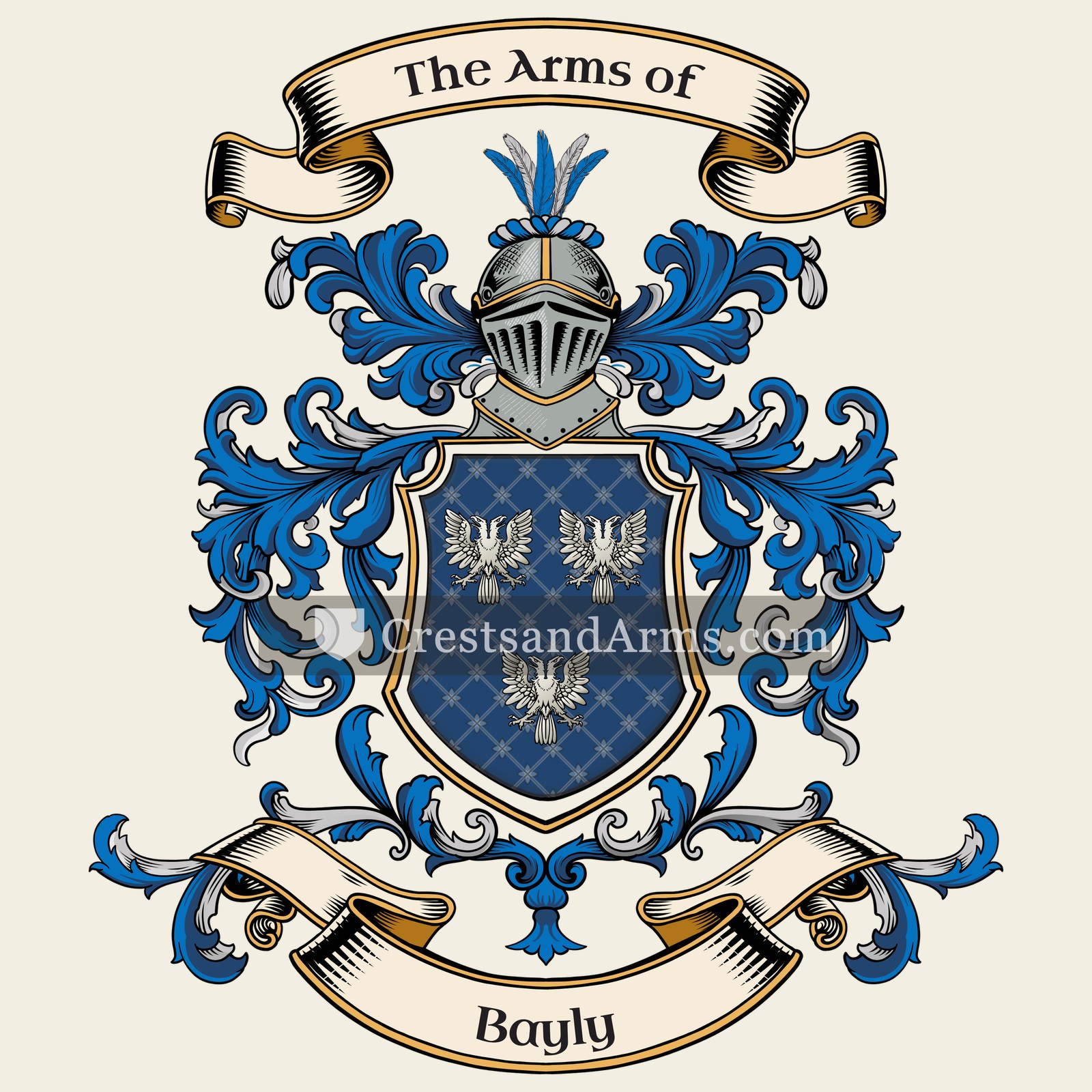


 fessThe military belt, and readiness to serve
 mulletThe third son, and a divine quality from above
 heartSincerity, charity and true affection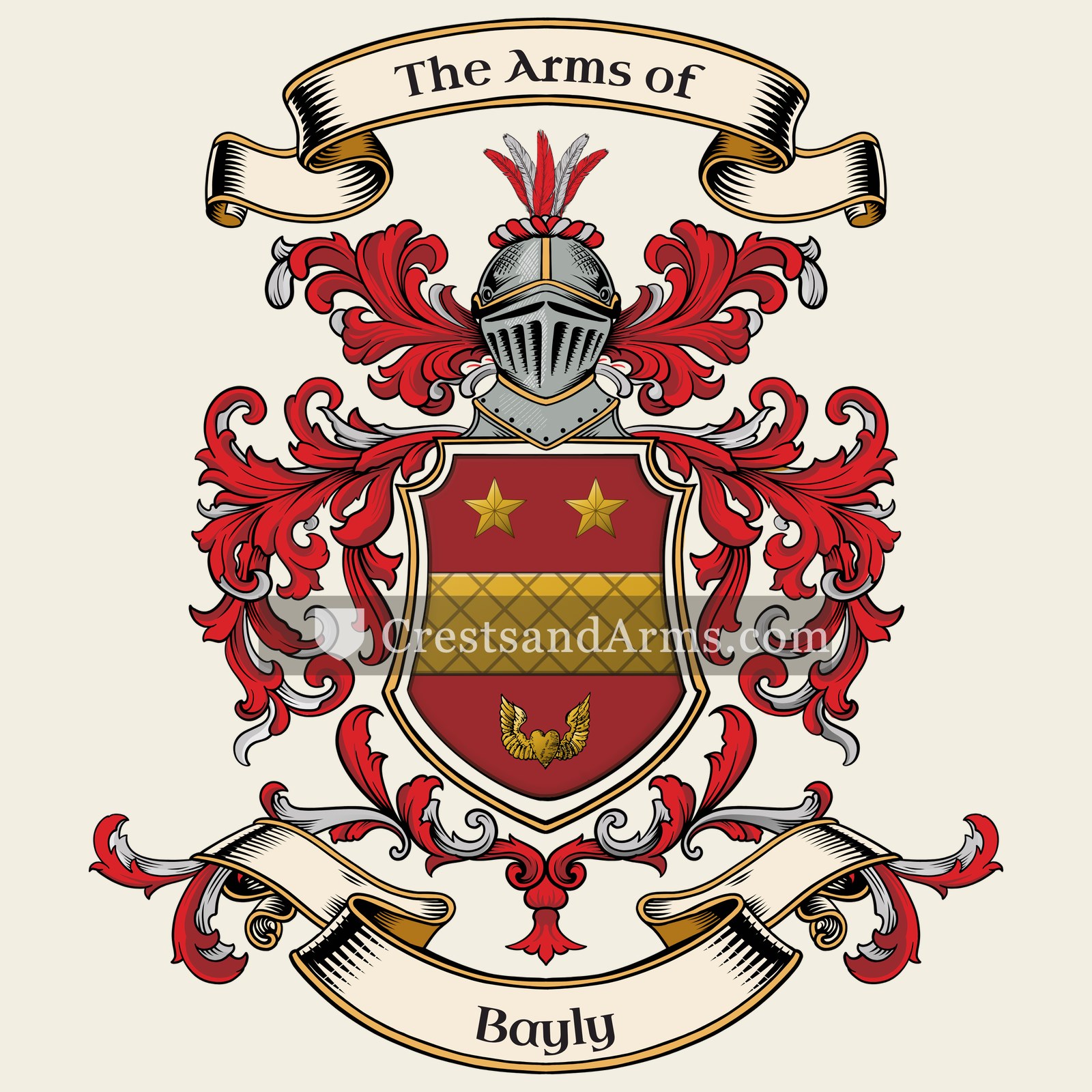


 starThe celestial goddess, and nobility