Map of France showing where the Bayne arms are recorded
The Bayne arms were recorded in Flandre, c. 1663.
Flandre grew rich on cloth, and its towns were among the busiest in Europe. Merchant families bought land with their profits and took arms to go with it, so trade put as many names in the registers here as land did.
This is where the arms were entered in the register. Families often moved to other parts of the country, so the same name can turn up in more than one region.
The body that granted and recorded arms in France in this period.
Louis XIV of France
Sovereign of the period
Louis XIV of France
1643–1715
Reigning in France when the Bayne arms are first recorded.
How Arms Worked in France
In France, a coat of arms was a mark of honor that passed down through the male line to all legitimate descendants. Families often used the same shield without changes to show their shared heritage. If a branch wanted to stand out, they could add a small mark to their shield to show their specific place in the family tree.
Granting authority
The Juge d'armes de France acted as the official authority that regulated and verified coats of arms across the country.
How they got arms
Families typically inherited their arms from ancestors, though they could also receive them through royal grants or by proving their noble status.
Where arms were recorded
Coats of arms were officially recorded in the Armorial Général de France, which began its main collection in the year 1696.
The family's standing
Recorded among the armigerous families of Flandre.
Origin & History of the Bayne Family in France
The history of the Bayne family name in France is deeply rooted in the cultural landscape of the Flanders region during the seventeenth century. By 1663, records confirm that members of the family were well established in this northern territory, which served as a vital crossroads between French and Flemish influences. The name likely evolved from local linguistic traditions where it functioned as a descriptive term for an individual’s physical appearance or their specific occupation within the community. During this era, families in Flanders often moved between growing urban centers and rural estates to manage trade or agriculture. As the family integrated into the social fabric of the region, they became part of the complex administrative life of the French monarchy. This period of history highlights how the Bayne name began to solidify its identity through local record-keeping and the daily interactions of people living in a rapidly changing European borderland.
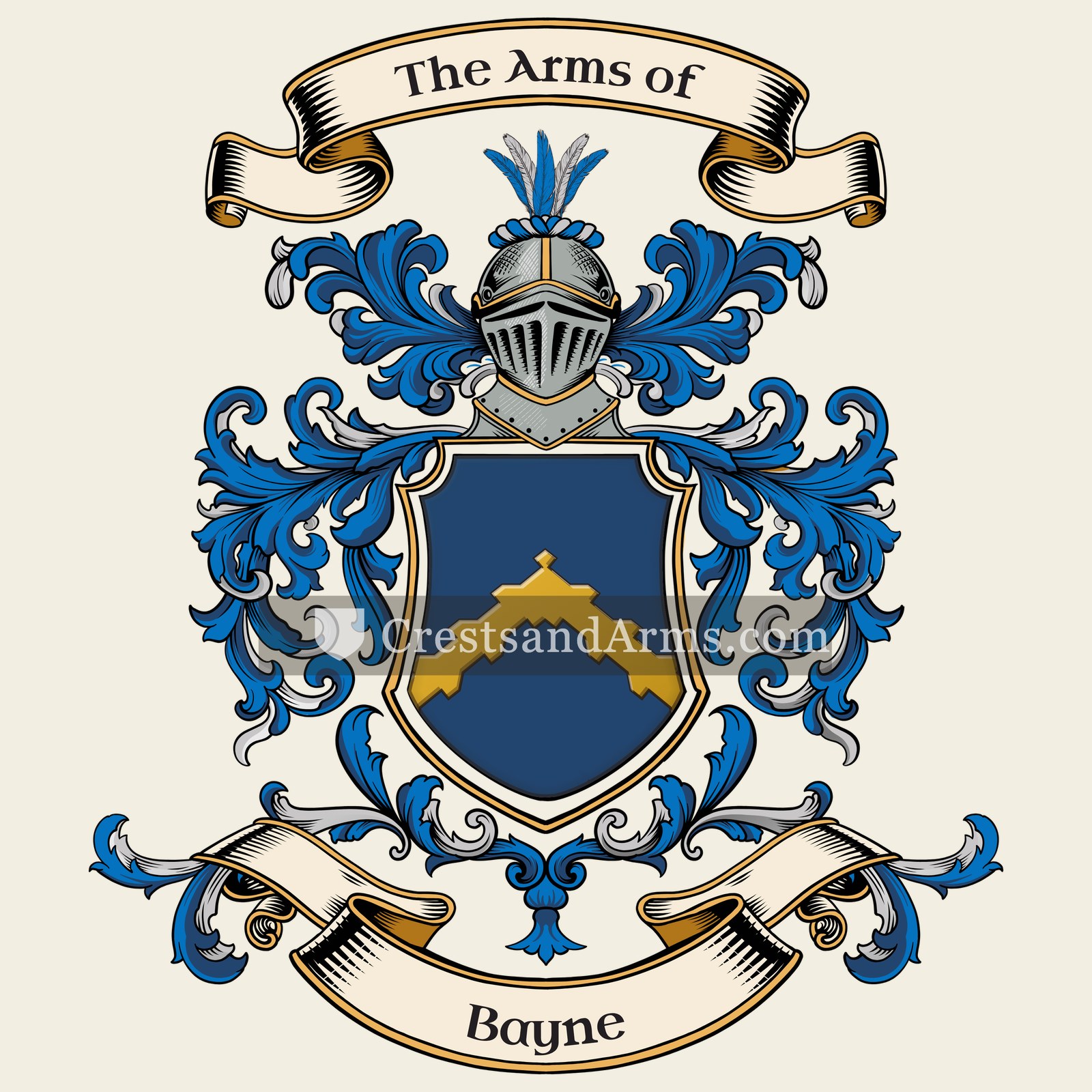
Coat of Arms & Family Crest Details
Symbols on this shield
chevronProtection, and faithful service completed
Colours
Blue (Azure)Means: Loyalty and truth
Gold (Or)Means: Generosity
Historical info
Source
Sir Bernard Burke, The General Armory of England, Scotland, Ireland and Wales, London: Harrison & Sons, 1884
Blazon (the actual original written record)
“Az. a chev. embattled or”
Scotlandc. 1748
Digital archive packCoat of arms PNG, gold border print PDF, vector SVG and the certificate of authenticity. Sent to your email in minutes.
Map of Scotland showing where the Bayne arms are recorded
The Bayne arms were recorded in Scotland, c. 1748.
Arms such as these were typically recorded in Edinburgh.
Edinburgh was the seat of Scotland's government, its courts and its heralds. Families with business there settled nearby, and being close to where arms were recorded is exactly why so many of them appear.
This is where the arms were entered in the register. Families often moved to other parts of the country, so the same name can turn up in more than one region.
The body that granted and recorded arms in Scotland in this period.
George II of Great Britain
Sovereign of the period
George II of Great Britain
1727–1760
Reigning in France when the Bayne arms are first recorded.
How Arms Worked in Scotland
Scottish heraldry is unique because it treats a coat of arms as a piece of personal property protected by law. Only one person can own a specific design at any given time. When a family grows, the head keeps the original shield while other relatives must apply for their own distinct version with slight changes to prove their specific identity.
Granting authority
The Court of the Lord Lyon acts as the official body that regulates and controls all heraldic matters throughout Scotland.
How they got arms
Individuals obtain a legal right to their arms through a formal petition process that confirms their identity and family connection.
Where arms were recorded
All valid coats of arms are officially entered into the Public Register of All Arms and Bearings starting from 1672.
The family's standing
Recorded among the armigerous families of Scotland.
Origin & History of the Bayne Family in Scotland
The surname Bayne has deep roots in Scotland, where it originated as a descriptive nickname derived from the Gaelic word *bàn*, meaning fair or white-haired. This name was often used to distinguish individuals based on their physical appearance, and it eventually transitioned into a hereditary family name as surnames became common across the Scottish Lowlands. By the mid-eighteenth century, the Bayne family had established a notable presence in Edinburgh, a city that served as the cultural and administrative heart of the nation. Records from 1748 confirm that family members were active participants in the urban life of the capital during a time of significant social change. These early residents were part of a growing class of citizens who contributed to the professional and civic development of Edinburgh as it transitioned into the modern era.
Bayne Meaning & Related Branches
Root word
bain
Old French term for a bath or bathing place.
This name
BayneA topographic name for someone who lived near a public bathhouse or a bathing spot.
also spelled
Baynee
Bayn
Bain
Baine
Bane
Related arms
Bainvariant spelling
Bainevariant spelling
Bainesvariant spelling
Banevariant spelling
Documented Sources
J. B. Rietstap, Armorial Général, Gouda: G. B. van Goor Zonen, 1884–87
Archives départementales du Nord, Série B (Registres de l'intendance de Flandre)
Lottin, Alain, Histoire des provinces françaises du Nord, 1989
Van der Essen, Léon, La Belgique sous la domination française, 1934
Digital archive packCoat of arms PNG, gold border print PDF, vector SVG and the certificate of authenticity. Sent to your email in minutes.


 fusilTravail and industry
 lambGentleness, patience and faith
 fusilTravail and industry
 lambGentleness, patience and faith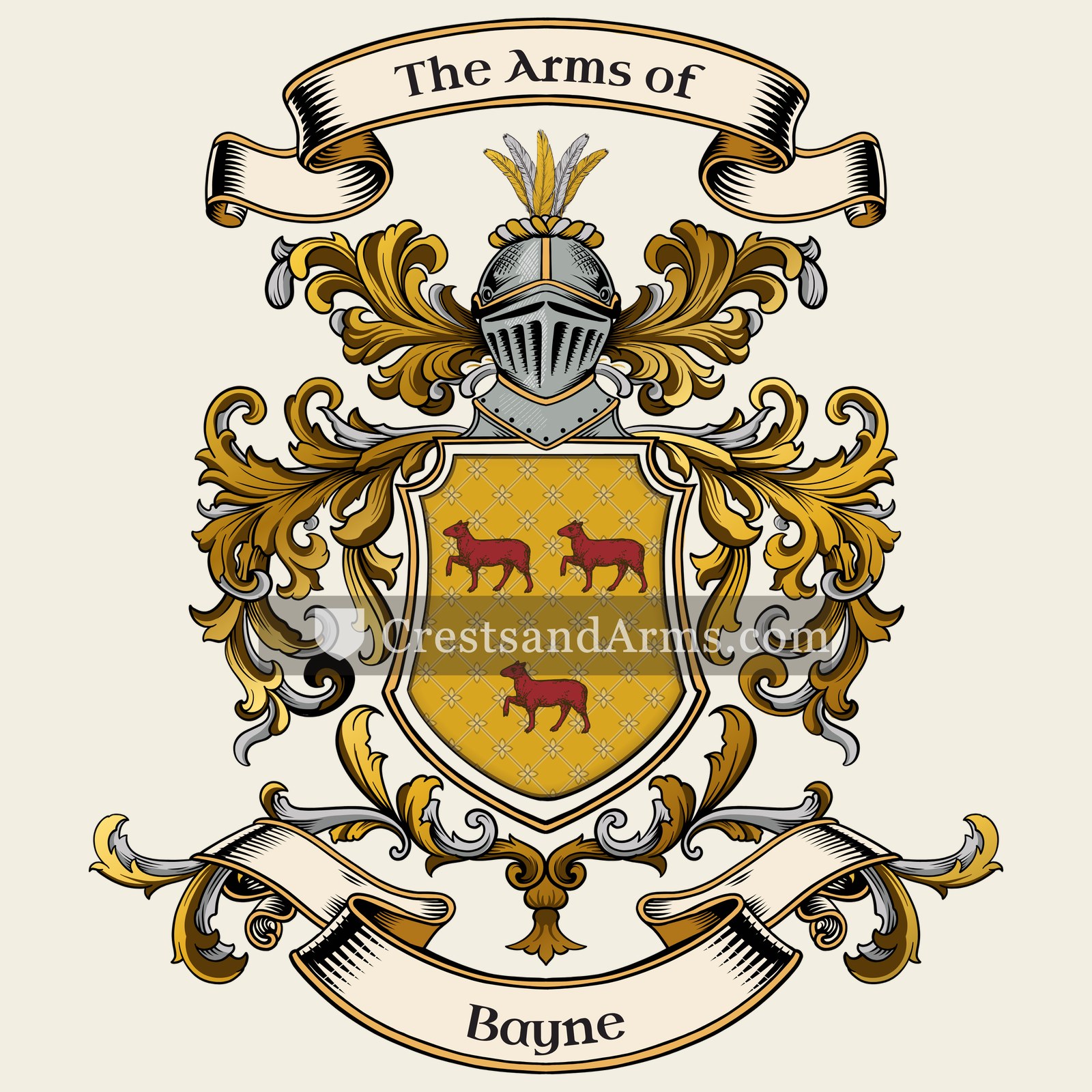


 chevronProtection, and faithful service completed