A record of documented arms, meaning and origin, researched for the Bayron family lines. Documented in 2 countries.
Reg. 3323 · Britain, A–C
Coat of Arms & Family Crest Details
Colours
Silver (Argent)Means: Peace and sincerity
Historical info
Source
J. B. Rietstap, Armorial Général, Gouda: G. B. van Goor Zonen, 1884–87
Blazon (the actual original written record)
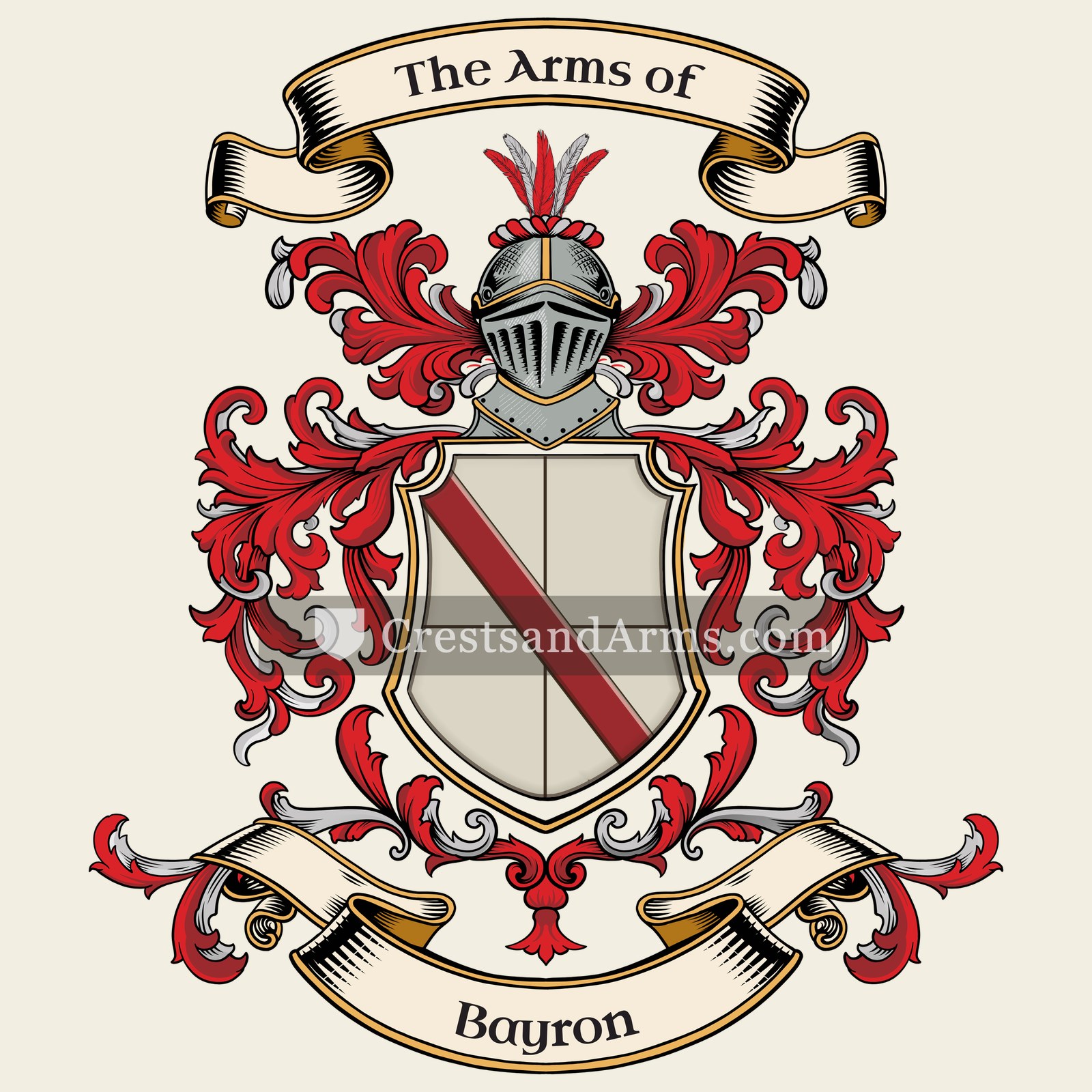
“D'arg. à trois cotices de gu., haussées dans l'écu. C.: une sirène, tenant de sa main dextre une peigne et de sa sen. un miroir, le tout au nat. S.: deux chevaux bais. D.: CREDE BYRON [A cette famille appartenait le célèbre poète George Gordon lord Byron.]”
DerbyshireDerbyshire, c. 1643
Digital archive packCoat of arms PNG, gold border print PDF, vector SVG and the certificate of authenticity. Sent to your email in minutes.
Map of Britain showing where the Bayron arms are recorded
The Bayron arms were recorded in Derbyshire, c. 1643.
This is where the arms were entered in the register. Families often moved to other parts of the country, so the same name can turn up in more than one region.
The body that granted and recorded arms in Britain in this period.
Charles I of England
Sovereign of the period
Charles I of England
1625–1649
Reigning in Britain when the Bayron arms are first recorded.
How Arms Worked in Britain
English heraldry allowed arms to be shared by all legitimate descendants of the original owner. These symbols were treated as personal property that moved through the generations to all children. While the eldest son kept the original design, other family members could use the same shield without needing to change it or register their own unique versions.
Granting authority
The College of Arms in London has regulated the use of coats of arms throughout England and Wales since 1484.
How they got arms
Families typically obtained their coats of arms through a formal grant from the Crown or by proving their ancient right to them.
Where arms were recorded
All official coats of arms are recorded in the registers kept at the College of Arms, which date back to the fifteenth century.
The family's standing
Recorded among the armigerous families of Derbyshire.
Origin & History of the Bayron Family in Britain
The family name Bayron traces its roots in Britain to the mid-seventeenth century, with documented evidence placing members of the family in the county of Derbyshire by 1643. During this period, England was deeply divided by the English Civil War, a conflict that forced many families to choose sides between the monarchy and Parliament. Living in Derbyshire, a region that saw significant military movement and strategic maneuvering, the Bayron family likely navigated the social and economic pressures of a country at war. The name itself reflects the linguistic shifts of the time, as families often adapted their surnames based on local dialects or the transition from oral traditions to written records. By establishing themselves in the Midlands, the early Bayrons became part of a local landscape defined by agriculture and the emerging industrial interests of the era. Their presence in the historical record during such a turbulent decade suggests they were part of the broader social fabric that helped shape the local community in Derbyshire during the seventeenth century.
Coat of Arms & Family Crest Details
Colours
Silver (Argent)Means: Peace and sincerity
Red (Gules)Means: Military strength
Historical info
Source
Sir Bernard Burke, The General Armory of England, Scotland, Ireland and Wales, London: Harrison & Sons, 1884
Blazon (the actual original written record)
“Quarterly, 1st and 4th, ar. three bendlets enhanced gu., for BYRON; 2nd and 3rd, az. three standishes ar., for STANDISH”
YorkAyton · York, c. 1620
Digital archive packCoat of arms PNG, gold border print PDF, vector SVG and the certificate of authenticity. Sent to your email in minutes.
Map of England showing where the Bayron arms are recorded
The Bayron arms were recorded in York, c. 1620.
Yorkshire is the largest of the English counties, and it held more gentry families than any other. Land there was split among a great many households rather than a few, so a great many of them carried arms.
This is where the arms were entered in the register. Families often moved to other parts of the country, so the same name can turn up in more than one region.
The body that granted and recorded arms in England in this period.
James VI and I
Sovereign of the period
James VI and I
1603–1625
Reigning in Britain when the Bayron arms are first recorded.
How Arms Worked in England
English heraldry allowed arms to be shared by all legitimate descendants of the original owner. These symbols were treated as personal property that moved through the generations to all children. While the eldest son kept the original design, other family members could use the same shield without needing to change it or register their own unique versions.
Granting authority
The College of Arms in London has regulated the use of coats of arms throughout England and Wales since 1484.
How they got arms
Families typically obtained their coats of arms through a formal grant from the Crown or by proving their ancient right to them.
Where arms were recorded
All official coats of arms are recorded in the registers kept at the College of Arms, which date back to the fifteenth century.
The family's standing
Recorded among the armigerous families of York.
Origin & History of the Bayron Family in England
The family name Bayron, while often associated with various European roots, established a notable presence in the historic city of York by the early seventeenth century. Records indicate that members of the family were living in this northern English hub by 1620, a time when York served as a vital center for trade, religion, and regional administration. During this period, families in York often lived in close-knit neighborhoods near the city walls or the Minster, participating in the local guilds and parish life that defined the social structure of the era. Because York was a major crossroads for travelers moving between London and Scotland, the Bayron family likely benefited from the city’s bustling economy and its reputation as a gateway to the north. By settling in such a prominent location, these early ancestors integrated themselves into a community that valued craftsmanship and civic duty, helping to anchor the name within the local history of Yorkshire.
Related Branches & Arms
Root word
Byron
Derived from the Old English word for a cowshed or barn.
This name
BayronA locational surname referring to someone who lived near a barn or cattle shed.
also spelled
Byrone
Byronn
Byrun
Biron
Documented Sources
J. B. Rietstap, Armorial Général, Gouda: G. B. van Goor Zonen, 1884–87
The National Archives, State Papers Domestic, Charles I (SP 16)
Derbyshire Record Office, Quarter Sessions Records (Q/SR)
Cox, J. Charles, Notes on the Churches of Derbyshire, 1875
Woolrych, Austin, Battles of the English Civil War, 1961
Digital archive packCoat of arms PNG, gold border print PDF, vector SVG and the certificate of authenticity. Sent to your email in minutes.