Map of France showing where the Bazin arms are recorded
The Bazin arms were recorded in Lorraine, c. 1522.
Lorraine sat on the border between France and the German lands, and border country bred soldiers. Families here held small estates and served in arms, and a fighting man was exactly the sort who carried a shield of his own.
This is where the arms were entered in the register. Families often moved to other parts of the country, so the same name can turn up in more than one region.
The body that granted and recorded arms in France in this period.
Francis I of France
Sovereign of the period
Francis I of France
1515–1547
Reigning in France when the Bazin arms are first recorded.
How Arms Worked in France
In France, a coat of arms was a mark of honor that passed down through the male line to all legitimate descendants. Families often used the same shield without changes to show their shared heritage. If a branch wanted to stand out, they could add a small mark to their shield to show their specific place in the family tree.
Granting authority
The Juge d'armes de France acted as the official authority that regulated and verified coats of arms across the country.
How they got arms
Families typically inherited their arms from ancestors, though they could also receive them through royal grants or by proving their noble status.
Where arms were recorded
Coats of arms were officially recorded in the Armorial Général de France, which began its main collection in the year 1696.
The family's standing
Recorded among the armigerous families of Lorraine.
Origin & History of the Bazin Family in France
The Bazin family name has deep roots in the northeastern region of France known as Lorraine. By the year 1522, records confirm that members of the family were already established residents in this area. The name itself is thought to have originated from the ancient Germanic name Basinus, which was popular during the early Middle Ages. Over many centuries, the name evolved through local dialects and eventually settled into the form recognized today. Families like the Bazins in Lorraine were often involved in the agricultural and social life of their villages, serving as the backbone of the local community. As the region experienced political shifts and border changes between France and the Holy Roman Empire, the Bazin family remained a consistent presence in the historical landscape of the province.
Coat of Arms & Family Crest Details
Colours
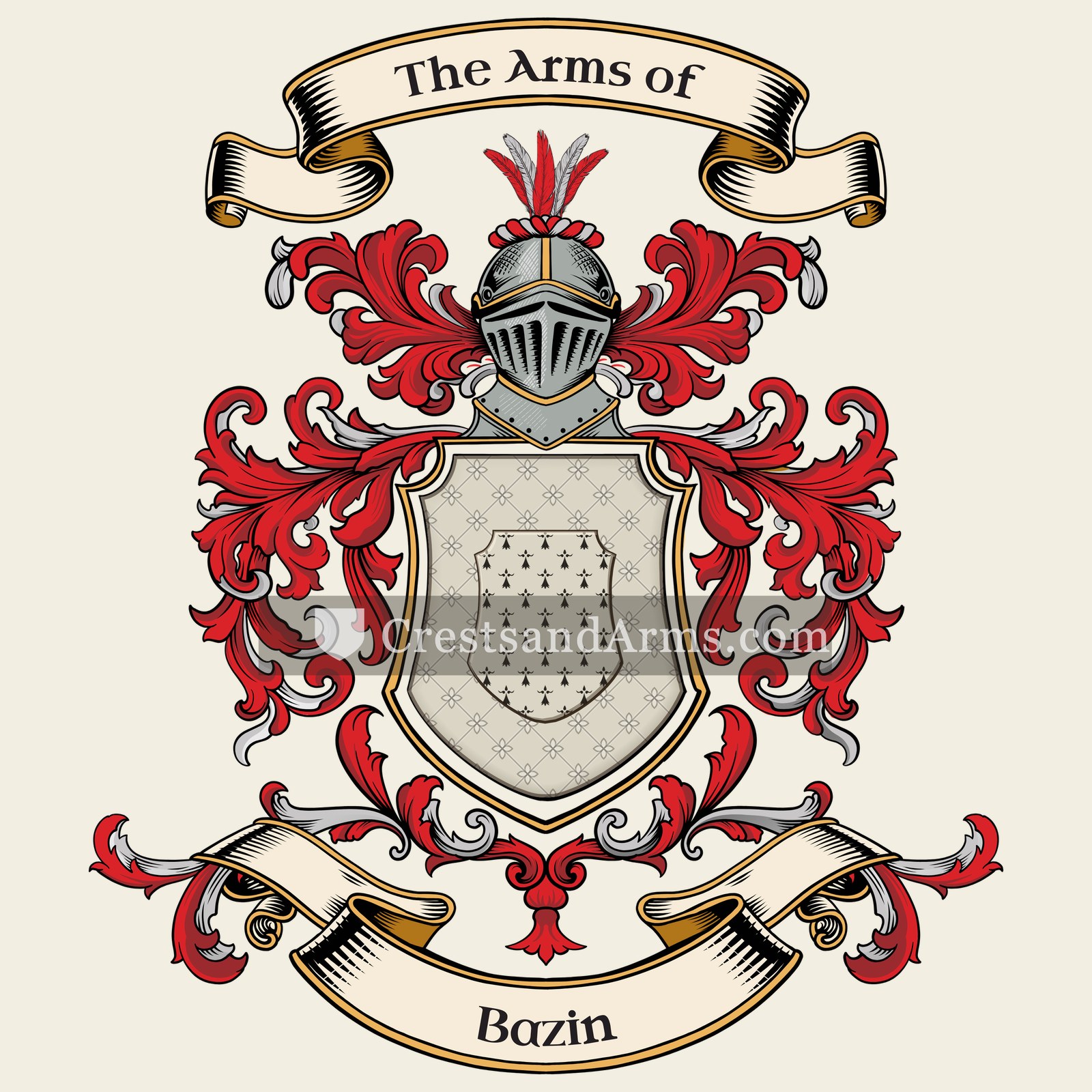
Silver (Argent)Means: Peace and sincerity
ErmineMeans: Dignity
Historical info
Source
Sir Bernard Burke, The General Armory of England, Scotland, Ireland and Wales, London: Harrison & Sons, 1884
Blazon (the actual original written record)
“Ar. an escutcheon erm”
EnglandLondon, c. 1620
Digital archive packCoat of arms PNG, gold border print PDF, vector SVG and the certificate of authenticity. Sent to your email in minutes.
Map of England showing where the Bazin arms are recorded
The Bazin arms were recorded in London, c. 1620.
This is where the arms were entered in the register. Families often moved to other parts of the country, so the same name can turn up in more than one region.
The body that granted and recorded arms in England in this period.
James VI and I
Sovereign of the period
James VI and I
1603–1625
Reigning in France when the Bazin arms are first recorded.
How Arms Worked in England
English heraldry allowed arms to be shared by all legitimate descendants of the original owner. These symbols were treated as personal property that moved through the generations to all children. While the eldest son kept the original design, other family members could use the same shield without needing to change it or register their own unique versions.
Granting authority
The College of Arms in London has regulated the use of coats of arms throughout England and Wales since 1484.
How they got arms
Families typically obtained their coats of arms through a formal grant from the Crown or by proving their ancient right to them.
Where arms were recorded
All official coats of arms are recorded in the registers kept at the College of Arms, which date back to the fifteenth century.
The family's standing
Recorded among the armigerous families of England.
Origin & History of the Bazin Family in England
The Bazin family name has roots that stretch back to medieval France, but its presence in England became firmly established by the early seventeenth century. By 1620, records indicate that members of the Bazin family were living and working in London, likely arriving as part of the waves of Huguenot refugees or merchants seeking new opportunities across the English Channel. These early settlers often integrated into the bustling trade networks of the city, where their name appeared in parish registers and legal documents related to commerce and craftsmanship. As they settled into their new environment, the family contributed to the growing diversity of London’s population during the reign of King James I. Their transition from continental Europe to the English capital reflects a broader pattern of migration that shaped the social and economic landscape of seventeenth-century Britain.
Bazin Meaning & Related Branches
Root word
Basilius
Derived from the Greek word for king or royal.
This name
BazinA patronymic surname originating from the given name Basil, signifying royal or kingly descent.
also spelled
Basin
Bazzin
Bazan
Bazyn
Documented Sources
J. B. Rietstap, Armorial Général, Gouda: G. B. van Goor Zonen, 1884–87
Albert Dauzat, Dictionnaire étymologique des noms et prénoms de France, 1951
Marie-Thérèse Morlet, Dictionnaire étymologique des noms de famille, 1991
Archives Départementales de Meurthe-et-Moselle, Série B: Cours et juridictions
Digital archive packCoat of arms PNG, gold border print PDF, vector SVG and the certificate of authenticity. Sent to your email in minutes.


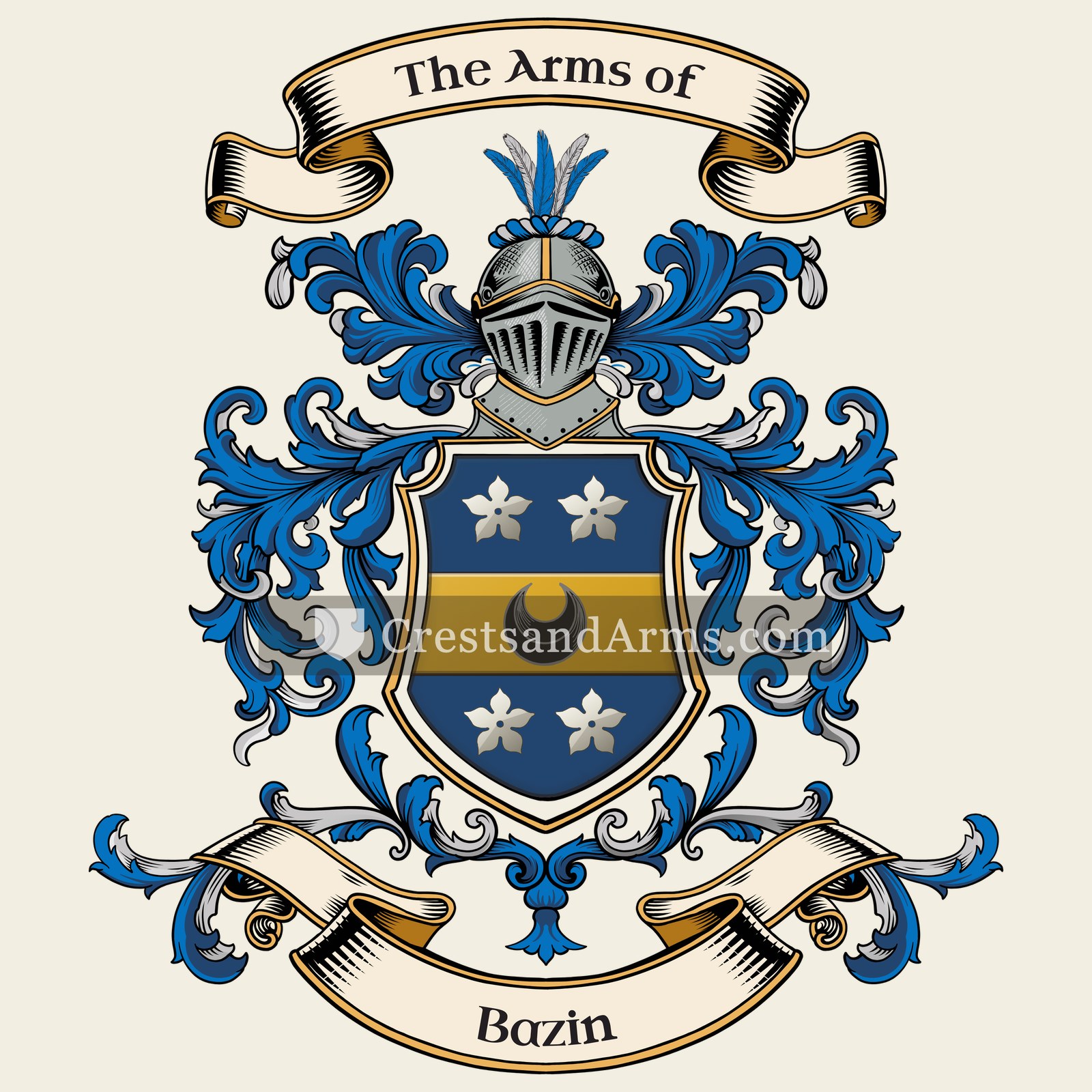
 fessThe military belt, and readiness to serve
 crescentHonour by the sovereign, and the second son
 cinquefoilHope and joy
 fessThe military belt, and readiness to serve
 crescentHonour by the sovereign, and the second son
 cinquefoilHope and joy