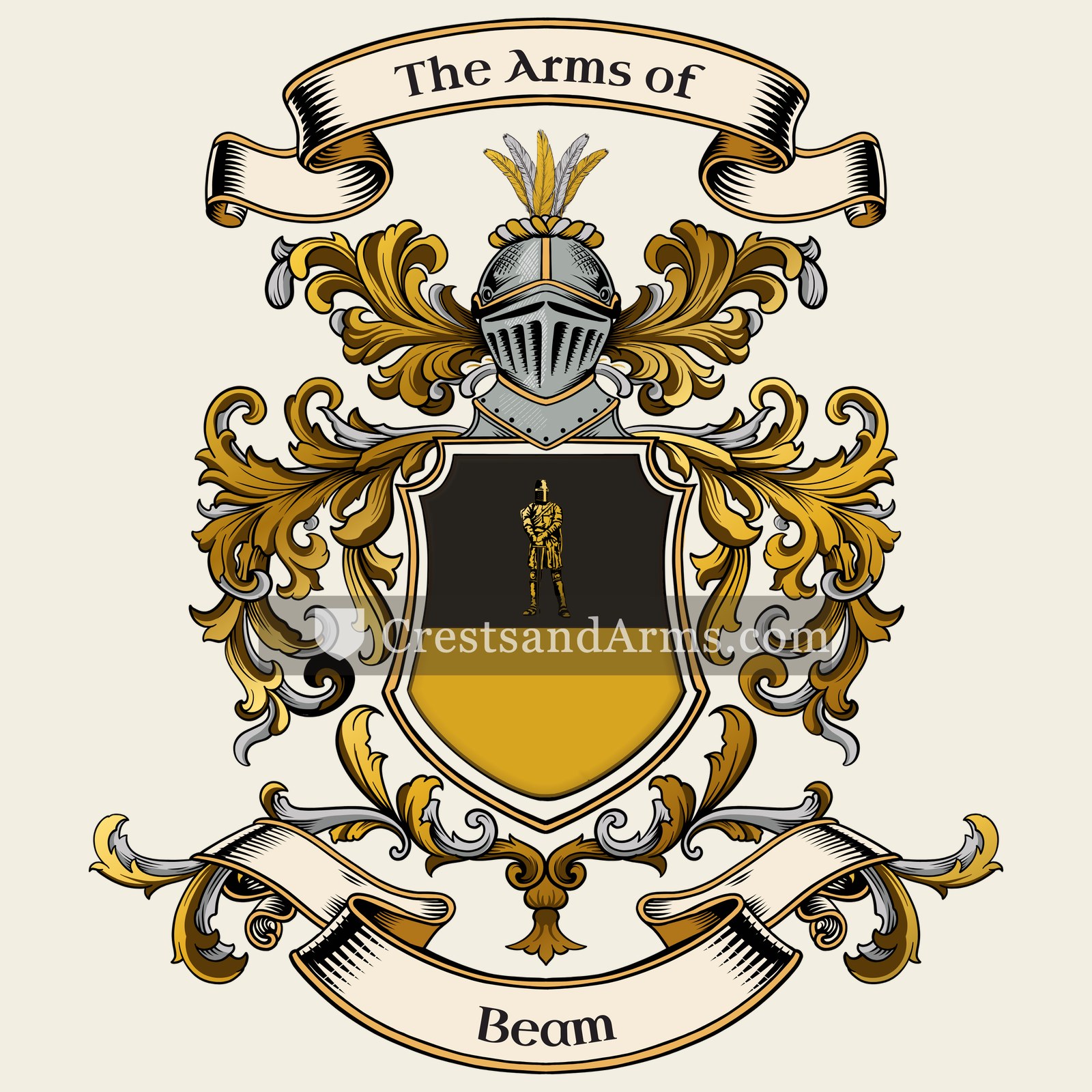
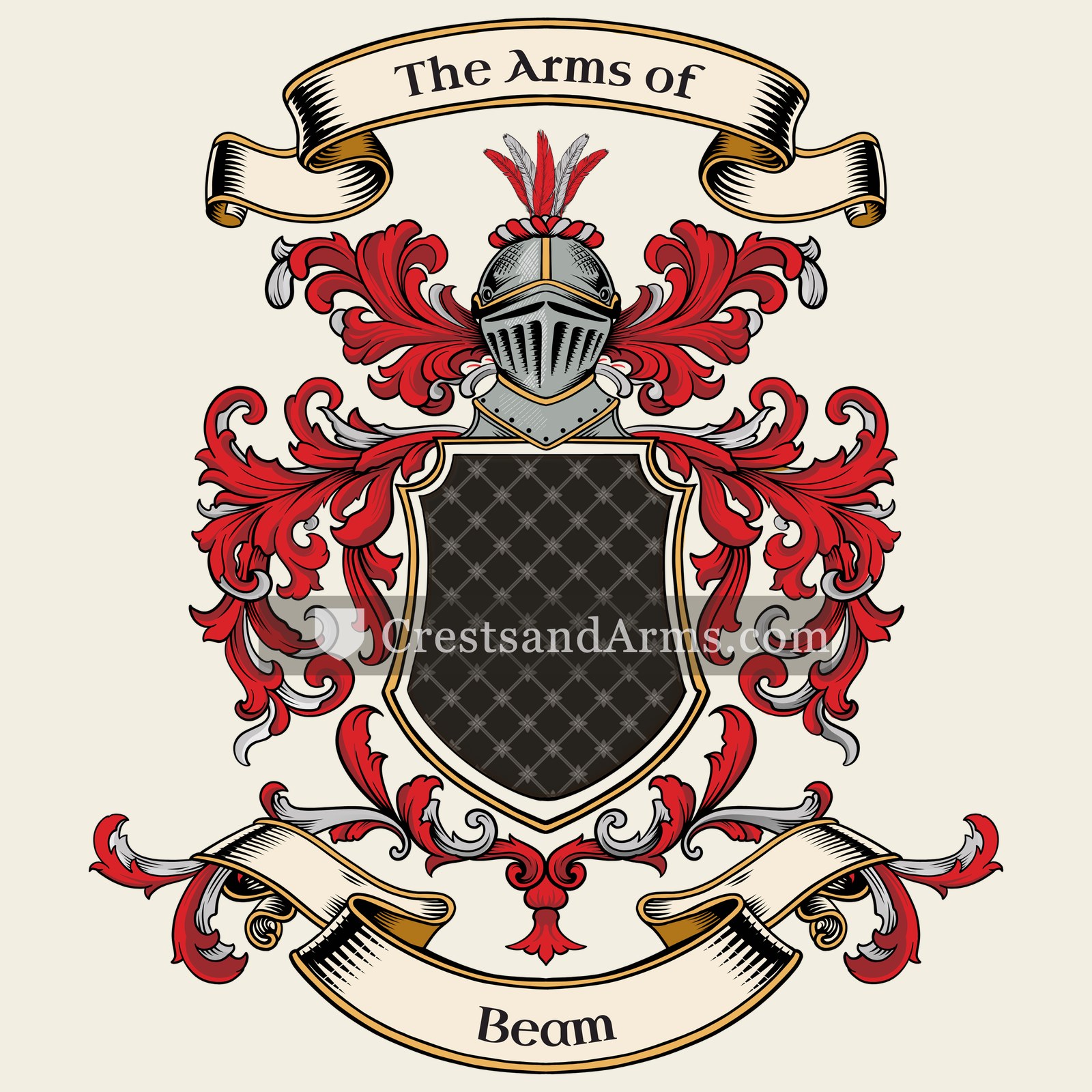
A record of documented arms, meaning and origin, researched for the Beam family lines. Documented in 2 countries.
Reg. 6347 · German, A–C
Coat of Arms & Family Crest Details
Symbols on this shield
knightChivalry and service in arms
Colours
Black (Sable)Means: Constancy
Gold (Or)Means: Generosity
Historical info
Source
J. B. Rietstap, Armorial Général, Gouda: G. B. van Goor Zonen, 1884–87
Blazon (the actual original written record)
“Coupé: au 1 de sa. à un homme iss., hab. d'or, mouv. du coupé, coiffé d'un bourlet de sa. et d'or, tenant de sa main dextre trois trèfles d'or, la sen. appuyée sur sa hanche; au 2 d'or plein. C.: l'homme de l'écu (à la différence qu'il est hab. de sa., avec une chemisette d'or); entre deux prob., coupées alt. d'or et de sa.”
GermanyNuremberg, c. 1765
Digital archive packCoat of arms PNG, gold border print PDF, vector SVG and the certificate of authenticity. Sent to your email in minutes.
Map of Germany showing where the Beam arms are recorded
The Beam arms were recorded in Nuremberg, c. 1765.
This is where the arms were entered in the register. Families often moved to other parts of the country, so the same name can turn up in more than one region.
The body that granted and recorded arms in Germany in this period.
Francis I, Holy Roman Emperor
Sovereign of the period
Francis I, Holy Roman Emperor
1745–1765
Reigning in Germany when the Beam arms are first recorded.
How Arms Worked in Germany
In the Holy Roman Empire, coats of arms were often granted to individuals by the Emperor or his representatives. These arms were then passed down through the generations to all legitimate descendants of the original holder. Younger branches of a family usually kept the same shield design without needing to change it, as the arms belonged to the entire lineage.
Granting authority
The Holy Roman Emperor held the sole power to grant new coats of arms throughout his vast imperial territories.
How they got arms
Families typically obtained their coats of arms through a formal imperial grant or by proving their noble status to the authorities.
Where arms were recorded
These grants were officially recorded in the Imperial Chancery registers, which began keeping formal records of such honors during the Middle Ages.
The family's standing
Recorded among the armigerous families of Germany.
Origin & History of the Beam Family in Germany
The surname Beam is deeply rooted in the German language, where it is derived from the Middle High German word *bēme*, which translates to tree. Historically, this name functioned as a topographic identifier, likely given to families who lived near a prominent tree or within a forested area. By the time the family was recorded in Nuremberg in 1765, the city served as a major hub for trade and craftsmanship in the Holy Roman Empire. Families living in Nuremberg during this era were often part of a structured urban society where surnames became increasingly fixed to help distinguish between different households. As the family established itself in this bustling center of commerce, they likely participated in the local guilds or merchant networks that defined the city’s economic life. This transition from a simple descriptive name to a formal family identity reflects the broader shift toward organized record-keeping in eighteenth-century Germany.
Coat of Arms & Family Crest Details
Colours
Black (Sable)Means: Constancy
Historical info
Source
J. B. Rietstap, Armorial Général, Gouda: G. B. van Goor Zonen, 1884–87
Blazon (the actual original written record)
“De sa. à une sirène à deux queues, qu'elle tient de ses mains, posée de front, les cheveux épars, le tout au nat., cour. d'or. C.: la sirène.”
AustriaVienne, c. 1772
Digital archive packCoat of arms PNG, gold border print PDF, vector SVG and the certificate of authenticity. Sent to your email in minutes.
Map of Austria showing where the Beam arms are recorded
The Beam arms were recorded in Vienne, c. 1772.
This is where the arms were entered in the register. Families often moved to other parts of the country, so the same name can turn up in more than one region.
Region
Vienne
Town
Vienne
First recorded
1772
Granting Authority for the Beam Arms
Imperial and Royal chancery
Sodacan · CC BY-SA 3.0
The body that granted and recorded arms in Austria in this period.
Joseph II, Holy Roman Emperor
Sovereign of the period
Joseph II, Holy Roman Emperor
1765–1790
Reigning in Germany when the Beam arms are first recorded.
How Arms Worked in Austria
Austrian coats of arms were often linked directly to noble titles granted by the Emperor. These symbols belonged to the entire family line rather than just one individual. When a family grew, new branches kept the original design without needing to change it. This system allowed all members of a noble house to share the same identity across many generations.
Granting authority
The Imperial and Royal chancery managed all heraldic matters and controlled the official granting of arms throughout the Austrian lands.
How they got arms
Families typically received their arms through a formal imperial decree that often accompanied the elevation of a person to noble status.
Where arms were recorded
Official records of these grants were kept in the Imperial Register of Nobility which began its formal documentation process in 1453.
The family's standing
Recorded among the armigerous families of Austria.
Origin & History of the Beam Family in Austria
The history of the Beam family in Austria is deeply tied to the vibrant urban life of Vienna during the late eighteenth century. By 1772, records confirm that members of the family were already established residents within the city, a time when Vienna served as the bustling cultural and administrative heart of the Habsburg Empire. The name itself likely originated as a descriptive term, potentially referring to a person who lived near a prominent timber structure or worked as a builder, reflecting the practical trades that helped construct the city’s iconic architecture. As the family navigated the social shifts of the Enlightenment era, they became part of the diverse tapestry of Viennese citizens who contributed to the growth of the capital. Their presence in the city during this period suggests they were integrated into the local economy, living through a transformative age of music, philosophy, and urban expansion that defined the Austrian identity of the time.
Related Branches & Arms
Root word
Baum
A woody perennial plant with a trunk and branches.
This name
BeamAn occupational name for someone who lived near a prominent tree or worked with timber.
Documented Sources
J. B. Rietstap, Armorial Général, Gouda: G. B. van Goor Zonen, 1884–87
Bahlow, Hans, Deutsches Namenlexikon: Familien- und Vornamen nach Ursprung und Sinn erklärt, 1967
Stadtarchiv Nürnberg, Bürgerbücher der Stadt Nürnberg, 1765
Heintze, Albert, Die deutschen Familien-Namen: geschichtlich, geographisch, sprachlich, 1903
Digital archive packCoat of arms PNG, gold border print PDF, vector SVG and the certificate of authenticity. Sent to your email in minutes.


 knightChivalry and service in arms
 knightChivalry and service in arms