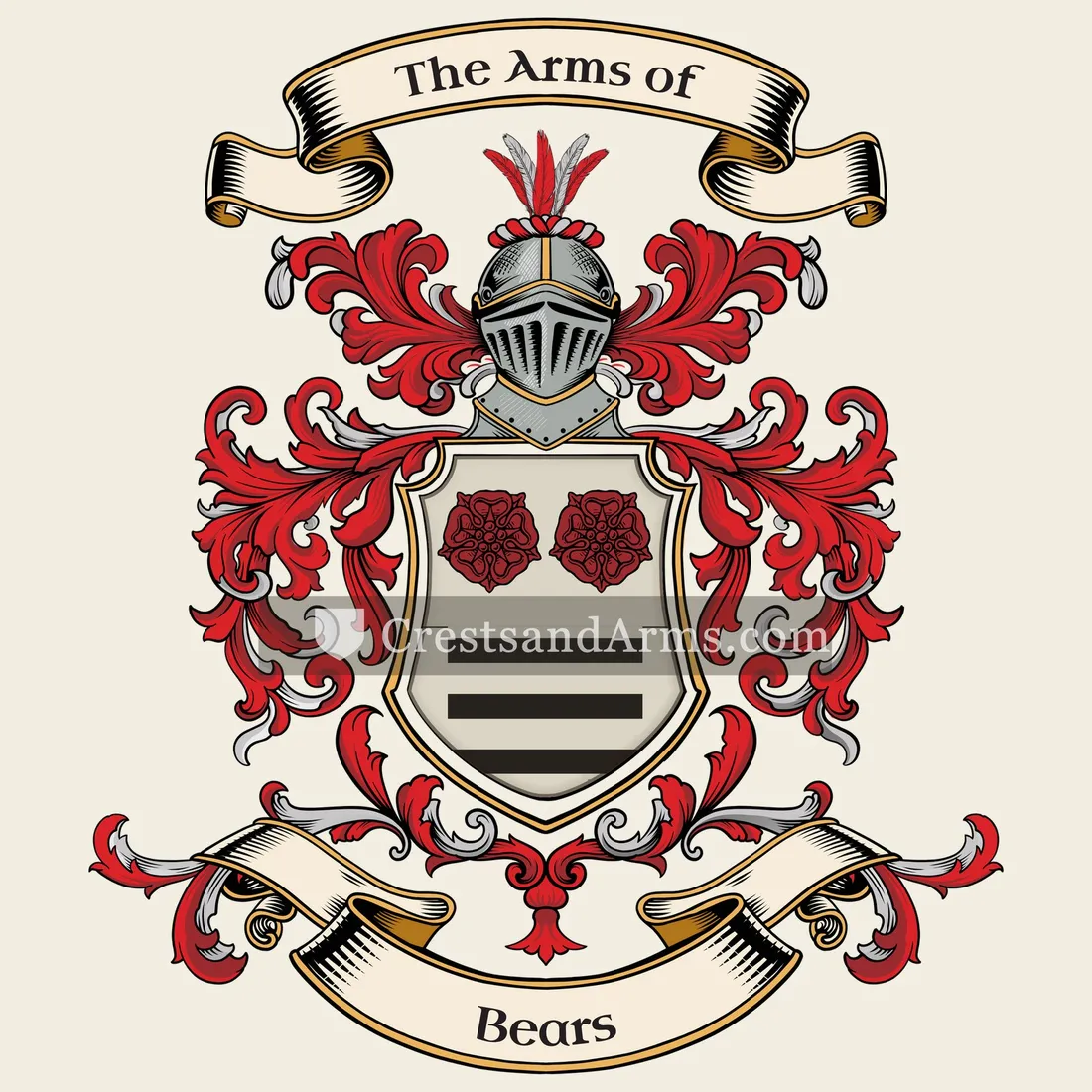
A record of documented arms, meaning and origin, researched for the Bears family lines. Documented in 3 countries.
Reg. 9304 · German, A–C
Meaning of the Bears family crest colors & symbols
Symbols on this shield
roseThe seventh son, and beauty with grace
Colours
Silver (Argent)Means: Peace and sincerity
Red (Gules)Means: Military strength
Historical info
Source
J. B. Rietstap, Armorial Général, Gouda: G. B. van Goor Zonen, 1884–87
Blazon (the actual original written record)
“Coupé: au 1 d'arg. à deux roses accostées de gu.; au 2 d'arg. à trois barres de gu. C.: trois tuyaux d'or soutenus d'une boule du même et sommés chacun de trois plumes de paon au nat.”
MecklenburgMecklenburg, c. 1765
Digital archive packCoat of arms PNG, gold border print PDF, vector SVG and the certificate of authenticity. Sent to your email in minutes.
Map of Germany showing where the Bears arms are recorded
The Bears arms were recorded in Mecklenburg, c. 1765.
Mecklenburg was farming country in the north of Germany, held by a small number of families who kept their estates for generations. Owning land was what entitled a family to arms, so a great many Mecklenburg names ended up in the registers.
This is where the arms were entered in the register. Families often moved to other parts of the country, so the same name can turn up in more than one region.
The body that granted and recorded arms in Germany in this period.
Francis I, Holy Roman Emperor
Sovereign of the period
Francis I, Holy Roman Emperor
1745–1765
Reigning in Germany when the Bears arms are first recorded.
How Arms Worked in Germany
In the Holy Roman Empire, coats of arms were often granted to individuals by the Emperor or his representatives. These arms were then passed down through the generations to all legitimate descendants of the original holder. Younger branches of a family usually kept the same shield design without needing to change it, as the arms belonged to the entire lineage.
Granting authority
The Holy Roman Emperor held the sole power to grant new coats of arms throughout his vast imperial territories.
How they got arms
Families typically obtained their coats of arms through a formal imperial grant or by proving their noble status to the authorities.
Where arms were recorded
These grants were officially recorded in the Imperial Chancery registers, which began keeping formal records of such honors during the Middle Ages.
The family's standing
Recorded among the armigerous families of Mecklenburg.
Origin & History of the Bears Family in Germany
The family name Bears traces its roots back to the northern regions of Germany, specifically within the historic territory of Mecklenburg. By the year 1765, records confirm that members of the family were firmly established in this area, which was characterized by a landscape of vast forests and agricultural plains. In the German language, the name is closely tied to the word for bear, suggesting that early ancestors may have been given this name as a nickname to describe someone with great strength or a courageous personality. During the eighteenth century, families in Mecklenburg were often tied to the land through farming or local trade, and the name likely served as a way to identify individuals within their tight-knit rural communities. As these families lived through the changing political landscape of the region, they maintained their presence in the local parish registers, which helped preserve their identity for future generations.
Meaning of the Bears family crest colors & symbols
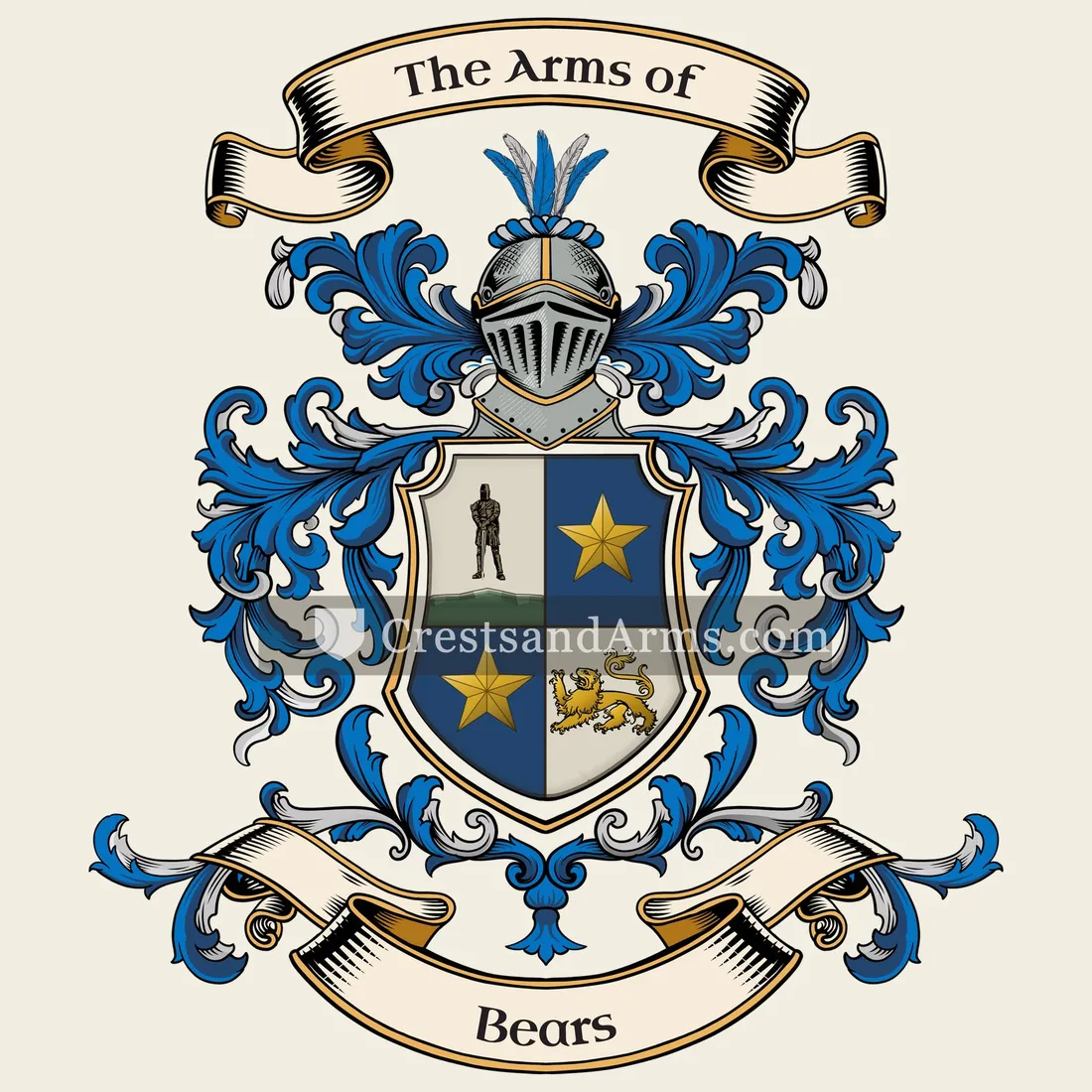
Symbols on this shield
mountThe ground held, and steadfastness upon it
knightChivalry and service in arms
mulletThe third son, and a divine quality from above
lionCourage, strength and royalty
Colours
Silver (Argent)Means: Peace and sincerity
Blue (Azure)Means: Loyalty and truth
Green (Vert)Means: Hope
Gold (Or)Means: Generosity
Historical info
Source
J. B. Rietstap, Armorial Général, Gouda: G. B. van Goor Zonen, 1884–87
Blazon (the actual original written record)
“Ec.: au 1 d'arg. à un sauvage de carn., ceint et cour. de lierre, la main appuyée sur une massue, le tout soutenu d'une terrasse de sin.; aux 2 et 3 d'azur à l'étoile d'or; au 4 de gu. au lion d'or, tenant de sa patte dextre un flambeau allumé du même. Cq. cour. C.: un bras, arm. d'arg., brandissant une épée du même, garnie d'or. L. d'or, d'arg. et d'azur.”
RussiaEsthonie, c. 1784
Digital archive packCoat of arms PNG, gold border print PDF, vector SVG and the certificate of authenticity. Sent to your email in minutes.
Map of Russia showing where the Bears arms are recorded
The Bears arms were recorded in Esthonie, c. 1784.
Arms such as these were typically recorded in Moscow.
Moscow held the Russian court, and rank there came from service rather than land. Families who served the Tsar were entered in the registers of nobility, and that entry is where their arms are recorded.
This is where the arms were entered in the register. Families often moved to other parts of the country, so the same name can turn up in more than one region.
The body that granted and recorded arms in Russia in this period.
Catherine II of Russia
Sovereign of the period
Catherine II of Russia
1762–1796
Reigning in Germany when the Bears arms are first recorded.
How Arms Worked in Russia
Russian heraldry was strictly tied to the nobility and the state service system. Families proved their ancient status or earned new rank to receive an official grant from the Tsar. These symbols were then inherited by all legitimate children of the noble line. If a family lacked proof of their status, they were often excluded from the official records entirely.
Granting authority
The Herald Master's Office acted as the central state body that strictly regulated and verified all noble heraldic symbols.
How they got arms
Families typically received their arms through a formal state grant or by proving their noble status to the government authorities.
Where arms were recorded
All approved coats of arms were officially recorded in the General Armorial of the Noble Families of the Russian Empire starting in 1797.
The family's standing
Recorded among the armigerous families of Russia.
Origin & History of the Bears Family in Russia
The history of the Bears family in Russia begins with established records of their presence in Moscow by 1784. During this period, Moscow served as a vibrant center for trade and social mobility, attracting families who often integrated into the city’s merchant and professional classes. The name likely functioned as a transliterated or adapted surname, reflecting the common practice of families adopting descriptive or symbolic identifiers that could bridge linguistic gaps within the multi-ethnic Russian Empire. As members of the family settled into the urban landscape of the late eighteenth century, they participated in the administrative and economic life of the city, navigating the complex social hierarchies of the era. By rooting themselves in the capital, the early Bears family members became part of the steady growth of Moscow’s middle strata, leaving behind a legacy tied to the development of the city’s civic identity during the reign of Catherine the Great.
Meaning of the Bears family crest colors & symbols
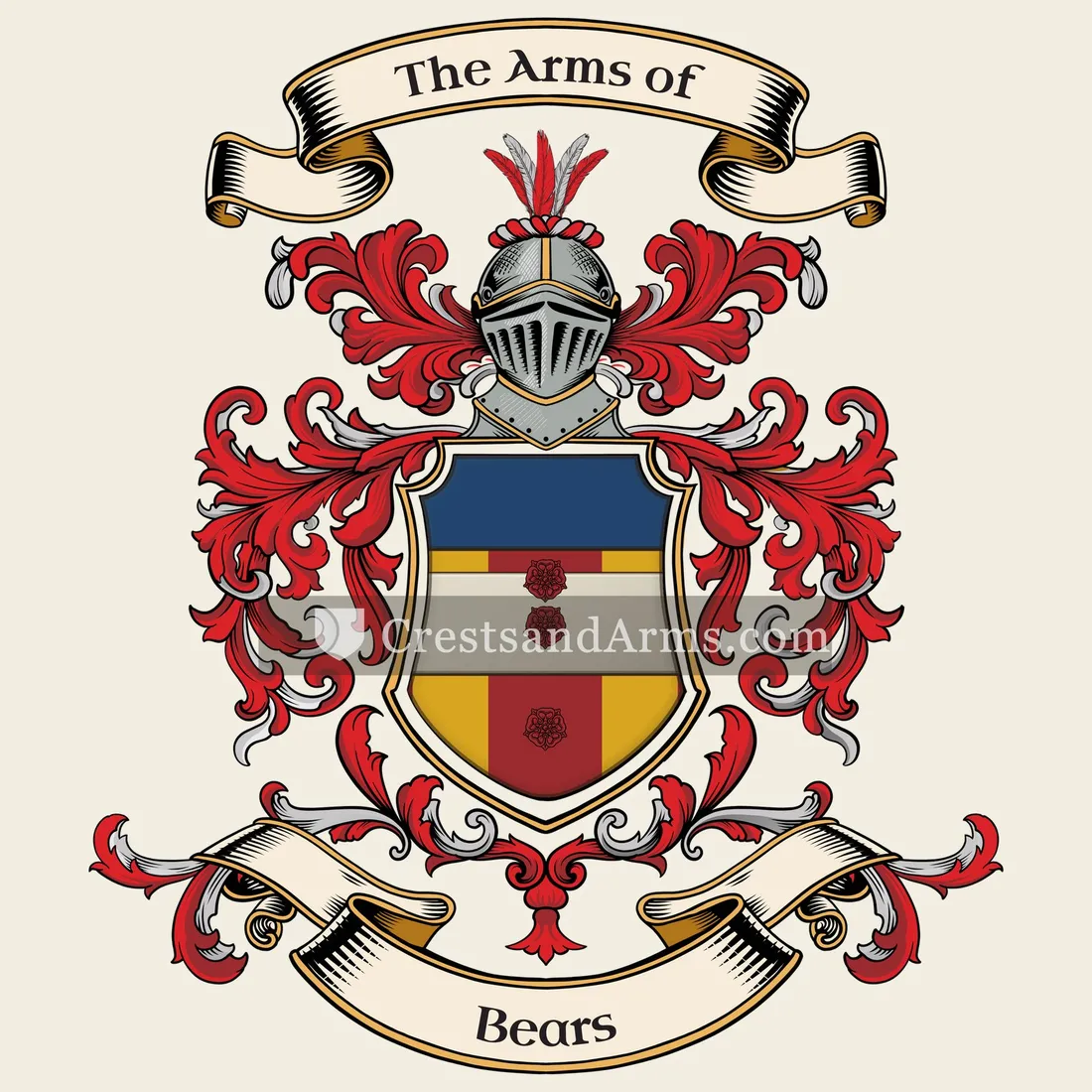
Symbols on this shield
paleMilitary strength, and a fortified defence
chiefAuthority, wisdom and dominion
roseThe seventh son, and beauty with grace
Colours
Red (Gules)Means: Military strength
Gold (Or)Means: Generosity
Blue (Azure)Means: Loyalty and truth
Silver (Argent)Means: Peace and sincerity
Historical info
Source
J. B. Rietstap, Armorial Général, Gouda: G. B. van Goor Zonen, 1884–87
Blazon (the actual original written record)
“De gu. à deux pals d'or, ch. chacun de trois roses du champ; au chef d'azur, ch. de deux bars d'arg. en fasce.”
PerigordPerigord, c. 1663
Digital archive packCoat of arms PNG, gold border print PDF, vector SVG and the certificate of authenticity. Sent to your email in minutes.
Map of France showing where the Bears arms are recorded
The Bears arms were recorded in Perigord, c. 1663.
Perigord was wooded upland country in south-western France, thick with small castles. Its gentry were numerous and mostly poor, and even a modest holding justified a shield of one's own.
This is where the arms were entered in the register. Families often moved to other parts of the country, so the same name can turn up in more than one region.
The body that granted and recorded arms in France in this period.
Louis XIV of France
Sovereign of the period
Louis XIV of France
1643–1715
Reigning in Germany when the Bears arms are first recorded.
How Arms Worked in France
In France, a coat of arms was a mark of honor that passed down through the male line to all legitimate descendants. Families often used the same shield without changes to show their shared heritage. If a branch wanted to stand out, they could add a small mark to their shield to show their specific place in the family tree.
Granting authority
The Juge d'armes de France acted as the official authority that regulated and verified coats of arms across the country.
How they got arms
Families typically inherited their arms from ancestors, though they could also receive them through royal grants or by proving their noble status.
Where arms were recorded
Coats of arms were officially recorded in the Armorial Général de France, which began its main collection in the year 1696.
The family's standing
Recorded among the armigerous families of Perigord.
Origin & History of the Bears Family in France
The history of the Bears family in France is deeply rooted in the rugged landscape of the Périgord region. By the year 1663, records confirm that members of the family were already established residents in this area, which is known for its rolling hills and ancient river valleys. During the seventeenth century, families in this part of France often lived in small, tight-knit rural communities where they worked the land or practiced specialized trades. The name likely evolved from local dialects or descriptive nicknames used to identify individuals within these small villages. As the family grew, they became part of the social fabric of the Périgord, navigating the complex agricultural and economic life of the French countryside during the reign of Louis XIV. Their presence in this specific province suggests a long-standing connection to the traditions and regional identity of southwestern France.
Bears Meaning & Related Branches
Root word
Bero
An ancient Germanic word meaning bear.
This name
BearsA surname derived from a nickname for a person with bear-like characteristics.
also spelled
Bar
Documented Sources
J. B. Rietstap, Armorial Général, Gouda: G. B. van Goor Zonen, 1884–87
Landeshauptarchiv Schwerin, Kirchenbücher der Evangelisch-Lutherischen Landeskirche Mecklenburgs
Digital archive packCoat of arms PNG, gold border print PDF, vector SVG and the certificate of authenticity. Sent to your email in minutes.


 roseThe seventh son, and beauty with grace
 roseThe seventh son, and beauty with grace


 mountThe ground held, and steadfastness upon it
 knightChivalry and service in arms
 mulletThe third son, and a divine quality from above
 lionCourage, strength and royalty


 paleMilitary strength, and a fortified defence
 chiefAuthority, wisdom and dominion