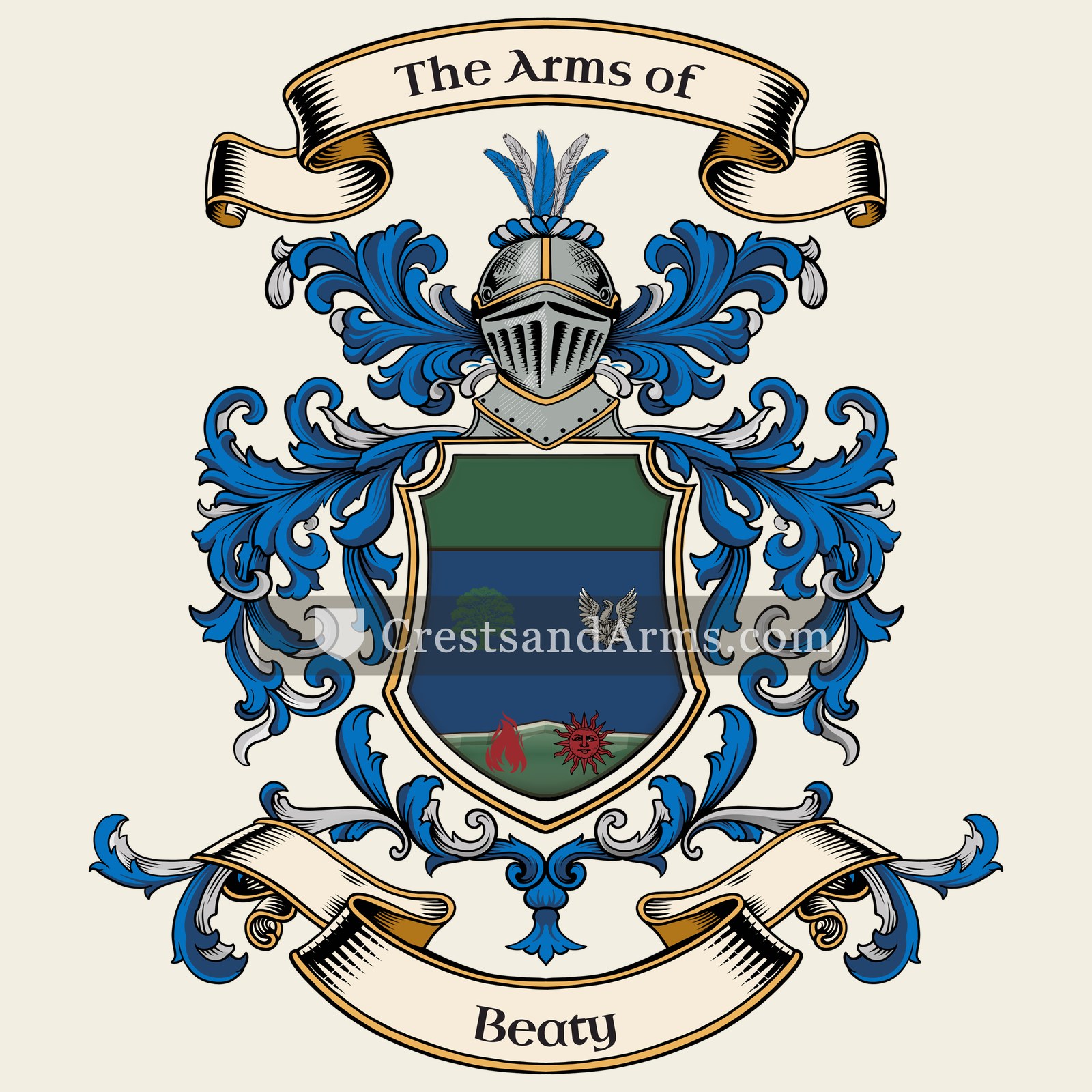
A record of documented arms, meaning and origin, researched for the Beaty family of Italy.
Reg. 6274 · Italian, A–C
Coat of Arms & Family Crest Details
Symbols on this shield
mountThe ground held, and steadfastness upon it
cantonA mark of honour granted by the sovereign
chiefAuthority, wisdom and dominion
labelThe eldest son, during his father's life
treeLife, endurance and deep roots
phoenixRebirth, and survival through fire
fireZeal and purification
sunGlory, splendour and the source of life
Colours
Blue (Azure)Means: Loyalty and truth
Green (Vert)Means: Hope
Silver (Argent)Means: Peace and sincerity
Red (Gules)Means: Military strength
Historical info
Source
J. B. Rietstap, Armorial Général, Gouda: G. B. van Goor Zonen, 1884–87
Blazon (the actual original written record)
“D'azur à un arbre terrassé de sin., supp. de sa cime un phénix d'arg. enveloppé de flammes de gu., fixant un soleil de gu., rayonnant d'or, mouv. du canton dextre du chef. Au chef du premier, ch. de trois fleurs-de-lis d'or, rangées entre les quatre pendants d'un lambel de gu.”
ItalyBologne, c. 1775
Digital archive packCoat of arms PNG, gold border print PDF, vector SVG and the certificate of authenticity. Sent to your email in minutes.
Map of Italy showing where the Beaty arms are recorded
The Beaty arms were recorded in Bologne, c. 1775.
This is where the arms were entered in the register. Families often moved to other parts of the country, so the same name can turn up in more than one region.
The body that granted and recorded arms in Italy in this period.
Alvise Giovanni Mocenigo
Sovereign of the period
Alvise Giovanni Mocenigo
1763–1778
Reigning in Italy when the Beaty arms are first recorded.
How Arms Worked in Italy
In the Italian states, coats of arms were often used by noble families to show their status and history. These symbols were passed down through the generations to all legitimate male descendants. Younger branches of a family usually kept the original design but sometimes added small changes to distinguish their specific line from the main branch.
Granting authority
Various local rulers and city governments controlled the use of coats of arms across the different Italian states.
How they got arms
Families often assumed their own arms or received them as official grants from local lords, popes, or city councils.
Where arms were recorded
Arms were recorded in local city archives or private family books rather than in one single national register.
The family's standing
Recorded among the armigerous families of Italy.
Origin & History of the Beaty Family in Italy
The surname Beaty is a variation of the name Beatty, which has deep roots in the border regions between Scotland and England. Historically, the name is linked to the Gaelic word "biadhtach," which referred to a person responsible for providing food and hospitality to travelers. By the late 18th century, members of the family had established a presence in the French port city of Boulogne-sur-Mer. This location served as a vital hub for trade and travel between the British Isles and mainland Europe. During the year 1775, families with this name were documented living in this coastal area, likely as part of the merchant class or expatriate communities that thrived in the region. These early ancestors were part of a mobile population that helped connect different cultures through commerce and shared traditions.
Related Branches & Arms
Root word
Beatus
Latin term meaning blessed, happy, or fortunate.
This name
BeatyDerived from a nickname for a person who was considered blessed or fortunate.
also spelled
Beaty
Beatti
Beattie
Documented Sources
J. B. Rietstap, Armorial Général, Gouda: G. B. van Goor Zonen, 1884–87
Black, George F., The Surnames of Scotland: Their Origin, Meaning, and History, 1946
Reaney, P.H., A Dictionary of British Surnames, 1958
Archives départementales du Pas-de-Calais, Registres paroissiaux et d'état civil de Boulogne-sur-Mer, 1775
Digital archive packCoat of arms PNG, gold border print PDF, vector SVG and the certificate of authenticity. Sent to your email in minutes.


 mountThe ground held, and steadfastness upon it
 cantonA mark of honour granted by the sovereign
 chiefAuthority, wisdom and dominion
 labelThe eldest son, during his father's life
 treeLife, endurance and deep roots
 phoenixRebirth, and survival through fire
 fireZeal and purification
 sunGlory, splendour and the source of life
 mountThe ground held, and steadfastness upon it
 cantonA mark of honour granted by the sovereign
 chiefAuthority, wisdom and dominion
 labelThe eldest son, during his father's life
 treeLife, endurance and deep roots
 phoenixRebirth, and survival through fire
 fireZeal and purification
 sunGlory, splendour and the source of life