Map of France showing where the Beauchamps arms are recorded
The Beauchamps arms were recorded in Bretagne, c. 1663.
More families held coats of arms in Bretagne than anywhere else in France. The land was divided into many small estates rather than a few large ones, so far more households counted as gentry, and each needed a shield of its own to be told apart.
This is where the arms were entered in the register. Families often moved to other parts of the country, so the same name can turn up in more than one region.
The body that granted and recorded arms in France in this period.
Louis XIV of France
Sovereign of the period
Louis XIV of France
1643–1715
Reigning in France when the Beauchamps arms are first recorded.
How Arms Worked in France
In France, a coat of arms was a mark of honor that passed down through the male line to all legitimate descendants. Families often used the same shield without changes to show their shared heritage. If a branch wanted to stand out, they could add a small mark to their shield to show their specific place in the family tree.
Granting authority
The Juge d'armes de France acted as the official authority that regulated and verified coats of arms across the country.
How they got arms
Families typically inherited their arms from ancestors, though they could also receive them through royal grants or by proving their noble status.
Where arms were recorded
Coats of arms were officially recorded in the Armorial Général de France, which began its main collection in the year 1696.
The family's standing
Recorded among the armigerous families of Bretagne.
Origin & History of the Beauchamps Family in France
The surname Beauchamps originates from the French language and translates literally to beautiful fields. Historically, this name was often given to families who lived near or cultivated land that was considered particularly scenic or fertile. By the year 1663, records confirm that members of the Beauchamps family were well-established in the region of Bretagne. During this period, families in this area were deeply connected to the local landscape and the agricultural traditions of the French countryside. As the name spread throughout the province, it became a marker of those who held a long-standing relationship with the rural terrain of western France. This connection to the land helped define the family identity as they navigated the social and economic changes of the seventeenth century.
Beauchamps Meaning & Related Branches
Root word
Bellus Campus
Latin for beautiful field or fair plain.
This name
BeauchampsA topographic name for someone who lived near a beautiful or productive field.
also spelled
Beauchampz
Boshon
Documented Sources
J. B. Rietstap, Armorial Général, Gouda: G. B. van Goor Zonen, 1884–87
Dauzat, Albert, Dictionnaire étymologique des noms de famille et prénoms de France, 1951
Morlet, Marie-Thérèse, Dictionnaire étymologique des noms de famille, 1991
Archives départementales d'Ille-et-Vilaine, Registres paroissiaux et d'état civil, 1663
Digital archive packCoat of arms PNG, gold border print PDF, vector SVG and the certificate of authenticity. Sent to your email in minutes.


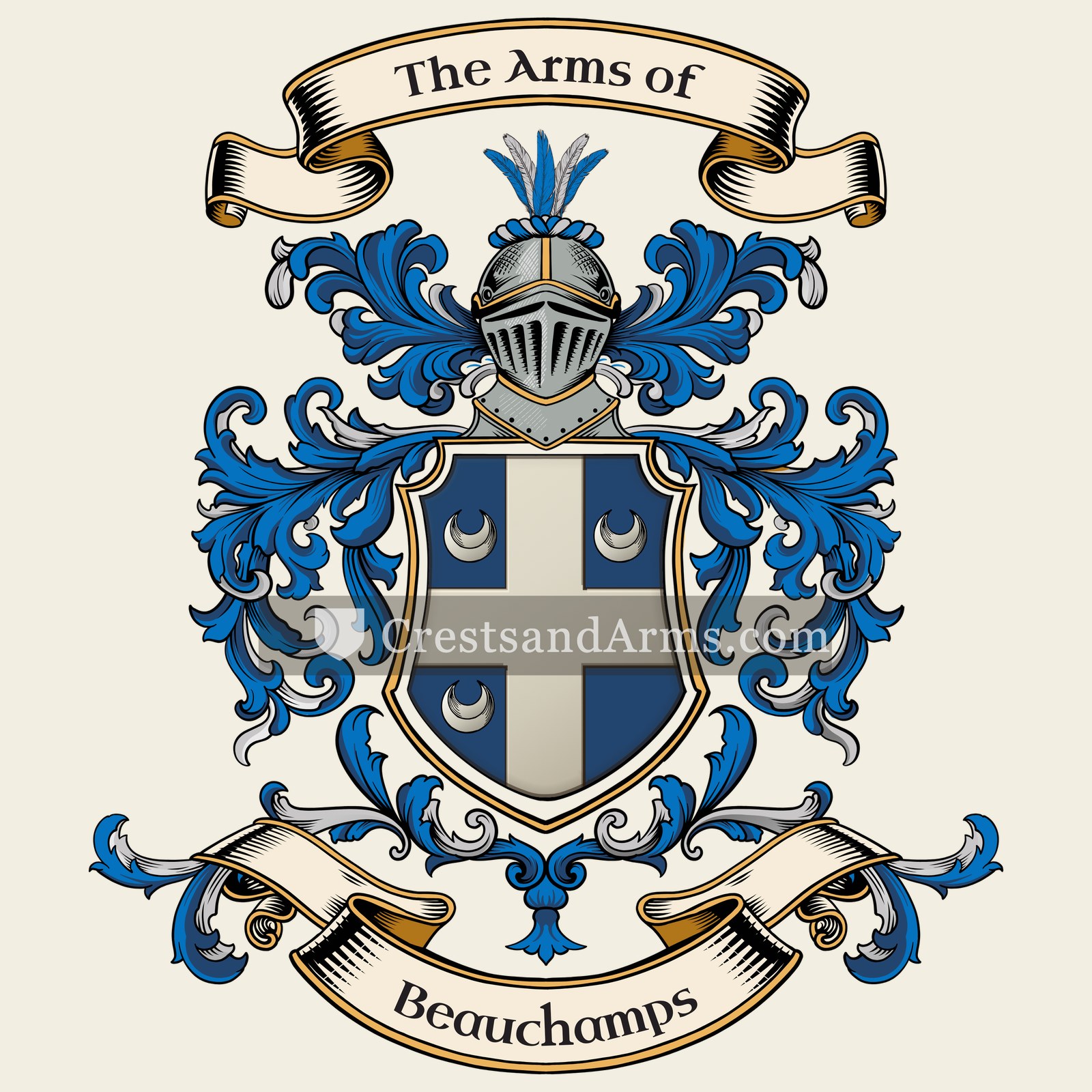
 cross symbolChristian faith and service
 crescentHonour by the sovereign, and the second son
 cross symbolChristian faith and service
 crescentHonour by the sovereign, and the second son