Map of France showing where the Beaudoin arms are recorded
The Beaudoin arms were recorded in Maine, c. 1663.
Maine was quiet farming country in western France, held in small manors by families who stayed for generations. Nothing about it was grand, but steady landholding is exactly what puts a name in the registers.
This is where the arms were entered in the register. Families often moved to other parts of the country, so the same name can turn up in more than one region.
The body that granted and recorded arms in France in this period.
Louis XIV of France
Sovereign of the period
Louis XIV of France
1643–1715
Reigning in France when the Beaudoin arms are first recorded.
How Arms Worked in France
In France, a coat of arms was a mark of honor that passed down through the male line to all legitimate descendants. Families often used the same shield without changes to show their shared heritage. If a branch wanted to stand out, they could add a small mark to their shield to show their specific place in the family tree.
Granting authority
The Juge d'armes de France acted as the official authority that regulated and verified coats of arms across the country.
How they got arms
Families typically inherited their arms from ancestors, though they could also receive them through royal grants or by proving their noble status.
Where arms were recorded
Coats of arms were officially recorded in the Armorial Général de France, which began its main collection in the year 1696.
The family's standing
Recorded among the armigerous families of Maine.
Origin & History of the Beaudoin Family in France
The surname Beaudoin is of ancient French origin, derived from the Germanic name Baldwin, which combines the elements for "bold" and "friend." Families bearing this name were well-established in the regions of Normandy and Poitou long before they crossed the Atlantic. By the mid-seventeenth century, members of the Beaudoin family were among the early European pioneers in North America. Historical records confirm their presence in the Maine region as early as 1663, where they participated in the challenging life of the frontier. These early settlers were often involved in the fur trade and the development of colonial outposts, navigating the complex relationships between French, English, and Indigenous populations. Their migration represents a broader movement of families seeking new opportunities in the wilderness, and their descendants eventually spread across both Canada and the United States.
Beaudoin Meaning & Related Branches
Root word
Baldwin
Derived from Germanic elements meaning bold or brave friend.
This name
BeaudoinA French patronymic surname originating from the Germanic given name meaning brave friend.
also spelled
Beaudoin
Baudouin
Bodwan
Baldwin
Documented Sources
J. B. Rietstap, Armorial Général, Gouda: G. B. van Goor Zonen, 1884–87
Jetté, René. Dictionnaire généalogique des familles du Québec. 1983
Tanguay, Cyprien. Dictionnaire généalogique des familles canadiennes depuis la fondation de la colonie jusqu'à nos jours. 1871
Digital archive packCoat of arms PNG, gold border print PDF, vector SVG and the certificate of authenticity. Sent to your email in minutes.


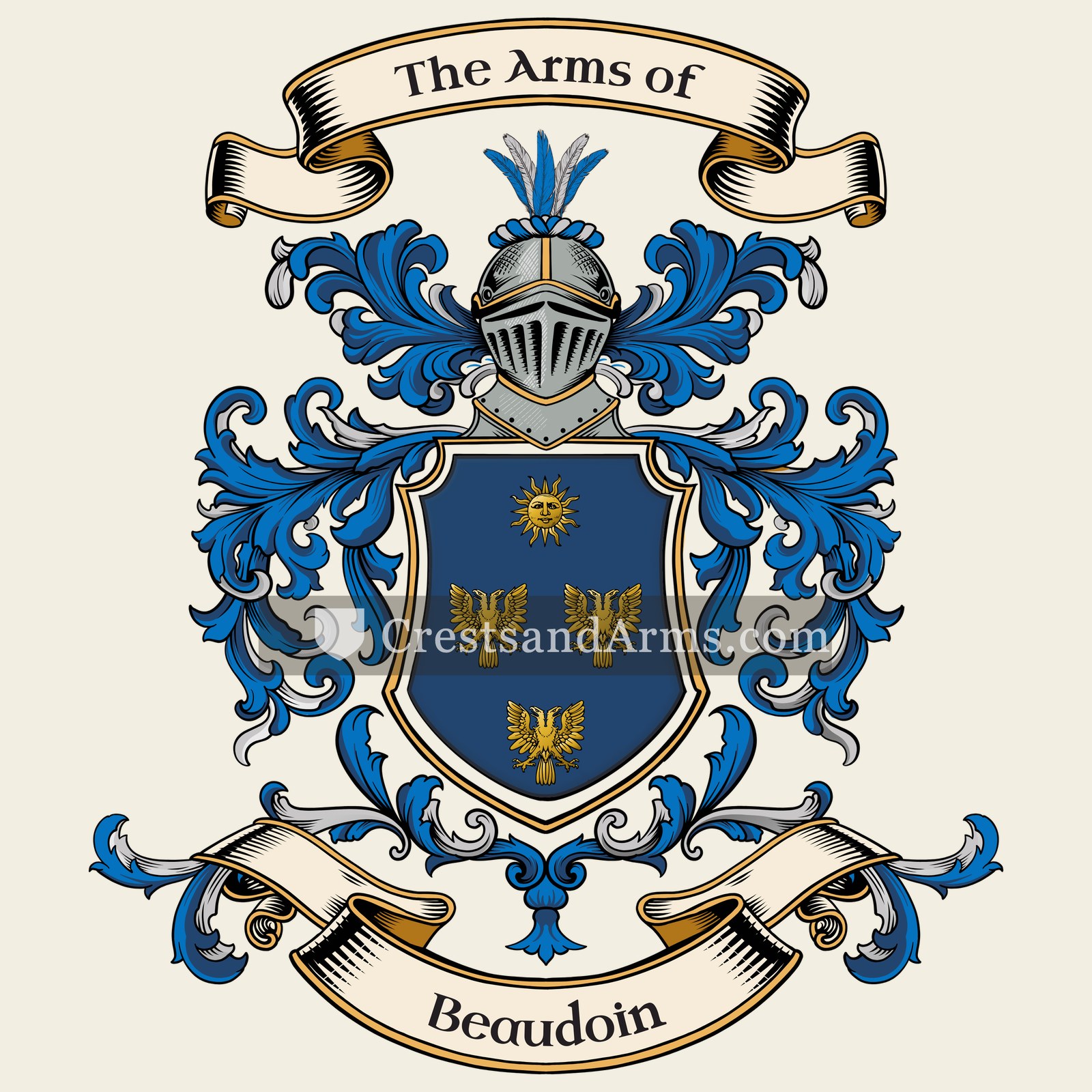
 eagleNobility, strength and a keen mind
 sunGlory, splendour and the source of life
 eagleNobility, strength and a keen mind
 sunGlory, splendour and the source of life