Map of France showing where the Beaulieu arms are recorded
The Beaulieu arms were recorded in Flandre, c. 1663.
Flandre grew rich on cloth, and its towns were among the busiest in Europe. Merchant families bought land with their profits and took arms to go with it, so trade put as many names in the registers here as land did.
This is where the arms were entered in the register. Families often moved to other parts of the country, so the same name can turn up in more than one region.
The body that granted and recorded arms in France in this period.
Louis XIV of France
Sovereign of the period
Louis XIV of France
1643–1715
Reigning in France when the Beaulieu arms are first recorded.
How Arms Worked in France
In France, a coat of arms was a mark of honor that passed down through the male line to all legitimate descendants. Families often used the same shield without changes to show their shared heritage. If a branch wanted to stand out, they could add a small mark to their shield to show their specific place in the family tree.
Granting authority
The Juge d'armes de France acted as the official authority that regulated and verified coats of arms across the country.
How they got arms
Families typically inherited their arms from ancestors, though they could also receive them through royal grants or by proving their noble status.
Where arms were recorded
Coats of arms were officially recorded in the Armorial Général de France, which began its main collection in the year 1696.
The family's standing
Recorded among the armigerous families of Flandre.
Origin & History of the Beaulieu Family in France
The surname Beaulieu is a classic example of a locative name, which means it was originally chosen to describe a specific place where a family lived. In French, the name translates literally to beautiful place. During the Middle Ages, many families adopted this name because they resided near a scenic estate, a monastery, or a village known for its natural charm. By the time members of the family were documented in the region of Flandre in 1663, the name had already spread across various provinces of France. Families with this name were often associated with the land and local administration, moving between rural estates and growing urban centers as the French kingdom expanded its reach. Because the name was tied to the landscape rather than a single bloodline, it emerged independently in several different regions, reflecting the diverse geography of the French countryside.
Coat of Arms & Family Crest Details
Symbols on this shield
fleur de lisPurity, light, and the sixth son
Colours
Blue (Azure)Means: Loyalty and truth
Silver (Argent)Means: Peace and sincerity
Historical info
Source
J. B. Rietstap, Armorial Général, Gouda: G. B. van Goor Zonen, 1884–87
Blazon (the actual original written record)
“D'azur à une fleur-de-lis d'arg. Cq. cour. C.: la fleur-de-lis. D.: FULTUM VIRTUTE [Les barons du nom ont pour S.: deux léopards lionnés, au nat. — Le général autrichien, J. P. Beaulieu, avait été créé baron, le 14 mars 1763, au port des mêmes armes.]”
BelgiumBruxelles, c. 1851
Digital archive packCoat of arms PNG, gold border print PDF, vector SVG and the certificate of authenticity. Sent to your email in minutes.
Map of Belgium showing where the Beaulieu arms are recorded
The Beaulieu arms were recorded in Bruxelles, c. 1851.
This is where the arms were entered in the register. Families often moved to other parts of the country, so the same name can turn up in more than one region.
The body that granted and recorded arms in Belgium in this period.
Leopold I of Belgium
Sovereign of the period
Leopold I of Belgium
1831–1865
Reigning in France when the Beaulieu arms are first recorded.
How Arms Worked in Belgium
In Belgium, a coat of arms is considered personal property that is passed down through the male line to legitimate descendants. Families often use the same shield design across generations to show their shared heritage. If a branch of the family wants to change the design, they must apply for an official update to their specific version of the arms.
Granting authority
The Conseil héraldique is the official body that regulates and approves all coats of arms in Belgium.
How they got arms
Families obtain their coats of arms through formal royal grants or by confirming their historical right to use existing designs.
Where arms were recorded
All approved coats of arms are officially recorded in the public registers of the Conseil héraldique since 1844.
The family's standing
Recorded among the armigerous families of Belgium.
Origin & History of the Beaulieu Family in Belgium
The surname Beaulieu is a topographical name of French origin that translates literally to beautiful place. While the name is often associated with various regions in France, its presence in Belgium is deeply rooted in the urban development of the nineteenth century. By 1851, records confirm that members of the Beaulieu family were established in Brussels, a city that was rapidly transforming into a major European capital during the Industrial Revolution. During this period, families bearing this name were often integrated into the growing professional and administrative classes of the city. As Brussels expanded, these individuals contributed to the social and economic fabric of the capital, moving away from rural origins to participate in the modernization of Belgian society. Their transition into the city environment reflects the broader migration patterns of the time, as families sought new opportunities in the heart of the newly independent Belgian state.
Coat of Arms & Family Crest Details
Symbols on this shield
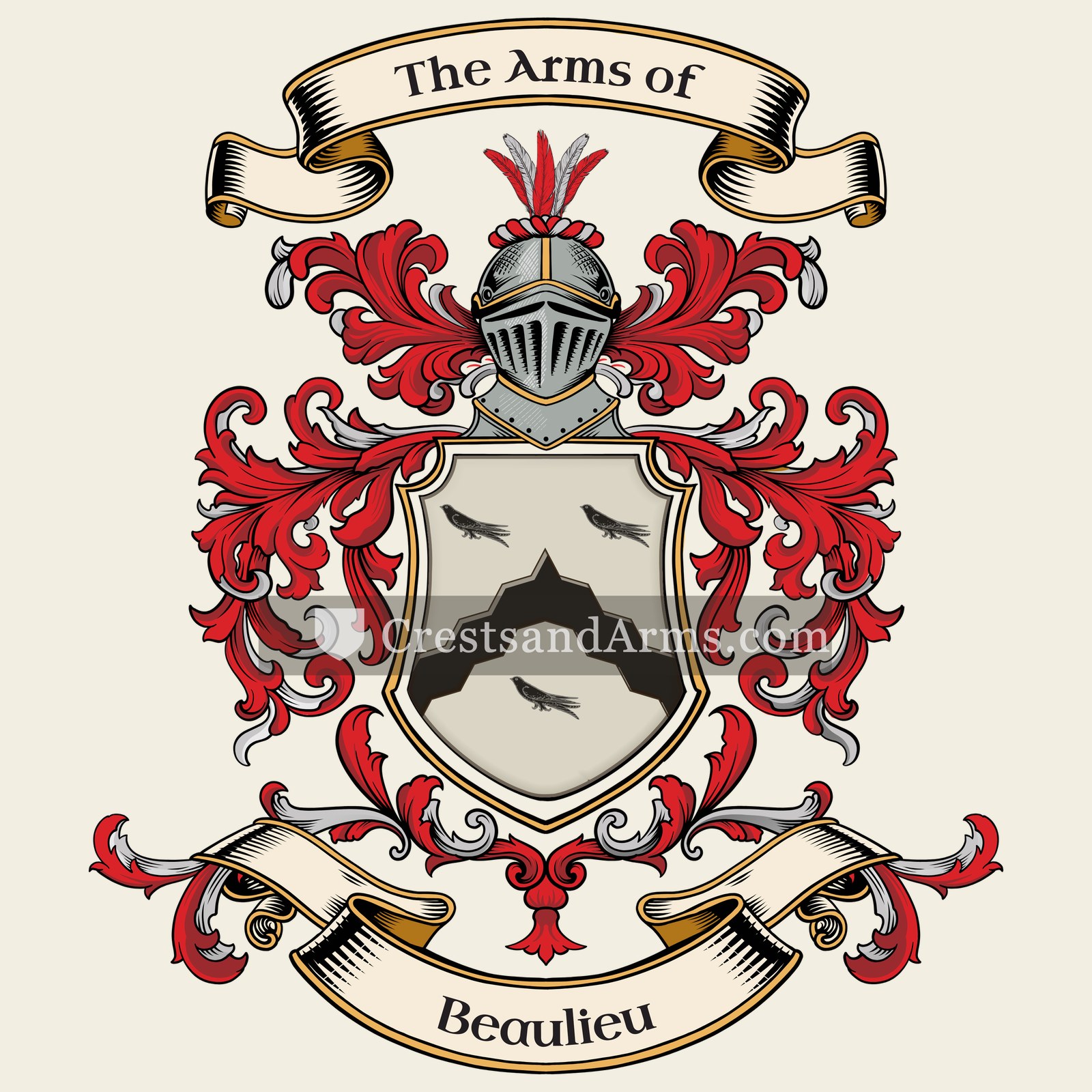
chevronProtection, and faithful service completed
martletA younger son, who must win his own land
Colours
Silver (Argent)Means: Peace and sincerity
Black (Sable)Means: Constancy
Historical info
Source
Sir Bernard Burke, The General Armory of England, Scotland, Ireland and Wales, London: Harrison & Sons, 1884
Blazon (the actual original written record)
“Ar. a chev. indented betw. three birds' heads couped sa”
Englandc. 1620
Digital archive packCoat of arms PNG, gold border print PDF, vector SVG and the certificate of authenticity. Sent to your email in minutes.
Map of England showing where the Beaulieu arms are recorded
The Beaulieu arms were recorded in England, c. 1620.
Arms such as these were typically recorded in York.
Yorkshire is the largest of the English counties, and it held more gentry families than any other. Land there was split among a great many households rather than a few, so a great many of them carried arms.
This is where the arms were entered in the register. Families often moved to other parts of the country, so the same name can turn up in more than one region.
The body that granted and recorded arms in England in this period.
James VI and I
Sovereign of the period
James VI and I
1603–1625
Reigning in France when the Beaulieu arms are first recorded.
How Arms Worked in England
English heraldry allowed arms to be shared by all legitimate descendants of the original owner. These symbols were treated as personal property that moved through the generations to all children. While the eldest son kept the original design, other family members could use the same shield without needing to change it or register their own unique versions.
Granting authority
The College of Arms in London has regulated the use of coats of arms throughout England and Wales since 1484.
How they got arms
Families typically obtained their coats of arms through a formal grant from the Crown or by proving their ancient right to them.
Where arms were recorded
All official coats of arms are recorded in the registers kept at the College of Arms, which date back to the fifteenth century.
The family's standing
Recorded among the armigerous families of England.
Origin & History of the Beaulieu Family in England
The surname Beaulieu originated in France as a topographic name, meaning beautiful place, and it was brought to England following the Norman Conquest. While many families with this name remained on the continent, those who settled in England often integrated into local communities as merchants or landowners. By 1620, records confirm that members of the Beaulieu family were established in the city of York. During this period, York was a significant northern hub for trade and administration, suggesting that these early settlers were likely involved in the bustling commercial life of the city. These families lived through a time of great religious and political change in England, which often influenced how they recorded their names and expanded their family lines across the northern counties. Their presence in York highlights how families of French origin became part of the social fabric of English cities during the seventeenth century.
Beaulieu Meaning & Related Branches
Root word
Bellus Locus
Latin for beautiful place or lovely site.
This name
BeaulieuA locative surname denoting someone who lived at a beautiful location.
also spelled
Beaulie
Bolyu
Boly
Beauliew
Beaulue
Related arms
Bereursimilar arms
Brunot de Resteausimilar arms
Cramersimilar arms
Bealieuvariant spelling
Documented Sources
J. B. Rietstap, Armorial Général, Gouda: G. B. van Goor Zonen, 1884–87
Dauzat, Albert. Dictionnaire étymologique des noms et prénoms de France. 1951
Morlet, Marie-Thérèse. Dictionnaire étymologique des noms de famille. 1991
Digital archive packCoat of arms PNG, gold border print PDF, vector SVG and the certificate of authenticity. Sent to your email in minutes.


 bendDefence, and the scarf of a commander
 bendDefence, and the scarf of a commander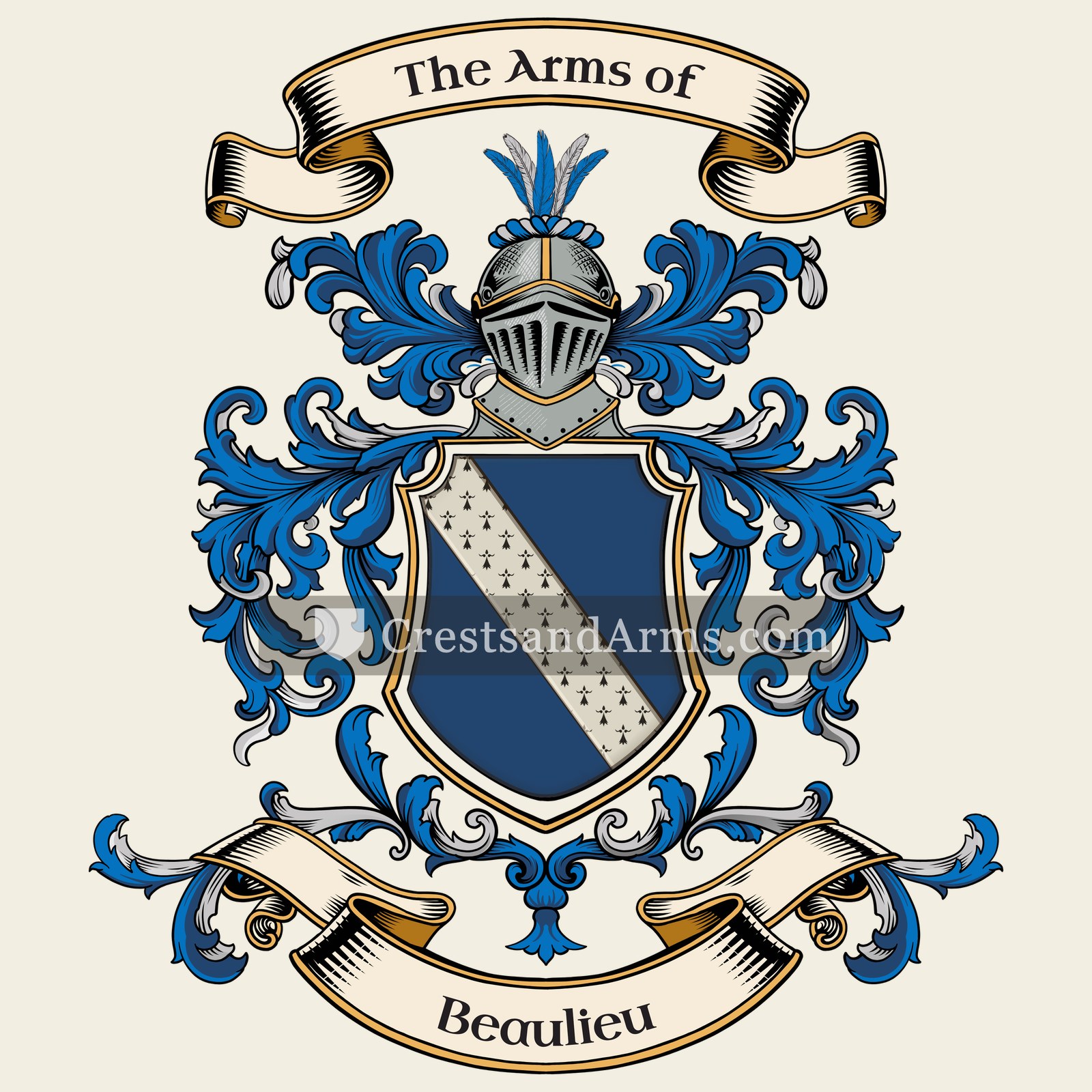


 fleur de lisPurity, light, and the sixth son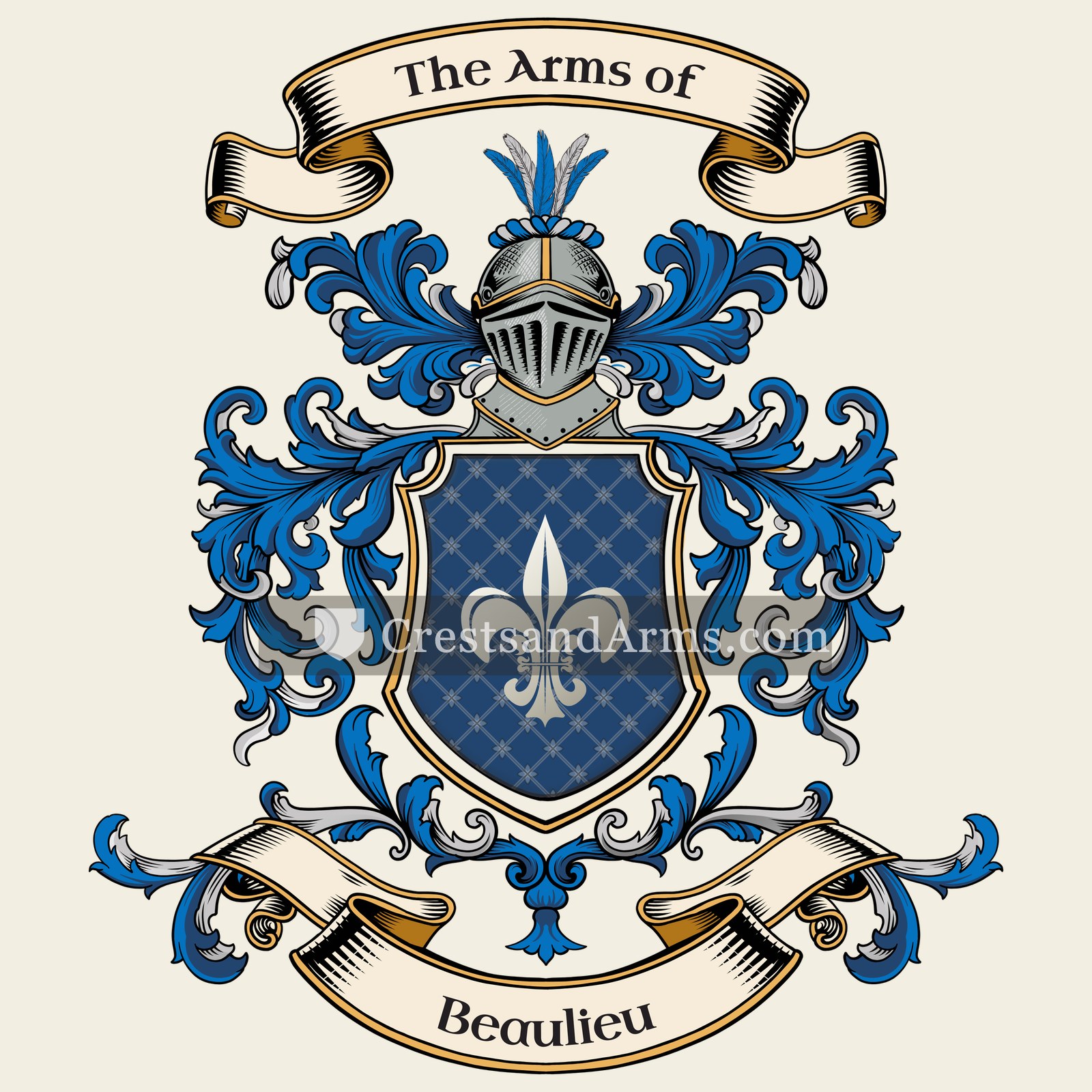


 chevronProtection, and faithful service completed
 martletA younger son, who must win his own land