A record of documented arms, meaning and origin, researched for the Beaumont family lines. Documented in 3 countries.
Reg. 5780 · Britain, A–C
Coat of Arms & Family Crest Details
Symbols on this shield
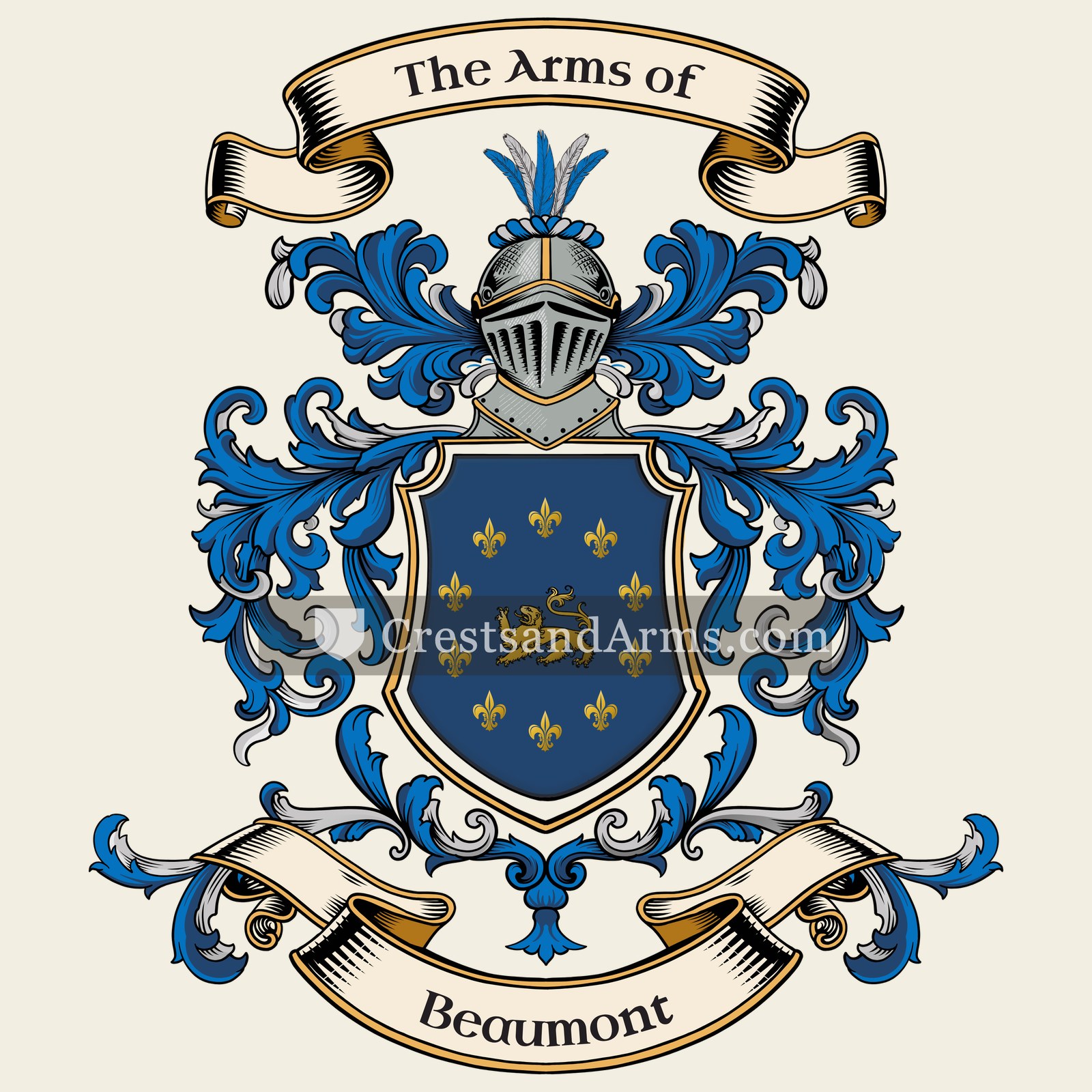
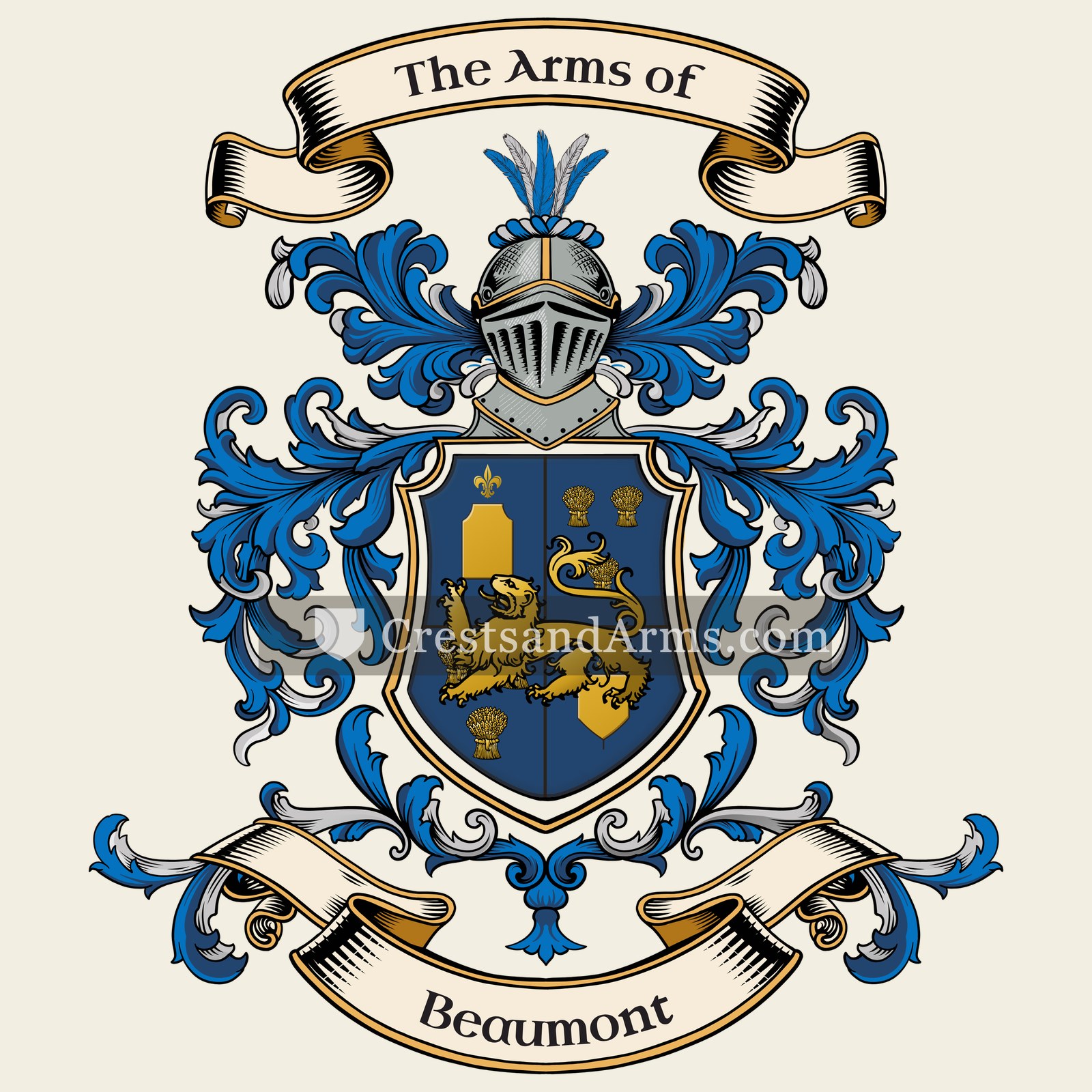
lionCourage, strength and royalty
fleur de lisPurity, light, and the sixth son
wheatsheafPlenty, and the harvest of one's own labour
Colours
Blue (Azure)Means: Loyalty and truth
Gold (Or)Means: Generosity
Historical info
Source
J. B. Rietstap, Armorial Général, Gouda: G. B. van Goor Zonen, 1884–87
Blazon (the actual original written record)
“Ec.: aux 1 et 4 d'azur semé de fleurs-de-lis d'or; au lion du même, br. sur le tout; aux 2 et 3 d'azur à trois gerbes d'or. C.: un chapeau de tournoi d'azur, retr. d'herm., supp. un lion léopardé d'or.”
Britainc. 1507
Digital archive packCoat of arms PNG, gold border print PDF, vector SVG and the certificate of authenticity. Sent to your email in minutes.
Map of Britain showing where the Beaumont arms are recorded
The Beaumont arms were recorded in Britain, c. 1507.
Arms such as these were typically recorded in Kent.
Kent sits between London and the short crossing to Europe, and the trade passing through made it wealthy. Merchant families bought land with that money, and it was landowners who took coats of arms.
This is where the arms were entered in the register. Families often moved to other parts of the country, so the same name can turn up in more than one region.
The body that granted and recorded arms in Britain in this period.
Henry VII of England
Sovereign of the period
Henry VII of England
1485–1509
Reigning in Britain when the Beaumont arms are first recorded.
How Arms Worked in Britain
English heraldry allowed arms to be shared by all legitimate descendants of the original owner. These symbols were treated as personal property that moved through the generations to all children. While the eldest son kept the original design, other family members could use the same shield without needing to change it or register their own unique versions.
Granting authority
The College of Arms in London has regulated the use of coats of arms throughout England and Wales since 1484.
How they got arms
Families typically obtained their coats of arms through a formal grant from the Crown or by proving their ancient right to them.
Where arms were recorded
All official coats of arms are recorded in the registers kept at the College of Arms, which date back to the fifteenth century.
The family's standing
Recorded among the armigerous families of Britain.
Origin & History of the Beaumont Family in Britain
The surname Beaumont is rooted in the French language, where it translates literally to beautiful mountain. The name was originally a locative title, meaning it was given to families who lived near a prominent hill or a fortified settlement on high ground. While the name originated in France, it became firmly established in Britain following the Norman Conquest. By the early sixteenth century, the family had secured a notable presence in the county of Kent. Records confirm that members of the Beaumont family were living in this region by 1507, where they likely integrated into the local agricultural or merchant communities. Over time, the name spread across the British Isles, evolving from a description of a landscape feature into a lasting family identity that reflects the movement of people across medieval Europe.
Coat of Arms & Family Crest Details
Symbols on this shield
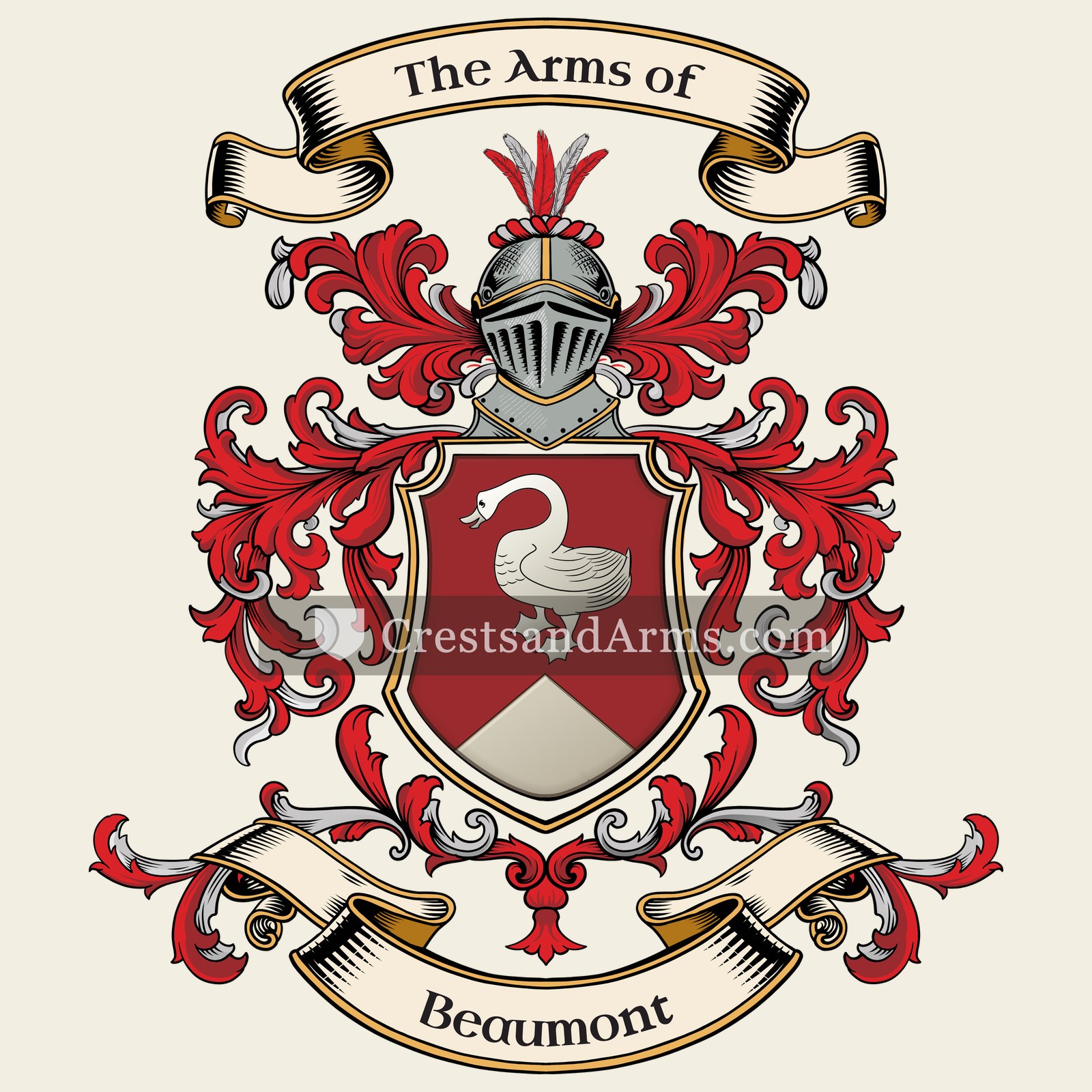
swanGrace, light and the poet's art
Colours
Red (Gules)Means: Military strength
Silver (Argent)Means: Peace and sincerity
Historical info
Source
J. B. Rietstap, Armorial Général, Gouda: G. B. van Goor Zonen, 1884–87
Blazon (the actual original written record)
“De gu. à un cygne d'arg., bq. et m. d'or, les ailes éployées de sin., posé sur une onde d'azur.”
LorraineLorraine, c. 1509
Digital archive packCoat of arms PNG, gold border print PDF, vector SVG and the certificate of authenticity. Sent to your email in minutes.
Map of France showing where the Beaumont arms are recorded
The Beaumont arms were recorded in Lorraine, c. 1509.
Lorraine sat on the border between France and the German lands, and border country bred soldiers. Families here held small estates and served in arms, and a fighting man was exactly the sort who carried a shield of his own.
This is where the arms were entered in the register. Families often moved to other parts of the country, so the same name can turn up in more than one region.
The body that granted and recorded arms in France in this period.
Louis XII of France
Sovereign of the period
Louis XII of France
1498–1515
Reigning in Britain when the Beaumont arms are first recorded.
How Arms Worked in France
In France, a coat of arms was a mark of honor that passed down through the male line to all legitimate descendants. Families often used the same shield without changes to show their shared heritage. If a branch wanted to stand out, they could add a small mark to their shield to show their specific place in the family tree.
Granting authority
The Juge d'armes de France acted as the official authority that regulated and verified coats of arms across the country.
How they got arms
Families typically inherited their arms from ancestors, though they could also receive them through royal grants or by proving their noble status.
Where arms were recorded
Coats of arms were officially recorded in the Armorial Général de France, which began its main collection in the year 1696.
The family's standing
Recorded among the armigerous families of Lorraine.
Origin & History of the Beaumont Family in France
The name Beaumont originates from the French words "beau" and "mont," which together translate to "beautiful mountain." This descriptive name was commonly given to families who lived near a prominent hill or a high, scenic landscape. By the early sixteenth century, historical records confirm that members of the Beaumont family were well-established in the Lorraine region of France. During this period, Lorraine was a crossroads of European culture and politics, situated between the French Kingdom and the Holy Roman Empire. Families living in this area often held roles in local administration or land management, reflecting the importance of their geographic location. As the name spread across different provinces, it became a marker of families who were deeply connected to the distinct terrains and rural estates of the French countryside.
Coat of Arms & Family Crest Details
Symbols on this shield
lionCourage, strength and royalty
fleur de lisPurity, light, and the sixth son
Colours
Blue (Azure)Means: Loyalty and truth
Gold (Or)Means: Generosity
Historical info
Source
Sir Bernard Burke, The General Armory of England, Scotland, Ireland and Wales, London: Harrison & Sons, 1884
Blazon (the actual original written record)
“Az. a lion ramp. betw. ten fleurs-de-lis or, armed and langued gu”
SuffolkBeaumont Hall · Suffolk, c. 1620
Digital archive packCoat of arms PNG, gold border print PDF, vector SVG and the certificate of authenticity. Sent to your email in minutes.
Map of England showing where the Beaumont arms are recorded
The Beaumont arms were recorded in Suffolk, c. 1620.
Suffolk was wool country, and its cloth towns were among the wealthiest in England. Clothier families bought manors with their profits, and holding a manor was the ordinary route to a coat of arms.
This is where the arms were entered in the register. Families often moved to other parts of the country, so the same name can turn up in more than one region.
The body that granted and recorded arms in England in this period.
James VI and I
Sovereign of the period
James VI and I
1603–1625
Reigning in Britain when the Beaumont arms are first recorded.
How Arms Worked in England
English heraldry allowed arms to be shared by all legitimate descendants of the original owner. These symbols were treated as personal property that moved through the generations to all children. While the eldest son kept the original design, other family members could use the same shield without needing to change it or register their own unique versions.
Granting authority
The College of Arms in London has regulated the use of coats of arms throughout England and Wales since 1484.
How they got arms
Families typically obtained their coats of arms through a formal grant from the Crown or by proving their ancient right to them.
Where arms were recorded
All official coats of arms are recorded in the registers kept at the College of Arms, which date back to the fifteenth century.
The family's standing
Recorded among the armigerous families of Suffolk.
Origin & History of the Beaumont Family in England
The surname Beaumont originated in France and translates to beautiful mountain or beautiful hill. After the Norman Conquest of 1066, many families bearing this name settled in England to serve the new ruling class. By the early 17th century, the name had become well-established across various English counties, including Suffolk. Records from 1620 confirm that members of the Beaumont family were active participants in the local community life of Suffolk during this period. These early settlers were often involved in agriculture or local trade, which helped them integrate into the social fabric of the English countryside. Over time, the family name spread from these regional hubs to other parts of the country as individuals sought new opportunities for work and land ownership.
Beaumont Meaning & Related Branches
Root word
Bellus Mons
Latin for beautiful mountain or hill.
This name
BeaumontA locational surname referring to someone who lived near a beautiful hill or mountain.
also spelled
Beaumond
Bomon
Bomont
Related arms
Bois (du) l'Espinaysame arms
Courcysame arms
Couveysame arms
Bemontvariant spelling
Documented Sources
J. B. Rietstap, Armorial Général, Gouda: G. B. van Goor Zonen, 1884–87
Reaney, P.H. and Wilson, R.M., A Dictionary of English Surnames, 1997
The National Archives, Early Chancery Proceedings, C 1/298/46
Digital archive packCoat of arms PNG, gold border print PDF, vector SVG and the certificate of authenticity. Sent to your email in minutes.


 lionCourage, strength and royalty
 fleur de lisPurity, light, and the sixth son
 wheatsheafPlenty, and the harvest of one's own labour
 lionCourage, strength and royalty
 fleur de lisPurity, light, and the sixth son
 wheatsheafPlenty, and the harvest of one's own labour


 swanGrace, light and the poet's art