Map of Belgium showing where the Beaupré arms are recorded
The Beaupré arms were recorded in Brabant, c. 1737.
Brabant lay at the heart of the Low Countries, where the trade routes met. Its towns were wealthy and its landowners many, and both kinds of family kept arms, which is why the region is so heavily represented.
This is where the arms were entered in the register. Families often moved to other parts of the country, so the same name can turn up in more than one region.
The body that granted and recorded arms in Belgium in this period.
Charles VI, Holy Roman Emperor
Sovereign of the period
Charles VI, Holy Roman Emperor
1711–1740
Reigning in Belgium when the Beaupré arms are first recorded.
How Arms Worked in Belgium
In Belgium, a coat of arms is considered personal property that is passed down through the male line to legitimate descendants. Families often use the same shield design across generations to show their shared heritage. If a branch of the family wants to change the design, they must apply for an official update to their specific version of the arms.
Granting authority
The Conseil héraldique is the official body that regulates and approves all coats of arms in Belgium.
How they got arms
Families obtain their coats of arms through formal royal grants or by confirming their historical right to use existing designs.
Where arms were recorded
All approved coats of arms are officially recorded in the public registers of the Conseil héraldique since 1844.
The family's standing
Recorded among the armigerous families of Brabant.
Origin & History of the Beaupré Family in Belgium
The family name Beaupré finds its roots in the descriptive traditions of the French language, where it literally translates to "beautiful meadow." In the context of 18th-century Belgium, the name emerged within the historical Duchy of Brabant, a region known for its complex social structures and agricultural landscape. By 1737, records confirm that members of the Beaupré family were established residents in this area, likely integrated into the local community through farming or trade. During this period, the Duchy of Brabant was under the control of the Austrian Habsburgs, and families often moved within these borders to seek better economic opportunities in growing market towns. The presence of the family in Brabant suggests they were part of the steady demographic shifts that defined the Low Countries before the industrial changes of the next century. As the family settled into these rural or semi-urban environments, their name became a permanent fixture in the local parish registers and administrative documents that tracked the lives of common citizens.
Coat of Arms & Family Crest Details
Symbols on this shield
paleMilitary strength, and a fortified defence
arrowReadiness for battle, and affliction endured
Colours
Black (Sable)Means: Constancy
Gold (Or)Means: Generosity
Red (Gules)Means: Military strength
Historical info
Source
J. B. Rietstap, Armorial Général, Gouda: G. B. van Goor Zonen, 1884–87
Blazon (the actual original written record)
“De sa. au pal d'or, ch. d'un dard de gu.”
NormandieNormandie, c. 1663
Digital archive packCoat of arms PNG, gold border print PDF, vector SVG and the certificate of authenticity. Sent to your email in minutes.
Map of France showing where the Beaupré arms are recorded
The Beaupré arms were recorded in Normandie, c. 1663.
Normandie held a dense crowd of knightly families on some of the best farmland in France. Its men had fought and settled abroad for generations, and a family that sent sons to war needed a shield they could be recognised by.
This is where the arms were entered in the register. Families often moved to other parts of the country, so the same name can turn up in more than one region.
The body that granted and recorded arms in France in this period.
Louis XIV of France
Sovereign of the period
Louis XIV of France
1643–1715
Reigning in Belgium when the Beaupré arms are first recorded.
How Arms Worked in France
In France, a coat of arms was a mark of honor that passed down through the male line to all legitimate descendants. Families often used the same shield without changes to show their shared heritage. If a branch wanted to stand out, they could add a small mark to their shield to show their specific place in the family tree.
Granting authority
The Juge d'armes de France acted as the official authority that regulated and verified coats of arms across the country.
How they got arms
Families typically inherited their arms from ancestors, though they could also receive them through royal grants or by proving their noble status.
Where arms were recorded
Coats of arms were officially recorded in the Armorial Général de France, which began its main collection in the year 1696.
The family's standing
Recorded among the armigerous families of Normandie.
Origin & History of the Beaupré Family in France
The surname Beaupré originated in France as a descriptive name, likely referring to someone who lived near a beautiful meadow or a pleasant field. The name is composed of the French words "beau," meaning beautiful, and "pré," meaning meadow. By the mid-seventeenth century, families bearing this name were well-established in the region of Normandy. This area was a hub of activity during the 1660s, as many people from the province began to look toward the French colonies in North America for new opportunities. Records confirm that individuals from the Beaupré lineage were present in Normandy in 1663, living through a period of significant social and economic change in the French countryside. Their presence in this specific region suggests they were part of the local agricultural or artisan communities that defined the Norman landscape before many of their descendants eventually embarked on journeys across the Atlantic.
Coat of Arms & Family Crest Details
Symbols on this shield
bendDefence, and the scarf of a commander
fessThe military belt, and readiness to serve
cross symbolChristian faith and service
Colours
Silver (Argent)Means: Peace and sincerity
Blue (Azure)Means: Loyalty and truth
Gold (Or)Means: Generosity
Historical info
Source
Sir Bernard Burke, The General Armory of England, Scotland, Ireland and Wales, London: Harrison & Sons, 1884
Blazon (the actual original written record)
“Ar. on a bend az. a fesse betw. six crosses crosslet or, (being the Arms of St. Omer in the bend) quartered by Fountaine, High Brigge”
Englandc. 1620
Digital archive packCoat of arms PNG, gold border print PDF, vector SVG and the certificate of authenticity. Sent to your email in minutes.
Map of England showing where the Beaupré arms are recorded
The Beaupré arms were recorded in England, c. 1620.
Arms such as these were typically recorded in York.
Yorkshire is the largest of the English counties, and it held more gentry families than any other. Land there was split among a great many households rather than a few, so a great many of them carried arms.
This is where the arms were entered in the register. Families often moved to other parts of the country, so the same name can turn up in more than one region.
The body that granted and recorded arms in England in this period.
James VI and I
Sovereign of the period
James VI and I
1603–1625
Reigning in Belgium when the Beaupré arms are first recorded.
How Arms Worked in England
English heraldry allowed arms to be shared by all legitimate descendants of the original owner. These symbols were treated as personal property that moved through the generations to all children. While the eldest son kept the original design, other family members could use the same shield without needing to change it or register their own unique versions.
Granting authority
The College of Arms in London has regulated the use of coats of arms throughout England and Wales since 1484.
How they got arms
Families typically obtained their coats of arms through a formal grant from the Crown or by proving their ancient right to them.
Where arms were recorded
All official coats of arms are recorded in the registers kept at the College of Arms, which date back to the fifteenth century.
The family's standing
Recorded among the armigerous families of England.
Origin & History of the Beaupré Family in England
The surname Beaupré originates from the French words for beautiful meadow, suggesting that the earliest ancestors likely lived near a scenic pasture or a lush landscape. While the name is deeply rooted in French history, members of the family established a presence in the English city of York by 1620. During this period, York was a significant regional hub for trade and administration, making it a logical destination for families moving across the channel. These early settlers arrived during a time of shifting religious and political landscapes in England, which often prompted families to seek new opportunities in growing urban centers. By integrating into the local community of York, the family became part of the city’s long history of craftsmanship and commerce. Their presence in the city records from the early seventeenth century highlights how the family adapted to life in Northern England while maintaining a name that reflected their continental heritage.
Beaupré Meaning & Related Branches
Root word
Bellus Pratum
Latin for beautiful meadow
This name
BeaupréA topographic surname referring to someone who lived near a beautiful or pleasant meadow.
also spelled
Beauprey
Beaupre-de
Bopray
Beaupray
Related arms
Bewprevariant spelling
Documented Sources
J. B. Rietstap, Armorial Général, Gouda: G. B. van Goor Zonen, 1884–87
State Archives in Belgium (Algemeen Rijksarchief), Parochieregisters van Brabant
State Archives in Belgium (Algemeen Rijksarchief), Registers van de Burgerlijke Stand
Dauzat, Albert, Dictionnaire étymologique des noms et prénoms de France, 1951
Fourez, Lucien, Les noms de famille en Belgique, 1962
Digital archive packCoat of arms PNG, gold border print PDF, vector SVG and the certificate of authenticity. Sent to your email in minutes.


 ermineDignity and rank
 lionCourage, strength and royalty
 ermineDignity and rank
 lionCourage, strength and royalty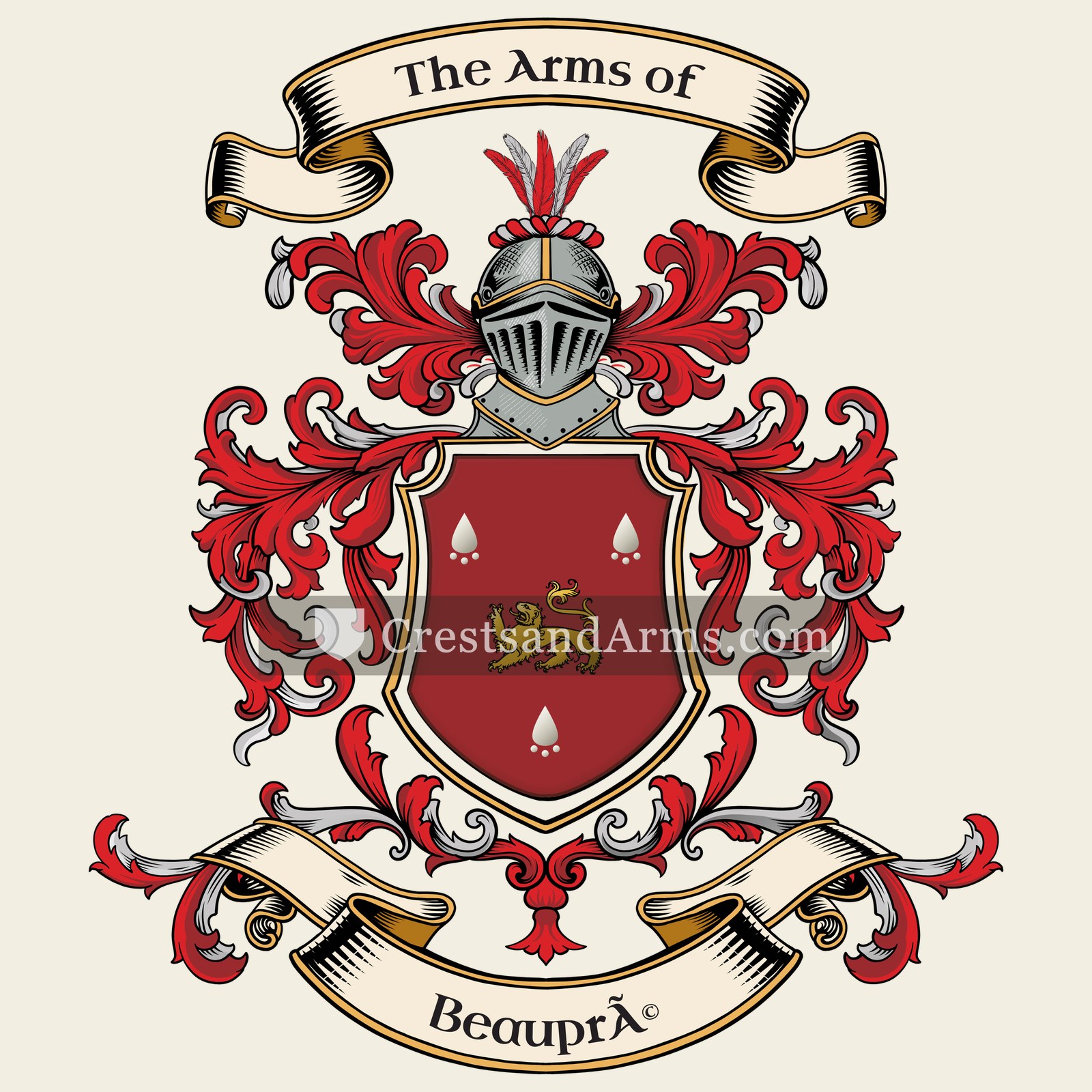


 paleMilitary strength, and a fortified defence
 arrowReadiness for battle, and affliction endured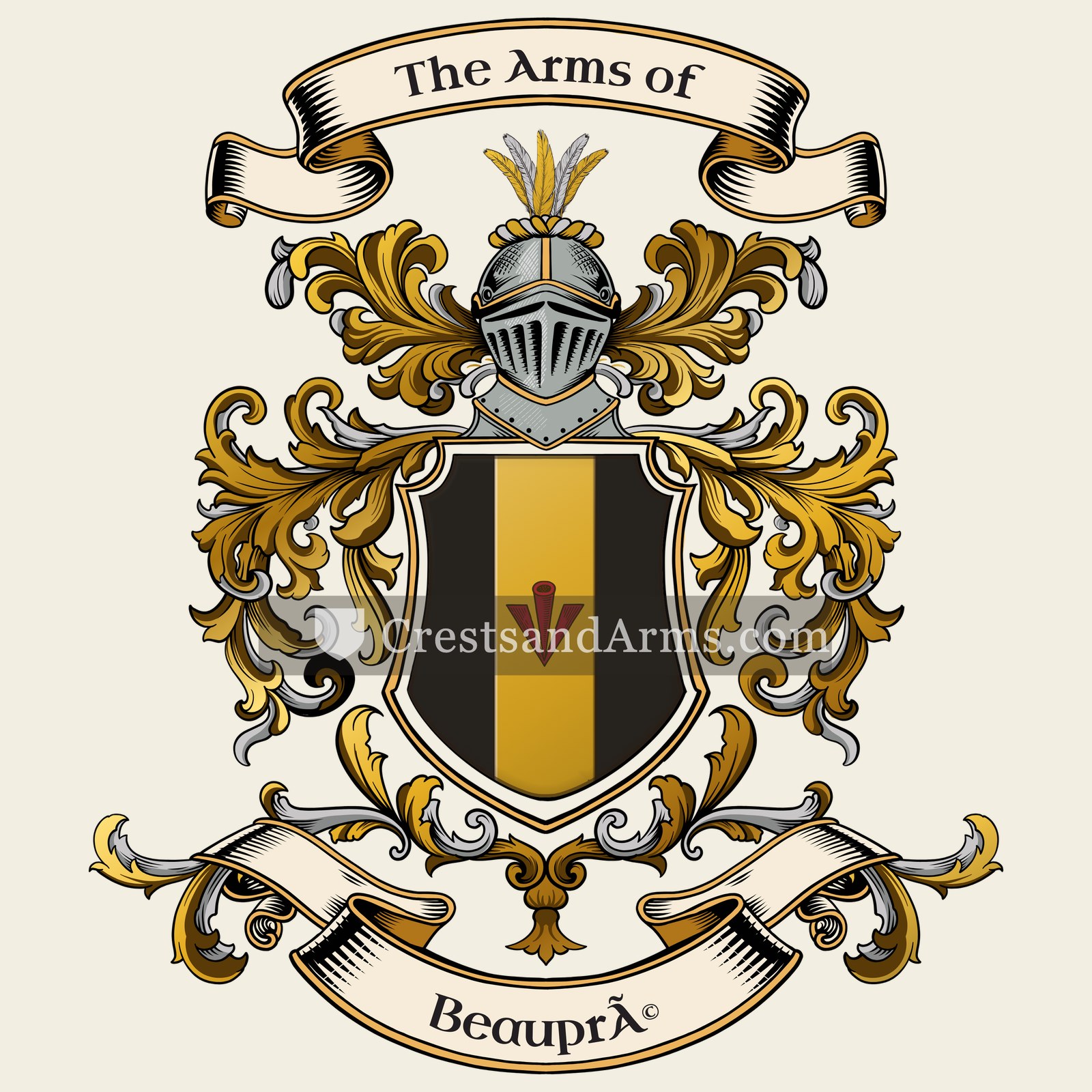


 bendDefence, and the scarf of a commander
 fessThe military belt, and readiness to serve
 cross symbolChristian faith and service