Map of France showing where the Becerril arms are recorded
The Becerril arms were recorded in Bugey, c. 1725.
Bugey was small Alpine-edge country in eastern France, held in modest estates. Its gentry were numerous rather than wealthy, and even a small holding justified a shield.
This is where the arms were entered in the register. Families often moved to other parts of the country, so the same name can turn up in more than one region.
The body that granted and recorded arms in France in this period.
Louis XV of France
Sovereign of the period
Louis XV of France
1715–1774
Reigning in France when the Becerril arms are first recorded.
How Arms Worked in France
In France, a coat of arms was a mark of honor that passed down through the male line to all legitimate descendants. Families often used the same shield without changes to show their shared heritage. If a branch wanted to stand out, they could add a small mark to their shield to show their specific place in the family tree.
Granting authority
The Juge d'armes de France acted as the official authority that regulated and verified coats of arms across the country.
How they got arms
Families typically inherited their arms from ancestors, though they could also receive them through royal grants or by proving their noble status.
Where arms were recorded
Coats of arms were officially recorded in the Armorial Général de France, which began its main collection in the year 1696.
The family's standing
Recorded among the armigerous families of Bugey.
Origin & History of the Becerril Family in France
The family name Becerril carries a history deeply rooted in the agricultural and linguistic traditions of the Iberian Peninsula. The name is derived from the Spanish word becerro, which refers to a young bull or a calf. Historically, this suggests that the earliest ancestors to adopt the name were likely involved in cattle ranching or lived in regions known for livestock production. By the early 18th century, members of the family had established a presence in the Bugey region of France by 1725. This movement indicates that the family was part of the broader patterns of migration and trade that connected rural communities across Europe during the 1700s. Whether they were traveling for work, commerce, or personal reasons, their relocation to Bugey highlights the adaptability of the family as they integrated into new local economies and social structures while maintaining their distinct ancestral identity.
Becerril Meaning & Related Branches
Root word
Becerro
A young bull or calf in Spanish.
This name
BecerrilA topographic or occupational surname referring to a place where calves were raised or kept.
also spelled
Becere
Becerels
Beserel
Documented Sources
J. B. Rietstap, Armorial Général, Gouda: G. B. van Goor Zonen, 1884–87
Moll, Francesc de B., Els llinatges catalans, 1959
García Carraffa, Alberto y Arturo, Enciclopedia heráldica y genealógica hispano-americana, 1920
Archives départementales de l'Ain, Registres paroissiaux et d'état civil du Bugey
Digital archive packCoat of arms PNG, gold border print PDF, vector SVG and the certificate of authenticity. Sent to your email in minutes.


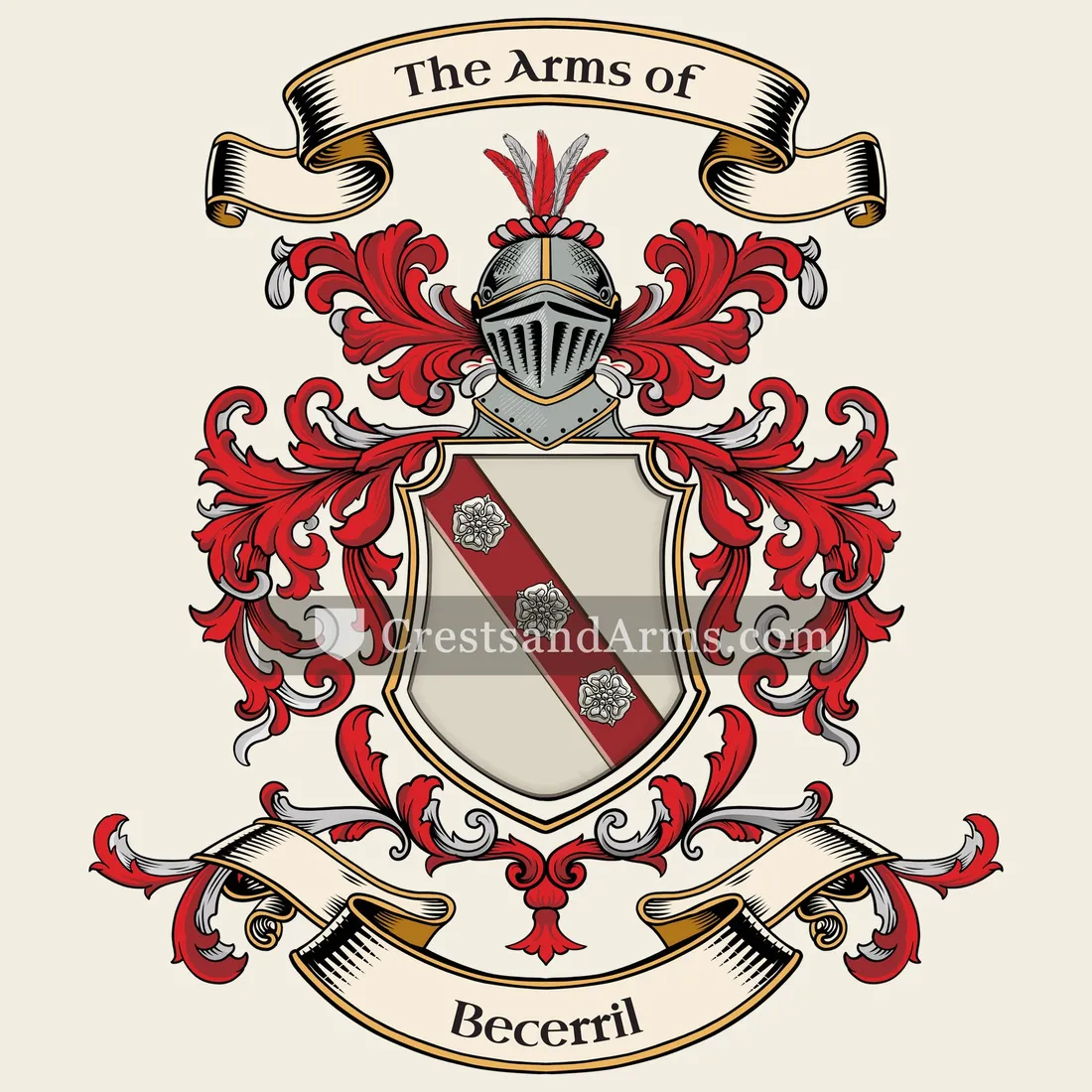
 bendDefence, and the scarf of a commander
 roseThe seventh son, and beauty with grace
 bendDefence, and the scarf of a commander
 roseThe seventh son, and beauty with grace