Map of Germany showing where the Becht arms are recorded
The Becht arms were recorded in Heilbronn, c. 1765.
This is where the arms were entered in the register. Families often moved to other parts of the country, so the same name can turn up in more than one region.
The body that granted and recorded arms in Germany in this period.
Francis I, Holy Roman Emperor
Sovereign of the period
Francis I, Holy Roman Emperor
1745–1765
Reigning in Germany when the Becht arms are first recorded.
How Arms Worked in Germany
In the Holy Roman Empire, coats of arms were often granted to individuals by the Emperor or his representatives. These arms were then passed down through the generations to all legitimate descendants of the original holder. Younger branches of a family usually kept the same shield design without needing to change it, as the arms belonged to the entire lineage.
Granting authority
The Holy Roman Emperor held the sole power to grant new coats of arms throughout his vast imperial territories.
How they got arms
Families typically obtained their coats of arms through a formal imperial grant or by proving their noble status to the authorities.
Where arms were recorded
These grants were officially recorded in the Imperial Chancery registers, which began keeping formal records of such honors during the Middle Ages.
The family's standing
Recorded among the armigerous families of Germany.
Origin & History of the Becht Family in Germany
The surname Becht is a patronymic name that originated in the German-speaking regions of Europe, likely evolving as a shortened form of names like Berthold or Berchtold. These names were rooted in the Old High German words for bright and ruler, suggesting that the name was once associated with someone of noble character or high standing. By the mid-18th century, the family was well-established in the city of Heilbronn, a historic trade hub located in the Neckar valley. Records from 1765 confirm that members of the Becht family were active participants in the civic and economic life of this region during a time of significant transition for the Holy Roman Empire. As residents of a prominent merchant city, these early ancestors likely contributed to the local craft guilds or agricultural networks that defined the social structure of southwestern Germany during the Enlightenment era.
Becht Meaning & Related Branches
Root word
Berht
An Old High German term meaning bright, shining, or famous.
This name
BechtA shortened form of names like Berthold, signifying a bright or illustrious ruler.
also spelled
Bech
Bekt
Bechtl
Related arms
Bechvariant spelling
Berlinrecorded with Becht, same area
Feyerabendrecorded with Becht, same area
Rieserrecorded with Becht, same area
Documented Sources
J. B. Rietstap, Armorial Général, Gouda: G. B. van Goor Zonen, 1884–87
Heuss, Theodor. Heilbronn: Geschichte einer Stadt. 1951
Stadtarchiv Heilbronn. Bürgerbuch der Stadt Heilbronn. 1765
Bahlow, Hans. Deutsches Namenlexikon: Familien- und Vornamen nach Ursprung und Sinn erklärt. 1967
Digital archive packCoat of arms PNG, gold border print PDF, vector SVG and the certificate of authenticity. Sent to your email in minutes.


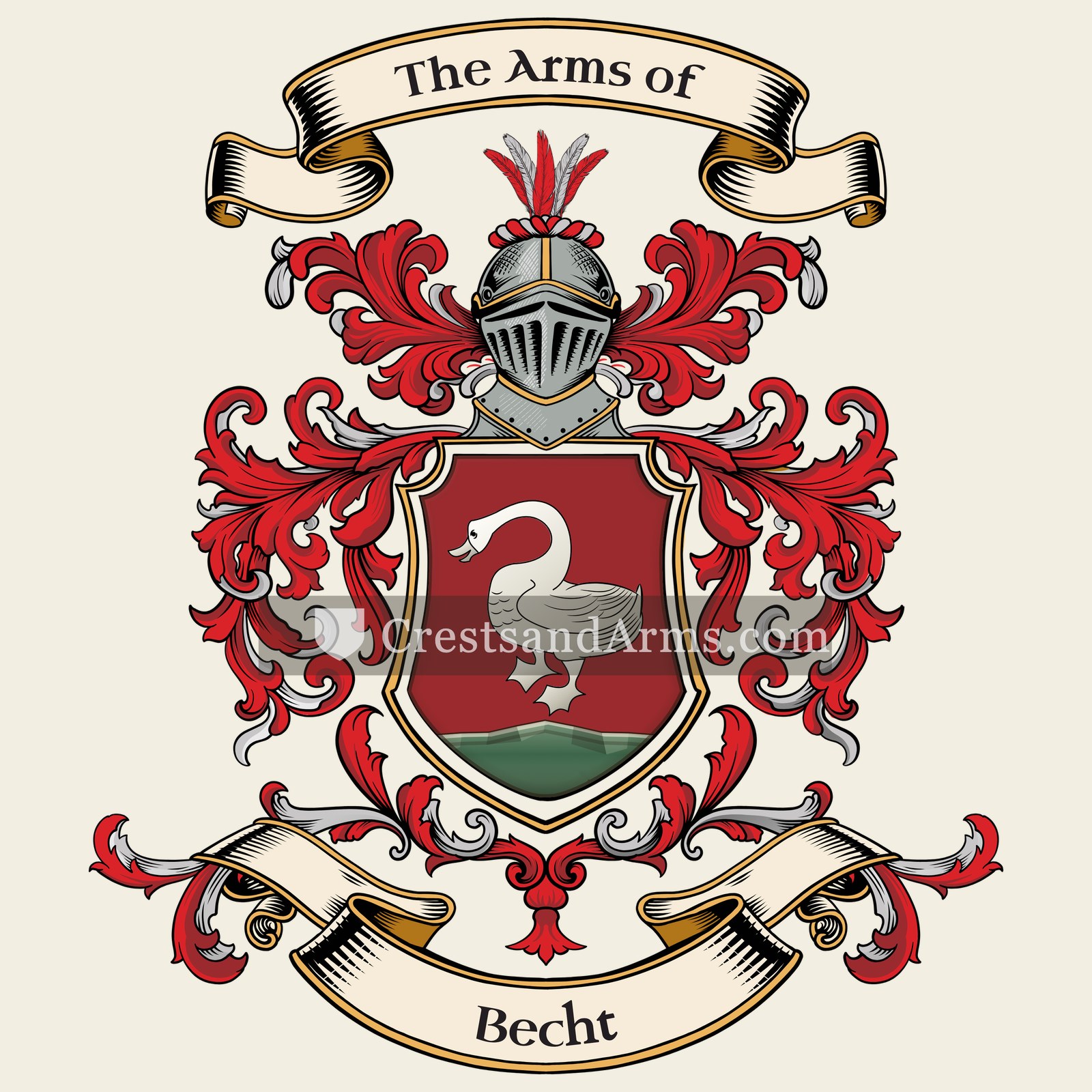
 mountThe ground held, and steadfastness upon it
 swanGrace, light and the poet's art
 mountThe ground held, and steadfastness upon it
 swanGrace, light and the poet's art