A record of documented arms, meaning and origin, researched for the Becke family lines. Documented in 3 countries.
Reg. 0111 · Polish, A–C
Coat of Arms & Family Crest Details
Symbols on this shield
bendDefence, and the scarf of a commander
roundelA coin, and one who has been to the crusades
lionCourage, strength and royalty
crownSovereignty, authority and just reward
Colours
Blue (Azure)Means: Loyalty and truth
Red (Gules)Means: Military strength
Silver (Argent)Means: Peace and sincerity
Black (Sable)Means: Constancy
Gold (Or)Means: Generosity
Historical info
Source
J. B. Rietstap, Armorial Général, Gouda: G. B. van Goor Zonen, 1884–87
Blazon (the actual original written record)
“D'azur à la bande de gu., ch. de trois bes. d'arg., celui du milieu ch. d'un lion de sa. et les deux autres ch. chacun d'une couronne d'or. C.: un demi-vol, aux armes de l'écu.”
PolandThorn, c. 1772
Digital archive packCoat of arms PNG, gold border print PDF, vector SVG and the certificate of authenticity. Sent to your email in minutes.
Map of Poland showing where the Becke arms are recorded
The Becke arms were recorded in Thorn, c. 1772.
This is where the arms were entered in the register. Families often moved to other parts of the country, so the same name can turn up in more than one region.
Region
Thorn
Town
Thorn
First recorded
1772
Granting Authority for the Becke Arms
Ennoblement by the Sejm
Author: Olek Remesz · CC BY-SA 3.0
The body that granted and recorded arms in Poland in this period.
Stanisław August Poniatowski
Sovereign of the period
Stanisław August Poniatowski
1764–1795
Reigning in Poland when the Becke arms are first recorded.
How Arms Worked in Poland
Polish noble families shared a single coat of arms across many different surnames, creating large clans rather than individual designs. These symbols were held collectively by all members of the clan regardless of their specific family name. When a new family joined the nobility, they were adopted into an existing clan and began using that group's established shield.
Granting authority
The Sejm, which was the Polish parliament, held the power to grant noble status and the right to bear arms.
How they got arms
Families typically received their coat of arms through a formal act of ennoblement granted by the Sejm for distinguished service.
Where arms were recorded
These grants were officially recorded in the Crown Metrica, which served as the central archive for state documents starting in the sixteenth century.
The family's standing
Recorded among the armigerous families of Poland.
Origin & History of the Becke Family in Poland
The family name Becke has deep roots in the city of Thorn, which is known today as Toruń, Poland. By the year 1772, the family was already established within this historic trade center during a time of significant political transition. The name itself likely originated from Germanic linguistic roots, often referring to a person who lived near a brook or a small stream. As the family settled in Thorn, they became part of a diverse urban community that served as a vital link between Central and Eastern Europe. Because Thorn was a major hub for merchants and artisans, the Becke family likely participated in the local economy through trade or craft guilds. Their presence in the city during the late eighteenth century suggests they were integrated into the social fabric of a region that frequently shifted between different cultural and political influences. Over time, the family name persisted as a marker of their long-standing connection to this historic Polish city.
Coat of Arms & Family Crest Details
Symbols on this shield
fessThe military belt, and readiness to serve
swanGrace, light and the poet's art
Colours
Gold (Or)Means: Generosity
Blue (Azure)Means: Loyalty and truth
Silver (Argent)Means: Peace and sincerity
Historical info
Source
J. B. Rietstap, Armorial Général, Gouda: G. B. van Goor Zonen, 1884–87
Blazon (the actual original written record)
“D'or à trois fasces ondées d'azur, celle en p. supp. un cygne nageant d'arg. Cq. cour. C.: une étoile d'or, entre un vol d'arg.”
WestphaliaWestphalia, c. 1765
Digital archive packCoat of arms PNG, gold border print PDF, vector SVG and the certificate of authenticity. Sent to your email in minutes.
Map of Germany showing where the Becke arms are recorded
The Becke arms were recorded in Westphalia, c. 1765.
Westphalia was a land of small estates and fortified farmhouses in western Germany. Its families were numerous and not especially rich, but each held its own ground, and holding ground was what brought arms.
This is where the arms were entered in the register. Families often moved to other parts of the country, so the same name can turn up in more than one region.
The body that granted and recorded arms in Germany in this period.
Francis I, Holy Roman Emperor
Sovereign of the period
Francis I, Holy Roman Emperor
1745–1765
Reigning in Poland when the Becke arms are first recorded.
How Arms Worked in Germany
In the Holy Roman Empire, coats of arms were often granted to individuals by the Emperor or his representatives. These arms were then passed down through the generations to all legitimate descendants of the original holder. Younger branches of a family usually kept the same shield design without needing to change it, as the arms belonged to the entire lineage.
Granting authority
The Holy Roman Emperor held the sole power to grant new coats of arms throughout his vast imperial territories.
How they got arms
Families typically obtained their coats of arms through a formal imperial grant or by proving their noble status to the authorities.
Where arms were recorded
These grants were officially recorded in the Imperial Chancery registers, which began keeping formal records of such honors during the Middle Ages.
The family's standing
Recorded among the armigerous families of Westphalia.
Origin & History of the Becke Family in Germany
The surname Becke is deeply rooted in the linguistic landscape of medieval Germany, where it functioned as a topographic name for families living near a stream or a small brook. The term is derived from the Middle Low German word *beke*, which translates directly to a creek or a flowing water source. By the time records place the family in the Westphalia region during the 18th century, the name had already been established for generations as a way to identify individuals by their proximity to local geography. In the rural communities of Westphalia, families often adopted these names to distinguish themselves within their villages as the population grew and administrative record-keeping became more common. This connection to the land reflects a time when a person’s identity was closely tied to the specific features of the countryside they inhabited.
Coat of Arms & Family Crest Details
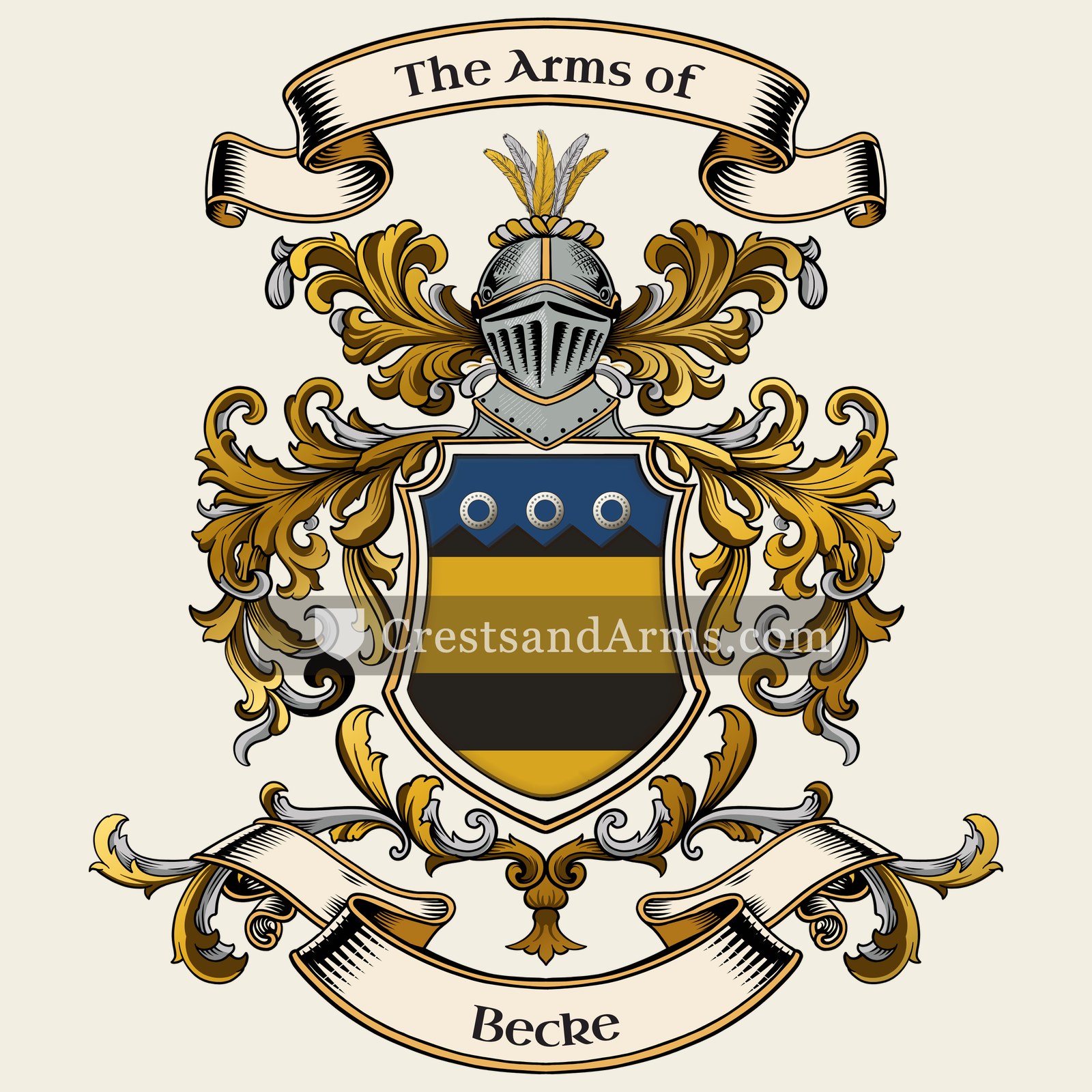
Symbols on this shield
chiefAuthority, wisdom and dominion
ringFidelity, and a promise kept
Colours
Gold (Or)Means: Generosity
Black (Sable)Means: Constancy
Blue (Azure)Means: Loyalty and truth
Silver (Argent)Means: Peace and sincerity
Historical info
Source
Sir Bernard Burke, The General Armory of England, Scotland, Ireland and Wales, London: Harrison & Sons, 1884
Blazon (the actual original written record)
“Or, two bars dancettée sa. on a chief az. three annulets ar”
BerkshireBerkshire, c. 1620
Digital archive packCoat of arms PNG, gold border print PDF, vector SVG and the certificate of authenticity. Sent to your email in minutes.
Map of England showing where the Becke arms are recorded
The Becke arms were recorded in Berkshire, c. 1620.
This is where the arms were entered in the register. Families often moved to other parts of the country, so the same name can turn up in more than one region.
The body that granted and recorded arms in England in this period.
James VI and I
Sovereign of the period
James VI and I
1603–1625
Reigning in Poland when the Becke arms are first recorded.
How Arms Worked in England
English heraldry allowed arms to be shared by all legitimate descendants of the original owner. These symbols were treated as personal property that moved through the generations to all children. While the eldest son kept the original design, other family members could use the same shield without needing to change it or register their own unique versions.
Granting authority
The College of Arms in London has regulated the use of coats of arms throughout England and Wales since 1484.
How they got arms
Families typically obtained their coats of arms through a formal grant from the Crown or by proving their ancient right to them.
Where arms were recorded
All official coats of arms are recorded in the registers kept at the College of Arms, which date back to the fifteenth century.
The family's standing
Recorded among the armigerous families of Berkshire.
Origin & History of the Becke Family in England
The surname Becke is rooted in the Old English and Old Norse languages, where the term "beck" referred to a small stream or a brook. Families carrying this name often lived near these natural water features, which served as important landmarks in the rural landscape of medieval England. By the early 17th century, the Becke family had established a notable presence in the county of Berkshire. Records from 1620 confirm that members of the family were settled in this region, likely working as farmers or tradespeople who relied on the local geography for their livelihood. During this period, the name was frequently recorded in parish registers as families began to settle more permanently in specific villages. This transition from identifying people by their surroundings to using fixed surnames helped the Becke family build a lasting identity within the local community of Berkshire.
Becke Meaning & Related Branches
Root word
Bach
A German term referring to a small stream or brook.
This name
BeckeA topographic name for someone who lived near a small stream or creek.
also spelled
Bekke
Beka
Beck
Bec
Bek
Related arms
Becvariant spelling
Bonserirecorded with Becke, same area
Bruckenrecorded with Becke, same area
Graeffendorffrecorded with Becke, same area
Documented Sources
J. B. Rietstap, Armorial Général, Gouda: G. B. van Goor Zonen, 1884–87
Biskup, Marian, Historia Torunia, 1992
Archiwum Państwowe w Toruniu, Akta miasta Torunia, 1772
Digital archive packCoat of arms PNG, gold border print PDF, vector SVG and the certificate of authenticity. Sent to your email in minutes.


 bendDefence, and the scarf of a commander
 roundelA coin, and one who has been to the crusades
 lionCourage, strength and royalty
 crownSovereignty, authority and just reward
 bendDefence, and the scarf of a commander
 roundelA coin, and one who has been to the crusades
 lionCourage, strength and royalty
 crownSovereignty, authority and just reward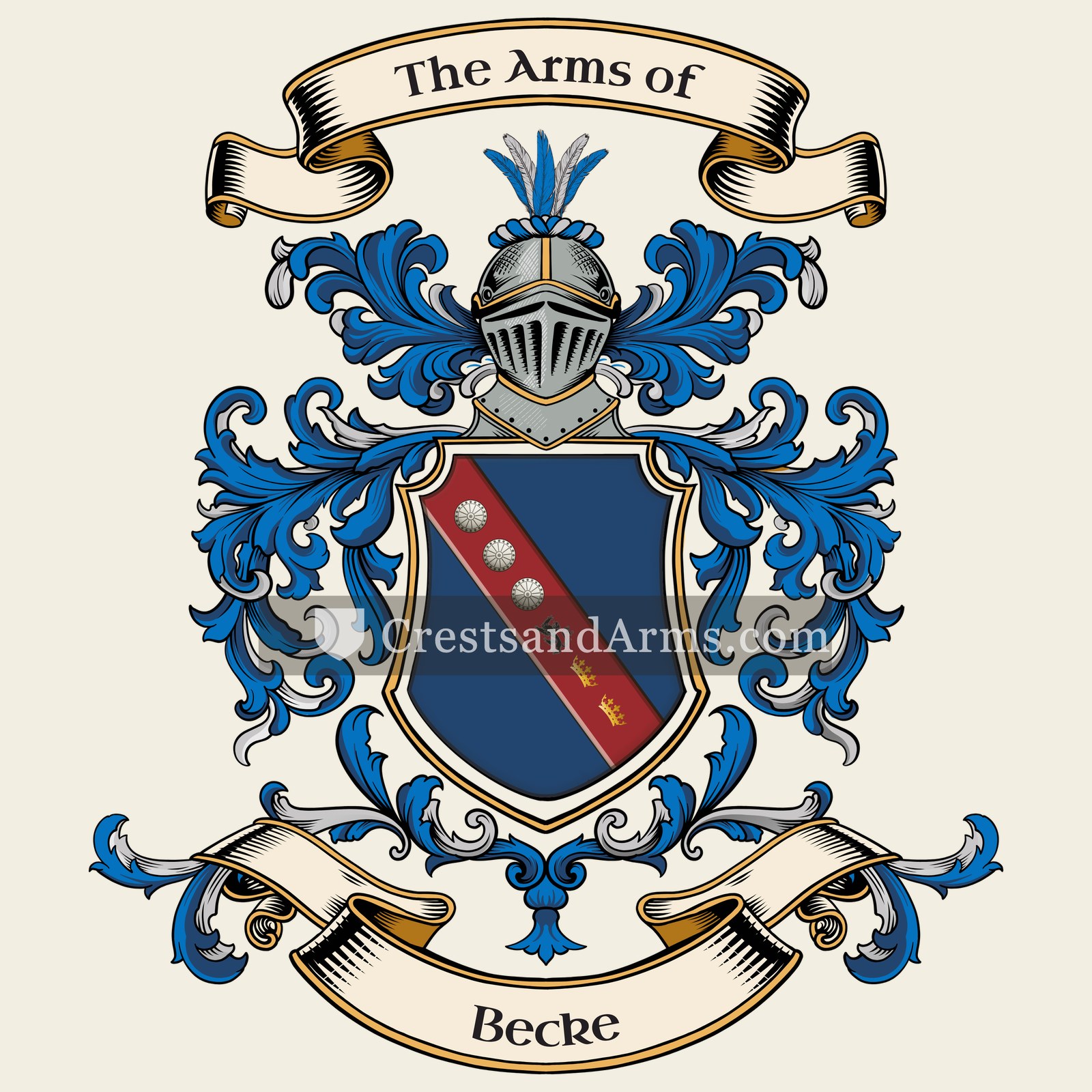


 fessThe military belt, and readiness to serve
 swanGrace, light and the poet's art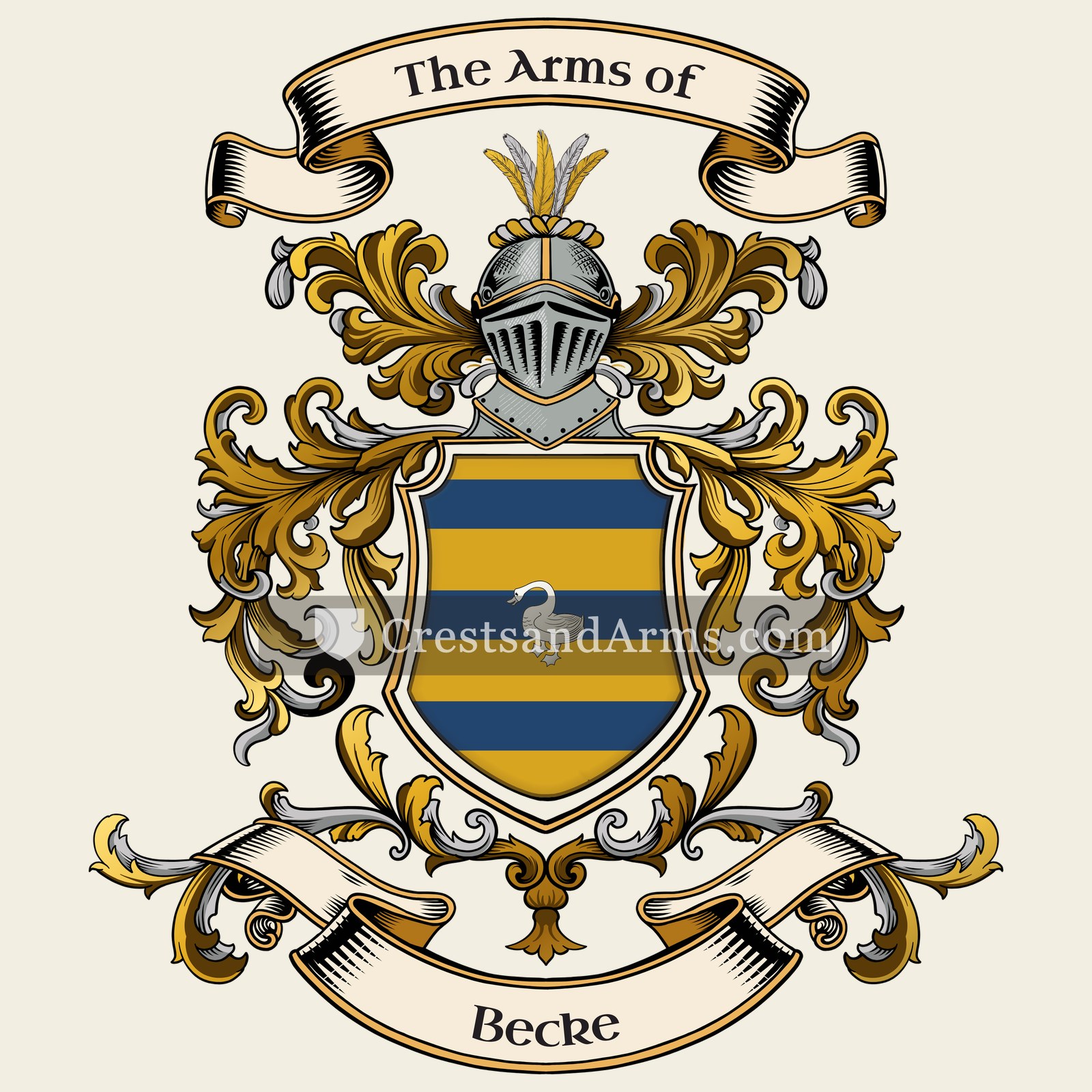


 chiefAuthority, wisdom and dominion
 ringFidelity, and a promise kept