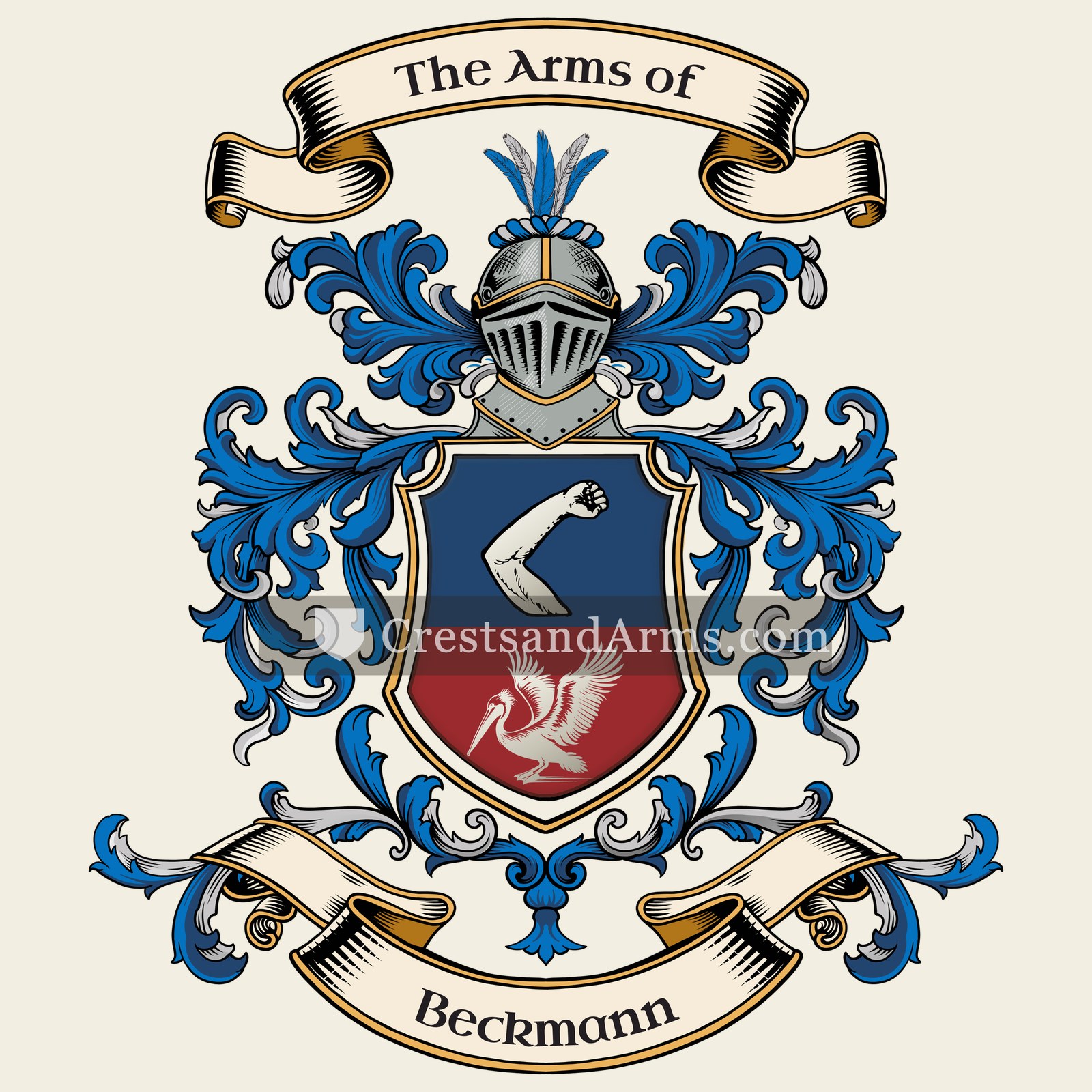
Map of Germany showing where the Beckmann arms are recorded
The Beckmann arms were recorded in Germany, c. 1765.
Arms such as these were typically recorded in Bavaria.
Bavaria was a country of old landed families and walled market towns. Estates passed down the same line for centuries, and both the landowners and the leading townsmen kept arms, which is why so many Bavarian names sit in the registers.
This is where the arms were entered in the register. Families often moved to other parts of the country, so the same name can turn up in more than one region.
The body that granted and recorded arms in Germany in this period.
Francis I, Holy Roman Emperor
Sovereign of the period
Francis I, Holy Roman Emperor
1745–1765
Reigning in Germany when the Beckmann arms are first recorded.
How Arms Worked in Germany
In the Holy Roman Empire, coats of arms were often granted to individuals by the Emperor or his representatives. These arms were then passed down through the generations to all legitimate descendants of the original holder. Younger branches of a family usually kept the same shield design without needing to change it, as the arms belonged to the entire lineage.
Granting authority
The Holy Roman Emperor held the sole power to grant new coats of arms throughout his vast imperial territories.
How they got arms
Families typically obtained their coats of arms through a formal imperial grant or by proving their noble status to the authorities.
Where arms were recorded
These grants were officially recorded in the Imperial Chancery registers, which began keeping formal records of such honors during the Middle Ages.
The family's standing
Recorded among the armigerous families of Germany.
Origin & History of the Beckmann Family in Germany
The surname Beckmann is a classic occupational name that originated in Germany during the Middle Ages. It is derived from the Middle Low German word "beke," which means a stream or a brook. A person who lived near such a water source or served as a manager of a stream was often called a Beckmann. By the time the family was firmly established in the Bavarian region in 1765, the name had become a common way to identify individuals based on their local geography or their professional duties. Because Bavaria was a hub for trade and agriculture during the eighteenth century, families with this name were likely integrated into the rural economy as landowners or skilled workers who relied on local water systems for their livelihoods. This connection to the land helped the name persist through generations as the family grew and moved across the German states.
Beckmann Meaning & Related Branches
Root word
Bach
A small stream or brook of water.
This name
BeckmannA person who lived near a stream or worked as a stream-side miller.
also spelled
Beckman
Bekman
Documented Sources
J. B. Rietstap, Armorial Général, Gouda: G. B. van Goor Zonen, 1884–87
Bahlow, Hans, Deutsches Namenlexikon: Familien- und Vornamen nach Ursprung und Sinn erklärt, 1967
Heintze, Albert, Die deutschen Familien-Namen: geschichtlich, geographisch, sprachlich, 1903


 armA person of action, industrious and laborious
 pelicanSelf-sacrifice and devotion to one's children
 armA person of action, industrious and laborious
 pelicanSelf-sacrifice and devotion to one's children