Map of Netherlands showing where the Beevers arms are recorded
The Beevers arms were recorded in Zeeland, c. 1815.
Zeeland was a scatter of islands in the south-west of the Netherlands, living on the sea and on land reclaimed from it. Families who drained and held that land were counted among the gentry, and gentry carried arms.
This is where the arms were entered in the register. Families often moved to other parts of the country, so the same name can turn up in more than one region.
Region
Zeeland
First recorded
1815
Granting Authority for the Beevers Arms
Hoge Raad van Adel
Photograph made by me · CC BY-SA 3.0
The body that granted and recorded arms in Netherlands in this period.
William I of the Netherlands
Sovereign of the period
William I of the Netherlands
1815–1840
Reigning in Netherlands when the Beevers arms are first recorded.
How Arms Worked in Netherlands
In the Netherlands, coats of arms were often used by noble families and those who held specific public offices. These arms were passed down through the generations to legitimate descendants. Younger branches of a family usually kept the original design without needing to add special marks. This system ensured that the family identity remained clear and consistent over many years.
Granting authority
The Hoge Raad van Adel is the official body that regulates and manages noble titles and coats of arms in the Netherlands.
How they got arms
Families typically obtained their coats of arms through official royal grants or by proving their long-standing historical use of the symbols.
Where arms were recorded
Coats of arms are officially recorded in the registers held by the Hoge Raad van Adel, which began its work in 1814.
The family's standing
Recorded among the armigerous families of Zeeland.
Origin & History of the Beevers Family in Netherlands
The surname Beevers, often appearing in Dutch records as Bevers, carries a history deeply rooted in the coastal landscape of the Netherlands. By the early nineteenth century, the family established a notable presence in the province of Zeeland, a region defined by its complex network of islands and its constant struggle against the sea. The name itself is likely derived from the Middle Dutch word bever, which means beaver. In medieval times, such names were often occupational or descriptive, perhaps identifying an ancestor who lived near a waterway where these animals were common or someone who traded in their valuable pelts. As the family settled in Zeeland by 1815, they became part of a resilient maritime culture that relied on land reclamation and trade. This environment shaped the lives of early family members as they navigated the social and economic shifts of the Napoleonic era and the subsequent formation of the United Kingdom of the Netherlands.
Meaning of the Beevers family crest colors & symbols
Symbols on this shield
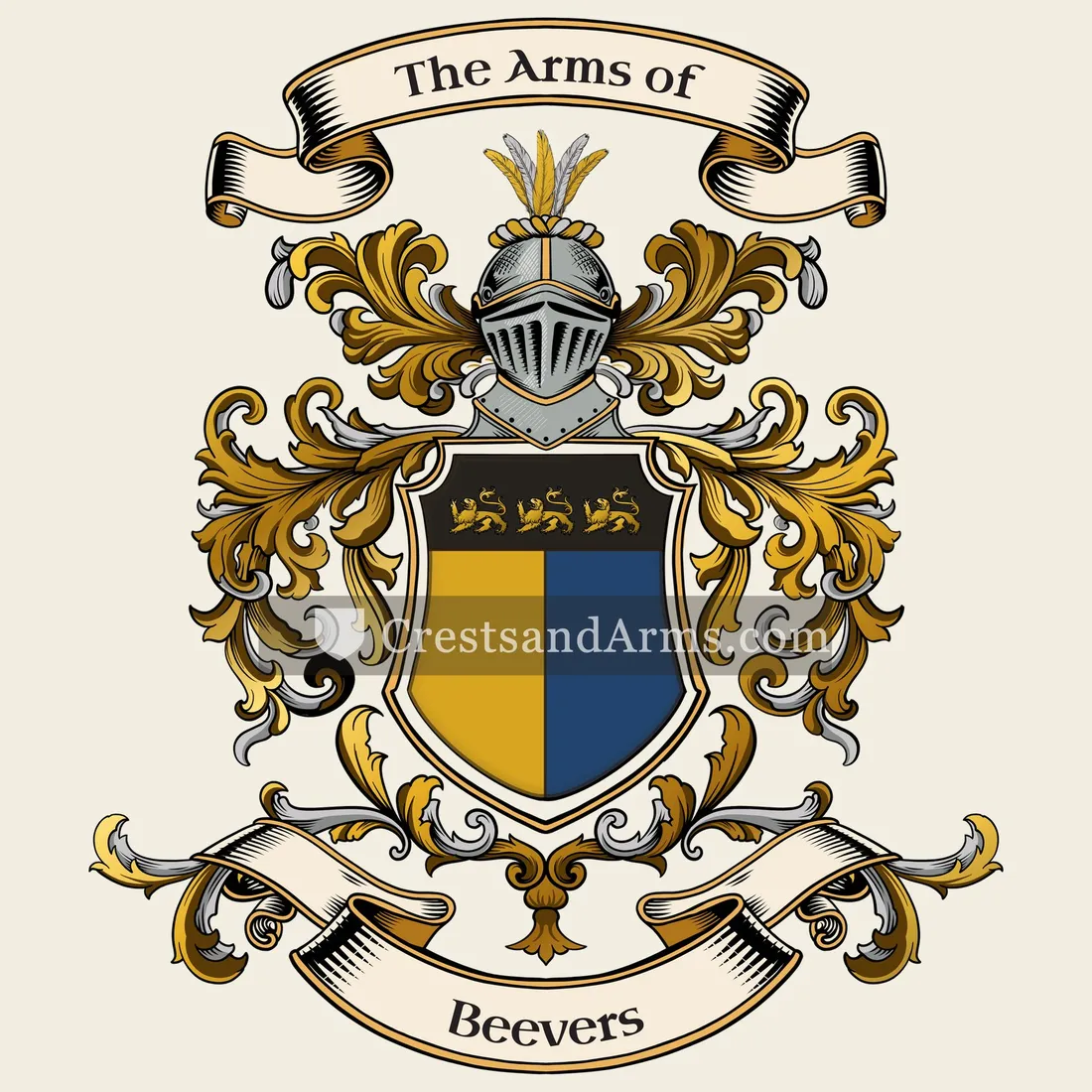
chiefAuthority, wisdom and dominion
lionCourage, strength and royalty
Colours
Gold (Or)Means: Generosity
Blue (Azure)Means: Loyalty and truth
Black (Sable)Means: Constancy
Historical info
Source
Sir Bernard Burke, The General Armory of England, Scotland, Ireland and Wales, London: Harrison & Sons, 1884
Blazon (the actual original written record)
“Per pale or and az. on a chief indented sa. three lions ramp. of the first”
NorfolkOxon · Norfolk, c. 1620
Digital archive packCoat of arms PNG, gold border print PDF, vector SVG and the certificate of authenticity. Sent to your email in minutes.
Map of England showing where the Beevers arms are recorded
The Beevers arms were recorded in Norfolk, c. 1620.
Norfolk grew rich on wool and grain, and its wealth was spread among many middling families rather than a few great ones. Households of that kind bought land and took arms, and the county holds a large share of English names.
This is where the arms were entered in the register. Families often moved to other parts of the country, so the same name can turn up in more than one region.
The body that granted and recorded arms in England in this period.
James VI and I
Sovereign of the period
James VI and I
1603–1625
Reigning in Netherlands when the Beevers arms are first recorded.
How Arms Worked in England
English heraldry allowed arms to be shared by all legitimate descendants of the original owner. These symbols were treated as personal property that moved through the generations to all children. While the eldest son kept the original design, other family members could use the same shield without needing to change it or register their own unique versions.
Granting authority
The College of Arms in London has regulated the use of coats of arms throughout England and Wales since 1484.
How they got arms
Families typically obtained their coats of arms through a formal grant from the Crown or by proving their ancient right to them.
Where arms were recorded
All official coats of arms are recorded in the registers kept at the College of Arms, which date back to the fifteenth century.
The family's standing
Recorded among the armigerous families of Norfolk.
Origin & History of the Beevers Family in England
The surname Beevers is a topographical name that likely originated from individuals who lived near a river or stream where beavers were commonly found. In the medieval period, many English surnames were derived from the local landscape or the wildlife that defined a specific area. By the early 17th century, the family had established a notable presence in the county of Norfolk. Records from 1620 confirm that members of the Beevers family were settled in this region, which was a hub for trade and agriculture at the time. Life in Norfolk during this era was shaped by the proximity to the North Sea and the expansion of local parishes, where families like the Beevers were often recorded in baptismal and marriage registers. These early ancestors were likely part of the hardworking rural population that helped build the foundations of local community life in East Anglia.
Beevers Meaning & Related Branches
Root word
Bever
A semi-aquatic mammal known for building dams.
This name
BeeversA patronymic or occupational surname referring to a person who hunted or trapped beavers.
also spelled
Bever
Beverss
Beaver
Beever
Documented Sources
J. B. Rietstap, Armorial Général, Gouda: G. B. van Goor Zonen, 1884–87
Zeeuws Archief, Burgerlijke Stand Zeeland (1811-1950)
Nationaal Archief, Bevolkingsregisters van Zeeland
Meertens, P.J., De Zeeuwse familienamen: ontstaan en geschiedenis, 1947
Van der Schaar, J., Woordenboek van voornamen: verklaring van de voornamen van man en vrouw, 1964
Digital archive packCoat of arms PNG, gold border print PDF, vector SVG and the certificate of authenticity. Sent to your email in minutes.


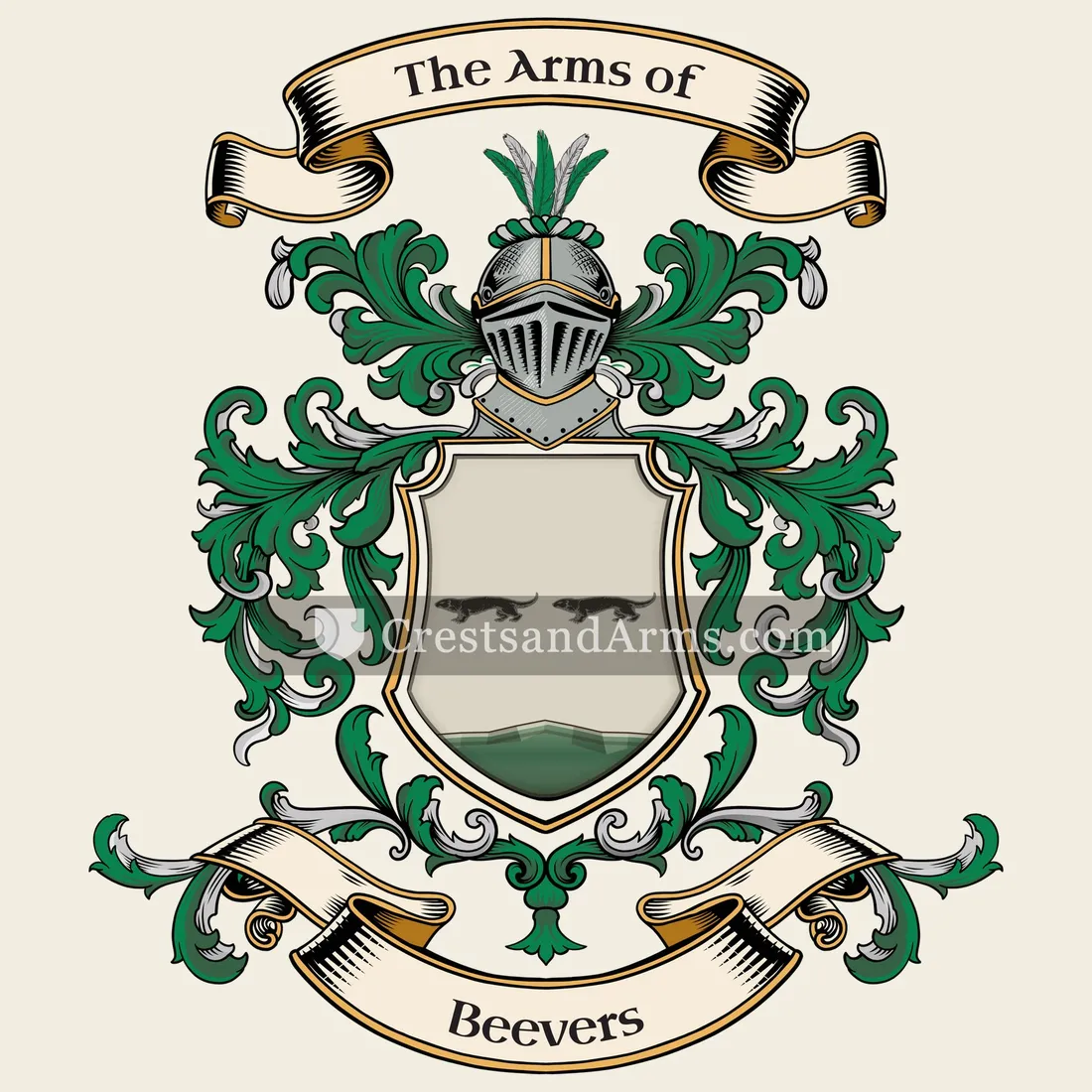
 mountThe ground held, and steadfastness upon it
 otterOne who lives life to the full
 mountThe ground held, and steadfastness upon it
 otterOne who lives life to the full


 chiefAuthority, wisdom and dominion
 lionCourage, strength and royalty