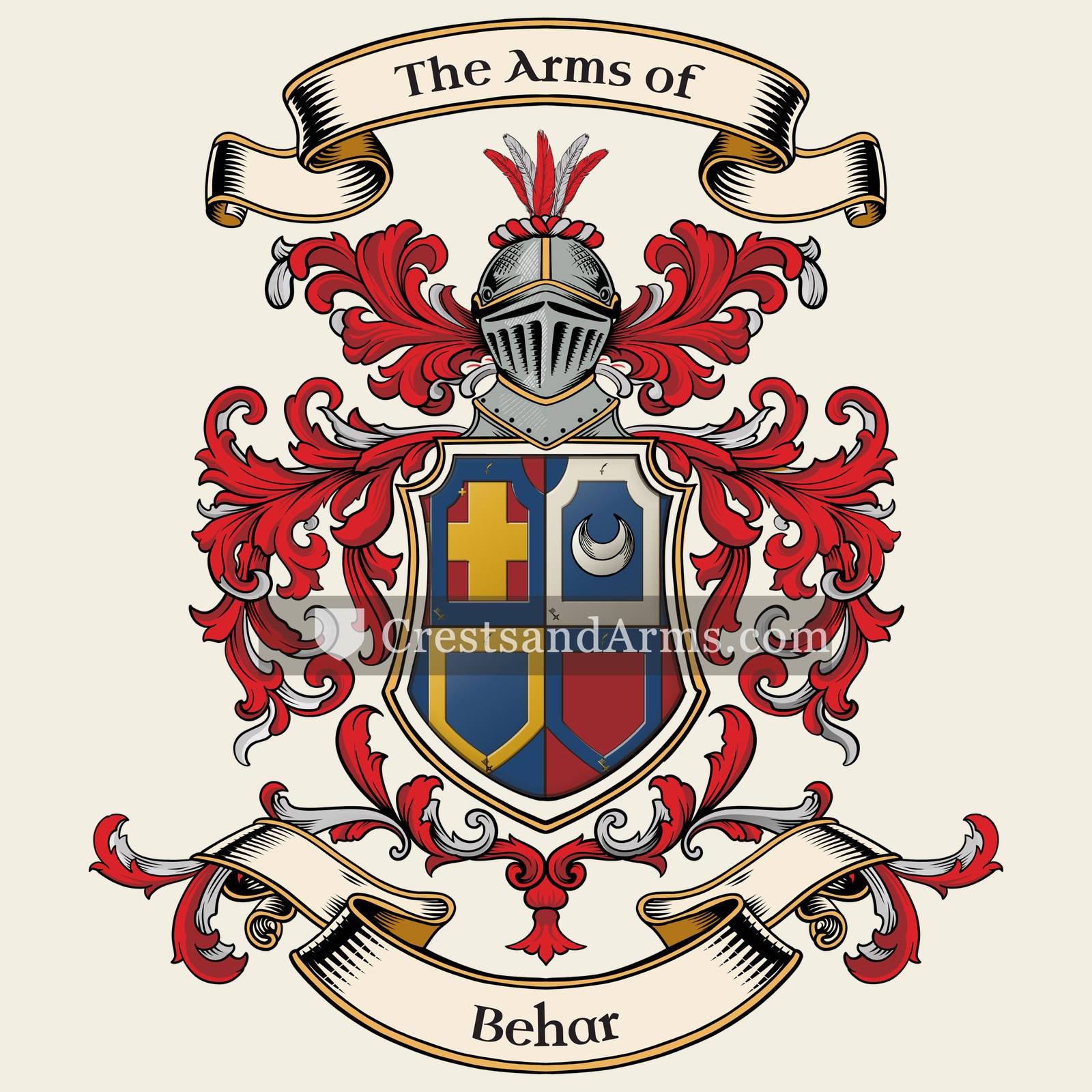
A record of documented arms, meaning and origin, researched for the Behar family of Spain.
Reg. 2411 · Spanish, A–C
Coat of Arms & Family Crest Details
Symbols on this shield
cross symbolChristian faith and service
swordJustice, and military honour
keyGuardianship, and the office of a steward
crescentHonour by the sovereign, and the second son
Colours
Red (Gules)Means: Military strength
Blue (Azure)Means: Loyalty and truth
Gold (Or)Means: Generosity
Silver (Argent)Means: Peace and sincerity
Historical info
Source
J. B. Rietstap, Armorial Général, Gouda: G. B. van Goor Zonen, 1884–87
Blazon (the actual original written record)
“Ec., de gu. à une croix fleur. d'or, et d'azur au croiss. versé d'arg.; le tout entouré d'une bord. comp. d'azur et de gu. de quatre pièces: sur l'azur une épée et une clé d'arg., élevées l'une l'autre, et sur le gu. une épée et une clé d'or, dans la même position. Cq. cour. C.: la croix de l'écu.”
BrabantBrabant, c. 1722
Digital archive packCoat of arms PNG, gold border print PDF, vector SVG and the certificate of authenticity. Sent to your email in minutes.
Map of Spain showing where the Behar arms are recorded
The Behar arms were recorded in Brabant, c. 1722.
Brabant lay at the heart of the Low Countries, where the trade routes met. Its towns were wealthy and its landowners many, and both kinds of family kept arms, which is why the region is so heavily represented.
This is where the arms were entered in the register. Families often moved to other parts of the country, so the same name can turn up in more than one region.
The body that granted and recorded arms in Spain in this period.
Philip V of Spain
Sovereign of the period
Philip V of Spain
1714–1724
Reigning in Spain when the Behar arms are first recorded.
How Arms Worked in Spain
In Spain, a coat of arms was considered a form of property that belonged to the entire family line. These arms were passed down from a father to all his children equally. Younger branches of the family usually kept the original design without needing to add any special marks to distinguish their specific line.
Granting authority
The Cronista Rey de Armas was the official body that regulated and granted coats of arms throughout Spain.
How they got arms
Families often obtained their arms through royal grants or by proving their noble status to the official heraldic authority.
Where arms were recorded
Coats of arms were officially recorded in the registers of the Cronista Rey de Armas starting in 1496.
The family's standing
Recorded among the armigerous families of Brabant.
Origin & History of the Behar Family in Spain
The surname Behar carries a rich history that reflects the movement of families across European borders during the eighteenth century. While the name is often associated with Sephardic Jewish roots and the Spanish word for "mountain," its presence in the Duchy of Brabant by 1722 suggests a period of migration and integration into the Low Countries. During this era, families often settled in commercial hubs to participate in trade and craft guilds. The name likely served as a marker of identity for a family navigating the complex social and religious landscape of the Holy Roman Empire. By establishing themselves in Brabant, these early ancestors became part of a diverse population that helped shape the region's economic and cultural development. This transition from earlier ancestral lands to the heart of Western Europe highlights the resilience and adaptability of the family name throughout the early modern period.
Related Branches & Arms
Root word
Behar
Derived from the Hebrew word for mountain or hill.
This name
BeharA topographic surname referring to someone who lived on or near a mountain.
also spelled
Behar
Beyar
Documented Sources
J. B. Rietstap, Armorial Général, Gouda: G. B. van Goor Zonen, 1884–87
State Archives in Belgium (Rijksarchief te Brussel), Registers van de parochie van de Sint-Niklaaskerk te Brussel
City Archives of Antwerp (Stadsarchief Antwerpen), Privilegieregisters van de stad Antwerpen
Goffin, Arnold, Histoire de la ville de Bruxelles, 1922
Pirenne, Henri, Histoire de Belgique, 1902
Digital archive packCoat of arms PNG, gold border print PDF, vector SVG and the certificate of authenticity. Sent to your email in minutes.


 cross symbolChristian faith and service
 swordJustice, and military honour
 keyGuardianship, and the office of a steward
 crescentHonour by the sovereign, and the second son
 cross symbolChristian faith and service
 swordJustice, and military honour
 keyGuardianship, and the office of a steward
 crescentHonour by the sovereign, and the second son