Map of Spain showing where the Behera arms are recorded
The Behera arms were recorded in Spain, c. 1722.
Arms such as these were typically recorded in Castile.
Castile was the heart of Spain and the source of most of its noble families. Land won in the long wars against the Moors was granted out to fighting men, and a man granted land was granted arms along with it.
This is where the arms were entered in the register. Families often moved to other parts of the country, so the same name can turn up in more than one region.
The body that granted and recorded arms in Spain in this period.
Philip V of Spain
Sovereign of the period
Philip V of Spain
1714–1724
Reigning in Spain when the Behera arms are first recorded.
How Arms Worked in Spain
In Spain, a coat of arms was considered a form of property that belonged to the entire family line. These arms were passed down from a father to all his children equally. Younger branches of the family usually kept the original design without needing to add any special marks to distinguish their specific line.
Granting authority
The Cronista Rey de Armas was the official body that regulated and granted coats of arms throughout Spain.
How they got arms
Families often obtained their arms through royal grants or by proving their noble status to the official heraldic authority.
Where arms were recorded
Coats of arms were officially recorded in the registers of the Cronista Rey de Armas starting in 1496.
The family's standing
Recorded among the armigerous families of Spain.
Origin & History of the Behera Family in Spain
The history of the Behera family name is deeply rooted in the cultural landscape of the Iberian Peninsula, with documented evidence placing early members in the region of Castile by the year 1722. During this period, the name was associated with families living in a society shaped by the transition from the late colonial era to the early modern age. The name likely evolved as a regional identifier or a descriptive term used to distinguish specific lineages within the complex social hierarchy of the Spanish crown. As these families settled in Castile, they became part of the local administrative and agricultural systems that defined life in the eighteenth century. By tracking these early records, historians can see how the family integrated into the community through local parish registers and land management documents, which served as the primary way to establish identity and legal standing in the kingdom.
Behera Meaning & Related Branches
Root word
Vera
Latin word meaning true or real
This name
BeheraDerived from a Basque topographic term referring to a place near a riverbank or stream.
also spelled
Boher
Documented Sources
J. B. Rietstap, Armorial Général, Gouda: G. B. van Goor Zonen, 1884–87
Archivo Histórico Nacional, Sección Nobleza, Protocolos Notariales de Castilla, 1722
Archivo General de Simancas, Registro del Sello de Corte, 1722
García Carraffa, Alberto y Arturo, Enciclopedia heráldica y genealógica hispano-americana, 1920
Digital archive packCoat of arms PNG, gold border print PDF, vector SVG and the certificate of authenticity. Sent to your email in minutes.


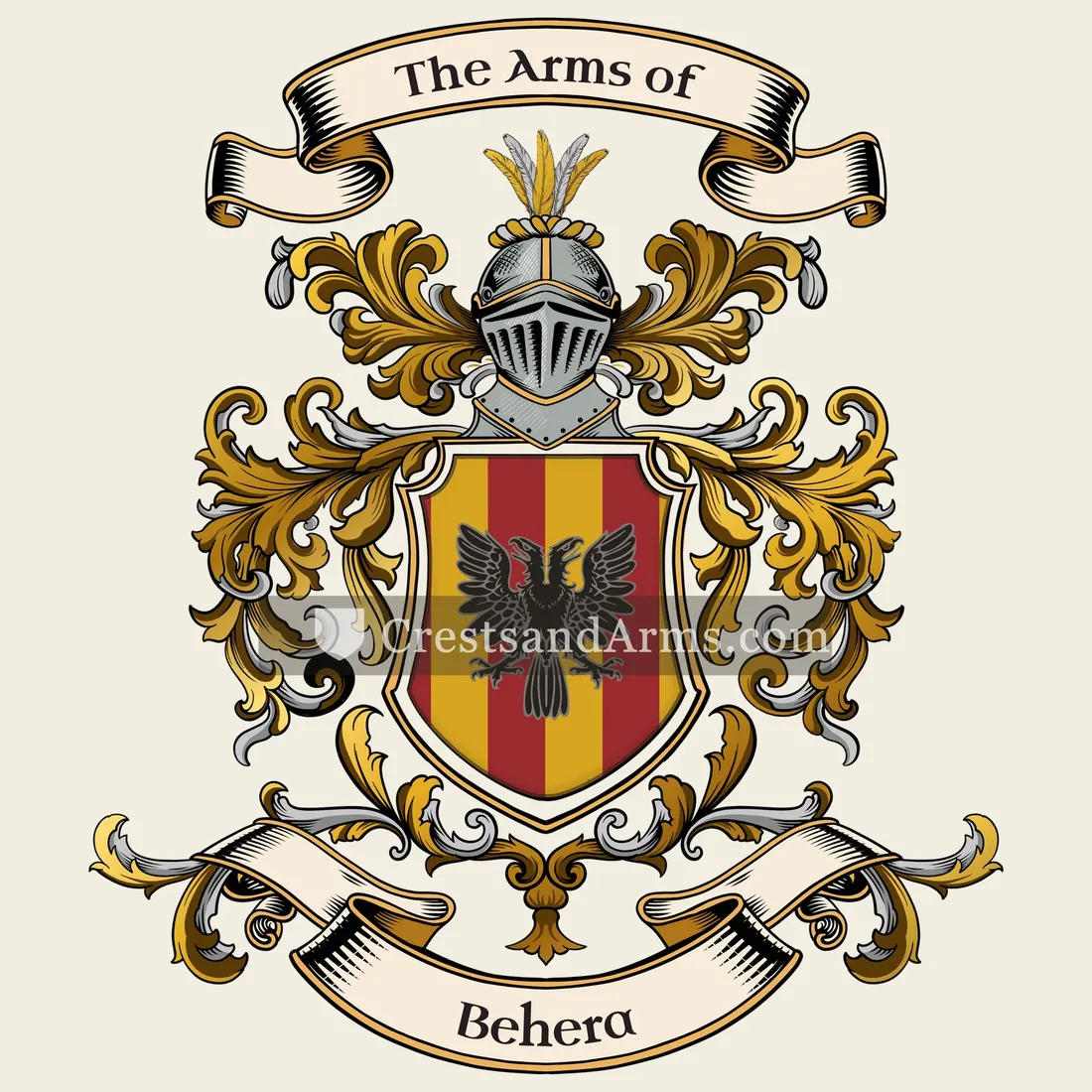
 paleMilitary strength, and a fortified defence
 eagleNobility, strength and a keen mind
 paleMilitary strength, and a fortified defence
 eagleNobility, strength and a keen mind