A record of documented arms, meaning and origin, researched for the Behl family lines. Documented in 2 countries.
Reg. 6129 · Russian, A–C
Meaning of the Behl family crest colors & symbols
Symbols on this shield
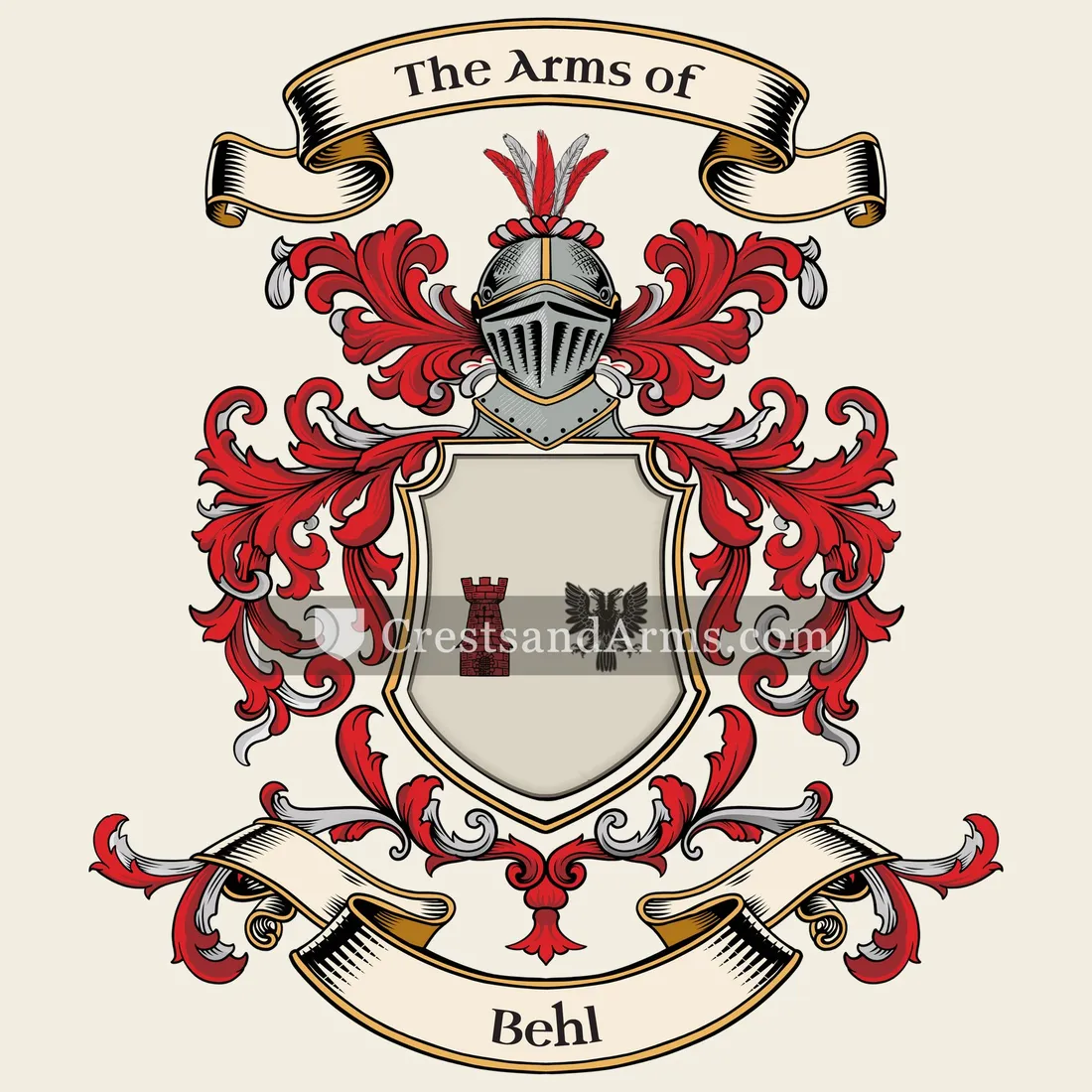
towerGrandeur and solidity, and a stronghold defended
eagleNobility, strength and a keen mind
Colours
Silver (Argent)Means: Peace and sincerity
Red (Gules)Means: Military strength
Black (Sable)Means: Constancy
Historical info
Source
J. B. Rietstap, Armorial Général, Gouda: G. B. van Goor Zonen, 1884–87
Blazon (the actual original written record)
“Coupé d'arg. sur gu., le gu. ch. d'un château d'arg., ouv. et aj. de sa., les créneaux touchant le coupé et supp. une aigle de sa., bq. et m. d'or. Cq. cour. C.: un lion iss. d'or, tenant une bannière d'or ch. d'une aigle de sa., ladite bannière terminée en deux listels de gu., la hampe d'or. L.: à dextre d'arg. et de gu., à sen. d'arg. et de sa.”
RussiaEsthonie, c. 1711
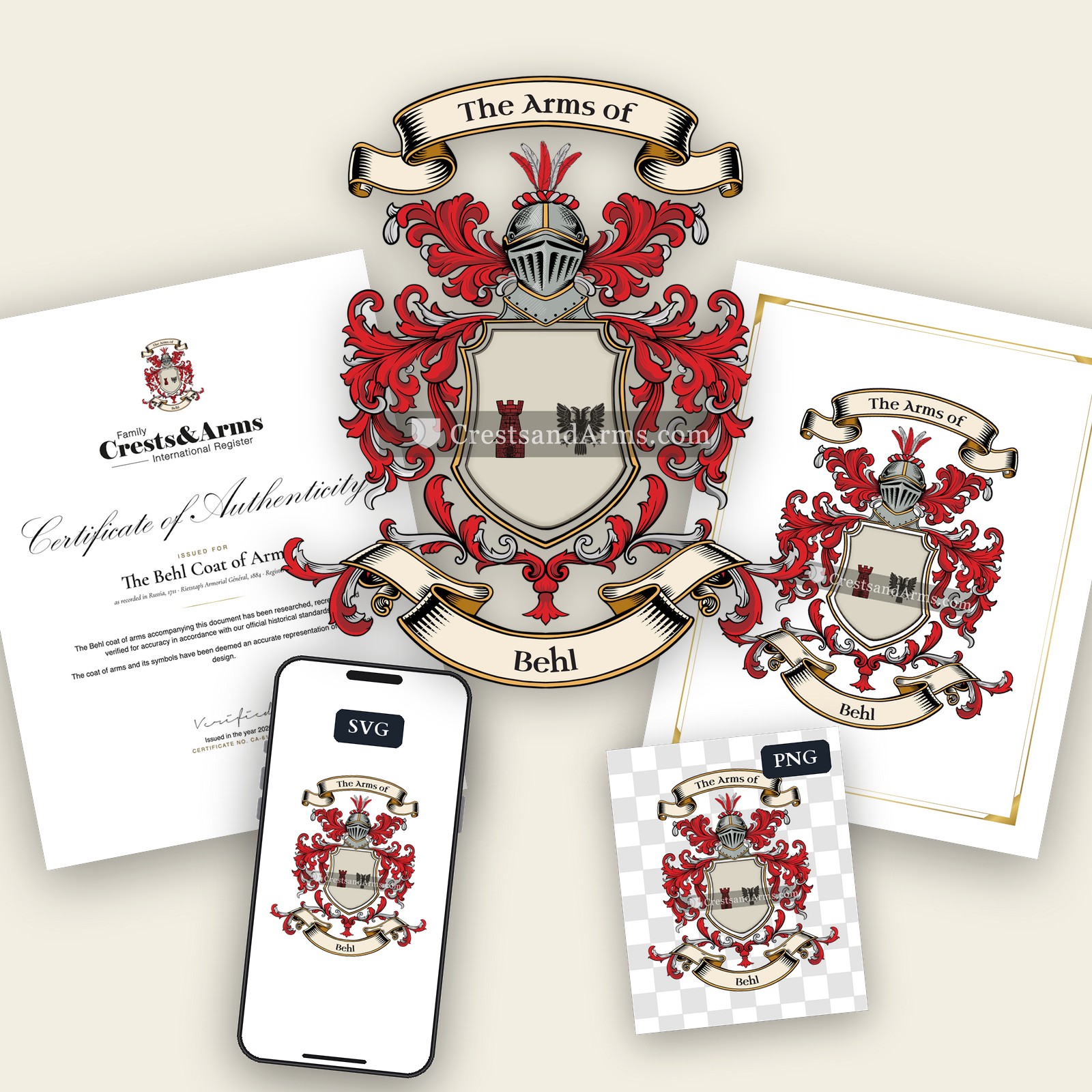
Digital archive packCoat of arms PNG, gold border print PDF, vector SVG and the certificate of authenticity. Sent to your email in minutes.
Map of Russia showing where the Behl arms are recorded
The Behl arms were recorded in Esthonie, c. 1711.
Arms such as these were typically recorded in Moscow.
Moscow held the Russian court, and rank there came from service rather than land. Families who served the Tsar were entered in the registers of nobility, and that entry is where their arms are recorded.
This is where the arms were entered in the register. Families often moved to other parts of the country, so the same name can turn up in more than one region.
The body that granted and recorded arms in Russia in this period.
Peter the Great
Sovereign of the period
Peter the Great
1682–1721
Reigning in Russia when the Behl arms are first recorded.
How Arms Worked in Russia
Russian heraldry was strictly tied to the nobility and the state service system. Families proved their ancient status or earned new rank to receive an official grant from the Tsar. These symbols were then inherited by all legitimate children of the noble line. If a family lacked proof of their status, they were often excluded from the official records entirely.
Granting authority
The Herald Master's Office acted as the central state body that strictly regulated and verified all noble heraldic symbols.
How they got arms
Families typically received their arms through a formal state grant or by proving their noble status to the government authorities.
Where arms were recorded
All approved coats of arms were officially recorded in the General Armorial of the Noble Families of the Russian Empire starting in 1797.
The family's standing
Recorded among the armigerous families of Russia.
Origin & History of the Behl Family in Russia
The history of the Behl family in Russia begins during a period of rapid modernization under Tsar Peter the Great. By 1711, records confirm that members of the family were already established in Moscow, a city that was then the cultural heart of the Russian Empire. During this era, the Russian government actively recruited skilled professionals, artisans, and administrators from across Europe to help build a new, Western-leaning state. It is highly probable that the Behl ancestors arrived in Moscow as part of this wave of migration, seeking new opportunities in a rapidly changing society. As they settled into the city, they likely integrated into the growing community of foreign-born residents who played essential roles in the development of Russian trade, medicine, or civil service. Over time, the family name became part of the diverse social fabric of Moscow, marking their transition from newcomers to established residents of the Russian capital.
Meaning of the Behl family crest colors & symbols
Symbols on this shield
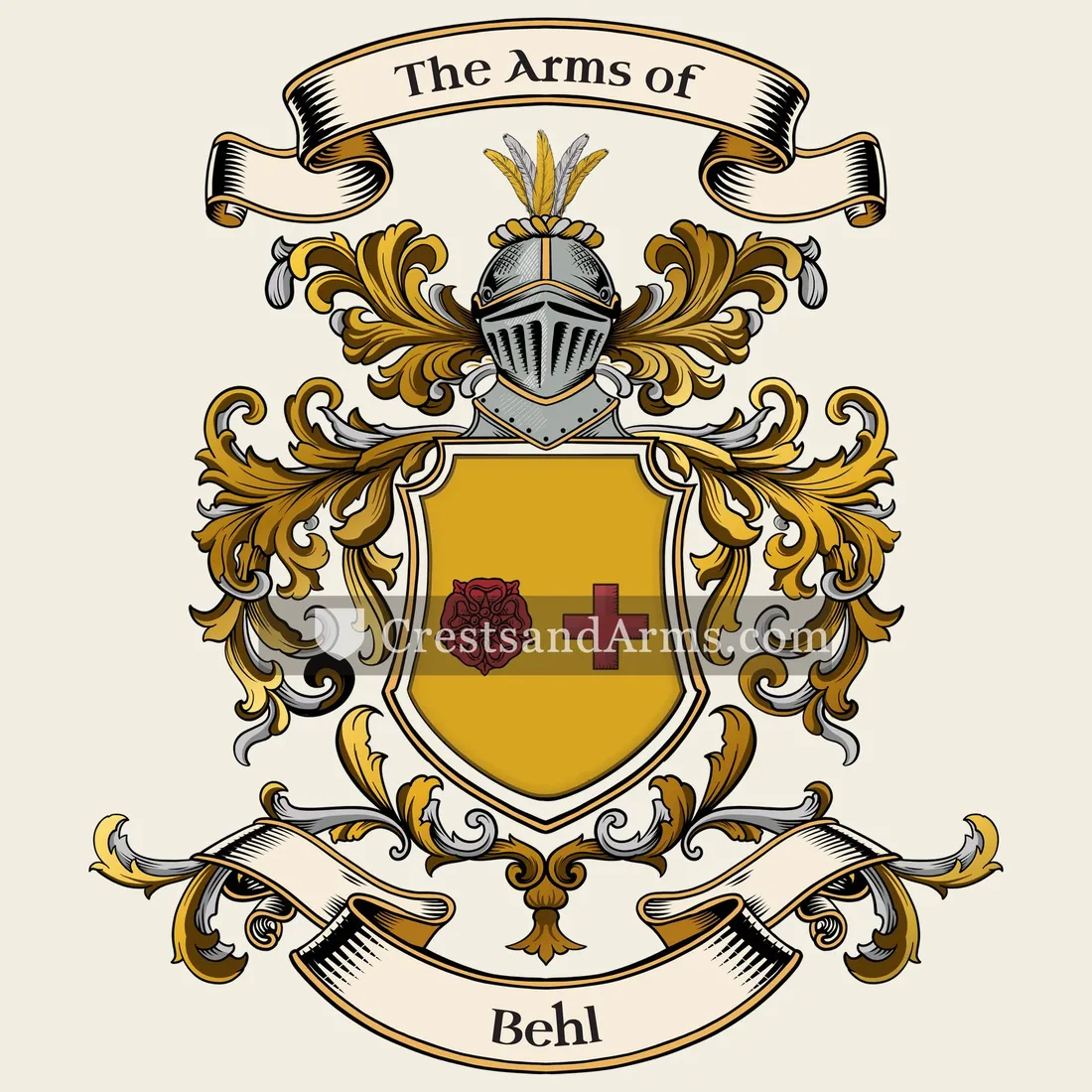
cross symbolChristian faith and service
roseThe seventh son, and beauty with grace
Colours
Gold (Or)Means: Generosity
Red (Gules)Means: Military strength
Historical info
Source
J. B. Rietstap, Armorial Général, Gouda: G. B. van Goor Zonen, 1884–87
Blazon (the actual original written record)
“Taillé: au 1 d'or à la rose de gu., bout. du champ, tigée, feuillée et barbée de sin., et posée en barre; au 2 de gu. à la croix de Lorraine d'or, posée en barre. C.: une femme iss., cour. d'un bandeau d'or, hab. d'azur, ceinte d'or, la main dextre levée et supp. un coeur de gu. dans lequel sont enfoncées deux flèches d'arg., la main sen. appuyée sur sa hanche; le tout entre un vol d'arg. L. d'or et de gu.”
WurttembergWurttemberg, c. 1765
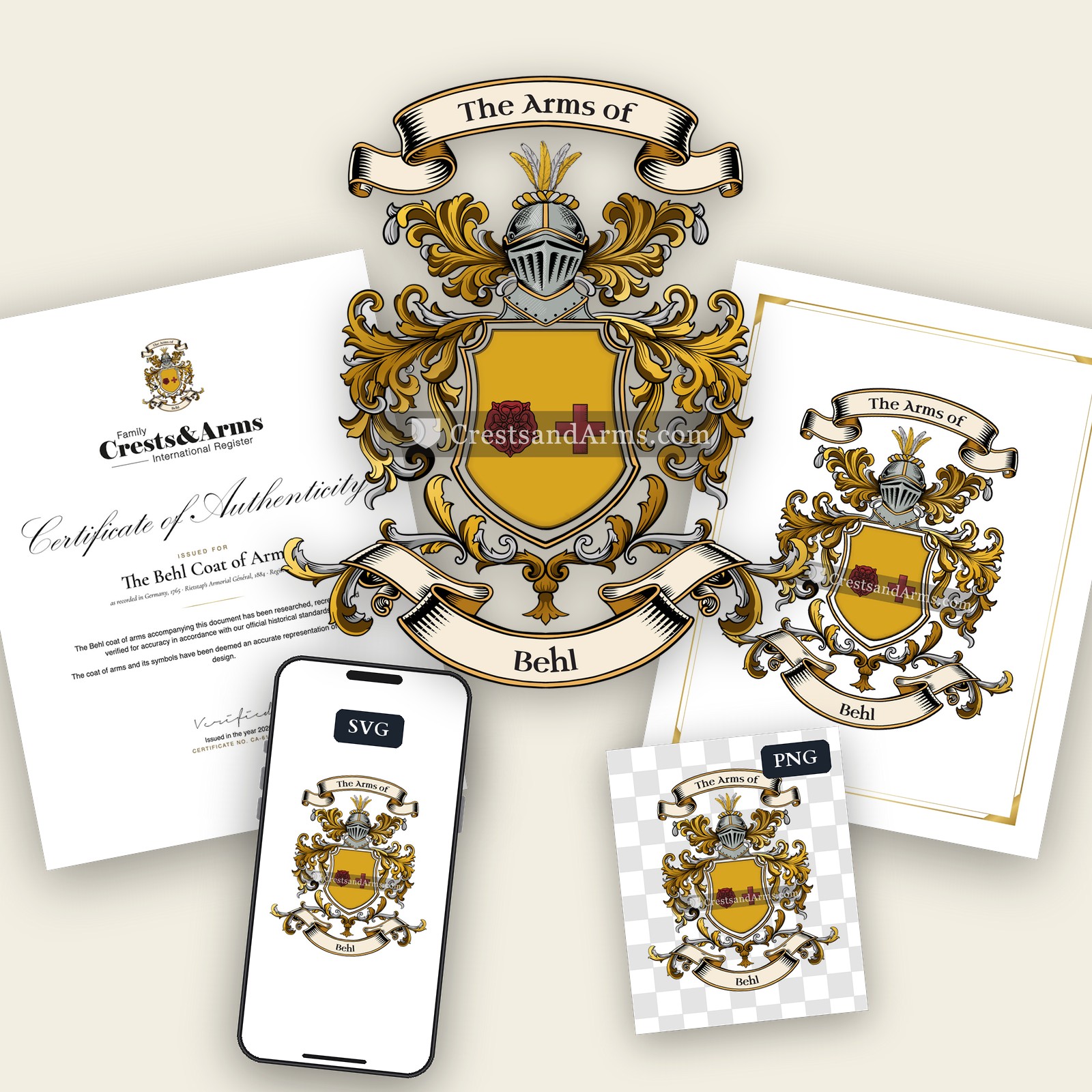
Digital archive packCoat of arms PNG, gold border print PDF, vector SVG and the certificate of authenticity. Sent to your email in minutes.
Map of Germany showing where the Behl arms are recorded
The Behl arms were recorded in Wurttemberg, c. 1765.
Wurttemberg was southern German country of small estates and well-off market towns. Both landowners and leading townsmen kept arms there, so the region carries far more names than its size suggests.
This is where the arms were entered in the register. Families often moved to other parts of the country, so the same name can turn up in more than one region.
The body that granted and recorded arms in Germany in this period.
Francis I, Holy Roman Emperor
Sovereign of the period
Francis I, Holy Roman Emperor
1745–1765
Reigning in Russia when the Behl arms are first recorded.
How Arms Worked in Germany
In the Holy Roman Empire, coats of arms were often granted to individuals by the Emperor or his representatives. These arms were then passed down through the generations to all legitimate descendants of the original holder. Younger branches of a family usually kept the same shield design without needing to change it, as the arms belonged to the entire lineage.
Granting authority
The Holy Roman Emperor held the sole power to grant new coats of arms throughout his vast imperial territories.
How they got arms
Families typically obtained their coats of arms through a formal imperial grant or by proving their noble status to the authorities.
Where arms were recorded
These grants were officially recorded in the Imperial Chancery registers, which began keeping formal records of such honors during the Middle Ages.
The family's standing
Recorded among the armigerous families of Wurttemberg.
Origin & History of the Behl Family in Germany
The surname Behl is deeply rooted in the historical landscape of southwestern Germany, particularly within the region of Württemberg. By the mid-18th century, families bearing this name were well-established in local communities, likely working as farmers or skilled tradespeople. In the German naming tradition, the name Behl is often considered a shortened form of names like Berthold or a descriptive nickname derived from Middle High German terms related to physical appearance or character. During the 1700s, life in Württemberg was defined by strict record-keeping in parish registers, where births, marriages, and deaths were meticulously tracked by local clergy. These early Behl ancestors lived through a time of significant social change as the region transitioned through various political shifts within the Holy Roman Empire. Because the family was present in Württemberg by 1765, they were likely part of the resilient agrarian population that sustained the local economy through generations of stability and regional growth.
Behl Meaning & Related Branches
Root word
Bael
A Germanic or Hebrew term meaning lord, master, or shining one.
This name
BehlA topographic or occupational surname likely denoting a person who lived near a specific landmark or held status.
also spelled
Buhel
Bul
Documented Sources
J. B. Rietstap, Armorial Général, Gouda: G. B. van Goor Zonen, 1884–87
Bauer, Friedrich Wilhelm, Bauer's Map of Moscow, 1739
Russian State Archive of Ancient Documents (RGADA), Fond 1209: Pomestny Prikaz (Land Office Records), 1711
Shvidkovsky, Dmitry, The Empress and the Architect: British Architecture and Gardens at the Court of Catherine the Great, 1996
Digital archive packCoat of arms PNG, gold border print PDF, vector SVG and the certificate of authenticity. Sent to your email in minutes.


 towerGrandeur and solidity, and a stronghold defended
 eagleNobility, strength and a keen mind
 towerGrandeur and solidity, and a stronghold defended
 eagleNobility, strength and a keen mind


 cross symbolChristian faith and service
 roseThe seventh son, and beauty with grace