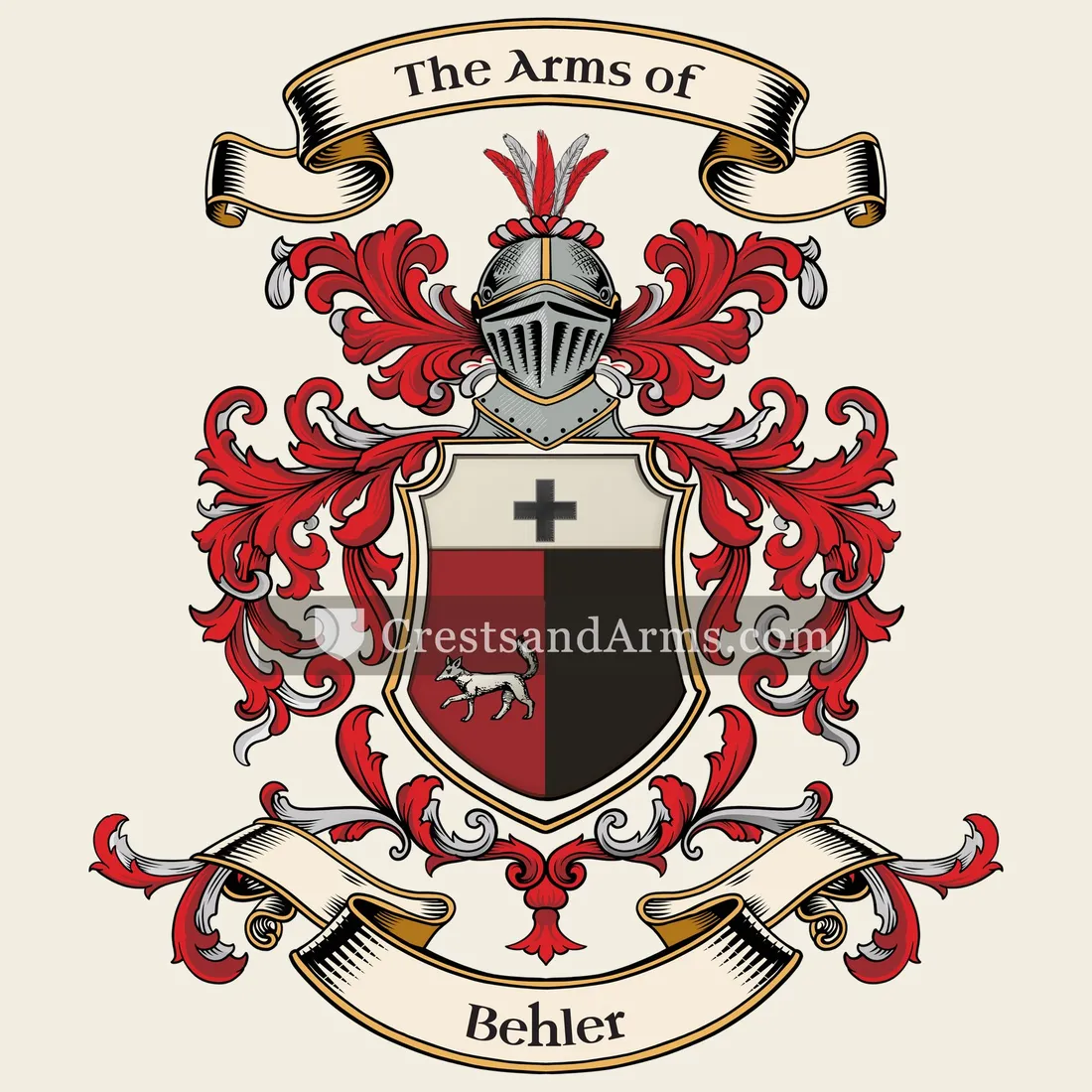
A record of documented arms, meaning and origin, researched for the Behler family of Germany.
Reg. 1177 · German, A–C
Meaning of the Behler family crest colors & symbols
Symbols on this shield
chiefAuthority, wisdom and dominion
cross symbolChristian faith and service
foxWit and wisdom in defence
Colours
Red (Gules)Means: Military strength
Black (Sable)Means: Constancy
Silver (Argent)Means: Peace and sincerity
Historical info
Source
J. B. Rietstap, Armorial Général, Gouda: G. B. van Goor Zonen, 1884–87
Blazon (the actual original written record)
“Parti: au 1 de gu. au renard courant d'arg.; au 2 de sa. à un crochet d'escalade de trois traverses d'arg. Au chef d'arg.; ch. de la Croix de fer. C.: un château de couleur rougeâtre, sommé du drapeau allemand. L.: à dextre d'arg. et de gu., à sen. d'arg. et de sa.”
Germanyc. 1871
Digital archive packCoat of arms PNG, gold border print PDF, vector SVG and the certificate of authenticity. Sent to your email in minutes.
Map of Germany showing where the Behler arms are recorded
The Behler arms were recorded in Germany, c. 1871.
Arms such as these were typically recorded in Bavaria.
Bavaria was a country of old landed families and walled market towns. Estates passed down the same line for centuries, and both the landowners and the leading townsmen kept arms, which is why so many Bavarian names sit in the registers.
This is where the arms were entered in the register. Families often moved to other parts of the country, so the same name can turn up in more than one region.
The body that granted and recorded arms in Germany in this period.
Wilhelm I
Sovereign of the period
Wilhelm I
1861–1888
Reigning in Germany when the Behler arms are first recorded.
How Arms Worked in Germany
Prussian heraldry was strictly tied to social rank and noble status rather than being a free choice for every citizen. These symbols were treated as permanent family property that moved through the generations to all legitimate heirs. If a family branch wanted to change their design to stand out, they had to apply for official permission to alter their specific version of the shield.
Granting authority
The Prussian Heroldsamt acted as the central state office that managed and strictly controlled all noble titles and coats of arms.
How they got arms
Families usually obtained their arms through formal royal grants or by proving their long-standing noble status to the state authorities.
Where arms were recorded
All official coats of arms were kept in the rolls of the Prussian Heroldsamt, which functioned from 1706 until 1918.
The family's standing
Recorded among the armigerous families of Germany.
Origin & History of the Behler Family in Germany
The family name Behler originates from the southern German regions, with deep historical roots in Bavaria. Etymologists believe the name is occupational in nature, likely derived from the Middle High German word *bëhel*, which referred to a person who worked with specific tools or served as a mediator in local trade. By the time of the German Unification in 1871, families bearing this name were well-established members of the Bavarian community. During this era, the region was undergoing significant social and industrial changes that encouraged families to settle in specific towns and villages. Because the name was tied to local trades, many Behler families became deeply integrated into the agricultural and craft-based economies that defined nineteenth-century rural Bavaria. These early ancestors helped build the local infrastructure and social networks that allowed the family name to persist through generations of regional development.
Behler Meaning & Related Branches
Root word
Böhler
Derived from the Middle High German word for a hill or mound.
This name
BehlerAn occupational or topographic name for someone who lived on or near a hill.
also spelled
Byehler
Beeler
Documented Sources
J. B. Rietstap, Armorial Général, Gouda: G. B. van Goor Zonen, 1884–87
Bahlow, Hans. Deutsches Namenlexikon: Familien- und Vornamen nach Ursprung und Sinn erklärt. 1967
Bayerisches Hauptstaatsarchiv. Kirchenbücher und Standesamtsregister. 1871
Heintze, Albert. Die deutschen Familiennamen, geschichtlich, geographisch, sprachlich. 1903
Digital archive packCoat of arms PNG, gold border print PDF, vector SVG and the certificate of authenticity. Sent to your email in minutes.


 chiefAuthority, wisdom and dominion
 cross symbolChristian faith and service
 foxWit and wisdom in defence
 chiefAuthority, wisdom and dominion
 cross symbolChristian faith and service
 foxWit and wisdom in defence