A record of documented arms, meaning and origin, researched for the Behm family lines. Documented in 2 countries.
Reg. 2075 · Austrian, A–C
Meaning of the Behm family crest colors & symbols
Symbols on this shield
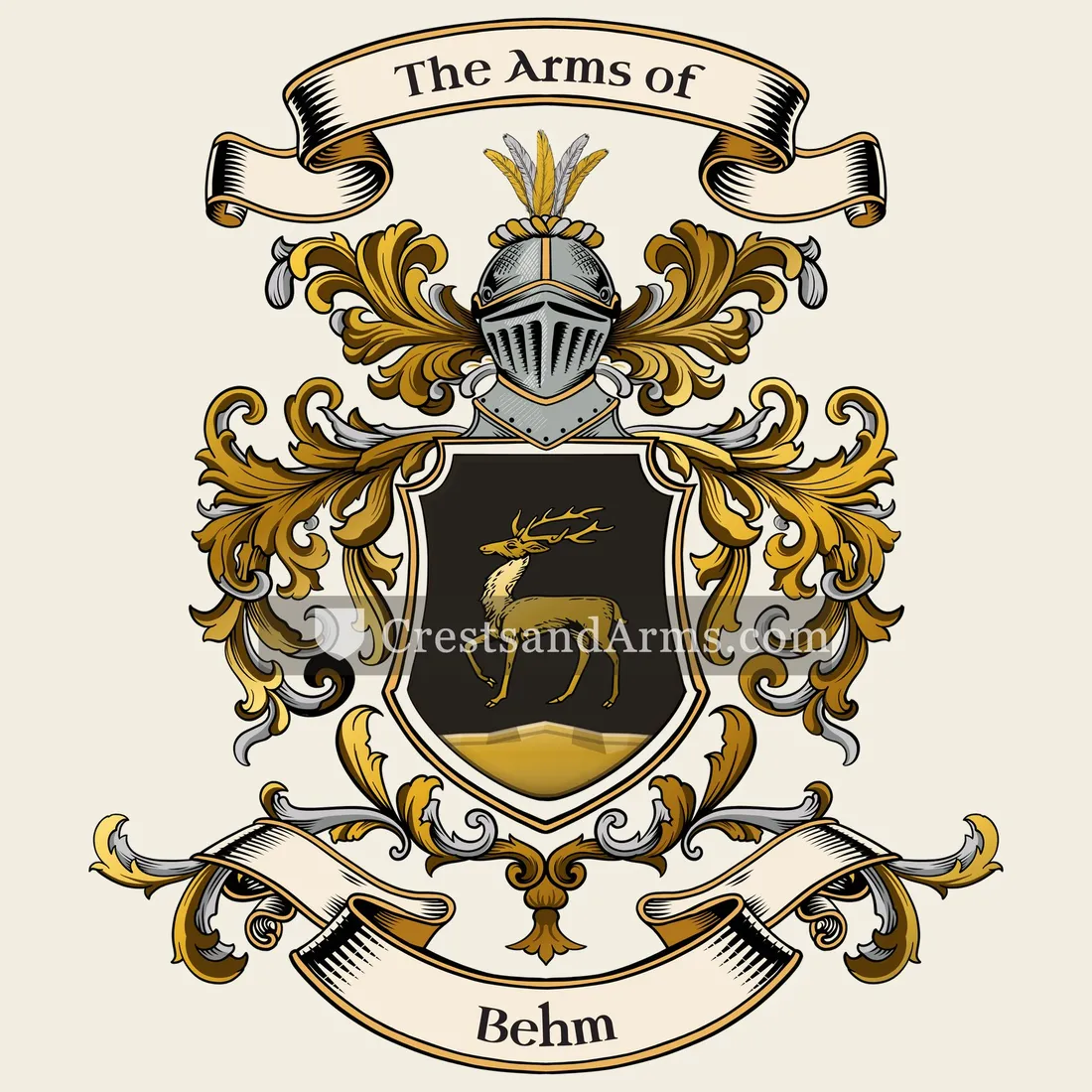
mountThe ground held, and steadfastness upon it
stagPeace and harmony, and one who will not fight unprovoked
Colours
Black (Sable)Means: Constancy
Gold (Or)Means: Generosity
Historical info
Source
J. B. Rietstap, Armorial Général, Gouda: G. B. van Goor Zonen, 1884–87
Blazon (the actual original written record)
“De sa. à un cerf arrêté d'or, sur un tertre de trois coupeaux du même, le coupeau du milieu sommé d'un lis d'arg., tigé de sin. C.: deux prob., coupées alt. d'or et de sa., ornées chacune dans son embouchure d'un lis d'arg.”
AustriaVienne, c. 1592
Digital archive packCoat of arms PNG, gold border print PDF, vector SVG and the certificate of authenticity. Sent to your email in minutes.
Map of Austria showing where the Behm arms are recorded
The Behm arms were recorded in Vienne, c. 1592.
This is where the arms were entered in the register. Families often moved to other parts of the country, so the same name can turn up in more than one region.
Region
Vienne
Town
Vienne
First recorded
1592
Granting Authority for the Behm Arms
Imperial and Royal chancery
Sodacan · CC BY-SA 3.0
The body that granted and recorded arms in Austria in this period.
Emperor Rudolf II
Sovereign of the period
Emperor Rudolf II
1576–1612
Reigning in Austria when the Behm arms are first recorded.
How Arms Worked in Austria
Austrian coats of arms were often linked directly to noble titles granted by the Emperor. These symbols belonged to the entire family line rather than just one individual. When a family grew, new branches kept the original design without needing to change it. This system allowed all members of a noble house to share the same identity across many generations.
Granting authority
The Imperial and Royal chancery managed all heraldic matters and controlled the official granting of arms throughout the Austrian lands.
How they got arms
Families typically received their arms through a formal imperial decree that often accompanied the elevation of a person to noble status.
Where arms were recorded
Official records of these grants were kept in the Imperial Register of Nobility which began its formal documentation process in 1453.
The family's standing
Recorded among the armigerous families of Austria.
Origin & History of the Behm Family in Austria
The family name Behm has deep roots in the historical landscape of Austria, where it emerged as a descriptor for individuals who migrated from the region of Bohemia. By the late sixteenth century, the name was firmly established within the social fabric of Vienna. Records confirm that members of the Behm family were active residents of the city by 1592, a time when Vienna served as a vital center of trade and imperial administration. During this era, families with this name often integrated into the urban workforce, contributing to the growth and development of the capital. As the family settled into the city, they became part of the diverse population that defined the Holy Roman Empire. Their presence in the historical archives of Vienna highlights how families moved and adapted to new environments during the Renaissance period.
Meaning of the Behm family crest colors & symbols
Symbols on this shield
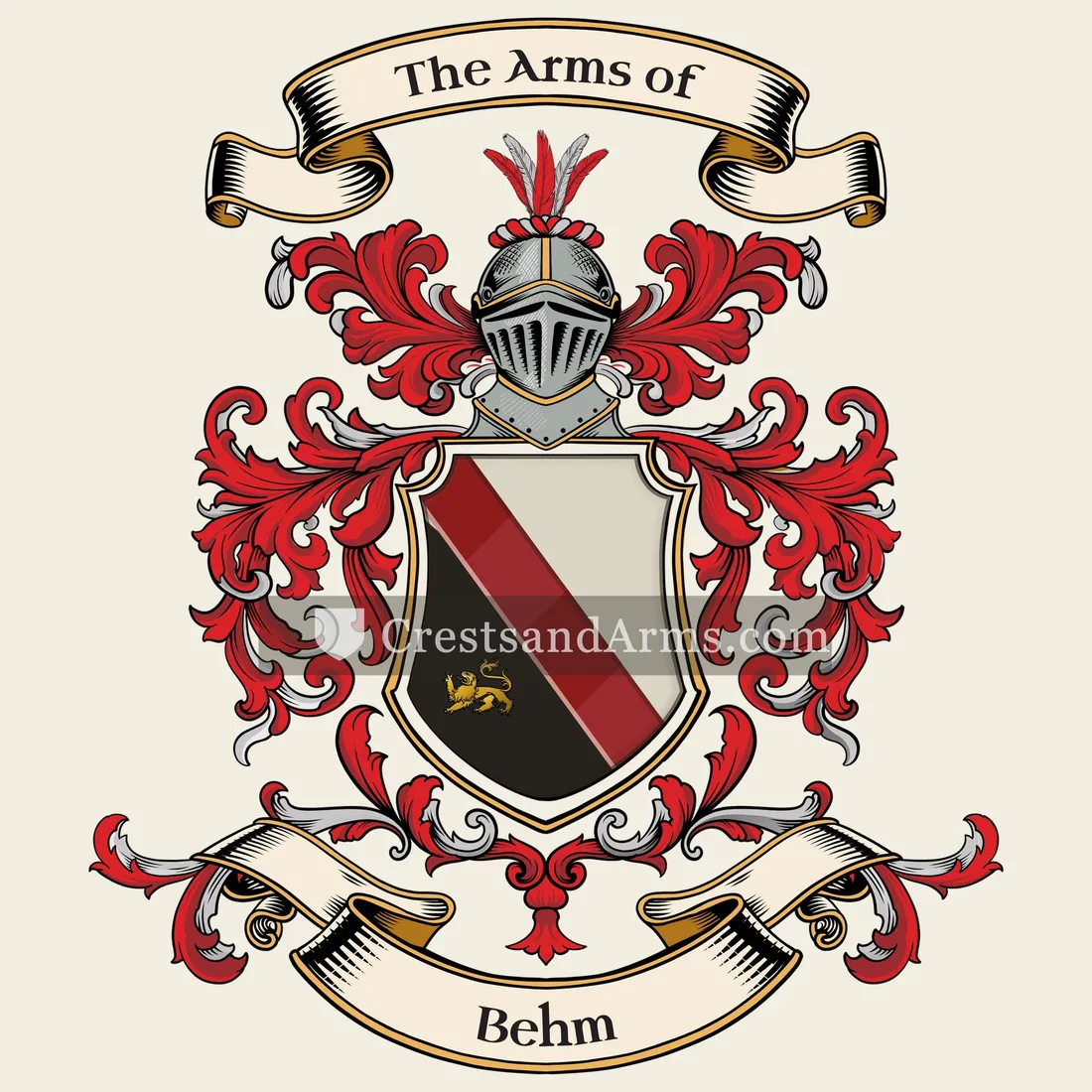
bendDefence, and the scarf of a commander
lionCourage, strength and royalty
Colours
Black (Sable)Means: Constancy
Silver (Argent)Means: Peace and sincerity
Red (Gules)Means: Military strength
Gold (Or)Means: Generosity
Historical info
Source
J. B. Rietstap, Armorial Général, Gouda: G. B. van Goor Zonen, 1884–87
Blazon (the actual original written record)
“Tranché: au 1 de sa. au lion d'or, cour. du même; au 2 d'arg. à la bande de gu. Cq. cour. C.: le lion iss., entre un vol, l'aile dextre bandée et la sen. barrée de sa., d'or, d'arg., de gu. et d'arg. L. d'or et de sa.”
Germanyc. 1765
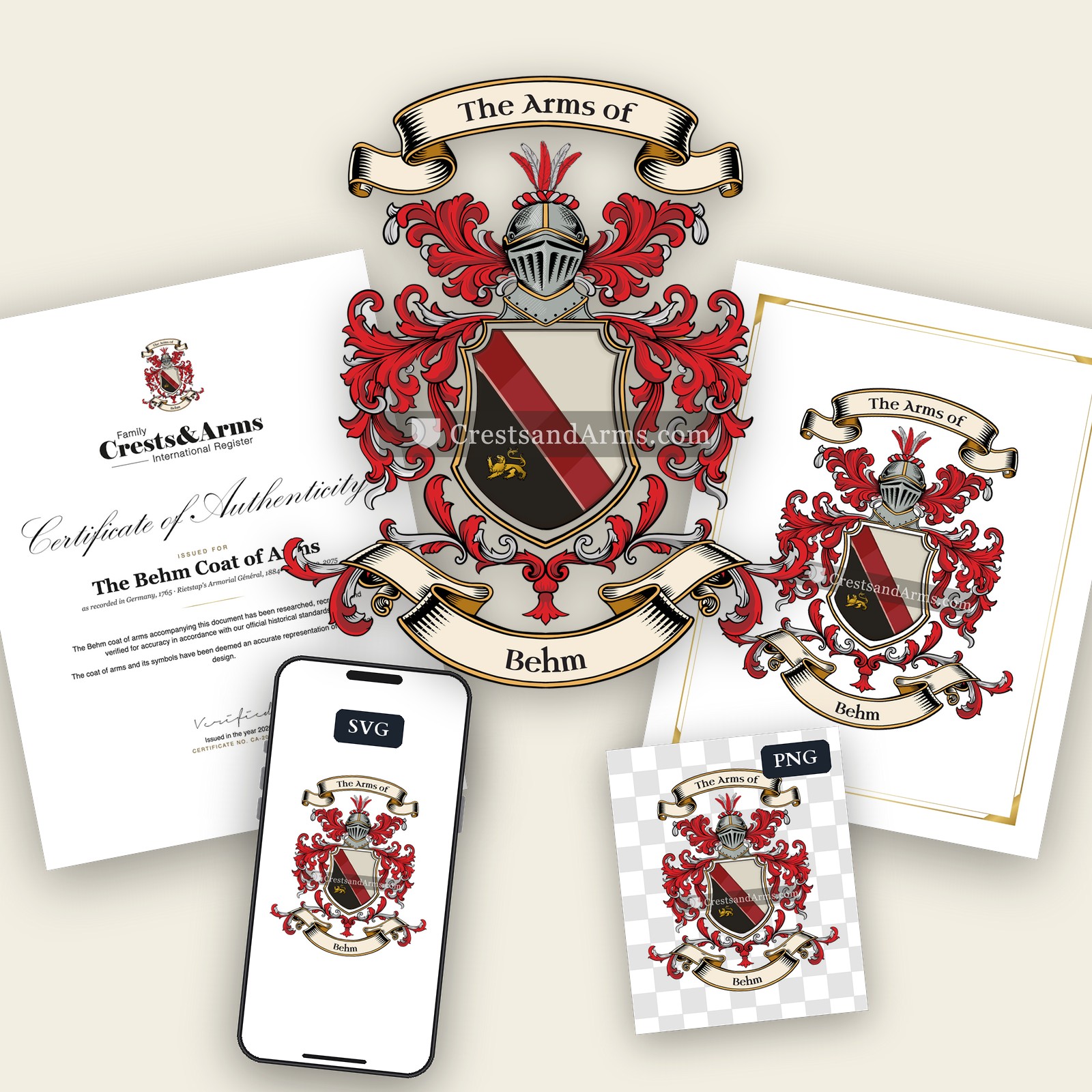
Digital archive packCoat of arms PNG, gold border print PDF, vector SVG and the certificate of authenticity. Sent to your email in minutes.
Map of Germany showing where the Behm arms are recorded
The Behm arms were recorded in Germany, c. 1765.
Arms such as these were typically recorded in Bavaria.
Bavaria was a country of old landed families and walled market towns. Estates passed down the same line for centuries, and both the landowners and the leading townsmen kept arms, which is why so many Bavarian names sit in the registers.
This is where the arms were entered in the register. Families often moved to other parts of the country, so the same name can turn up in more than one region.
The body that granted and recorded arms in Germany in this period.
Francis I, Holy Roman Emperor
Sovereign of the period
Francis I, Holy Roman Emperor
1745–1765
Reigning in Austria when the Behm arms are first recorded.
How Arms Worked in Germany
In the Holy Roman Empire, coats of arms were often granted to individuals by the Emperor or his representatives. These arms were then passed down through the generations to all legitimate descendants of the original holder. Younger branches of a family usually kept the same shield design without needing to change it, as the arms belonged to the entire lineage.
Granting authority
The Holy Roman Emperor held the sole power to grant new coats of arms throughout his vast imperial territories.
How they got arms
Families typically obtained their coats of arms through a formal imperial grant or by proving their noble status to the authorities.
Where arms were recorded
These grants were officially recorded in the Imperial Chancery registers, which began keeping formal records of such honors during the Middle Ages.
The family's standing
Recorded among the armigerous families of Germany.
Origin & History of the Behm Family in Germany
The surname Behm is rooted in the historical regions of Germany, specifically tracing back to the Middle Ages as a descriptive name. It is widely considered a regional identifier, as the term was used to describe people who originated from Bohemia, which is known as Böhmen in the German language. By the time the family was firmly established in Bavaria in 1765, the name had evolved from a simple label for a traveler or migrant into a permanent hereditary surname. During this era, families like the Behms were often integrated into the local agrarian or trade-based economy of southern Germany. Their presence in Bavarian records from the mid-18th century reflects a period of increased record-keeping by local parishes and regional authorities, which helps historians track the movement of families across German-speaking lands. This transition from a geographical nickname to a fixed family name mirrors the broader social shifts occurring in the Holy Roman Empire as populations became more settled and administrative documentation became more standardized.
Behm Meaning & Related Branches
Root word
Böhm
A person originating from the region of Bohemia.
This name
BehmAn occupational or ethnic identifier for someone who migrated from the Czech lands.
Documented Sources
J. B. Rietstap, Armorial Général, Gouda: G. B. van Goor Zonen, 1884–87
Archives: Wiener Stadt- und Landesarchiv, Bürger- und Inwohnerverzeichnisse


 mountThe ground held, and steadfastness upon it
 stagPeace and harmony, and one who will not fight unprovoked
 mountThe ground held, and steadfastness upon it
 stagPeace and harmony, and one who will not fight unprovoked


 bendDefence, and the scarf of a commander
 lionCourage, strength and royalty