A record of documented arms, meaning and origin, researched for the Beiriger family lines. Documented in 3 countries.
Reg. 2307 · French, A–C
Coat of Arms & Family Crest Details
Symbols on this shield
saltireResolution, and St Andrew's cross
bendDefence, and the scarf of a commander
flag / pennantA command held, and a following kept
Colours
Gold (Or)Means: Generosity
Red (Gules)Means: Military strength
Silver (Argent)Means: Peace and sincerity
Historical info
Source
J. B. Rietstap, Armorial Général, Gouda: G. B. van Goor Zonen, 1884–87
Blazon (the actual original written record)
“Ec.: aux 1 et 4 d'or à deux guidons passés en saut., celui à dextre coupé de sa. sur or, celui à sen. coupé de gu. sur arg.; aux 2 et 3 de gu. à la bande ondée d'arg. Cq. cour. C.: un croiss. figuré d'or entre un vol de sa. L.: à dextre d'or et de sa., à sen. de gu. et d'arg.”
Francec. 1608
Digital archive packCoat of arms PNG, gold border print PDF, vector SVG and the certificate of authenticity. Sent to your email in minutes.
Map of France showing where the Beiriger arms are recorded
The Beiriger arms were recorded in France, c. 1608.
Arms such as these were typically recorded in Bretagne.
More families held coats of arms in Bretagne than anywhere else in France. The land was divided into many small estates rather than a few large ones, so far more households counted as gentry, and each needed a shield of its own to be told apart.
This is where the arms were entered in the register. Families often moved to other parts of the country, so the same name can turn up in more than one region.
The body that granted and recorded arms in France in this period.
Henry IV of France
Sovereign of the period
Henry IV of France
1589–1610
Reigning in France when the Beiriger arms are first recorded.
How Arms Worked in France
In France, a coat of arms was a mark of honor that passed down through the male line to all legitimate descendants. Families often used the same shield without changes to show their shared heritage. If a branch wanted to stand out, they could add a small mark to their shield to show their specific place in the family tree.
Granting authority
The Juge d'armes de France acted as the official authority that regulated and verified coats of arms across the country.
How they got arms
Families typically inherited their arms from ancestors, though they could also receive them through royal grants or by proving their noble status.
Where arms were recorded
Coats of arms were officially recorded in the Armorial Général de France, which began its main collection in the year 1696.
The family's standing
Recorded among the armigerous families of France.
Origin & History of the Beiriger Family in France
The history of the Beiriger name in France is deeply rooted in the rugged landscape of the Brittany region during the early seventeenth century. By 1608, members of the family were established in this coastal area, which was known for its distinct cultural identity and maritime traditions. During this period, families often lived in small, tight-knit rural communities where they relied on agriculture or trade to sustain their households. The name likely evolved as a way to identify specific lineages within these local parishes. As the family grew, they became part of the social fabric of the region, navigating the complex political and religious changes that defined life in western France. Their presence in Brittany suggests a long-standing connection to the land and the unique customs of the Breton people, marking the beginning of a family legacy that would eventually span generations.
Coat of Arms & Family Crest Details
Symbols on this shield
paleMilitary strength, and a fortified defence
mountThe ground held, and steadfastness upon it
serpentWisdom, healing and prudence
eagleNobility, strength and a keen mind
Colours
Red (Gules)Means: Military strength
Gold (Or)Means: Generosity
Green (Vert)Means: Hope
Black (Sable)Means: Constancy
Historical info
Source
J. B. Rietstap, Armorial Général, Gouda: G. B. van Goor Zonen, 1884–87
Blazon (the actual original written record)
“Ec.: aux 1 et 4 de gu. à deux couleuvres en pals entrelacées d'or, les têtes regardant les flancs du quartier; aux 2 et 3 d'or à la demi-aigle de sa., bq., m. et cour. du champ, mouv. du parti. Enté en p. d'or à un chamois au nat., posé sur un tertre de sin. Deux cq. cour. C.: 1° les meubles de la p. entée, le chamois cont., entre un vol de sa.; l. d'or et de gu.; 2° un lion iss. d'or, cour. du même; l. d'arg. et de sa.”
SaxonySaxony, c. 1717
Digital archive packCoat of arms PNG, gold border print PDF, vector SVG and the certificate of authenticity. Sent to your email in minutes.
Map of Germany showing where the Beiriger arms are recorded
The Beiriger arms were recorded in Saxony, c. 1717.
Saxony had mines, trade and old landed families all at once. Silver made some fortunes and land held others, and both sorts of family kept arms, which is why Saxon names appear so often in the registers.
This is where the arms were entered in the register. Families often moved to other parts of the country, so the same name can turn up in more than one region.
The body that granted and recorded arms in Germany in this period.
Charles VI, Holy Roman Emperor
Sovereign of the period
Charles VI, Holy Roman Emperor
1711–1740
Reigning in France when the Beiriger arms are first recorded.
How Arms Worked in Germany
In the Holy Roman Empire, coats of arms were often granted to individuals by the Emperor or his representatives. These arms were then passed down through the generations to all legitimate descendants of the original holder. Younger branches of a family usually kept the same shield design without needing to change it, as the arms belonged to the entire lineage.
Granting authority
The Holy Roman Emperor held the sole power to grant new coats of arms throughout his vast imperial territories.
How they got arms
Families typically obtained their coats of arms through a formal imperial grant or by proving their noble status to the authorities.
Where arms were recorded
These grants were officially recorded in the Imperial Chancery registers, which began keeping formal records of such honors during the Middle Ages.
The family's standing
Recorded among the armigerous families of Saxony.
Origin & History of the Beiriger Family in Germany
The Beiriger family name finds its historical roots in the German-speaking regions of Central Europe, with documented evidence placing members of the family in Saxony by the year 1717. During this era, the name likely emerged as a topographic or occupational descriptor within the local dialect, reflecting the way people identified their neighbors in small, tight-knit village communities. Life in 18th-century Saxony was heavily influenced by the agricultural cycles and the strict social hierarchies of the Holy Roman Empire. Families like the Beirigers were often tied to the land or specific local trades, which helped them establish deep roots in the region over several generations. As the family grew, they navigated the complex political shifts of the German states, eventually contributing to the cultural and social fabric of the Saxon landscape long before the modern era of mass migration.
Coat of Arms & Family Crest Details
Symbols on this shield
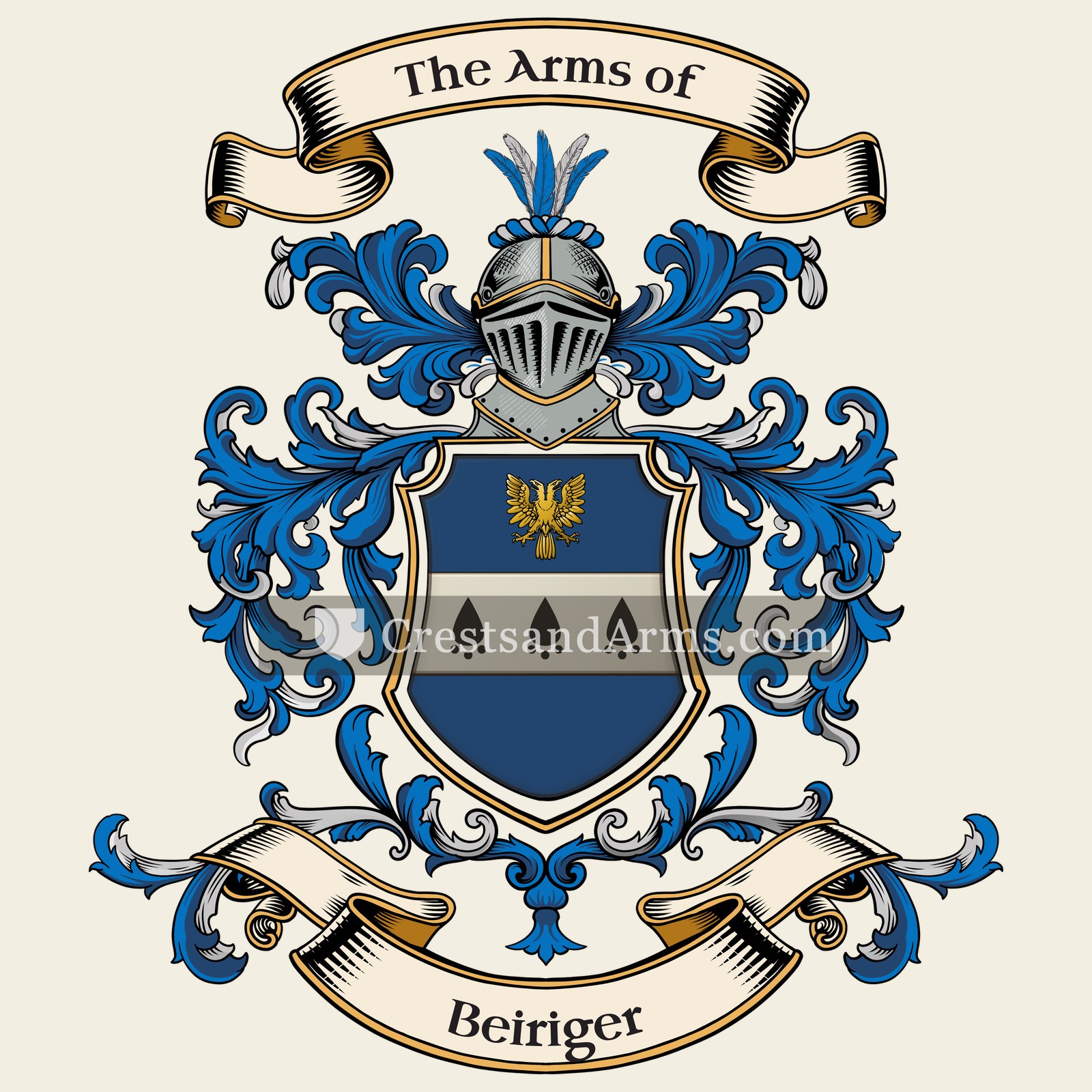
fessThe military belt, and readiness to serve
ermineDignity and rank
eagleNobility, strength and a keen mind
Colours
Blue (Azure)Means: Loyalty and truth
Silver (Argent)Means: Peace and sincerity
Gold (Or)Means: Generosity
Black (Sable)Means: Constancy
Historical info
Source
Sir Bernard Burke, The General Armory of England, Scotland, Ireland and Wales, London: Harrison & Sons, 1884
Blazon (the actual original written record)
“Az. an eagle displ. or, debruised by a fesse ar. charged with three erm. spots sa”
Englandc. 1620
Digital archive packCoat of arms PNG, gold border print PDF, vector SVG and the certificate of authenticity. Sent to your email in minutes.
Map of England showing where the Beiriger arms are recorded
The Beiriger arms were recorded in England, c. 1620.
Arms such as these were typically recorded in York.
Yorkshire is the largest of the English counties, and it held more gentry families than any other. Land there was split among a great many households rather than a few, so a great many of them carried arms.
This is where the arms were entered in the register. Families often moved to other parts of the country, so the same name can turn up in more than one region.
The body that granted and recorded arms in England in this period.
James VI and I
Sovereign of the period
James VI and I
1603–1625
Reigning in France when the Beiriger arms are first recorded.
How Arms Worked in England
English heraldry allowed arms to be shared by all legitimate descendants of the original owner. These symbols were treated as personal property that moved through the generations to all children. While the eldest son kept the original design, other family members could use the same shield without needing to change it or register their own unique versions.
Granting authority
The College of Arms in London has regulated the use of coats of arms throughout England and Wales since 1484.
How they got arms
Families typically obtained their coats of arms through a formal grant from the Crown or by proving their ancient right to them.
Where arms were recorded
All official coats of arms are recorded in the registers kept at the College of Arms, which date back to the fifteenth century.
The family's standing
Recorded among the armigerous families of England.
Origin & History of the Beiriger Family in England
The family name Beiriger has roots that trace back to the historic city of York in the early 17th century. By 1620, records indicate that members of the family were established within this northern English hub, a time when York served as a vital center for trade and religious administration. The name itself suggests a connection to continental European origins, likely arriving in England through migration patterns common among skilled laborers or merchants seeking new opportunities in the bustling urban centers of the north. Life in York during this period was defined by the city’s medieval layout and its role as a regional capital, where families like the Beirigers would have participated in the local economy and social life of the parish. While the name remains rare in English historical documents, its presence in York provides a clear starting point for understanding how the family integrated into the local community during the reign of King James I.
Related Branches & Arms
Root word
Bayer
A person originating from the region of Bavaria in Germany.
This name
BeirigerA locational surname denoting an individual who migrated from the Bavarian region.
also spelled
Bergerh
Bergere
Berzhay
Bergar
Bergher
Documented Sources
J. B. Rietstap, Armorial Général, Gouda: G. B. van Goor Zonen, 1884–87
Archives départementales du Finistère, Registres paroissiaux et d'état civil
Le Moyne de La Borderie, Arthur, Histoire de Bretagne, 1896
Pocquet du Haut-Jussé, Barthélemy, Histoire de la Bretagne, 1937
Digital archive packCoat of arms PNG, gold border print PDF, vector SVG and the certificate of authenticity. Sent to your email in minutes.


 saltireResolution, and St Andrew's cross
 bendDefence, and the scarf of a commander
 flag / pennantA command held, and a following kept
 saltireResolution, and St Andrew's cross
 bendDefence, and the scarf of a commander
 flag / pennantA command held, and a following kept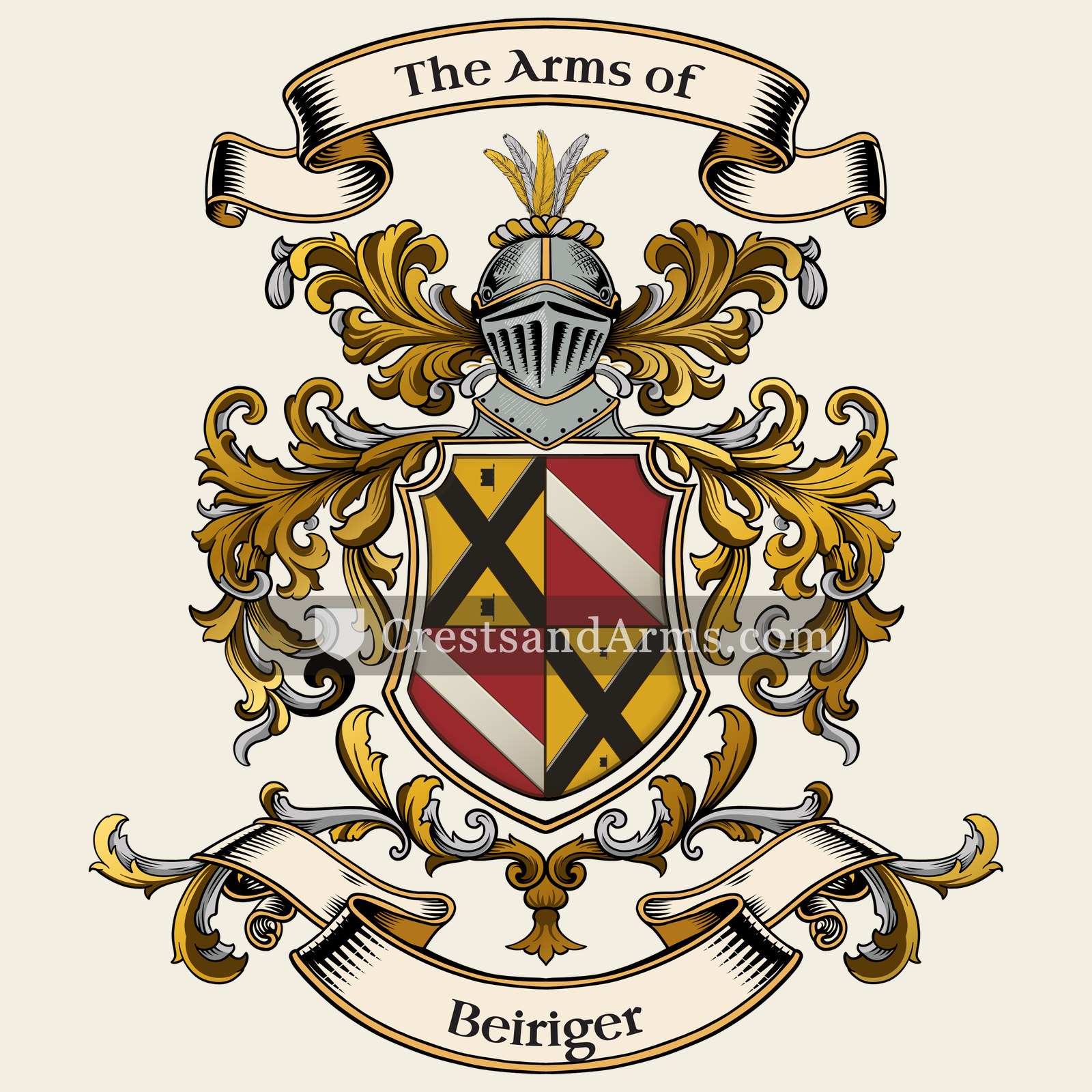


 paleMilitary strength, and a fortified defence
 mountThe ground held, and steadfastness upon it
 serpentWisdom, healing and prudence
 eagleNobility, strength and a keen mind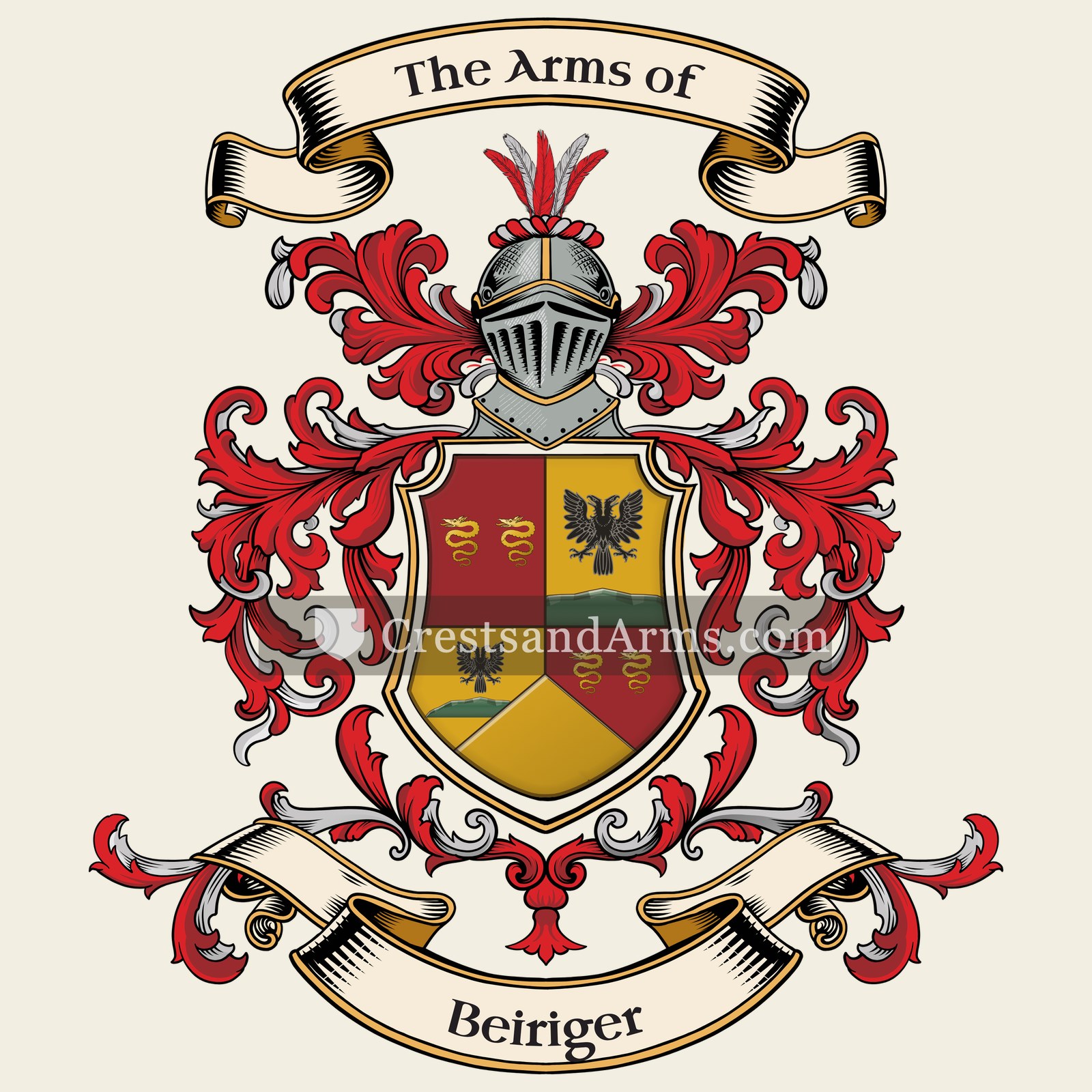


 fessThe military belt, and readiness to serve
 ermineDignity and rank