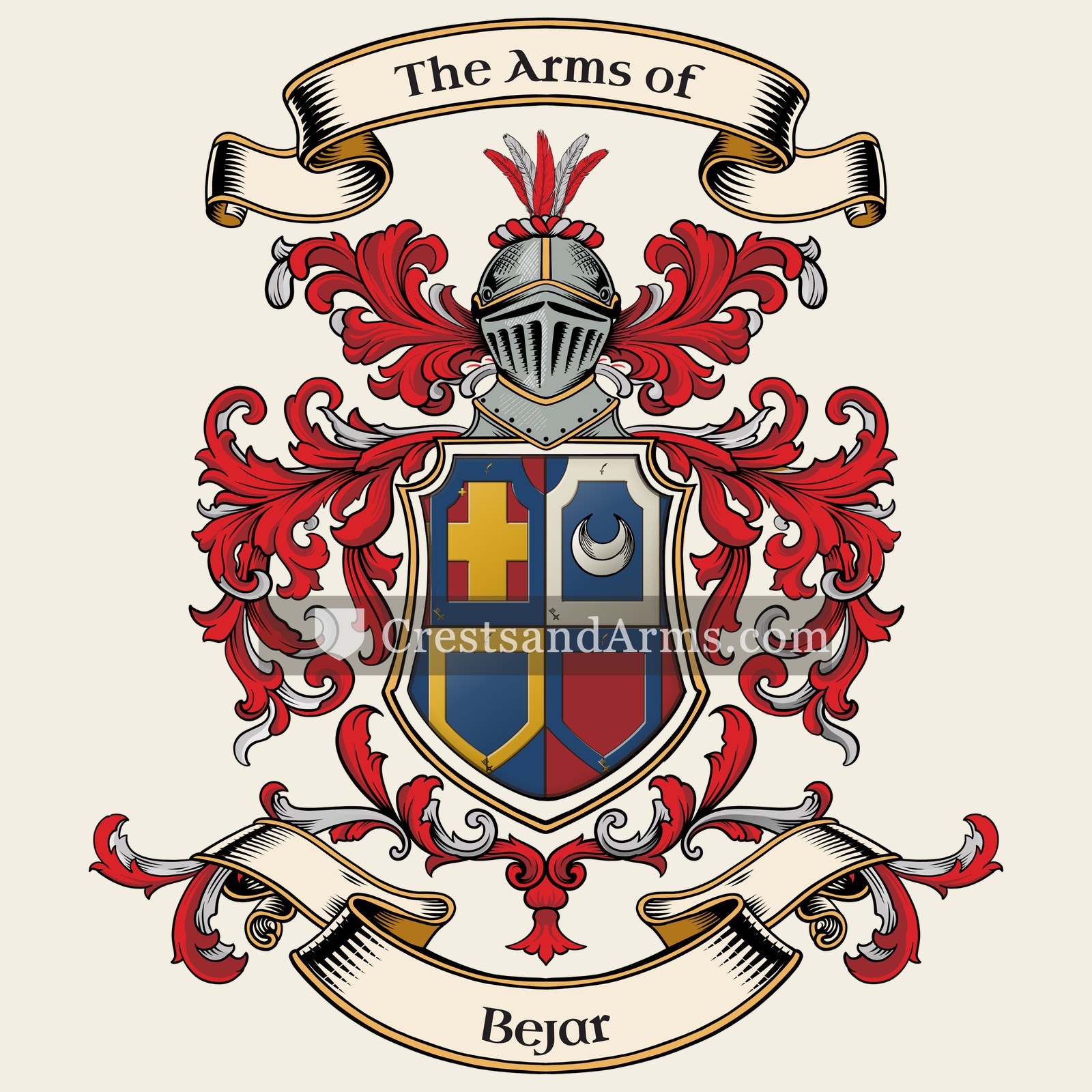
A record of documented arms, meaning and origin, researched for the Bejar family of Spain.
Reg. 8146 · Spanish, A–C
Coat of Arms & Family Crest Details
Symbols on this shield
cross symbolChristian faith and service
swordJustice, and military honour
keyGuardianship, and the office of a steward
crescentHonour by the sovereign, and the second son
Colours
Red (Gules)Means: Military strength
Blue (Azure)Means: Loyalty and truth
Gold (Or)Means: Generosity
Silver (Argent)Means: Peace and sincerity
Historical info
Source
J. B. Rietstap, Armorial Général, Gouda: G. B. van Goor Zonen, 1884–87
Blazon (the actual original written record)
“Ec., de gu. à une croix fleur. d'or, et d'azur au croiss. versé d'arg.; le tout entouré d'une bord. comp. d'azur et de gu. de quatre pièces: sur l'azur une épée et une clé d'arg., élevées l'une l'autre, et sur le gu. une épée et une clé d'or, dans la même position. Cq. cour. C.: la croix de l'écu.”
BrabantBrabant, c. 1722
Digital archive packCoat of arms PNG, gold border print PDF, vector SVG and the certificate of authenticity. Sent to your email in minutes.
Map of Spain showing where the Bejar arms are recorded
The Bejar arms were recorded in Brabant, c. 1722.
Brabant lay at the heart of the Low Countries, where the trade routes met. Its towns were wealthy and its landowners many, and both kinds of family kept arms, which is why the region is so heavily represented.
This is where the arms were entered in the register. Families often moved to other parts of the country, so the same name can turn up in more than one region.
The body that granted and recorded arms in Spain in this period.
Philip V of Spain
Sovereign of the period
Philip V of Spain
1714–1724
Reigning in Spain when the Bejar arms are first recorded.
How Arms Worked in Spain
In Spain, a coat of arms was considered a form of property that belonged to the entire family line. These arms were passed down from a father to all his children equally. Younger branches of the family usually kept the original design without needing to add any special marks to distinguish their specific line.
Granting authority
The Cronista Rey de Armas was the official body that regulated and granted coats of arms throughout Spain.
How they got arms
Families often obtained their arms through royal grants or by proving their noble status to the official heraldic authority.
Where arms were recorded
Coats of arms were officially recorded in the registers of the Cronista Rey de Armas starting in 1496.
The family's standing
Recorded among the armigerous families of Brabant.
Origin & History of the Bejar Family in Spain
The family name Bejar carries a rich history that traces back to the Iberian Peninsula before spreading across Europe. While the name is famously linked to the town of Béjar in the province of Salamanca, Spain, its reach extended far beyond these borders by the early eighteenth century. Historical records confirm that members of the family were established in the region of Brabant by 1722. During this period, Brabant was a bustling center of trade and cultural exchange, making it a significant location for families moving between southern and northern Europe. The presence of the Bejar name in this area suggests that these ancestors were likely involved in the active merchant networks or administrative circles that defined the Low Countries at the time. By settling in such a prominent region, the family became part of the complex migration patterns that shaped the social landscape of eighteenth-century Europe.
Bejar Meaning & Related Branches
Root word
Béjar
Derived from the Latin word Viarium meaning a place of passage.
This name
BejarA topographic surname referring to someone who lived near a road or mountain pass.
also spelled
Behar
Beyar
Documented Sources
J. B. Rietstap, Armorial Général, Gouda: G. B. van Goor Zonen, 1884–87
Pérez Bustamante, Rogelio. El linaje de los duques de Béjar. 1980
Digital archive packCoat of arms PNG, gold border print PDF, vector SVG and the certificate of authenticity. Sent to your email in minutes.


 cross symbolChristian faith and service
 swordJustice, and military honour
 keyGuardianship, and the office of a steward
 crescentHonour by the sovereign, and the second son
 cross symbolChristian faith and service
 swordJustice, and military honour
 keyGuardianship, and the office of a steward
 crescentHonour by the sovereign, and the second son