Map of France showing where the Bellegarde arms are recorded
The Bellegarde arms were recorded in Toulouse, c. 1663.
This is where the arms were entered in the register. Families often moved to other parts of the country, so the same name can turn up in more than one region.
The body that granted and recorded arms in France in this period.
Louis XIV of France
Sovereign of the period
Louis XIV of France
1643–1715
Reigning in France when the Bellegarde arms are first recorded.
How Arms Worked in France
In France, a coat of arms was a mark of honor that passed down through the male line to all legitimate descendants. Families often used the same shield without changes to show their shared heritage. If a branch wanted to stand out, they could add a small mark to their shield to show their specific place in the family tree.
Granting authority
The Juge d'armes de France acted as the official authority that regulated and verified coats of arms across the country.
How they got arms
Families typically inherited their arms from ancestors, though they could also receive them through royal grants or by proving their noble status.
Where arms were recorded
Coats of arms were officially recorded in the Armorial Général de France, which began its main collection in the year 1696.
The family's standing
Recorded among the armigerous families of France.
Origin & History of the Bellegarde Family in France
The name Bellegarde originates from the French words for beautiful and guard, suggesting that the family likely took their name from a fortified location or a scenic defensive position. By 1663, records confirm that members of the family were established in the city of Toulouse, a major cultural and political hub in southern France. During this period, the family was deeply integrated into the social and administrative fabric of the Languedoc region. They lived in an era where the French monarchy was centralizing power, and families like the Bellegardes often served as local officials or professionals who helped maintain order in growing urban centers. Their presence in Toulouse indicates that they were part of the established middle or upper classes who contributed to the intellectual and economic life of the city during the reign of King Louis XIV.
Coat of Arms & Family Crest Details
Symbols on this shield
fireZeal and purification
eagleNobility, strength and a keen mind
Colours
Gold (Or)Means: Generosity
Blue (Azure)Means: Loyalty and truth
Black (Sable)Means: Constancy
Historical info
Source
J. B. Rietstap, Armorial Général, Gouda: G. B. van Goor Zonen, 1884–87
Blazon (the actual original written record)
“Coupé: au 1 d'or à l'aigle ep. de sa., arm. et cour. du champ; au 2 d'azur aux rayons ondés, mouv. d'une portion de cercle du chef vers la pointe de l'écu, le tout d'or; en p. cinq flammes d'or, suivant la direction de ladite portion de cercle. Cq. cour. C.: une aigle iss. d'or. L. d'or et d'azur. S.: deux aigles reg. d'or. D.: EX CANDORE DECUS.”
SilesiaSilesia, c. 1682
Digital archive packCoat of arms PNG, gold border print PDF, vector SVG and the certificate of authenticity. Sent to your email in minutes.
Map of Germany showing where the Bellegarde arms are recorded
The Bellegarde arms were recorded in Silesia, c. 1682.
Silesia was farming country in the east of the German lands, held in large estates by families who stayed put for generations. Owning land was what entitled a family to arms, so the region fills a good deal of the register.
This is where the arms were entered in the register. Families often moved to other parts of the country, so the same name can turn up in more than one region.
The body that granted and recorded arms in Germany in this period.
Leopold I, Holy Roman Emperor
Sovereign of the period
Leopold I, Holy Roman Emperor
1658–1705
Reigning in France when the Bellegarde arms are first recorded.
How Arms Worked in Germany
In the Holy Roman Empire, coats of arms were often granted to individuals by the Emperor or his representatives. These arms were then passed down through the generations to all legitimate descendants of the original holder. Younger branches of a family usually kept the same shield design without needing to change it, as the arms belonged to the entire lineage.
Granting authority
The Holy Roman Emperor held the sole power to grant new coats of arms throughout his vast imperial territories.
How they got arms
Families typically obtained their coats of arms through a formal imperial grant or by proving their noble status to the authorities.
Where arms were recorded
These grants were officially recorded in the Imperial Chancery registers, which began keeping formal records of such honors during the Middle Ages.
The family's standing
Recorded among the armigerous families of Silesia.
Origin & History of the Bellegarde Family in Germany
The Bellegarde family name carries a history deeply rooted in the shifting borders of Central Europe. While the name itself has French origins, the family established a significant presence in the region of Silesia by 1682. During this period, Silesia was a vibrant area under the influence of the Habsburg Monarchy, which encouraged noble families to settle and manage lands across their vast territories. The Bellegardes integrated into the local aristocracy, serving as military officers and administrators who helped maintain order in a region frequently affected by political and religious tensions. By settling in Silesia, the family transitioned from their ancestral roots into the complex social fabric of the Holy Roman Empire. Their influence grew as they participated in the governance and defense of these eastern lands, marking a successful adaptation to the German-speaking cultural sphere of the seventeenth century.
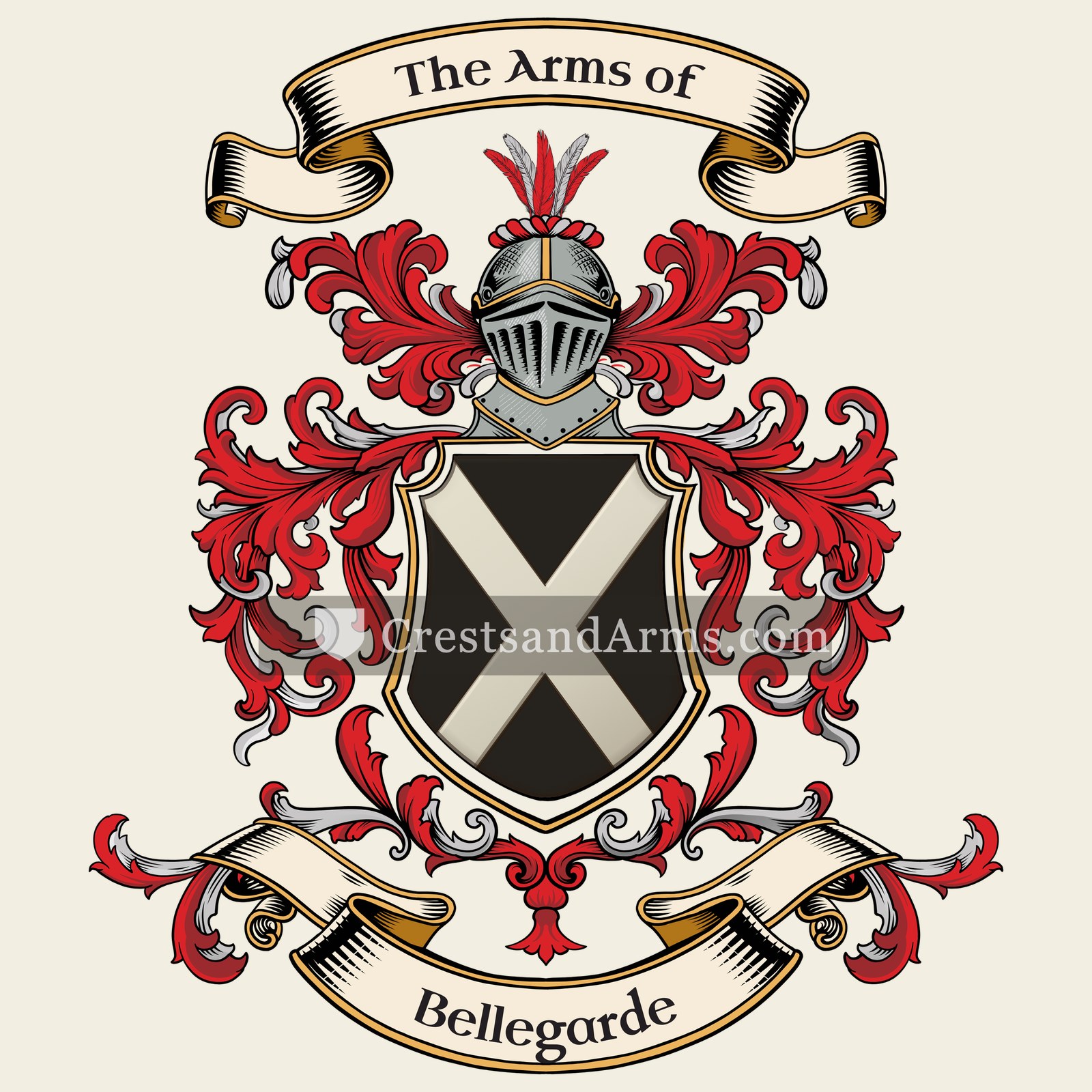
Coat of Arms & Family Crest Details
Symbols on this shield
saltireResolution, and St Andrew's cross
Colours
Black (Sable)Means: Constancy
Silver (Argent)Means: Peace and sincerity
Historical info
Source
J. B. Rietstap, Armorial Général, Gouda: G. B. van Goor Zonen, 1884–87
Blazon (the actual original written record)
“De sa. au saut. d'arg.”
SwitzerlandFribourg, c. 1745
Digital archive packCoat of arms PNG, gold border print PDF, vector SVG and the certificate of authenticity. Sent to your email in minutes.
Map of Switzerland showing where the Bellegarde arms are recorded
The Bellegarde arms were recorded in Fribourg, c. 1745.
This is where the arms were entered in the register. Families often moved to other parts of the country, so the same name can turn up in more than one region.
The body that granted and recorded arms in Switzerland in this period.
How Arms Worked in Switzerland
In Switzerland, coats of arms were not restricted to the nobility and were often adopted by common citizens and families. These symbols were passed down through generations to show family identity. When branches of a family grew, they often changed small details of the design to distinguish their own line from the original group.
Granting authority
Cantonal and civic authorities managed the use of coats of arms within their specific regions and local jurisdictions.
How they got arms
Families typically assumed their own coats of arms based on local custom rather than receiving them from a central monarch.
Where arms were recorded
Arms were recorded in various cantonal and civic registers starting from the fourteenth century throughout the Swiss region.
The family's standing
Recorded among the armigerous families of Switzerland.
Origin & History of the Bellegarde Family in Switzerland
The family name Bellegarde carries a rich history tied to the alpine landscapes and political shifts of Switzerland. While the name itself evokes images of beautiful fortifications, its presence in the region of Fribourg by 1745 suggests a family deeply integrated into the social and administrative fabric of the Old Swiss Confederacy. During the eighteenth century, Fribourg was a center of influence where families like the Bellegardes often navigated the complex intersection of local governance and regional trade. As members of the community, they were likely involved in the civic life of the city, which was then governed by a strict patrician class. The name reflects a period when families were establishing deep roots in specific cantons, often moving between roles in the military, civil service, or local agriculture. By settling in Fribourg, the family became part of a long tradition of Swiss lineage that valued stability and community standing during a time of significant transition in European history.
Bellegarde Meaning & Related Branches
Root word
bellus and garda
Latin for beautiful and Germanic for enclosure or protected place.
This name
BellegardeRefers to a beautiful watchtower or a well-fortified, pleasant defensive position.
also spelled
Belegarde
Belegard
Documented Sources
J. B. Rietstap, Armorial Général, Gouda: G. B. van Goor Zonen, 1884–87
Archives départementales de la Haute-Garonne, Série B: Cours et juridictions
Wolff, Philippe, Histoire de Toulouse, 1974
Digital archive packCoat of arms PNG, gold border print PDF, vector SVG and the certificate of authenticity. Sent to your email in minutes.


 armA person of action, industrious and laborious
 armA person of action, industrious and laborious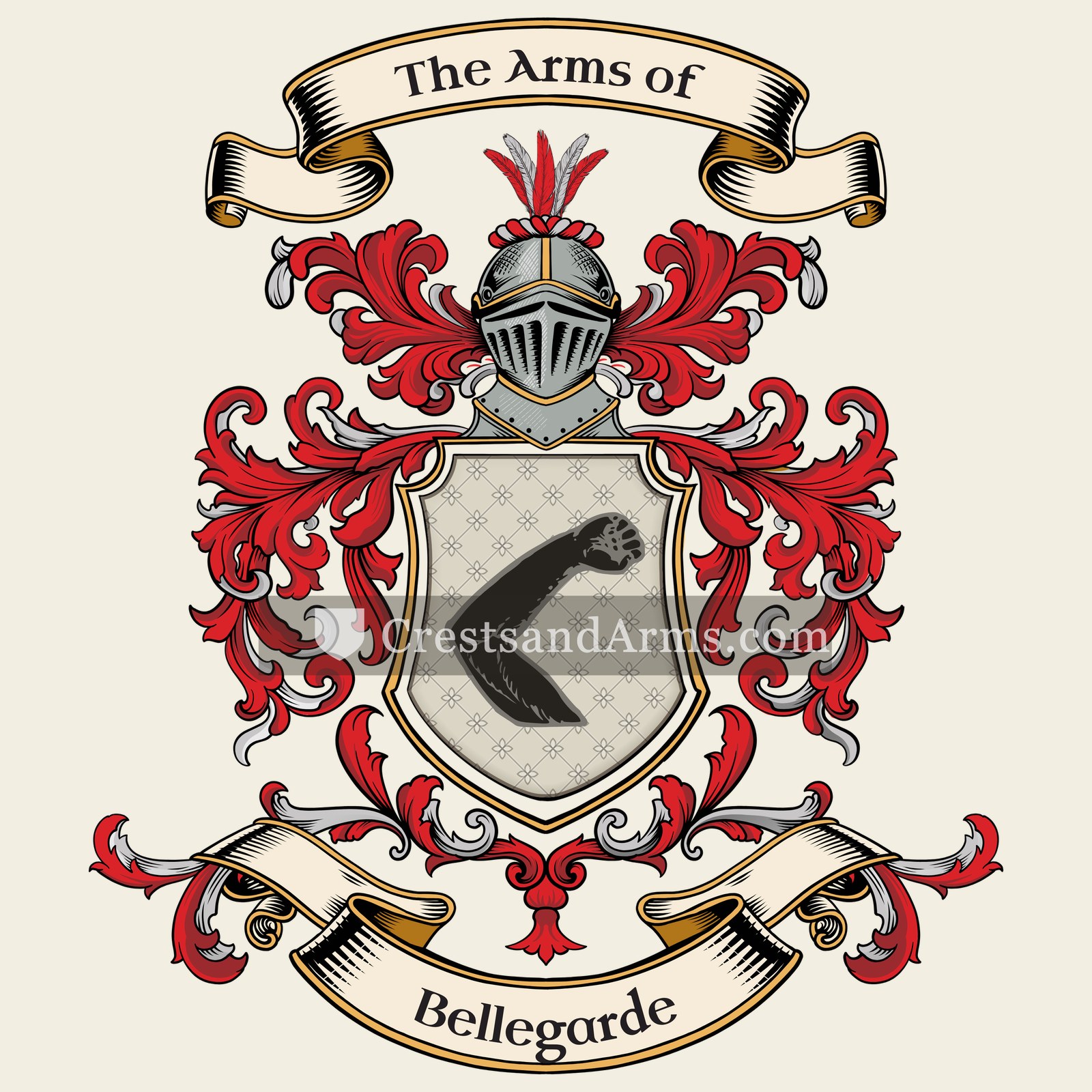


 fireZeal and purification
 eagleNobility, strength and a keen mind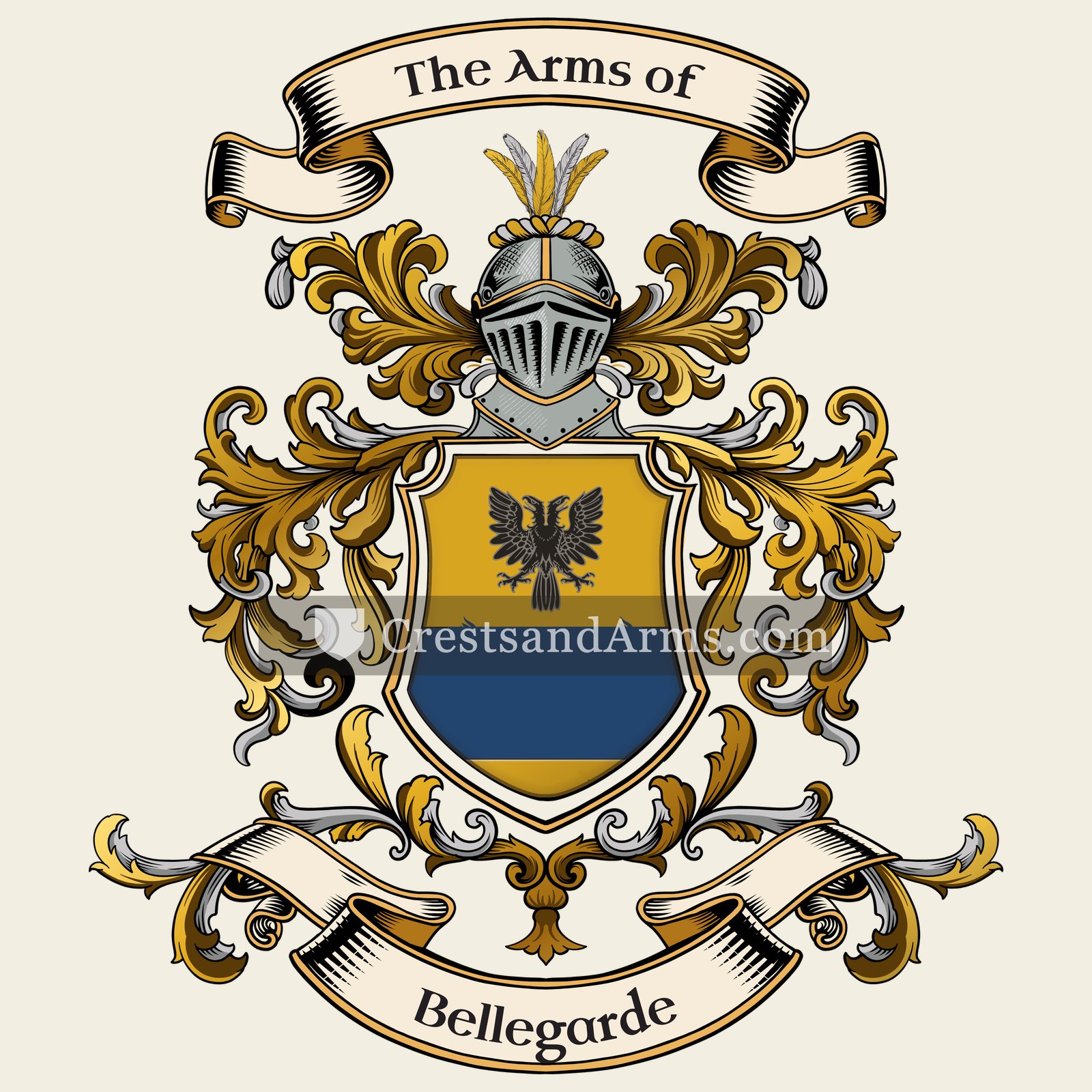


 saltireResolution, and St Andrew's cross