Map of Spain showing where the Bellora arms are recorded
The Bellora arms were recorded in Catalonia, c. 1722.
Catalonia lived by sea trade, and its merchant houses were as powerful as its landowners. Both sorts of family took arms, and Barcelona kept records of the houses entitled to bear them.
This is where the arms were entered in the register. Families often moved to other parts of the country, so the same name can turn up in more than one region.
The body that granted and recorded arms in Spain in this period.
Philip V of Spain
Sovereign of the period
Philip V of Spain
1714–1724
Reigning in Spain when the Bellora arms are first recorded.
How Arms Worked in Spain
In Spain, a coat of arms was considered a form of property that belonged to the entire family line. These arms were passed down from a father to all his children equally. Younger branches of the family usually kept the original design without needing to add any special marks to distinguish their specific line.
Granting authority
The Cronista Rey de Armas was the official body that regulated and granted coats of arms throughout Spain.
How they got arms
Families often obtained their arms through royal grants or by proving their noble status to the official heraldic authority.
Where arms were recorded
Coats of arms were officially recorded in the registers of the Cronista Rey de Armas starting in 1496.
The family's standing
Recorded among the armigerous families of Catalonia.
Origin & History of the Bellora Family in Spain
The family name Bellora traces its historical roots to the northeastern region of Catalonia, where members of the family were documented as early as 1722. During the eighteenth century, this area was a vibrant center for trade and agriculture, and families like the Belloras often lived in small rural communities or growing coastal towns. The name itself likely evolved from local dialects spoken in the Pyrenees mountains or the surrounding Mediterranean plains. Life for the family in the early 1700s was deeply connected to the land and the changing political landscape of the Spanish Crown. As the region experienced shifts in governance and economic growth, the Bellora family established their presence through local community involvement and traditional trades. By preserving their name through generations, they became a small but enduring part of the rich cultural tapestry that defines Catalan history.
Bellora Meaning & Related Branches
Root word
Bellus
Latin term meaning beautiful, handsome, or fair.
This name
BelloraA locative or descriptive surname likely derived from beautiful or fair surroundings.
also spelled
Belera
Documented Sources
J. B. Rietstap, Armorial Général, Gouda: G. B. van Goor Zonen, 1884–87
Arxiu de la Corona d'Aragó, Catàleg de la Secció de Cancelleria Reial
Institut d'Estudis Catalans, Diccionari etimològic i complementari de la llengua catalana, 1980
Pujades, Jeroni, Crònica universal del Principat de Catalunya, 1609
Digital archive packCoat of arms PNG, gold border print PDF, vector SVG and the certificate of authenticity. Sent to your email in minutes.


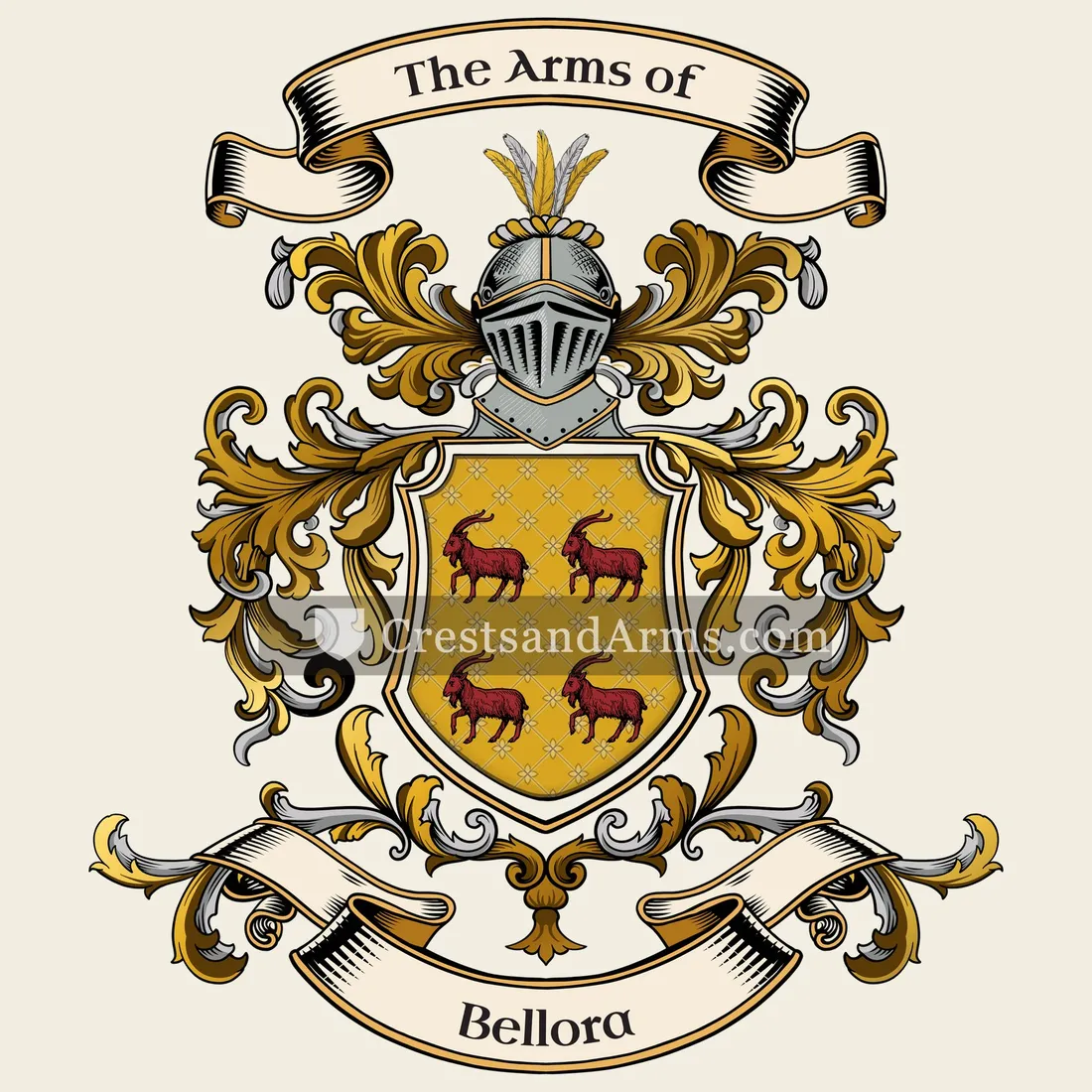
 goatOne who wins by diplomacy rather than force
 goatOne who wins by diplomacy rather than force