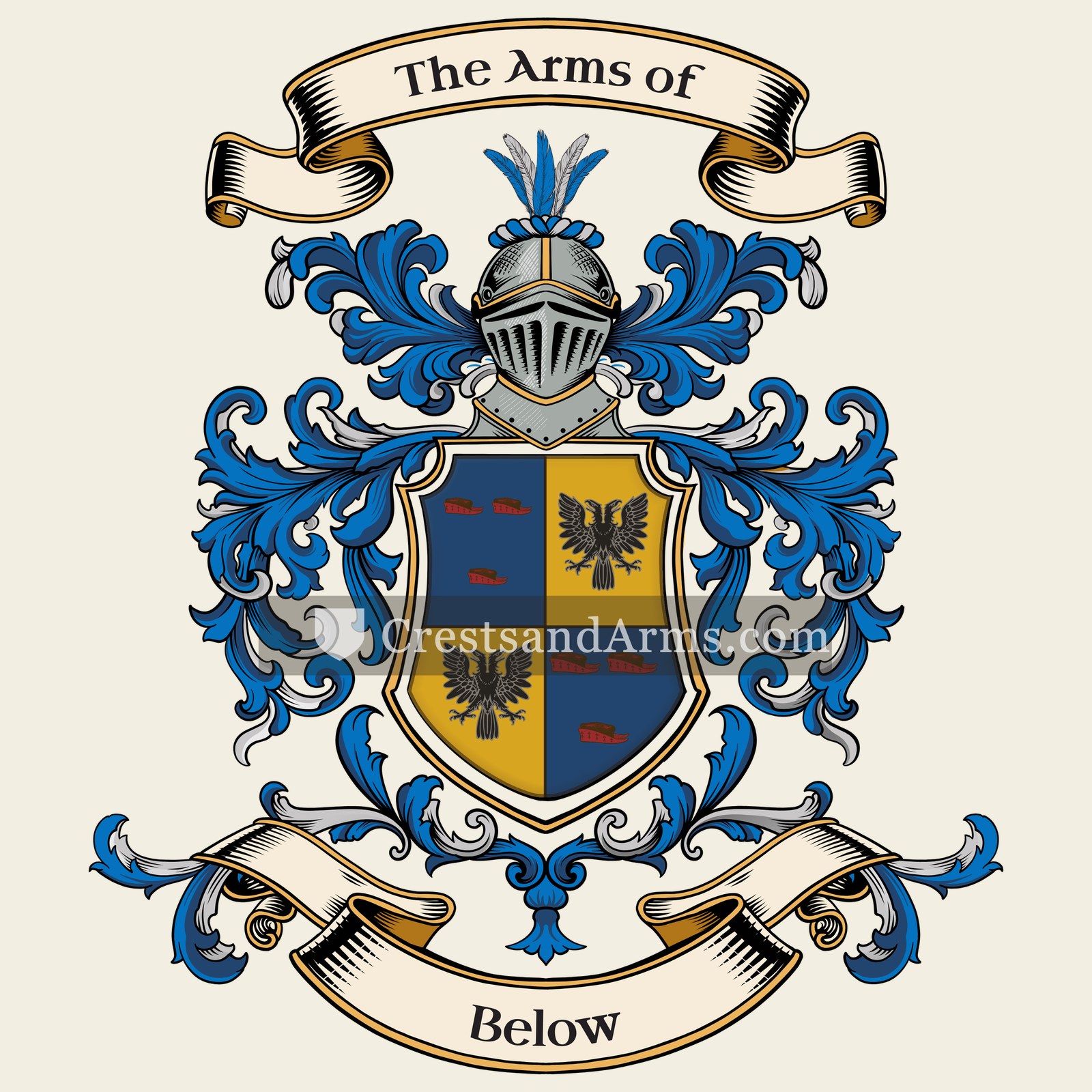
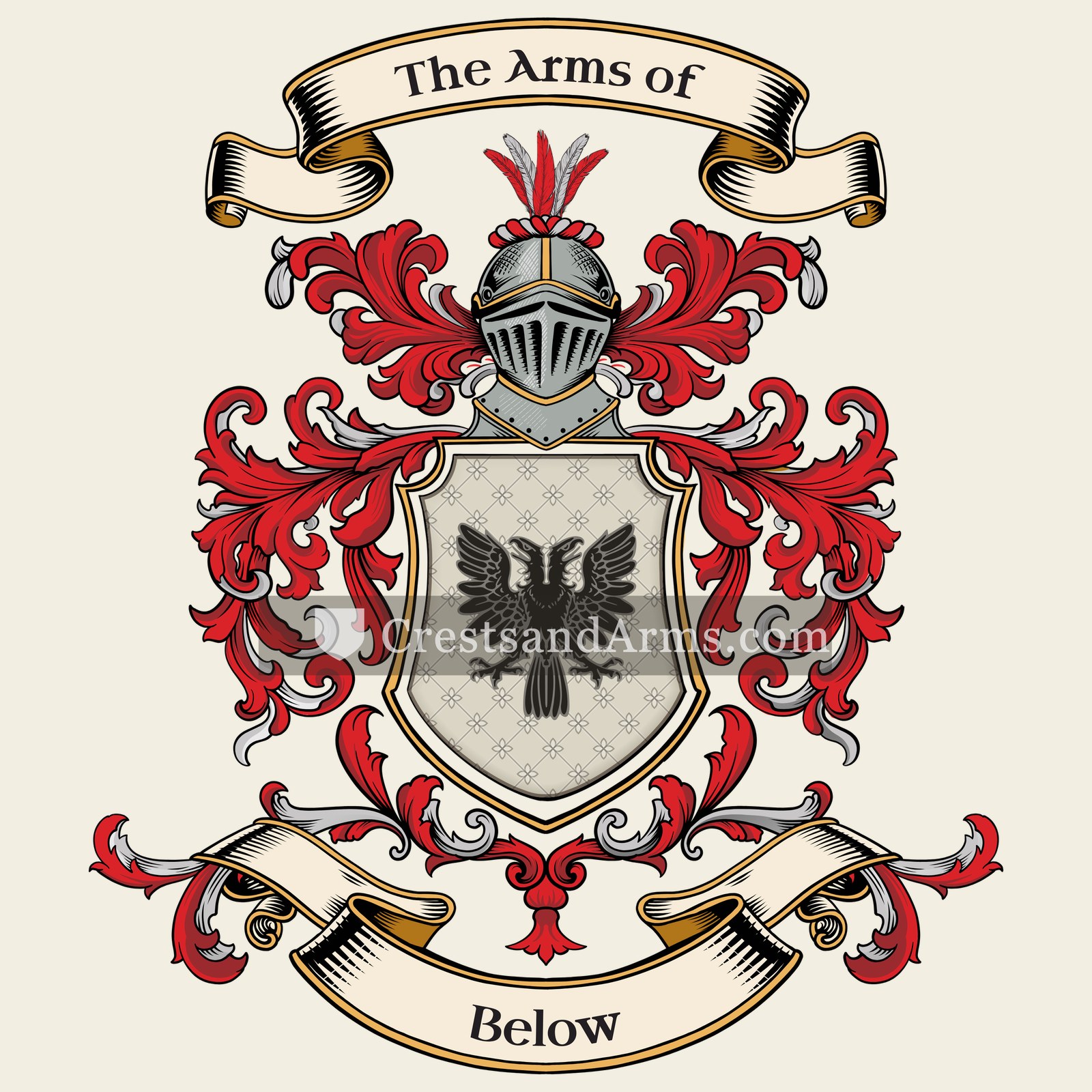
A record of documented arms, meaning and origin, researched for the Below family lines. Documented in 2 countries.
Reg. 3764 · Polish, A–C
Coat of Arms & Family Crest Details
Symbols on this shield
hat or capDignity, and the honour of office
eagleNobility, strength and a keen mind
Colours
Blue (Azure)Means: Loyalty and truth
Gold (Or)Means: Generosity
Red (Gules)Means: Military strength
Black (Sable)Means: Constancy
Historical info
Source
J. B. Rietstap, Armorial Général, Gouda: G. B. van Goor Zonen, 1884–87
Blazon (the actual original written record)
“Ec.: aux 1 et 4 d'azur à trois têtes d'homme de carn., posées de front, coiffées de bonnets albanais de gu., refr. et houppés d'or; aux 2 et 3 d'or à l'aigle ép. de sa., chaque tête diadémée d'or. Trois cq. cour. C.: 1° un bras, arm. d'arg., gantelé du même, iss. de la couronne, le poing fermé; 2° l'aigle ép. du 2; 3° une tête d'homme du 1, le bonnet sommé de sept fers de fléche accostés d'arg. L.: à dextre d'or et de gu., à sen. d'or et de sa.”
LivoniaEsthonie · Livonia, c. 1772
Digital archive packCoat of arms PNG, gold border print PDF, vector SVG and the certificate of authenticity. Sent to your email in minutes.
Map of Poland showing where the Below arms are recorded
The Below arms were recorded in Livonia, c. 1772.
Livonia was Baltic country held by a small number of landed families who kept their estates for centuries. Land there passed down whole rather than being divided, and long unbroken tenure is what fills a register.
This is where the arms were entered in the register. Families often moved to other parts of the country, so the same name can turn up in more than one region.
Region
Livonia
Town
Esthonie
First recorded
1772
Granting Authority for the Below Arms
Ennoblement by the Sejm
Author: Olek Remesz · CC BY-SA 3.0
The body that granted and recorded arms in Poland in this period.
Stanisław August Poniatowski
Sovereign of the period
Stanisław August Poniatowski
1764–1795
Reigning in Poland when the Below arms are first recorded.
How Arms Worked in Poland
Polish noble families shared a single coat of arms across many different surnames, creating large clans rather than individual designs. These symbols were held collectively by all members of the clan regardless of their specific family name. When a new family joined the nobility, they were adopted into an existing clan and began using that group's established shield.
Granting authority
The Sejm, which was the Polish parliament, held the power to grant noble status and the right to bear arms.
How they got arms
Families typically received their coat of arms through a formal act of ennoblement granted by the Sejm for distinguished service.
Where arms were recorded
These grants were officially recorded in the Crown Metrica, which served as the central archive for state documents starting in the sixteenth century.
The family's standing
Recorded among the armigerous families of Livonia.
Origin & History of the Below Family in Poland
The family name Below traces its roots to the Baltic region, where members of the family established a notable presence in Livonia by 1772. During this era, the territory was a complex crossroads of cultural and political influence, shifting between the oversight of the Polish-Lithuanian Commonwealth and the expanding Russian Empire. Families like the Below line often served as administrators or landowners within these borderlands, navigating the social hierarchies that defined life in the eastern Baltic provinces. Because the region was deeply connected to the trade networks and administrative systems of the Polish-Lithuanian state, the family became part of a mobile class of people who moved between rural estates and urban centers. This historical context suggests that the family was well-positioned to adapt to the changing borders and shifting loyalties that characterized the eighteenth century in Eastern Europe.
Coat of Arms & Family Crest Details
Symbols on this shield
eagleNobility, strength and a keen mind
Colours
Silver (Argent)Means: Peace and sincerity
Black (Sable)Means: Constancy
Historical info
Source
J. B. Rietstap, Armorial Général, Gouda: G. B. van Goor Zonen, 1884–87
Blazon (the actual original written record)
“D'arg. à l'aigle ép. de sa., bq. et m. d'or, languée de gu. C.: l'aigle, entre deux bras arm. au nat., les mains de carn.”
MecklenburgMecklenburg, c. 1765
Digital archive packCoat of arms PNG, gold border print PDF, vector SVG and the certificate of authenticity. Sent to your email in minutes.
Map of Germany showing where the Below arms are recorded
The Below arms were recorded in Mecklenburg, c. 1765.
Mecklenburg was farming country in the north of Germany, held by a small number of families who kept their estates for generations. Owning land was what entitled a family to arms, so a great many Mecklenburg names ended up in the registers.
This is where the arms were entered in the register. Families often moved to other parts of the country, so the same name can turn up in more than one region.
The body that granted and recorded arms in Germany in this period.
Francis I, Holy Roman Emperor
Sovereign of the period
Francis I, Holy Roman Emperor
1745–1765
Reigning in Poland when the Below arms are first recorded.
How Arms Worked in Germany
In the Holy Roman Empire, coats of arms were often granted to individuals by the Emperor or his representatives. These arms were then passed down through the generations to all legitimate descendants of the original holder. Younger branches of a family usually kept the same shield design without needing to change it, as the arms belonged to the entire lineage.
Granting authority
The Holy Roman Emperor held the sole power to grant new coats of arms throughout his vast imperial territories.
How they got arms
Families typically obtained their coats of arms through a formal imperial grant or by proving their noble status to the authorities.
Where arms were recorded
These grants were officially recorded in the Imperial Chancery registers, which began keeping formal records of such honors during the Middle Ages.
The family's standing
Recorded among the armigerous families of Mecklenburg.
Origin & History of the Below Family in Germany
The family name Below traces its roots to the northern regions of Germany, particularly within the historic territory of Mecklenburg. By the mid-eighteenth century, the family was well-established in this area, where the name likely originated as a topographical descriptor for people living near a specific valley or low-lying land. In the German language, the word "below" is not used, but the name is linked to the Old German term for a hollow or a low place. During the 1765 period, families in Mecklenburg were often tied to the land through agricultural work or local trade. Life in this region was shaped by the rural landscape and the strict social structures of the time. As the family grew, members moved across the northern German plains, carrying their name as a marker of their geographic heritage and their connection to the local environment.
Below Meaning & Related Branches
Root word
Biel
Old Slavic term for white or bright color.
This name
BelowRefers to a person with a fair complexion or someone living in a white-colored house.
also spelled
Belo
Documented Sources
J. B. Rietstap, Armorial Général, Gouda: G. B. van Goor Zonen, 1884–87
Kasekamp, Andres. A History of the Baltic States. 2010
Plakans, Andrejs. The Latvians: A Short History. 1995
Latvian State Historical Archives, Livlandische Gouvernements-Regierung (Livonian Governorate Government records)
National Archives of Estonia, Eestimaa rüütelkonna suguvõsaedabelid (Genealogical records of the Estonian nobility)
Digital archive packCoat of arms PNG, gold border print PDF, vector SVG and the certificate of authenticity. Sent to your email in minutes.


 hat or capDignity, and the honour of office
 eagleNobility, strength and a keen mind
 hat or capDignity, and the honour of office
 eagleNobility, strength and a keen mind