Map of France showing where the Benet arms are recorded
The Benet arms were recorded in Languedoc, c. 1663.
Languedoc stretched across the south of France, a country of small towns, vineyards and old local families. Its gentry were numerous rather than grand, and a great many of them held arms even where their estates were modest.
This is where the arms were entered in the register. Families often moved to other parts of the country, so the same name can turn up in more than one region.
The body that granted and recorded arms in France in this period.
Louis XIV of France
Sovereign of the period
Louis XIV of France
1643–1715
Reigning in France when the Benet arms are first recorded.
How Arms Worked in France
In France, a coat of arms was a mark of honor that passed down through the male line to all legitimate descendants. Families often used the same shield without changes to show their shared heritage. If a branch wanted to stand out, they could add a small mark to their shield to show their specific place in the family tree.
Granting authority
The Juge d'armes de France acted as the official authority that regulated and verified coats of arms across the country.
How they got arms
Families typically inherited their arms from ancestors, though they could also receive them through royal grants or by proving their noble status.
Where arms were recorded
Coats of arms were officially recorded in the Armorial Général de France, which began its main collection in the year 1696.
The family's standing
Recorded among the armigerous families of Languedoc.
Origin & History of the Benet Family in France
The family name Benet has deep roots in the Languedoc region of southern France, where records confirm members of the family were living as early as 1663. The name itself is a shortened form of the Latin name Benedictus, which translates to blessed. During the seventeenth century, families in this part of France often lived in small agricultural communities where they were closely tied to the local parish church. Because the name was linked to a religious term, it was likely adopted by ancestors who wanted to express their faith or honor a specific saint. As the family grew, they became part of the social fabric of the Languedoc landscape, participating in the daily life and local traditions of the French countryside during the reign of King Louis XIV.
Coat of Arms & Family Crest Details
Colours
Red (Gules)Means: Military strength
Historical info
Source
J. B. Rietstap, Armorial Général, Gouda: G. B. van Goor Zonen, 1884–87
Blazon (the actual original written record)
“De gu. à trois carreaux d'or, ch. chacun d'un B de sa.”
Spainc. 1722
Digital archive packCoat of arms PNG, gold border print PDF, vector SVG and the certificate of authenticity. Sent to your email in minutes.
Map of Spain showing where the Benet arms are recorded
The Benet arms were recorded in Spain, c. 1722.
Arms such as these were typically recorded in Castile.
Castile was the heart of Spain and the source of most of its noble families. Land won in the long wars against the Moors was granted out to fighting men, and a man granted land was granted arms along with it.
This is where the arms were entered in the register. Families often moved to other parts of the country, so the same name can turn up in more than one region.
The body that granted and recorded arms in Spain in this period.
Philip V of Spain
Sovereign of the period
Philip V of Spain
1714–1724
Reigning in France when the Benet arms are first recorded.
How Arms Worked in Spain
In Spain, a coat of arms was considered a form of property that belonged to the entire family line. These arms were passed down from a father to all his children equally. Younger branches of the family usually kept the original design without needing to add any special marks to distinguish their specific line.
Granting authority
The Cronista Rey de Armas was the official body that regulated and granted coats of arms throughout Spain.
How they got arms
Families often obtained their arms through royal grants or by proving their noble status to the official heraldic authority.
Where arms were recorded
Coats of arms were officially recorded in the registers of the Cronista Rey de Armas starting in 1496.
The family's standing
Recorded among the armigerous families of Spain.
Origin & History of the Benet Family in Spain
The surname Benet has deep roots in the Iberian Peninsula, where it evolved from the Latin name Benedictus, meaning blessed. By the early 18th century, the family was firmly established in the region of Castile, a central area of Spain known for its historical influence and agricultural development. During this period, families like the Benets were often involved in the social and economic shifts that defined the Spanish countryside. As the name spread through different provinces, it became associated with local communities that valued lineage and land ownership. The presence of the Benet name in Castile by 1722 suggests that the family was part of the steady expansion of settled populations during the Bourbon era. This time was marked by efforts to improve local administration and record-keeping, which helped families solidify their identity within the Spanish social structure.
Coat of Arms & Family Crest Details
Symbols on this shield
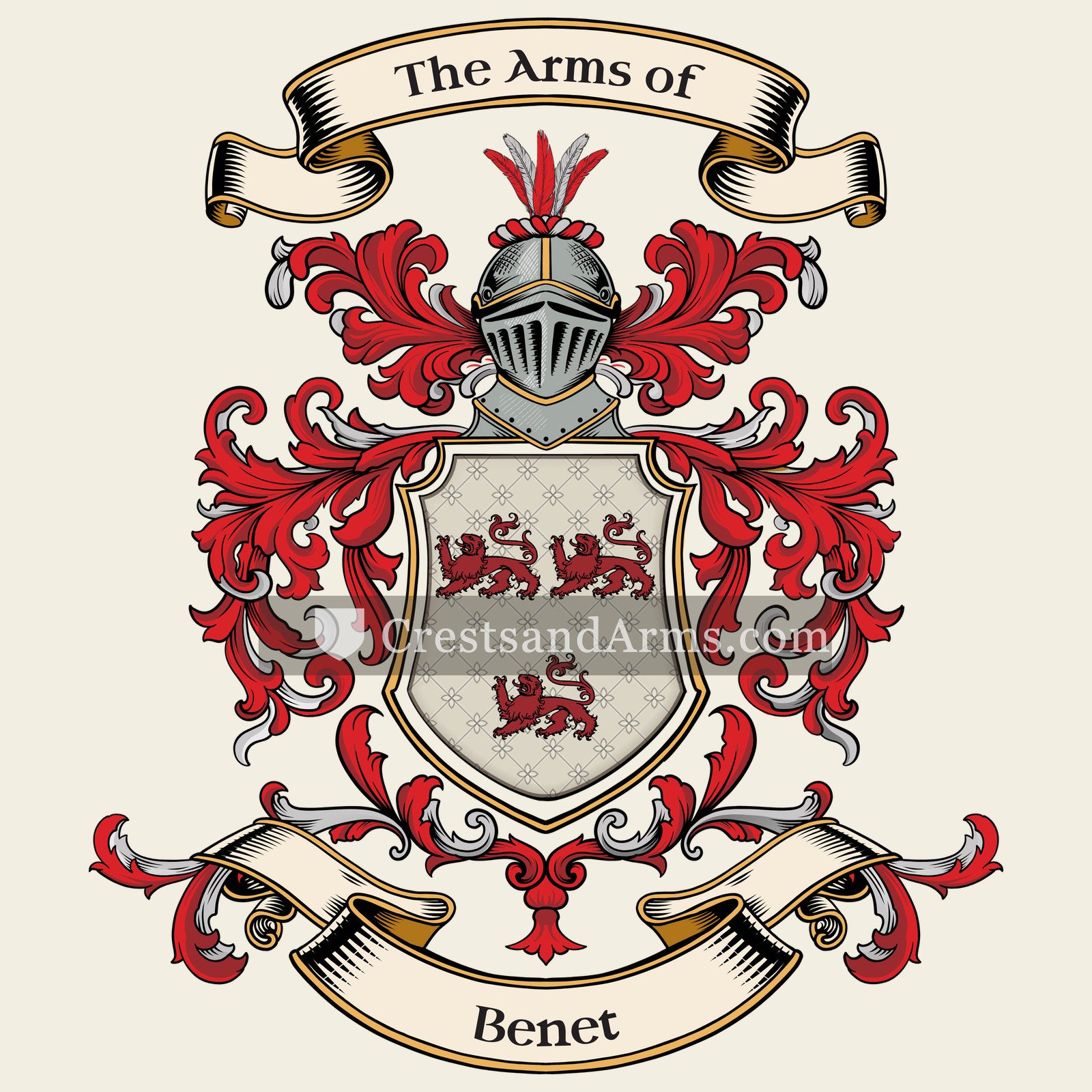
lionCourage, strength and royalty
Colours
Silver (Argent)Means: Peace and sincerity
Red (Gules)Means: Military strength
Historical info
Source
Sir Bernard Burke, The General Armory of England, Scotland, Ireland and Wales, London: Harrison & Sons, 1884
Blazon (the actual original written record)
“Ar. three demi lions ramp. gu”
BerkshireBerkshire, c. 1620
Digital archive packCoat of arms PNG, gold border print PDF, vector SVG and the certificate of authenticity. Sent to your email in minutes.
Map of England showing where the Benet arms are recorded
The Benet arms were recorded in Berkshire, c. 1620.
This is where the arms were entered in the register. Families often moved to other parts of the country, so the same name can turn up in more than one region.
The body that granted and recorded arms in England in this period.
James VI and I
Sovereign of the period
James VI and I
1603–1625
Reigning in France when the Benet arms are first recorded.
How Arms Worked in England
English heraldry allowed arms to be shared by all legitimate descendants of the original owner. These symbols were treated as personal property that moved through the generations to all children. While the eldest son kept the original design, other family members could use the same shield without needing to change it or register their own unique versions.
Granting authority
The College of Arms in London has regulated the use of coats of arms throughout England and Wales since 1484.
How they got arms
Families typically obtained their coats of arms through a formal grant from the Crown or by proving their ancient right to them.
Where arms were recorded
All official coats of arms are recorded in the registers kept at the College of Arms, which date back to the fifteenth century.
The family's standing
Recorded among the armigerous families of Berkshire.
Origin & History of the Benet Family in England
The surname Benet is a medieval variant of the name Benedict, which originates from the Latin word *benedictus*, meaning blessed. By the time the family was firmly established in Berkshire during the early 17th century, the name had been in use across England for several hundred years. It became popular following the influence of Saint Benedict of Nursia, the founder of the Benedictine monastic order, whose name spread throughout Europe during the Middle Ages. As people began to adopt fixed surnames, families often chose names based on religious devotion or the names of respected saints. In the rural landscape of Berkshire in 1620, the Benet family would have been part of a society transitioning from feudal traditions to a more modern system of record-keeping. Parish registers from this era often document the family as they participated in the daily life of their local communities, working as farmers, tradespeople, or landowners. This period marked a time when the spelling of the name began to stabilize, though it was still often written as Bennett or Benet depending on the preference of the local scribe.
Benet Meaning & Related Branches
Root word
Benedictus
Latin term meaning blessed or well spoken of.
This name
BenetA French surname derived from a personal name signifying one who is blessed.
also spelled
Bennett
Benit
Benitt
Bennette
Related arms
Bennetvariant spelling
Beneztvariant spelling
Bennettevariant spelling
Pagetrecorded with Benet, same area
Documented Sources
J. B. Rietstap, Armorial Général, Gouda: G. B. van Goor Zonen, 1884–87
Dauzat, Albert, Dictionnaire étymologique des noms de famille et prénoms de France, 1951
Archives départementales de l'Hérault, Registres paroissiaux et d'état civil, 1663
Morlet, Marie-Thérèse, Dictionnaire étymologique des noms de famille, 1991
Digital archive packCoat of arms PNG, gold border print PDF, vector SVG and the certificate of authenticity. Sent to your email in minutes.


 chiefAuthority, wisdom and dominion
 bearStrength, cunning and protection of kin
 mulletThe third son, and a divine quality from above
 chiefAuthority, wisdom and dominion
 bearStrength, cunning and protection of kin
 mulletThe third son, and a divine quality from above


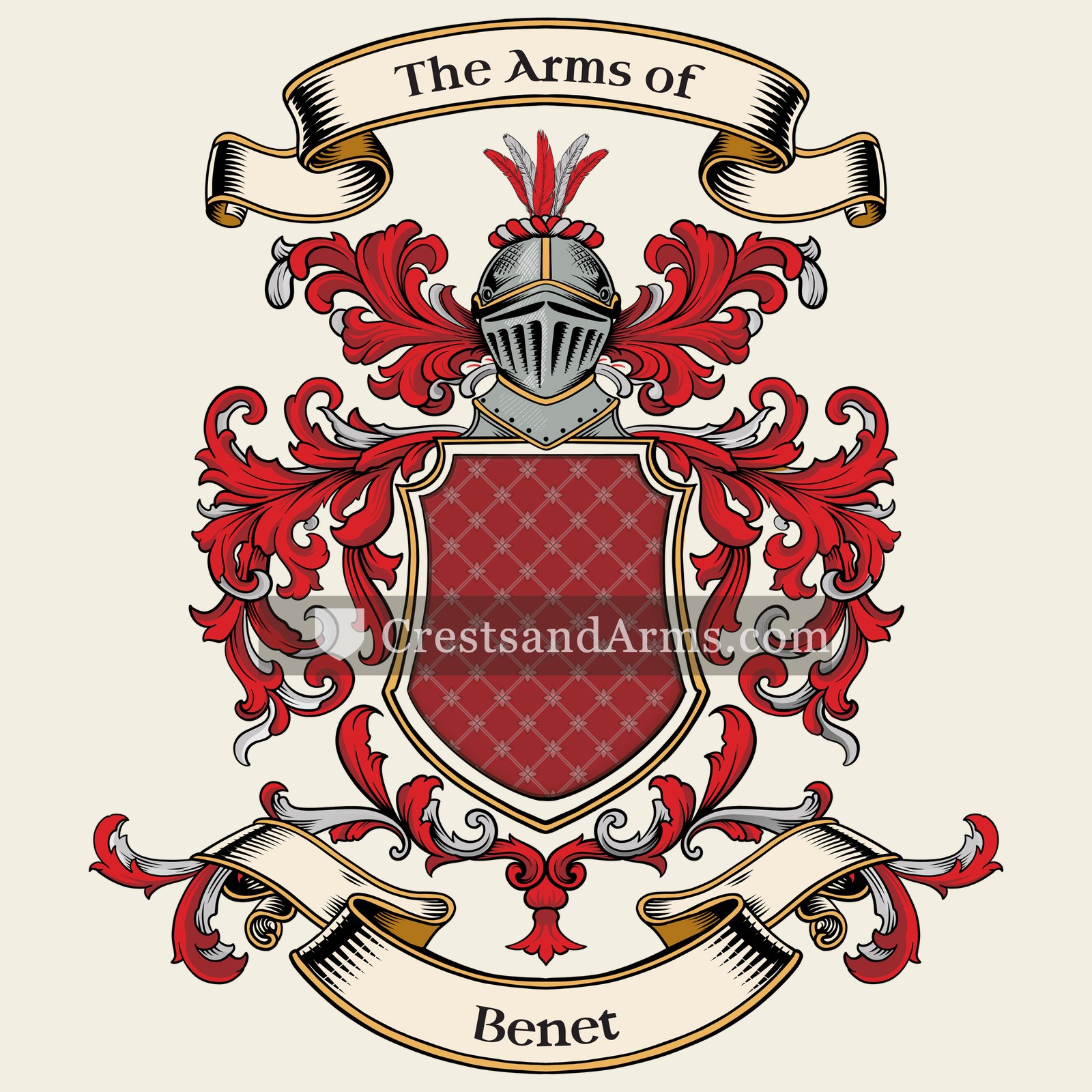


 lionCourage, strength and royalty