A record of documented arms, meaning and origin, researched for the Bennet family lines. Documented in 3 countries.
Reg. 7751 · Dutch, A–C
Coat of Arms & Family Crest Details
Symbols on this shield
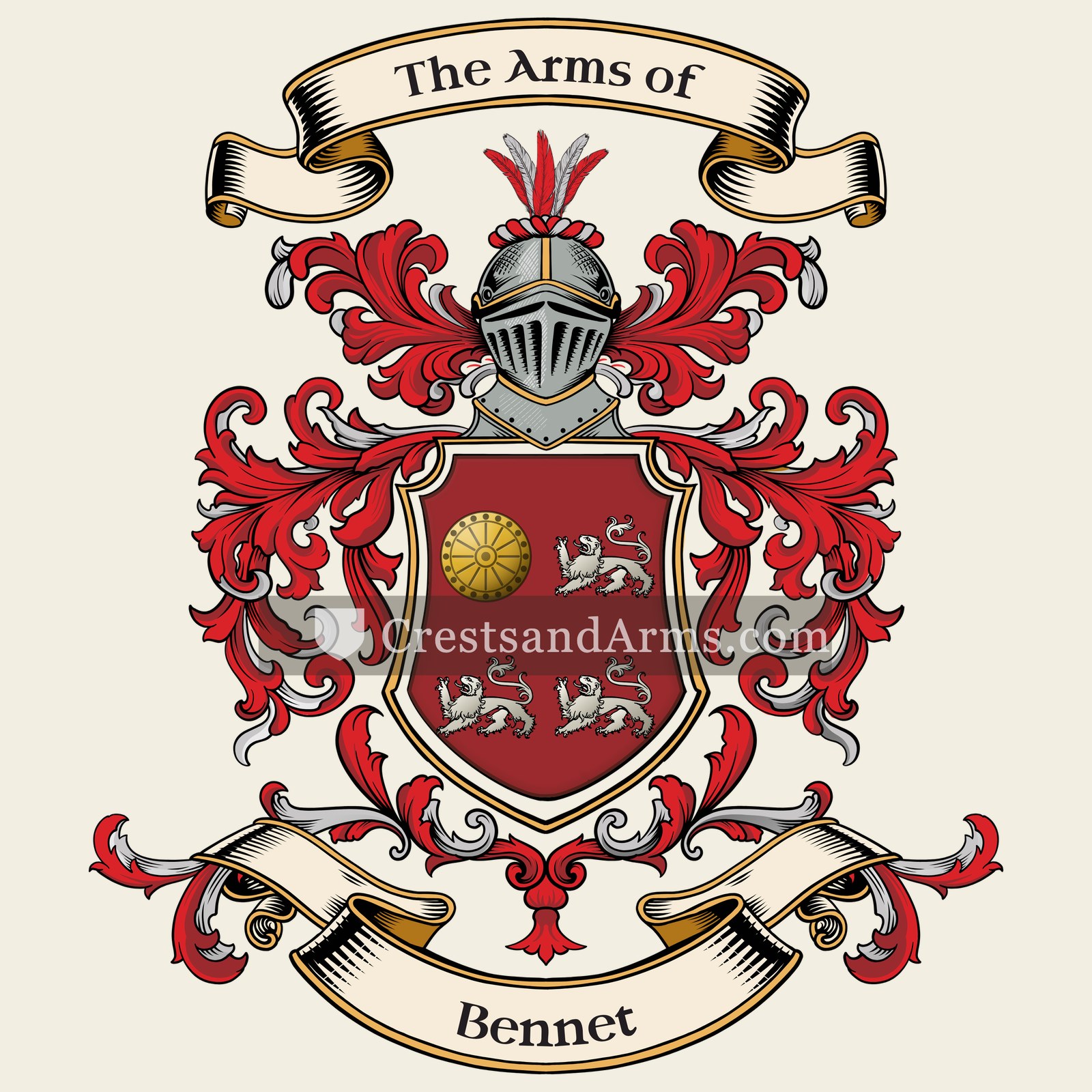
roundelA coin, and one who has been to the crusades
lionCourage, strength and royalty
Colours
Red (Gules)Means: Military strength
Gold (Or)Means: Generosity
Silver (Argent)Means: Peace and sincerity
Historical info
Source
J. B. Rietstap, Armorial Général, Gouda: G. B. van Goor Zonen, 1884–87
Blazon (the actual original written record)
“De gu. au besant d'or, acc. de trois lions naiss. d'arg. Cq. timbré d'une couronne murale d'or. C.: une tête de lion de gu., ch. d'un bes. d'or. S.: deux lions d'arg., cour. d'or, ch. chacun sur l'épaule d'un tourteau de gu. D.: DE BON VOULOIR SERVIR LE ROY.”
Netherlandsc. 1663
Digital archive packCoat of arms PNG, gold border print PDF, vector SVG and the certificate of authenticity. Sent to your email in minutes.
Map of Netherlands showing where the Bennet arms are recorded
The Bennet arms were recorded in Netherlands, c. 1663.
Arms such as these were typically recorded in Friesland.
Friesland was low, wet country on the northern coast of the Netherlands, farmed by families who had held the same land for centuries. Free landholders were unusually common there, and a free landholder could carry arms.
This is where the arms were entered in the register. Families often moved to other parts of the country, so the same name can turn up in more than one region.
Region
Friesland
First recorded
1663
Granting Authority for the Bennet Arms
Hoge Raad van Adel
Photograph made by me · CC BY-SA 3.0
The body that granted and recorded arms in Netherlands in this period.
How Arms Worked in Netherlands
In the Netherlands, coats of arms were often used by noble families and those who held specific public offices. These arms were passed down through the generations to legitimate descendants. Younger branches of a family usually kept the original design without needing to add special marks. This system ensured that the family identity remained clear and consistent over many years.
Granting authority
The Hoge Raad van Adel is the official body that regulates and manages noble titles and coats of arms in the Netherlands.
How they got arms
Families typically obtained their coats of arms through official royal grants or by proving their long-standing historical use of the symbols.
Where arms were recorded
Coats of arms are officially recorded in the registers held by the Hoge Raad van Adel, which began its work in 1814.
The family's standing
Recorded among the armigerous families of Netherlands.
Origin & History of the Bennet Family in Netherlands
The name Bennet has deep roots in the northern regions of the Netherlands, particularly within the province of Friesland. By the year 1663, records confirm that members of the family were already established in this area, living among the Frisian people who maintained a distinct culture and language. The name itself likely evolved from older Germanic naming traditions, often serving as a shortened or affectionate version of names like Benedictus, which means blessed. During the seventeenth century, families in Friesland were often tied to the land or local trade, and the presence of the Bennet name suggests they were part of the steady social fabric of the Dutch Republic. As the family moved through these coastal communities, they adapted to the local customs and legal systems of the time, leaving behind a trail of baptismal and property records that document their integration into the regional history of the northern Netherlands.
Coat of Arms & Family Crest Details
Symbols on this shield
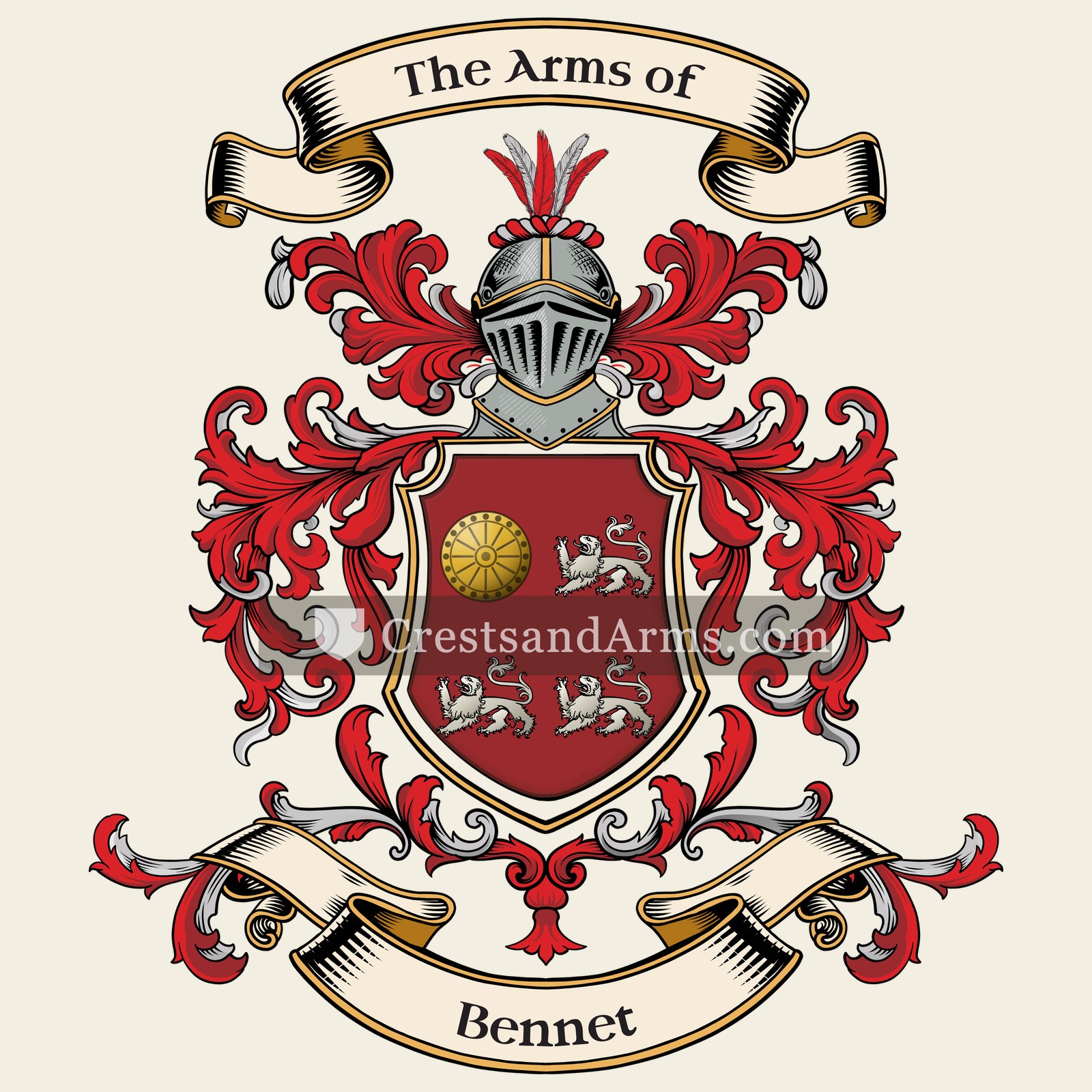
roundelA coin, and one who has been to the crusades
lionCourage, strength and royalty
Colours
Red (Gules)Means: Military strength
Gold (Or)Means: Generosity
Silver (Argent)Means: Peace and sincerity
Historical info
Source
Sir Bernard Burke, The General Armory of England, Scotland, Ireland and Wales, London: Harrison & Sons, 1884
Blazon (the actual original written record)
“Gu. a bezant betw. three demi lions ramp. ar”
MiddlesexTankerville · Middlesex, c. 1620
Digital archive packCoat of arms PNG, gold border print PDF, vector SVG and the certificate of authenticity. Sent to your email in minutes.
Map of England showing where the Bennet arms are recorded
The Bennet arms were recorded in Middlesex, c. 1620.
Middlesex was the county around London, and City money flowed straight into it. Merchants and officials bought estates within reach of the capital, and a new estate brought a coat of arms with it.
This is where the arms were entered in the register. Families often moved to other parts of the country, so the same name can turn up in more than one region.
The body that granted and recorded arms in England in this period.
James VI and I
Sovereign of the period
James VI and I
1603–1625
Reigning in Netherlands when the Bennet arms are first recorded.
How Arms Worked in England
English heraldry allowed arms to be shared by all legitimate descendants of the original owner. These symbols were treated as personal property that moved through the generations to all children. While the eldest son kept the original design, other family members could use the same shield without needing to change it or register their own unique versions.
Granting authority
The College of Arms in London has regulated the use of coats of arms throughout England and Wales since 1484.
How they got arms
Families typically obtained their coats of arms through a formal grant from the Crown or by proving their ancient right to them.
Where arms were recorded
All official coats of arms are recorded in the registers kept at the College of Arms, which date back to the fifteenth century.
The family's standing
Recorded among the armigerous families of Middlesex.
Origin & History of the Bennet Family in England
The surname Bennet originates from the medieval personal name Benedict, which stems from the Latin word meaning blessed. As surnames became more common in England during the Middle Ages, families often adopted the name to signify their religious devotion or to honor a local saint. By the early 17th century, the Bennet family had established a notable presence in Middlesex, a county that served as a vital hub for trade and administration near London. Records from this period show that members of the family were active participants in the social and economic life of the region as England transitioned into a more modern society. Their presence in Middlesex during the year 1620 suggests they were well-integrated into the local community, likely working as tradespeople, farmers, or minor landowners who helped shape the development of the English countryside.
Coat of Arms & Family Crest Details
Symbols on this shield
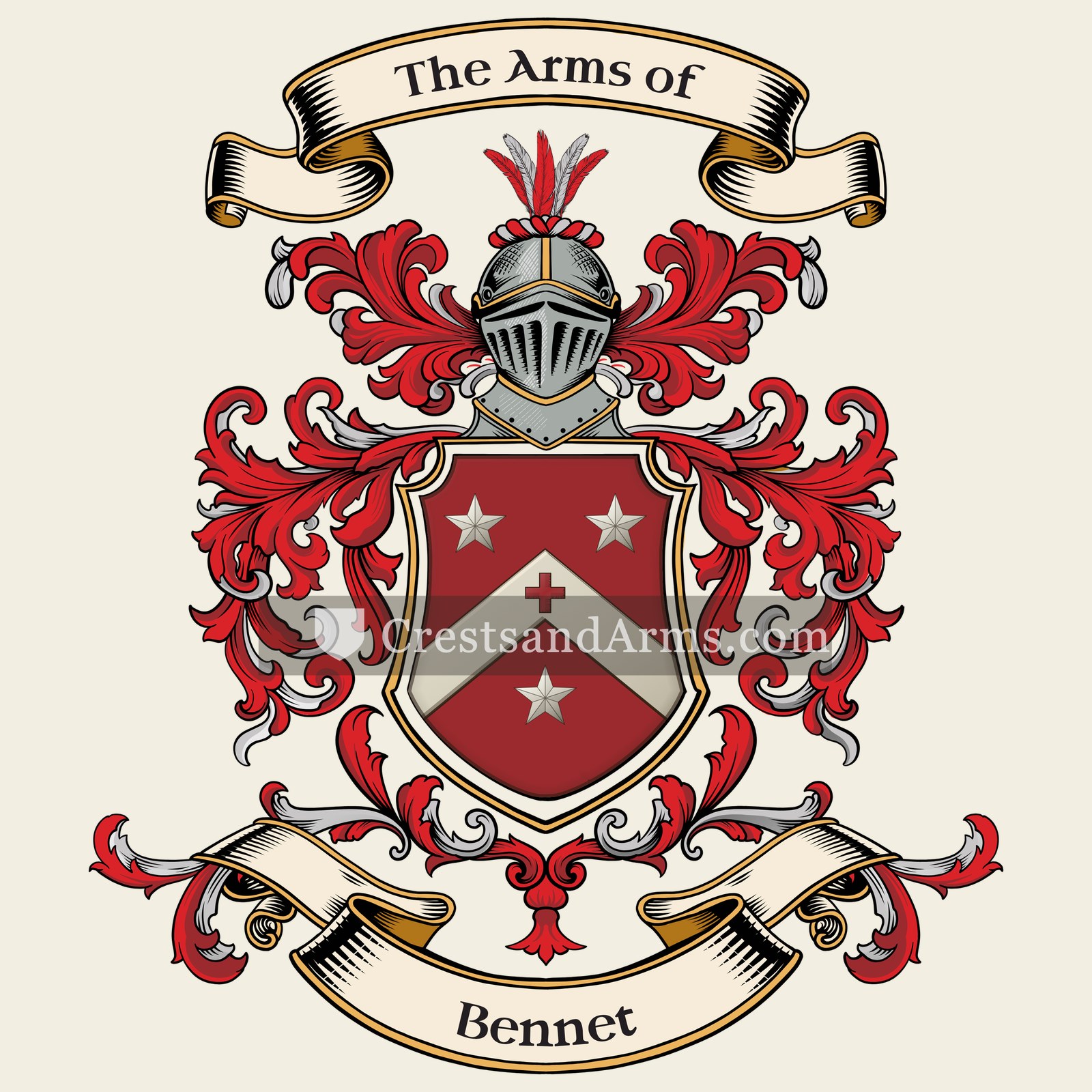
chevronProtection, and faithful service completed
cross symbolChristian faith and service
mulletThe third son, and a divine quality from above
Colours
Red (Gules)Means: Military strength
Silver (Argent)Means: Peace and sincerity
Historical info
Source
Sir Bernard Burke, The General Armory of England, Scotland, Ireland and Wales, London: Harrison & Sons, 1884
Blazon (the actual original written record)
“Gu. on a chev. betw. three stars ar. a cross Calvary gu”
RoxburghGrubbet · Roxburgh, c. 1670
Digital archive packCoat of arms PNG, gold border print PDF, vector SVG and the certificate of authenticity. Sent to your email in minutes.
Map of Scotland showing where the Bennet arms are recorded
The Bennet arms were recorded in Roxburgh, c. 1670.
Roxburghshire was Scottish border country, fought over for three hundred years. Land was held in return for defending it, and a family that fought needed a shield it could be recognised by.
This is where the arms were entered in the register. Families often moved to other parts of the country, so the same name can turn up in more than one region.
The body that granted and recorded arms in Scotland in this period.
Charles II of England
Sovereign of the period
Charles II of England
1660–1685
Reigning in Netherlands when the Bennet arms are first recorded.
How Arms Worked in Scotland
Scottish heraldry is unique because it treats a coat of arms as a piece of personal property protected by law. Only one person can own a specific design at any given time. When a family grows, the head keeps the original shield while other relatives must apply for their own distinct version with slight changes to prove their specific identity.
Granting authority
The Court of the Lord Lyon acts as the official body that regulates and controls all heraldic matters throughout Scotland.
How they got arms
Individuals obtain a legal right to their arms through a formal petition process that confirms their identity and family connection.
Where arms were recorded
All valid coats of arms are officially entered into the Public Register of All Arms and Bearings starting from 1672.
The family's standing
Recorded among the armigerous families of Roxburgh.
Origin & History of the Bennet Family in Scotland
The name Bennet has deep roots in the Scottish Borders, where families often identified themselves by their connection to the land and local parishes. By the year 1670, records confirm that members of the Bennet family were well established in the region of Roxburgh. During this period, the Borders were a rugged landscape defined by shifting loyalties and the influence of powerful local landowners. Families like the Bennets often lived as tenant farmers or tradespeople who played a vital role in the rural economy of the Scottish lowlands. Because the area was frequently affected by historical border conflicts, families often moved between small settlements to find stability and work. Over time, the Bennet name became a permanent fixture in the local community, reflecting the resilience of those who built their lives in the shadow of the Cheviot Hills.
Bennet Meaning & Related Branches
Root word
Benedictus
Latin for blessed or well spoken of.
This name
BennetA patronymic surname derived from the given name Benedict, signifying one who is blessed.
also spelled
Benet
Bennett
Bennot
Related arms
Benetvariant spelling
Bennittvariant spelling
Bernardrecorded with Bennet, same area
Kemptonrecorded with Bennet, same area
Documented Sources
J. B. Rietstap, Armorial Général, Gouda: G. B. van Goor Zonen, 1884–87
Tresoar (Fries Historisch en Letterkundig Centrum), Doop-, trouw-, begraaf- en lidmatenregisters (DTB)
Fries Genootschap, De Vrije Fries: Bijdragen tot de geschiedenis van Friesland, 1950
Hofstra, T., Friese familienamen: Een inleiding, 1998
Digital archive packCoat of arms PNG, gold border print PDF, vector SVG and the certificate of authenticity. Sent to your email in minutes.


 roundelA coin, and one who has been to the crusades
 lionCourage, strength and royalty
 roundelA coin, and one who has been to the crusades
 lionCourage, strength and royalty



 chevronProtection, and faithful service completed
 cross symbolChristian faith and service
 mulletThe third son, and a divine quality from above