Map of Ireland showing where the Bennish arms are recorded
The Bennish arms were recorded in Clare, c. 1645.
Clare was rocky western Irish country, poor in farmland but held tightly by a few old families. Land there changed hands rarely, and families who stayed put ended up in the records.
This is where the arms were entered in the register. Families often moved to other parts of the country, so the same name can turn up in more than one region.
The body that granted and recorded arms in Ireland in this period.
Charles I of England
Sovereign of the period
Charles I of England
1625–1649
Reigning in Ireland when the Bennish arms are first recorded.
How Arms Worked in Ireland
The Ulster King of Arms granted coats of arms to individuals who proved their social standing and good character. These symbols were typically inherited by all legitimate descendants of the original holder. If a family branch wanted a unique look, they could apply for a specific change to their design through the office to ensure their identity remained distinct.
Granting authority
The Ulster King of Arms acted as the official body that regulated and issued all coats of arms throughout Ireland.
How they got arms
Families obtained their arms through formal grants issued by the office after proving their eligibility and paying the required fees.
Where arms were recorded
All official grants were recorded in the registers held by the Ulster King of Arms starting from the year 1552.
The family's standing
Recorded among the armigerous families of Clare.
Origin & History of the Bennish Family in Ireland
The surname Bennish has roots that connect to the complex landscape of seventeenth-century Ireland. Records confirm that members of the family were established in County Clare by 1645, a period defined by significant political upheaval and the transition of land ownership during the Cromwellian era. The name likely evolved as a phonetic adaptation of older Gaelic or localized surnames, reflecting the way names were often recorded by English-speaking clerks during this time. Families in Clare during the mid-1600s often lived through the displacement caused by the Cromwellian settlement, which forced many to relocate or adapt their identities to survive changing social structures. By maintaining their presence in the region, the Bennish family became part of the enduring history of County Clare, surviving through centuries of agricultural and social change in the west of Ireland.
Bennish Meaning & Related Branches
Root word
Benedictus
Latin term meaning blessed or well spoken of.
This name
BennishAn Irish-Anglicized variant derived from the Latin name meaning blessed or fortunate.
also spelled
Bennys
Bennie
Benny
Beny
Documented Sources
Sir Bernard Burke, The General Armory of England, Scotland, Ireland and Wales, London: Harrison & Sons, 1884
Hardiman, James, A Chorographical Description of West or H-Iar Connaught, 1846
MacLysaght, Edward, The Surnames of Ireland, 1985
National Archives of Ireland, Civil Survey of the County of Clare, 1654–1656
Digital archive packCoat of arms PNG, gold border print PDF, vector SVG and the certificate of authenticity. Sent to your email in minutes.


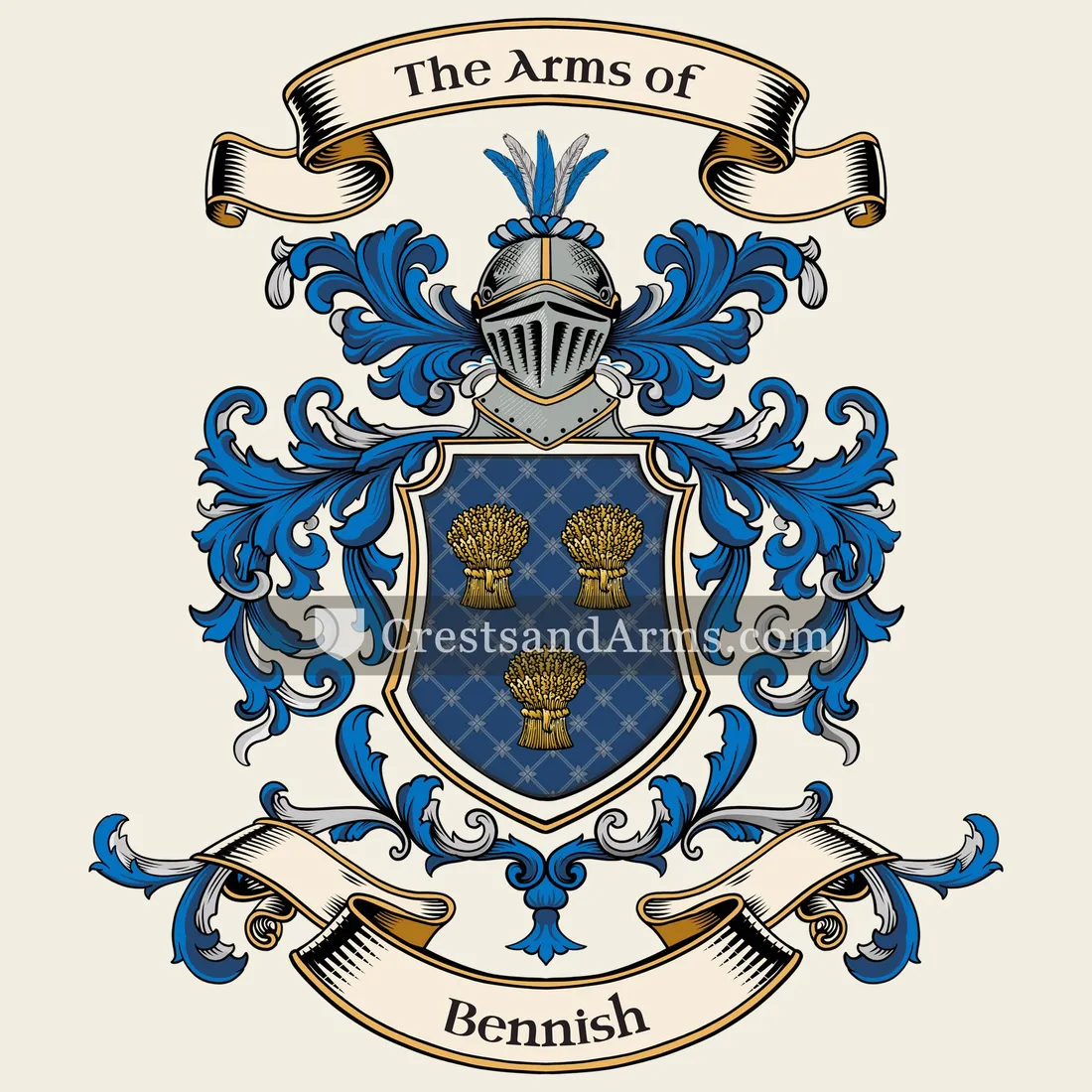
 wheatsheafPlenty, and the harvest of one's own labour
 wheatsheafPlenty, and the harvest of one's own labour