Map of Germany showing where the Benoit arms are recorded
The Benoit arms were recorded in Han, c. 1768.
This is where the arms were entered in the register. Families often moved to other parts of the country, so the same name can turn up in more than one region.
The body that granted and recorded arms in Germany in this period.
Joseph II, Holy Roman Emperor
Sovereign of the period
Joseph II, Holy Roman Emperor
1765–1790
Reigning in Germany when the Benoit arms are first recorded.
How Arms Worked in Germany
In the Holy Roman Empire, coats of arms were often granted to individuals by the Emperor or his representatives. These arms were then passed down through the generations to all legitimate descendants of the original holder. Younger branches of a family usually kept the same shield design without needing to change it, as the arms belonged to the entire lineage.
Granting authority
The Holy Roman Emperor held the sole power to grant new coats of arms throughout his vast imperial territories.
How they got arms
Families typically obtained their coats of arms through a formal imperial grant or by proving their noble status to the authorities.
Where arms were recorded
These grants were officially recorded in the Imperial Chancery registers, which began keeping formal records of such honors during the Middle Ages.
The family's standing
Recorded among the armigerous families of Germany.
Origin & History of the Benoit Family in Germany
The family name Benoit carries a rich history that reflects the movement of people across European borders during the eighteenth century. While the name is widely recognized as having French origins, its presence in the German region of Han by 1768 highlights the migration patterns of families seeking new opportunities in the Holy Roman Empire. During this era, many individuals with French-sounding names settled in German territories due to religious shifts or the search for better farmland. By establishing themselves in Han, the early members of this family became part of a local community that was navigating the transition from traditional village life to the more complex social structures of the late 1700s. These settlers often integrated into the local economy by working as skilled tradespeople or farmers, helping to shape the cultural landscape of their new home while maintaining the unique identity tied to their ancestral name.
Coat of Arms & Family Crest Details
Symbols on this shield
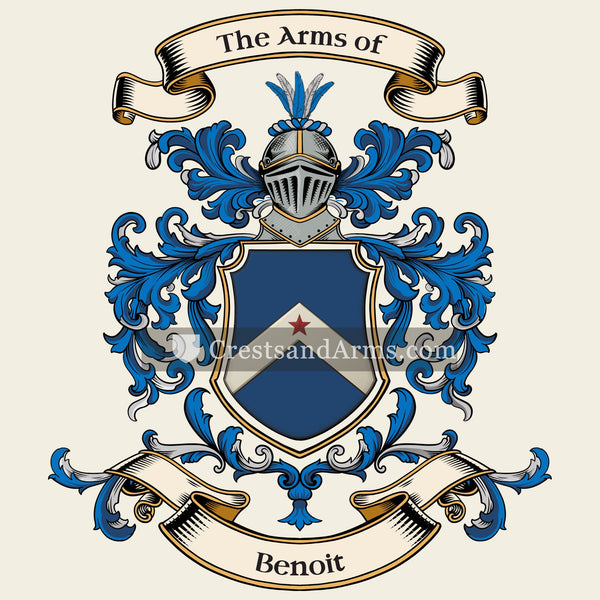
chevronProtection, and faithful service completed
mulletThe third son, and a divine quality from above
Colours
Blue (Azure)Means: Loyalty and truth
Silver (Argent)Means: Peace and sincerity
Red (Gules)Means: Military strength
Historical info
Source
J. B. Rietstap, Armorial Général, Gouda: G. B. van Goor Zonen, 1884–87
Blazon (the actual original written record)
“D'azur au chev. d'arg., ch. d'une étoile de gu.”
Franche-ComteFranche-Comte, c. 1602
Digital archive packCoat of arms PNG, gold border print PDF, vector SVG and the certificate of authenticity. Sent to your email in minutes.
Map of France showing where the Benoit arms are recorded
The Benoit arms were recorded in Franche-Comte, c. 1602.
Franche-Comte sat between France and the Empire and changed hands more than once. Border families held their land under arms and expected to defend it, so a shield was a practical thing rather than an ornament.
This is where the arms were entered in the register. Families often moved to other parts of the country, so the same name can turn up in more than one region.
The body that granted and recorded arms in France in this period.
Henry IV of France
Sovereign of the period
Henry IV of France
1589–1610
Reigning in Germany when the Benoit arms are first recorded.
How Arms Worked in France
In France, a coat of arms was a mark of honor that passed down through the male line to all legitimate descendants. Families often used the same shield without changes to show their shared heritage. If a branch wanted to stand out, they could add a small mark to their shield to show their specific place in the family tree.
Granting authority
The Juge d'armes de France acted as the official authority that regulated and verified coats of arms across the country.
How they got arms
Families typically inherited their arms from ancestors, though they could also receive them through royal grants or by proving their noble status.
Where arms were recorded
Coats of arms were officially recorded in the Armorial Général de France, which began its main collection in the year 1696.
The family's standing
Recorded among the armigerous families of Franche-Comte.
Origin & History of the Benoit Family in France
The surname Benoit originates from the Latin name Benedictus, which translates to blessed. In France, the name became popular because of the influence of Saint Benedict, the founder of the Benedictine monastic order. By the early 17th century, the family had established a notable presence in the Franche-Comté region. This area was a distinct territory located between the Jura Mountains and the Saône River. Families living in this region during the 1600s often worked as farmers, craftsmen, or local officials who managed the land for the nobility. The name spread throughout the French provinces as families moved for trade or marriage, eventually becoming one of the most common surnames across the country. Because the name was tied to a religious figure, it was frequently passed down through generations to honor the faith of the parents.
Coat of Arms & Family Crest Details
Symbols on this shield
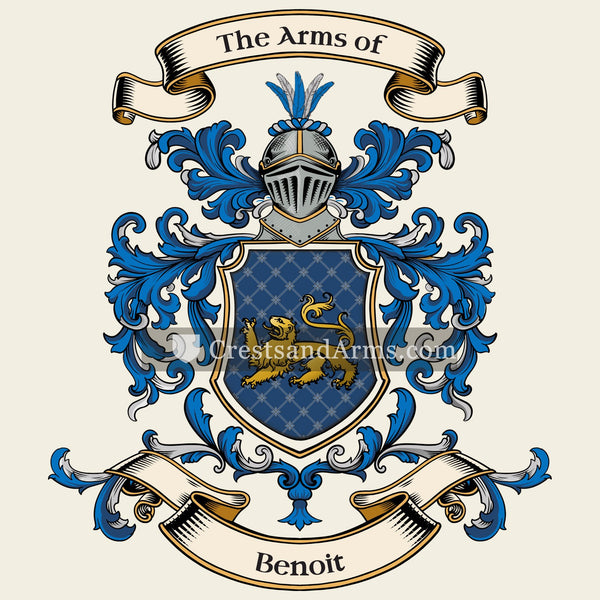
lionCourage, strength and royalty
Colours
Blue (Azure)Means: Loyalty and truth
Gold (Or)Means: Generosity
Historical info
Source
J. B. Rietstap, Armorial Général, Gouda: G. B. van Goor Zonen, 1884–87
Blazon (the actual original written record)
“D'azur au lion d'or. C.: le lion.”
SwitzerlandBerne, c. 1745
Digital archive packCoat of arms PNG, gold border print PDF, vector SVG and the certificate of authenticity. Sent to your email in minutes.
Map of Switzerland showing where the Benoit arms are recorded
The Benoit arms were recorded in Berne, c. 1745.
This is where the arms were entered in the register. Families often moved to other parts of the country, so the same name can turn up in more than one region.
The body that granted and recorded arms in Switzerland in this period.
How Arms Worked in Switzerland
In Switzerland, coats of arms were not restricted to the nobility and were often adopted by common citizens and families. These symbols were passed down through generations to show family identity. When branches of a family grew, they often changed small details of the design to distinguish their own line from the original group.
Granting authority
Cantonal and civic authorities managed the use of coats of arms within their specific regions and local jurisdictions.
How they got arms
Families typically assumed their own coats of arms based on local custom rather than receiving them from a central monarch.
Where arms were recorded
Arms were recorded in various cantonal and civic registers starting from the fourteenth century throughout the Swiss region.
The family's standing
Recorded among the armigerous families of Switzerland.
Origin & History of the Benoit Family in Switzerland
The surname Benoit is a French-derived name that traces its roots to the Latin word benedictus, meaning blessed. While the name is most commonly associated with France, its presence in Switzerland reflects the complex movement of families across European borders during the eighteenth century. By 1745, records confirm that members of the Benoit family were established in the city of Berne. During this period, Berne served as a significant center for trade and administration, attracting individuals who sought new opportunities in the Swiss Confederation. Families like the Benoits often integrated into the local community by participating in the city's guild system or through professional roles in the burgeoning urban economy. Their settlement in Berne highlights how families with French linguistic origins became part of the diverse social fabric of German-speaking Swiss cantons, contributing to the cultural exchange that defined the region throughout the Enlightenment era.
Benoit Meaning & Related Branches
Root word
Benedictus
Latin term meaning blessed or well spoken of.
This name
BenoitA French and German surname derived from the Latin word for blessed.
also spelled
Benoyt
Benoist
Benot
Benwa
Related arms
Benoietvariant spelling
Benoistvariant spelling
Documented Sources
J. B. Rietstap, Armorial Général, Gouda: G. B. van Goor Zonen, 1884–87
Büsch, Otto. Industrialisierung und Gewerbe im Raum Berlin. 1971
Klueting, Harm. Das Konfessionelle Zeitalter in Deutschland. 1989
Digital archive packCoat of arms PNG, gold border print PDF, vector SVG and the certificate of authenticity. Sent to your email in minutes.


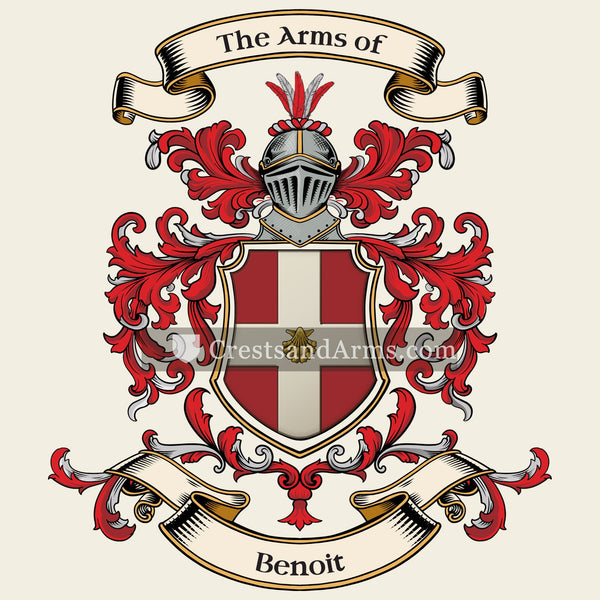
 cross symbolChristian faith and service
 escallopThe pilgrim's shell, and a long journey made
 cross symbolChristian faith and service
 escallopThe pilgrim's shell, and a long journey made


 chevronProtection, and faithful service completed
 mulletThe third son, and a divine quality from above


 lionCourage, strength and royalty