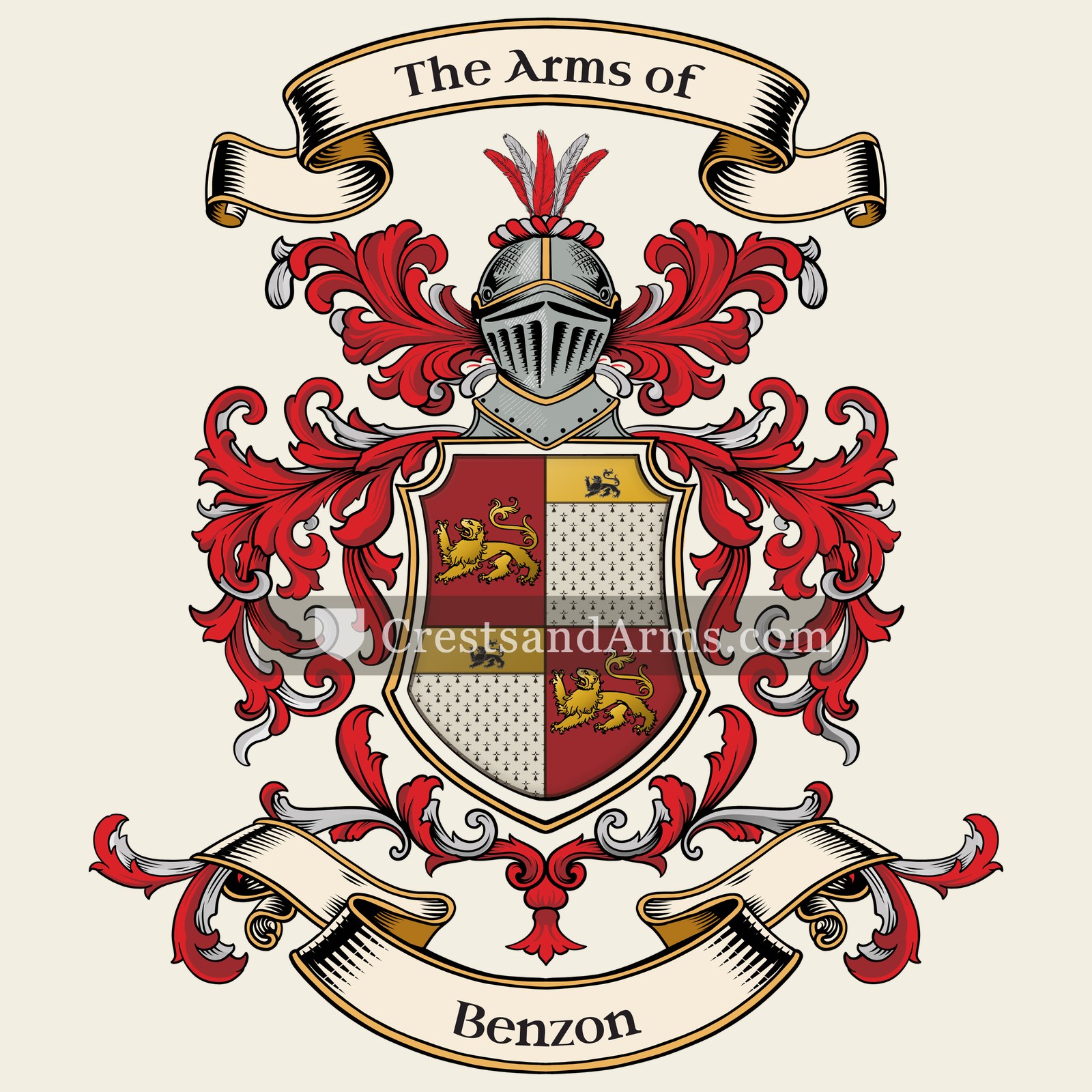
A record of documented arms, meaning and origin, researched for the Benzon family lines. Documented in 2 countries.
Reg. 8303 · Danish, A–C
Coat of Arms & Family Crest Details
Symbols on this shield
chevronProtection, and faithful service completed
chequyConstancy, and the counting-board
crescentHonour by the sovereign, and the second son
mulletThe third son, and a divine quality from above
roseThe seventh son, and beauty with grace
Colours
Blue (Azure)Means: Loyalty and truth
Gold (Or)Means: Generosity
Silver (Argent)Means: Peace and sincerity
Historical info
Source
J. B. Rietstap, Armorial Général, Gouda: G. B. van Goor Zonen, 1884–87
Blazon (the actual original written record)
“D'azur au chev. échiq. d'or et d'arg., le sommet supp. un croiss. d'or, chaque corne supp. à son tour une étoile du même; le chev. acc. en p. de trois roses mal-ordonnées d'or. Cq. cour. C.: un lion iss. d'azur, ailé d'or.”
Denmarkc. 1679
Digital archive packCoat of arms PNG, gold border print PDF, vector SVG and the certificate of authenticity. Sent to your email in minutes.
Map of Denmark showing where the Benzon arms are recorded
The Benzon arms were recorded in Denmark, c. 1679.
Arms such as these were typically recorded in Sjaælland.
Zealand held the Danish court, the crown's offices and Copenhagen itself. Families who served the king kept estates within reach of it, and royal service was the ordinary route to a coat of arms.
This is where the arms were entered in the register. Families often moved to other parts of the country, so the same name can turn up in more than one region.
The body that granted and recorded arms in Denmark in this period.
Christian V of Denmark
Sovereign of the period
Christian V of Denmark
1670–1699
Reigning in Denmark when the Benzon arms are first recorded.
How Arms Worked in Denmark
Danish heraldry during this period was closely tied to noble status and royal favor rather than being open to all citizens. Arms were typically granted by the monarch to individuals, and these symbols were then shared by all members of the noble house. If a family line died out, the right to use those specific arms ended with them.
Granting authority
The Danish royal chancery held the power to issue and regulate official coats of arms for the kingdom.
How they got arms
Families usually received their arms through a formal royal grant that confirmed their noble status and rights.
Where arms were recorded
These grants were officially recorded in the Danish Royal Chancery records starting in the sixteenth century.
The family's standing
Recorded among the armigerous families of Denmark.
Origin & History of the Benzon Family in Denmark
The history of the Benzon family in Denmark is deeply rooted in the social and political landscape of the seventeenth century. By 1679, members of the family were well established on the island of Sjaelland, where they began to rise within the ranks of the Danish administration. The name itself became associated with individuals who served the crown in various legal and bureaucratic roles. During this period, the family secured land and influence, which allowed them to integrate into the upper tiers of Danish society. Their presence in Sjaelland during the late 1600s marked the beginning of a long tradition of service to the state, as they navigated the complex hierarchies of the era to build a lasting legacy for their descendants.
Coat of Arms & Family Crest Details
Symbols on this shield
chiefAuthority, wisdom and dominion
lionCourage, strength and royalty
Colours
Red (Gules)Means: Military strength
ErmineMeans: Dignity
Gold (Or)Means: Generosity
Black (Sable)Means: Constancy
Historical info
Source
J. B. Rietstap, Armorial Général, Gouda: G. B. van Goor Zonen, 1884–87
Blazon (the actual original written record)
“Ec.: aux 1 et 4 de gu. au lion d'or, portant sur son épaule une épée d'arg.; aux 2 et 3 d'herm., au chef d'or ch. d'un lion léopardé de sa.”
VeniceVenice, c. 1775
Digital archive packCoat of arms PNG, gold border print PDF, vector SVG and the certificate of authenticity. Sent to your email in minutes.
Map of Italy showing where the Benzon arms are recorded
The Benzon arms were recorded in Venice, c. 1775.
Venice ran on trade, and its great families were merchants before they were anything else. The city kept a formal list of its noble houses, and a name on that list carried arms as a matter of record.
This is where the arms were entered in the register. Families often moved to other parts of the country, so the same name can turn up in more than one region.
The body that granted and recorded arms in Italy in this period.
Alvise Giovanni Mocenigo
Sovereign of the period
Alvise Giovanni Mocenigo
1763–1778
Reigning in Denmark when the Benzon arms are first recorded.
How Arms Worked in Italy
In the Italian states, coats of arms were often used by noble families to show their status and history. These symbols were passed down through the generations to all legitimate male descendants. Younger branches of a family usually kept the original design but sometimes added small changes to distinguish their specific line from the main branch.
Granting authority
Various local rulers and city governments controlled the use of coats of arms across the different Italian states.
How they got arms
Families often assumed their own arms or received them as official grants from local lords, popes, or city councils.
Where arms were recorded
Arms were recorded in local city archives or private family books rather than in one single national register.
The family's standing
Recorded among the armigerous families of Venice.
Origin & History of the Benzon Family in Italy
The Benzon family established a prominent presence in Venice by the late eighteenth century, becoming deeply integrated into the social and cultural fabric of the city. During this period, the family was recognized as part of the Venetian patriciate, which allowed them to participate in the political life of the Republic of Venice. Their home, the Palazzo Benzon, served as a famous gathering place for intellectuals, musicians, and artists who traveled through Italy. By 1775, the family had solidified their status as influential patrons of the arts, hosting sophisticated salons that attracted notable figures from across Europe. This era marked a time of significant prestige for the name, as the family used their wealth and social standing to support the vibrant cultural scene that defined Venice before the fall of the Republic.
Benzon Meaning & Related Branches
Root word
Benedictus
Latin for blessed or well-spoken.
This name
BenzonA patronymic surname meaning son of Benzon, a diminutive form of Benedict.
also spelled
Benson
Benzun
Related arms
Bensonvariant spelling
Documented Sources
J. B. Rietstap, Armorial Général, Gouda: G. B. van Goor Zonen, 1884–87
Bricka, C. F., Dansk Biografisk Lexikon, 1887–1905
Rigsarkivet (Danish National Archives), Danske Kancelli: Registre over breve, 1679
Trap, J. P., Kongeriget Danmark, 1898–1906
Digital archive packCoat of arms PNG, gold border print PDF, vector SVG and the certificate of authenticity. Sent to your email in minutes.


 chevronProtection, and faithful service completed
 chequyConstancy, and the counting-board
 crescentHonour by the sovereign, and the second son
 mulletThe third son, and a divine quality from above
 roseThe seventh son, and beauty with grace
 chevronProtection, and faithful service completed
 chequyConstancy, and the counting-board
 crescentHonour by the sovereign, and the second son
 mulletThe third son, and a divine quality from above
 roseThe seventh son, and beauty with grace


 chiefAuthority, wisdom and dominion
 lionCourage, strength and royalty