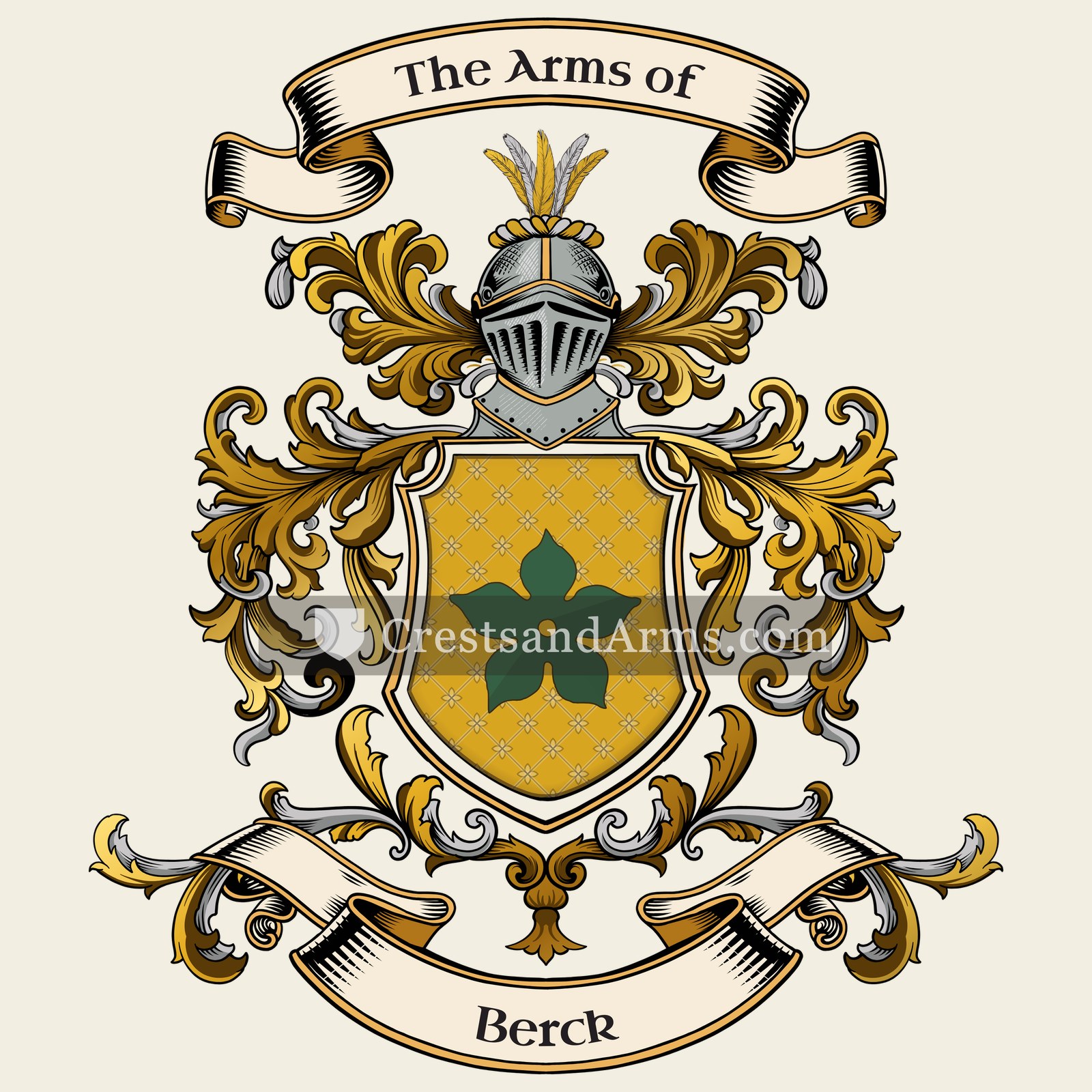
A record of documented arms, meaning and origin, researched for the Berck family lines. Documented in 2 countries.
Reg. 8450 · Dutch, A–C
Coat of Arms & Family Crest Details
Symbols on this shield
leafHappiness and abundance
Colours
Gold (Or)Means: Generosity
Green (Vert)Means: Hope
Historical info
Source
J. B. Rietstap, Armorial Général, Gouda: G. B. van Goor Zonen, 1884–87
Blazon (the actual original written record)
“D'or à cinq feuilles de bouleau de sin., disposées en quintefeuille. Cq. cour. C.: un chien braque de gu., coll. d'or, assis entre un vol d'or et de sin.; ou, un lévrier au nat., coll. d'azur, assis entre un vol d'or et de sin.; ou, la quintefeuille de l'écu, entre un vol d'or.”
NetherlandsDordrecht, c. 1815
Digital archive packCoat of arms PNG, gold border print PDF, vector SVG and the certificate of authenticity. Sent to your email in minutes.
Map of Netherlands showing where the Berck arms are recorded
The Berck arms were recorded in Dordrecht, c. 1815.
This is where the arms were entered in the register. Families often moved to other parts of the country, so the same name can turn up in more than one region.
Region
Dordrecht
Town
Dordrecht
First recorded
1815
Granting Authority for the Berck Arms
Hoge Raad van Adel
Photograph made by me · CC BY-SA 3.0
The body that granted and recorded arms in Netherlands in this period.
William I of the Netherlands
Sovereign of the period
William I of the Netherlands
1815–1840
Reigning in Netherlands when the Berck arms are first recorded.
How Arms Worked in Netherlands
In the Netherlands, coats of arms were often used by noble families and those who held specific public offices. These arms were passed down through the generations to legitimate descendants. Younger branches of a family usually kept the original design without needing to add special marks. This system ensured that the family identity remained clear and consistent over many years.
Granting authority
The Hoge Raad van Adel is the official body that regulates and manages noble titles and coats of arms in the Netherlands.
How they got arms
Families typically obtained their coats of arms through official royal grants or by proving their long-standing historical use of the symbols.
Where arms were recorded
Coats of arms are officially recorded in the registers held by the Hoge Raad van Adel, which began its work in 1814.
The family's standing
Recorded among the armigerous families of Netherlands.
Origin & History of the Berck Family in Netherlands
The history of the Berck family in the Netherlands is deeply rooted in the city of Dordrecht, a historic hub of trade and politics. By the early 19th century, members of the family were well-established figures in this region, which served as a vital center for the Dutch economy. The name itself likely originated from early Germanic roots, often associated with descriptions of the landscape or specific locations where the family first settled. During the period around 1815, the Netherlands was undergoing significant social changes as it transitioned into the United Kingdom of the Netherlands. Families like the Bercks were part of this evolving society, contributing to the local administration and the commercial life of the city. Their presence in Dordrecht suggests a long-standing connection to the urban development of the province of South Holland, where they participated in the civic life that defined the era.
Coat of Arms & Family Crest Details
Symbols on this shield
cinquefoilHope and joy
Colours
Gold (Or)Means: Generosity
Green (Vert)Means: Hope
Historical info
Source
J. B. Rietstap, Armorial Général, Gouda: G. B. van Goor Zonen, 1884–87
Blazon (the actual original written record)
“D'or à une quintefeuille de sin., surm. d'un croiss. d'azur. C.: le croiss., entre un vol de sa. L.: à dextre d'or et d'azur, à sen. d'or et de sin.”
GermanyLubeck, c. 1765
Digital archive packCoat of arms PNG, gold border print PDF, vector SVG and the certificate of authenticity. Sent to your email in minutes.
Map of Germany showing where the Berck arms are recorded
The Berck arms were recorded in Lubeck, c. 1765.
This is where the arms were entered in the register. Families often moved to other parts of the country, so the same name can turn up in more than one region.
The body that granted and recorded arms in Germany in this period.
Francis I, Holy Roman Emperor
Sovereign of the period
Francis I, Holy Roman Emperor
1745–1765
Reigning in Netherlands when the Berck arms are first recorded.
How Arms Worked in Germany
In the Holy Roman Empire, coats of arms were often granted to individuals by the Emperor or his representatives. These arms were then passed down through the generations to all legitimate descendants of the original holder. Younger branches of a family usually kept the same shield design without needing to change it, as the arms belonged to the entire lineage.
Granting authority
The Holy Roman Emperor held the sole power to grant new coats of arms throughout his vast imperial territories.
How they got arms
Families typically obtained their coats of arms through a formal imperial grant or by proving their noble status to the authorities.
Where arms were recorded
These grants were officially recorded in the Imperial Chancery registers, which began keeping formal records of such honors during the Middle Ages.
The family's standing
Recorded among the armigerous families of Germany.
Origin & History of the Berck Family in Germany
The family name Berck is deeply rooted in the northern German landscape, particularly within the historic city of Lübeck. By the mid-18th century, the family had established a firm presence in this influential Hanseatic port, a city known for its maritime trade and powerful merchant guilds. The name itself is thought to be a topographic surname, likely derived from the Middle Low German word for a hill or a birch tree, which suggests that the family’s earliest ancestors were identified by the specific landscape where they lived. As residents of Lübeck in 1765, the Berck family would have been part of a bustling urban environment defined by international commerce and strict social hierarchies. Their life in such a city indicates that they were likely involved in the professional or merchant classes that kept the Baltic trade routes thriving during the Enlightenment. Over time, the name evolved alongside the shifting borders and linguistic changes of the German states, yet it remained tethered to the cultural identity of the northern coastal regions.
Berck Meaning & Related Branches
Root word
Berk
A type of deciduous tree with smooth bark.
This name
BerckRefers to someone who lived near a birch tree or a birch forest.
also spelled
Berch
Berk
Related arms
Berchvariant spelling
Documented Sources
J. B. Rietstap, Armorial Général, Gouda: G. B. van Goor Zonen, 1884–87
Nationaal Archief, Bevolkingsregister Dordrecht
Regionaal Archief Dordrecht, Doop-, trouw- en begraafboeken (DTB)
Fruin, R., Geschiedenis der staatsinstellingen in Nederland tot den val van de republiek (1901)
Van Dillen, J. G., Van rijkdom en regenten: Handboek tot de economische en sociale geschiedenis van Nederland tijdens de Republiek (1970)
Digital archive packCoat of arms PNG, gold border print PDF, vector SVG and the certificate of authenticity. Sent to your email in minutes.


 leafHappiness and abundance
 leafHappiness and abundance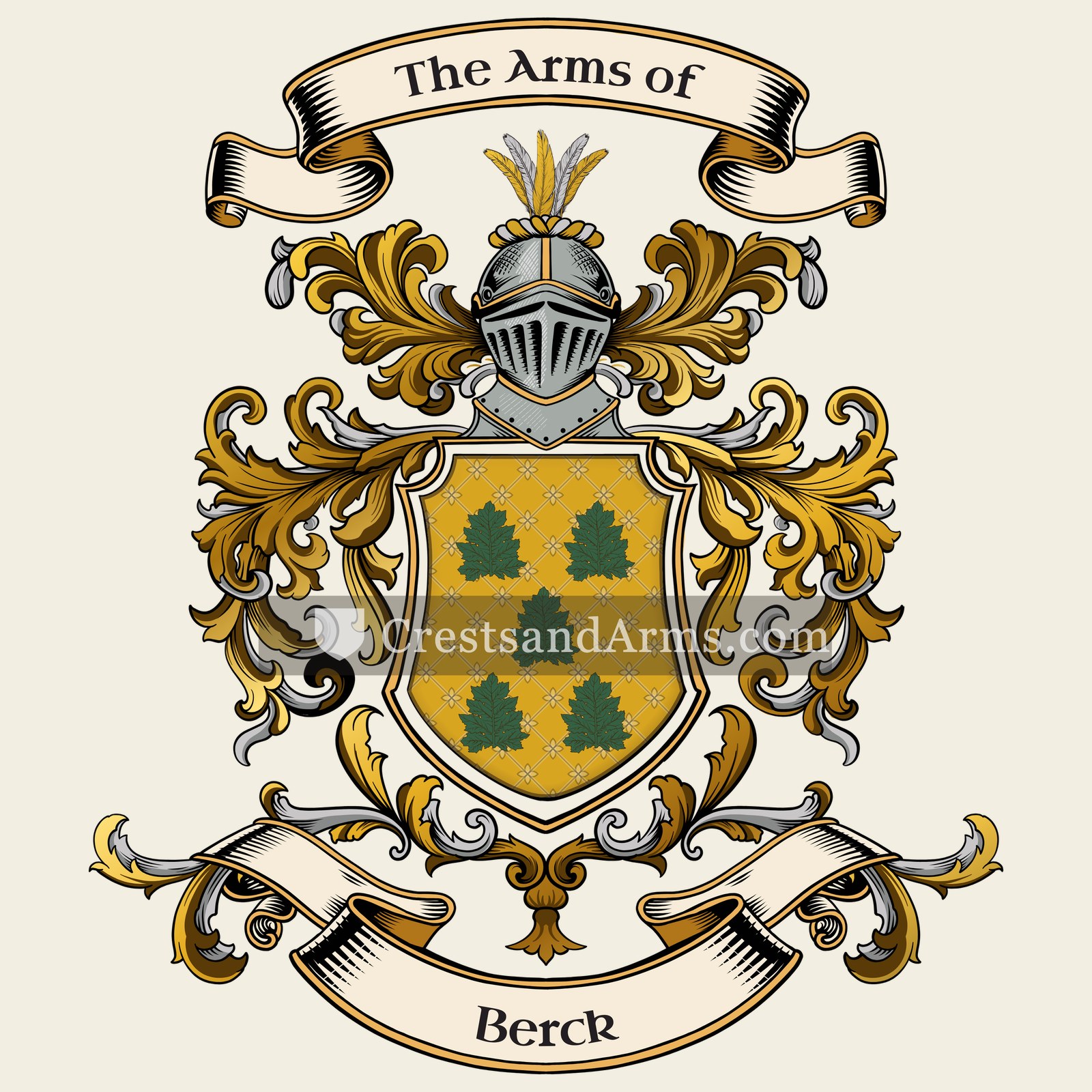


 cinquefoilHope and joy