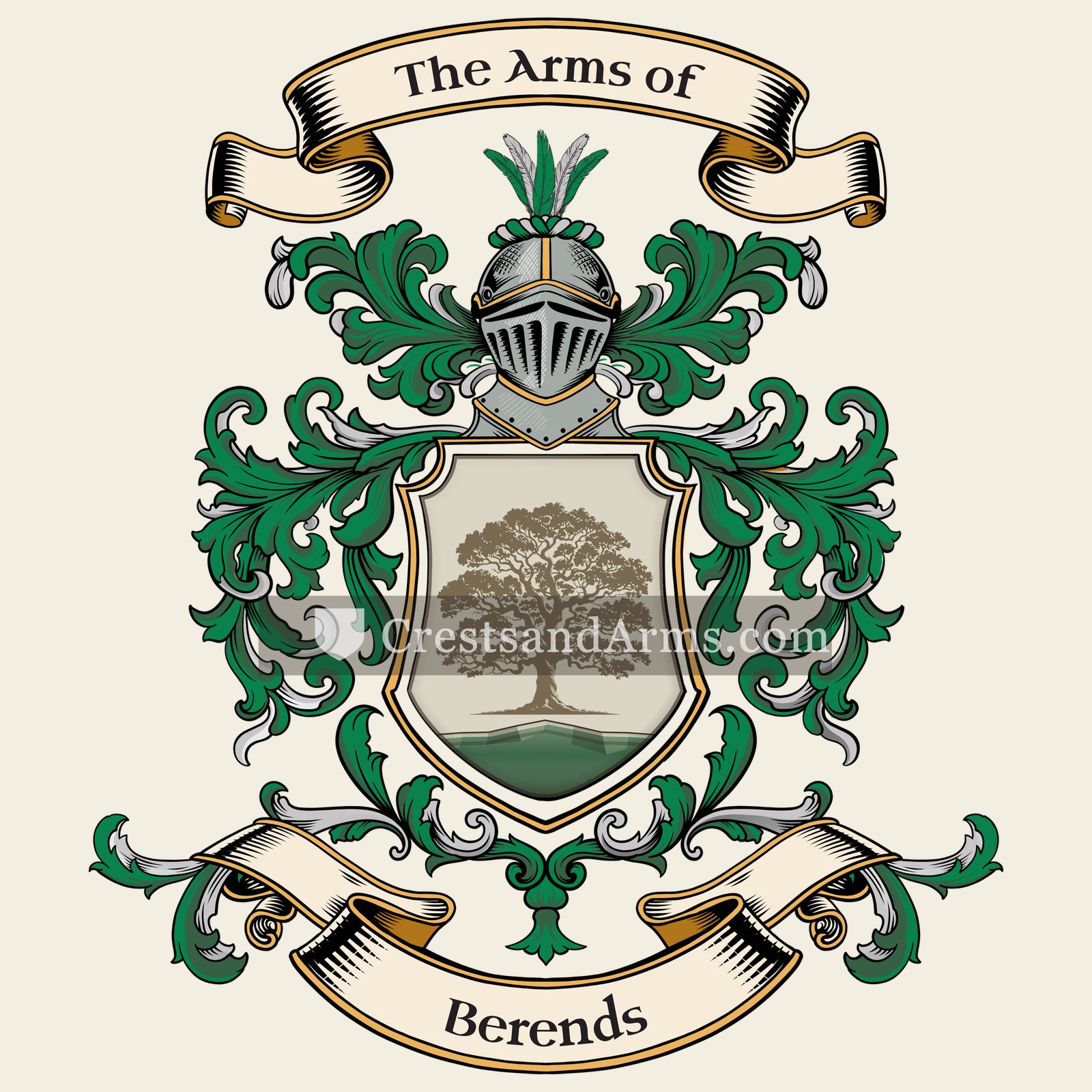
A record of documented arms, meaning and origin, researched for the Berends family of Poland.
Reg. 3497 · Polish, A–C
Coat of Arms & Family Crest Details
Symbols on this shield
mountThe ground held, and steadfastness upon it
treeLife, endurance and deep roots
Colours
Silver (Argent)Means: Peace and sincerity
Green (Vert)Means: Hope
Historical info
Source
J. B. Rietstap, Armorial Général, Gouda: G. B. van Goor Zonen, 1884–87
Blazon (the actual original written record)
“D'arg. à un pommier au nat., fruité de quatre pièces de gu., posé sur un tertre de sin. C.: un bras, arm. d'arg., la main de carn. empoignant une branche de pommier de sin. fruitée d'une pomme de gu.; entre deux cornes de buffle, coupées alt. d'arg. et d'azur. L.: d'arg. et d'azur.”
LivoniaEsthonie · Livonia, c. 1675
Digital archive packCoat of arms PNG, gold border print PDF, vector SVG and the certificate of authenticity. Sent to your email in minutes.
Map of Poland showing where the Berends arms are recorded
The Berends arms were recorded in Livonia, c. 1675.
Livonia was Baltic country held by a small number of landed families who kept their estates for centuries. Land there passed down whole rather than being divided, and long unbroken tenure is what fills a register.
This is where the arms were entered in the register. Families often moved to other parts of the country, so the same name can turn up in more than one region.
Region
Livonia
Town
Esthonie
First recorded
1675
Granting Authority for the Berends Arms
Ennoblement by the Sejm
Author: Olek Remesz · CC BY-SA 3.0
The body that granted and recorded arms in Poland in this period.
John III Sobieski
Sovereign of the period
John III Sobieski
1674–1696
Reigning in Poland when the Berends arms are first recorded.
How Arms Worked in Poland
Polish noble families shared a single coat of arms across many different surnames, creating large clans rather than individual designs. These symbols were held collectively by all members of the clan regardless of their specific family name. When a new family joined the nobility, they were adopted into an existing clan and began using that group's established shield.
Granting authority
The Sejm, which was the Polish parliament, held the power to grant noble status and the right to bear arms.
How they got arms
Families typically received their coat of arms through a formal act of ennoblement granted by the Sejm for distinguished service.
Where arms were recorded
These grants were officially recorded in the Crown Metrica, which served as the central archive for state documents starting in the sixteenth century.
The family's standing
Recorded among the armigerous families of Livonia.
Origin & History of the Berends Family in Poland
The family name Berends originates from the Germanic personal name Bernhard, which combines the words for bear and brave. By the late 17th century, the name had become well-established among families living in the Baltic region of Livonia. Records confirm that members of the Berends family were present in this area by 1675, a time when Livonia was under the control of the Swedish Empire. During this period, families in the region often adopted surnames based on their ancestral given names to distinguish themselves in growing urban centers. The presence of the family in Livonia suggests they were part of the social and economic shifts occurring in the Baltic provinces as trade and administration became more organized under Swedish rule. Over the following generations, the name spread further across Northern Europe as individuals moved for work, military service, or land ownership.
Berends Meaning & Related Branches
Root word
Bernhard
Germanic name composed of elements meaning bear and brave or hardy.
This name
BerendsA patronymic surname meaning son of Bernard, indicating descent from a brave warrior.
also spelled
Berend
Berendss
Related arms
Behrendsvariant spelling
Documented Sources
J. B. Rietstap, Armorial Général, Gouda: G. B. van Goor Zonen, 1884–87
Bahlow, Hans, Deutsches Namenlexikon: Familien- und Vornamen nach Ursprung und Sinn erklärt, 1967
Hellie, Richard, The Economy and Material Culture of Russia, 1600-1725, 1999
National Archives of Estonia (Eesti Rahvusarhiiv), Livonian Land Registry records (Liivimaa maaregistri toimikud)
Swedish National Archives (Riksarkivet), Livonian Governor-General’s administrative records (Generalguvernören över Livland arkiv)
Digital archive packCoat of arms PNG, gold border print PDF, vector SVG and the certificate of authenticity. Sent to your email in minutes.


 mountThe ground held, and steadfastness upon it
 treeLife, endurance and deep roots
 mountThe ground held, and steadfastness upon it
 treeLife, endurance and deep roots