Map of Poland showing where the Berens arms are recorded
The Berens arms were recorded in Livonia, c. 1772.
Livonia was Baltic country held by a small number of landed families who kept their estates for centuries. Land there passed down whole rather than being divided, and long unbroken tenure is what fills a register.
This is where the arms were entered in the register. Families often moved to other parts of the country, so the same name can turn up in more than one region.
Region
Livonia
First recorded
1772
Granting Authority for the Berens Arms
Ennoblement by the Sejm
Author: Olek Remesz · CC BY-SA 3.0
The body that granted and recorded arms in Poland in this period.
Stanisław August Poniatowski
Sovereign of the period
Stanisław August Poniatowski
1764–1795
Reigning in Poland when the Berens arms are first recorded.
How Arms Worked in Poland
Polish noble families shared a single coat of arms across many different surnames, creating large clans rather than individual designs. These symbols were held collectively by all members of the clan regardless of their specific family name. When a new family joined the nobility, they were adopted into an existing clan and began using that group's established shield.
Granting authority
The Sejm, which was the Polish parliament, held the power to grant noble status and the right to bear arms.
How they got arms
Families typically received their coat of arms through a formal act of ennoblement granted by the Sejm for distinguished service.
Where arms were recorded
These grants were officially recorded in the Crown Metrica, which served as the central archive for state documents starting in the sixteenth century.
The family's standing
Recorded among the armigerous families of Livonia.
Origin & History of the Berens Family in Poland
The Berens family name carries a deep history rooted in the Baltic region, particularly within the territory of Livonia. By the year 1772, the family was well-established in this area during a time of significant political transition as the region fell under the influence of the Russian Empire. While the name is often associated with Germanic origins, its presence in Poland and the surrounding Baltic lands reflects the movement of merchants and administrators across shifting borders. Families like the Berens often served as a bridge between different cultures, acting as essential links in the trade networks that connected the Baltic ports to the rest of Europe. Over generations, these individuals integrated into local society, adapting to the changing laws and social structures of the Polish-Lithuanian Commonwealth and its neighboring territories. Their history provides a window into how families maintained their identity while navigating the complex geopolitical landscape of eighteenth-century Eastern Europe.
Coat of Arms & Family Crest Details
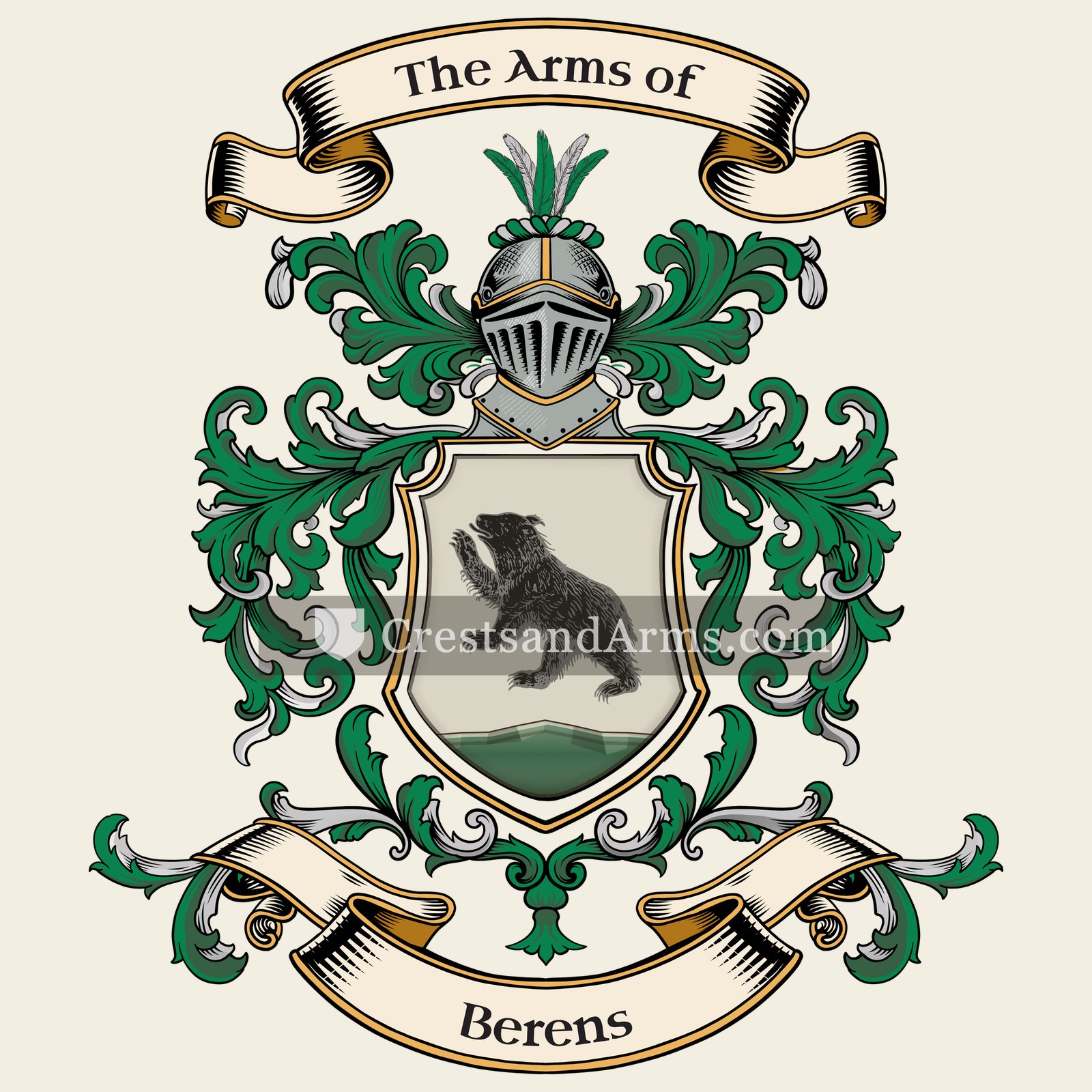
Symbols on this shield
mountThe ground held, and steadfastness upon it
bearStrength, cunning and protection of kin
Colours
Silver (Argent)Means: Peace and sincerity
Green (Vert)Means: Hope
Black (Sable)Means: Constancy
Historical info
Source
Sir Bernard Burke, The General Armory of England, Scotland, Ireland and Wales, London: Harrison & Sons, 1884
Blazon (the actual original written record)
“Ar. on a mount vert a bear pass. sa”
KentKevington · Kent, c. 1620
Digital archive packCoat of arms PNG, gold border print PDF, vector SVG and the certificate of authenticity. Sent to your email in minutes.
Map of England showing where the Berens arms are recorded
The Berens arms were recorded in Kent, c. 1620.
Kent sits between London and the short crossing to Europe, and the trade passing through made it wealthy. Merchant families bought land with that money, and it was landowners who took coats of arms.
This is where the arms were entered in the register. Families often moved to other parts of the country, so the same name can turn up in more than one region.
The body that granted and recorded arms in England in this period.
James VI and I
Sovereign of the period
James VI and I
1603–1625
Reigning in Poland when the Berens arms are first recorded.
How Arms Worked in England
English heraldry allowed arms to be shared by all legitimate descendants of the original owner. These symbols were treated as personal property that moved through the generations to all children. While the eldest son kept the original design, other family members could use the same shield without needing to change it or register their own unique versions.
Granting authority
The College of Arms in London has regulated the use of coats of arms throughout England and Wales since 1484.
How they got arms
Families typically obtained their coats of arms through a formal grant from the Crown or by proving their ancient right to them.
Where arms were recorded
All official coats of arms are recorded in the registers kept at the College of Arms, which date back to the fifteenth century.
The family's standing
Recorded among the armigerous families of Kent.
Origin & History of the Berens Family in England
The Berens family name has deep roots that connect to the social and economic shifts of seventeenth-century England. By 1620, records confirm that members of the family were established in the county of Kent, a region known for its prosperous trade and agricultural activity. The name itself is thought to be a variation of the Germanic name Bernhard, which suggests that the family’s ancestors likely migrated from Northern Europe to the British Isles during a period of increased movement across the North Sea. As these early settlers integrated into English society, they often found roles within the growing merchant classes or local landholding communities. Their presence in Kent during the early seventeenth century places them in a time of significant transition, as England began to expand its influence through global commerce and local industrial development. Over time, the family name became a fixture in the regional history of the area, reflecting the broader patterns of migration and settlement that shaped the English population.
Berens Meaning & Related Branches
Root word
Bern
A Germanic word meaning bear.
This name
BerensA patronymic surname meaning son of the bear, often used as a nickname for a brave person.
also spelled
Beren
Berenss
Berence
Berenz
Documented Sources
J. B. Rietstap, Armorial Général, Gouda: G. B. van Goor Zonen, 1884–87
Kasekamp, Andres, A History of the Baltic States, 2010
Plakans, Andrejs, The Latvians: A Short History, 1995
Raun, Toivo U., Estonia and the Estonians, 2001
Latvian State Historical Archives (Latvijas Valsts vēstures arhīvs), Livonian Land Registry Records
Estonian Historical Archives (Eesti Ajalooarhiiv), Baltic German Genealogical Collections
Digital archive packCoat of arms PNG, gold border print PDF, vector SVG and the certificate of authenticity. Sent to your email in minutes.


 mountThe ground held, and steadfastness upon it
 boarA fierce fighter who battles to the end
 mountThe ground held, and steadfastness upon it
 boarA fierce fighter who battles to the end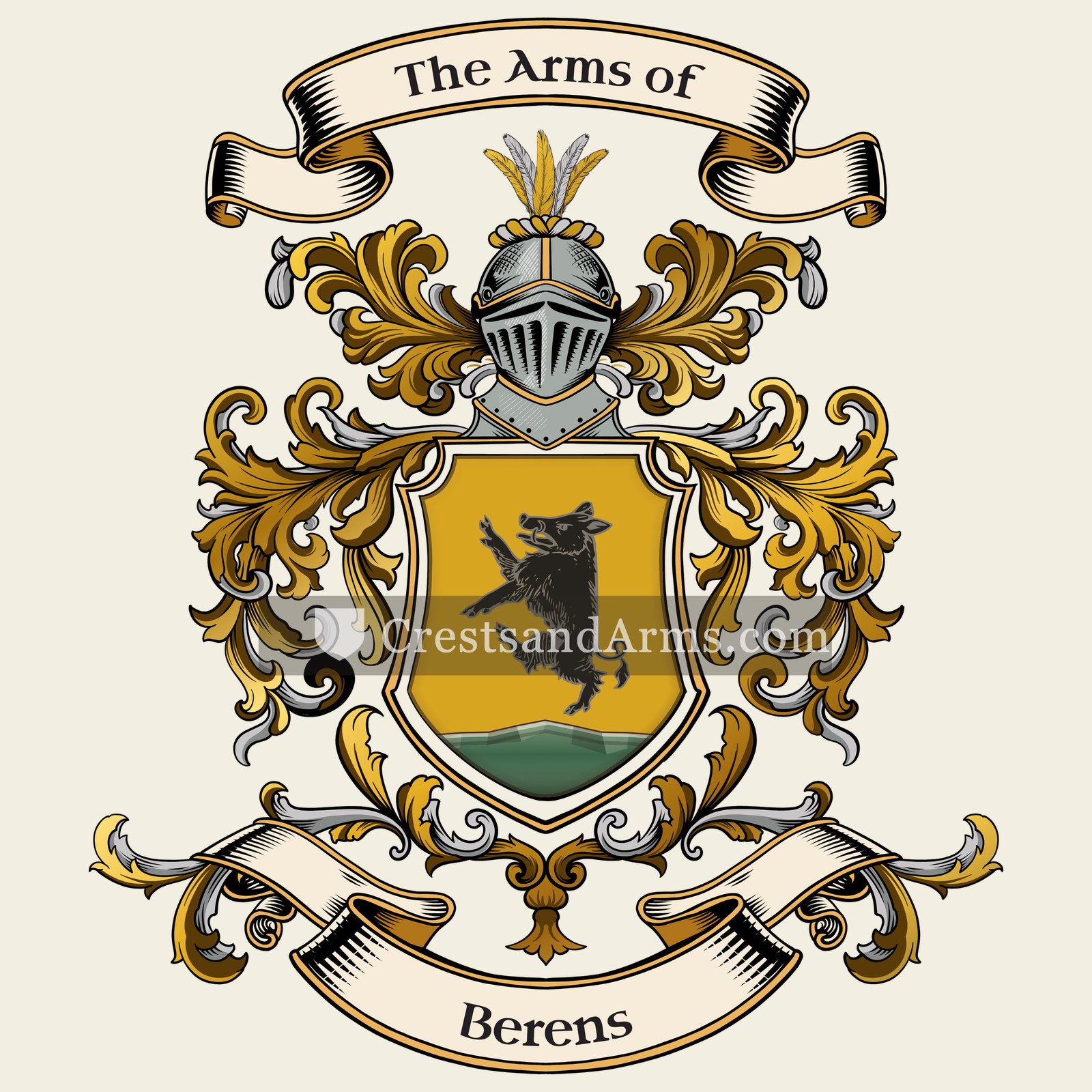


 bearStrength, cunning and protection of kin