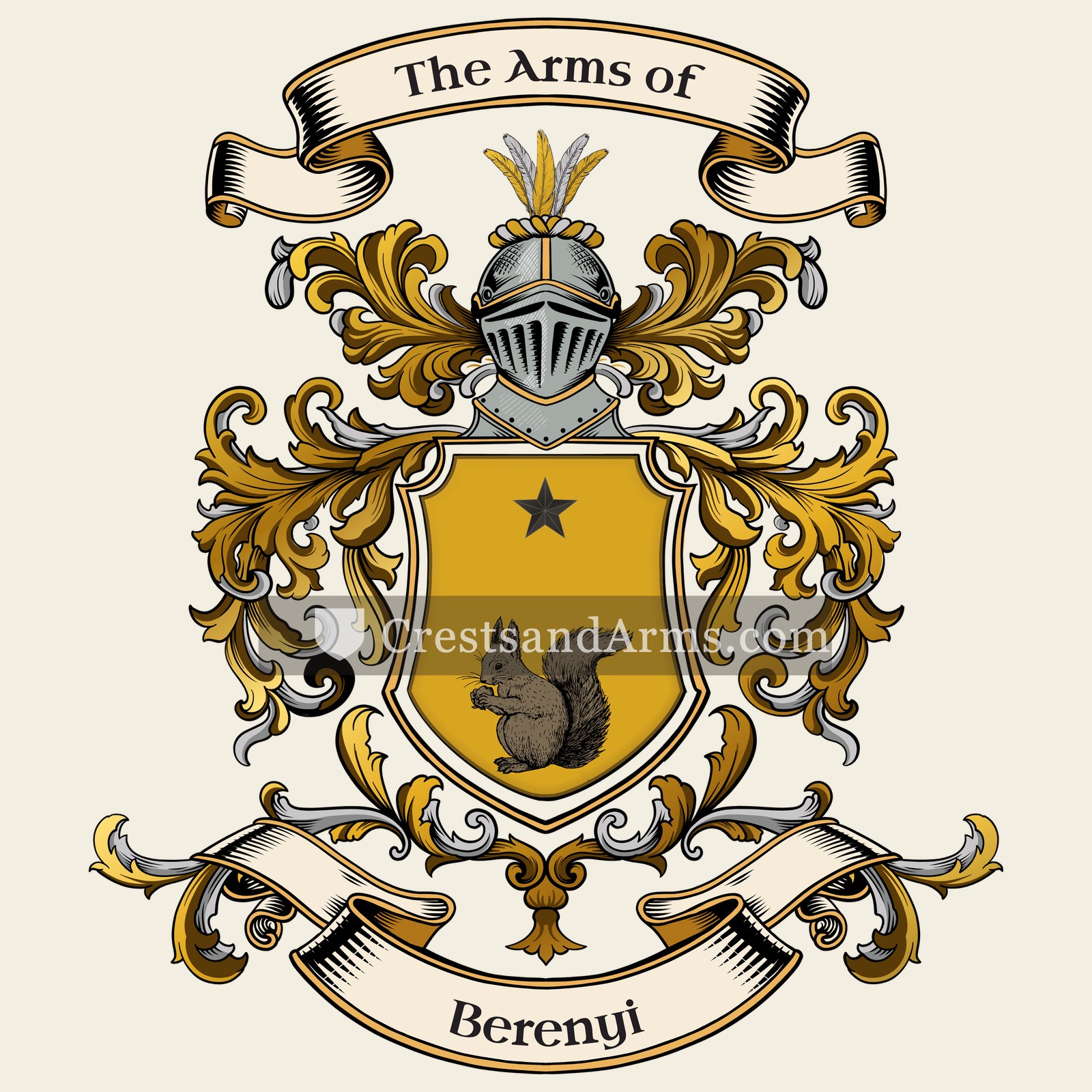
A record of documented arms, meaning and origin, researched for the Berenyi family of Austria.
Reg. 8072 · Austrian, A–C
Coat of Arms & Family Crest Details
Symbols on this shield
squirrelPatience and foresight in gathering
mulletThe third son, and a divine quality from above
Colours
Gold (Or)Means: Generosity
Historical info
Source
J. B. Rietstap, Armorial Général, Gouda: G. B. van Goor Zonen, 1884–87
Blazon (the actual original written record)
“D'or à un écureuil au nat., croquant une noix, assis sur une couronne à l'antique de cinq rayons du premier et adextré en chef d'une étoile aussi d'or. Cq. cour. C.: l'écureuil. L. de gu. (ou de sa.) et d'or. D.: QUO NON ASCENDAM?”
Austriac. 1431
Digital archive packCoat of arms PNG, gold border print PDF, vector SVG and the certificate of authenticity. Sent to your email in minutes.
Map of Austria showing where the Berenyi arms are recorded
The Berenyi arms were recorded in Austria, c. 1431.
Arms such as these were typically recorded in Tyrol.
Tyrol was mountain country in western Austria, where the valleys were held by families who had been there a very long time. Old tenure counted for more than money, and old families carried arms.
This is where the arms were entered in the register. Families often moved to other parts of the country, so the same name can turn up in more than one region.
Region
Tyrol
First recorded
1431
Granting Authority for the Berenyi Arms
Imperial and Royal chancery
Sodacan · CC BY-SA 3.0
The body that granted and recorded arms in Austria in this period.
How Arms Worked in Austria
Austrian coats of arms were often linked directly to noble titles granted by the Emperor. These symbols belonged to the entire family line rather than just one individual. When a family grew, new branches kept the original design without needing to change it. This system allowed all members of a noble house to share the same identity across many generations.
Granting authority
The Imperial and Royal chancery managed all heraldic matters and controlled the official granting of arms throughout the Austrian lands.
How they got arms
Families typically received their arms through a formal imperial decree that often accompanied the elevation of a person to noble status.
Where arms were recorded
Official records of these grants were kept in the Imperial Register of Nobility which began its formal documentation process in 1453.
The family's standing
Recorded among the armigerous families of Austria.
Origin & History of the Berenyi Family in Austria
The family name Berenyi traces its roots back to the mountainous region of Tyrol, where early members were documented as residents by the year 1431. During this period, the name was closely associated with the social and economic shifts occurring in the Alpine territories. Families in this region often derived their surnames from specific geographic landmarks or the roles they played within their local communities. As the Berenyi family established themselves in Tyrol, they became part of the complex social fabric of the late Middle Ages. Over the following centuries, the family expanded their influence and moved across Central Europe, eventually becoming deeply integrated into the history and culture of the Hungarian nobility. This transition from the Alpine valleys to the broader regions of the Austro-Hungarian Empire highlights the mobility and adaptability of the family during a time of significant political change.
Related Branches & Arms
Root word
Berény
Derived from the ancient Hungarian tribal name Berény.
This name
BerenyiRefers to a person originating from the Berény tribal lands or settlements.
also spelled
Berenyi
Bereni de Karanes Bereni
Karanesbereny
Documented Sources
J. B. Rietstap, Armorial Général, Gouda: G. B. van Goor Zonen, 1884–87
Kempelen, Béla. Magyar nemes családok (Hungarian Noble Families), 1911
Nagy, Iván. Magyarország családai czímerekkel és nemzékrendi táblákkal (Families of Hungary with Coats of Arms and Genealogical Tables), 1857


 squirrelPatience and foresight in gathering
 mulletThe third son, and a divine quality from above
 squirrelPatience and foresight in gathering
 mulletThe third son, and a divine quality from above