A record of documented arms, meaning and origin, researched for the Berga family lines. Documented in 2 countries.
Reg. 9962 · German, A–C
Coat of Arms & Family Crest Details
Symbols on this shield
fessThe military belt, and readiness to serve
greyhoundCourage, vigilance and loyalty
Colours
Silver (Argent)Means: Peace and sincerity
Black (Sable)Means: Constancy
Red (Gules)Means: Military strength
Historical info
Source
J. B. Rietstap, Armorial Général, Gouda: G. B. van Goor Zonen, 1884–87
Blazon (the actual original written record)
“Tiercé en fasce: d'arg., de sa. et de gu.; le sa. ch. d'un lévrier courant d'arg. C.: deux cornes de bouquetin adossées, d'arg et de gu., chacune d'une fasce de sa.”
SaxonySaxony, c. 1765
Digital archive packCoat of arms PNG, gold border print PDF, vector SVG and the certificate of authenticity. Sent to your email in minutes.
Map of Germany showing where the Berga arms are recorded
The Berga arms were recorded in Saxony, c. 1765.
Saxony had mines, trade and old landed families all at once. Silver made some fortunes and land held others, and both sorts of family kept arms, which is why Saxon names appear so often in the registers.
This is where the arms were entered in the register. Families often moved to other parts of the country, so the same name can turn up in more than one region.
The body that granted and recorded arms in Germany in this period.
Francis I, Holy Roman Emperor
Sovereign of the period
Francis I, Holy Roman Emperor
1745–1765
Reigning in Germany when the Berga arms are first recorded.
How Arms Worked in Germany
In the Holy Roman Empire, coats of arms were often granted to individuals by the Emperor or his representatives. These arms were then passed down through the generations to all legitimate descendants of the original holder. Younger branches of a family usually kept the same shield design without needing to change it, as the arms belonged to the entire lineage.
Granting authority
The Holy Roman Emperor held the sole power to grant new coats of arms throughout his vast imperial territories.
How they got arms
Families typically obtained their coats of arms through a formal imperial grant or by proving their noble status to the authorities.
Where arms were recorded
These grants were officially recorded in the Imperial Chancery registers, which began keeping formal records of such honors during the Middle Ages.
The family's standing
Recorded among the armigerous families of Saxony.
Origin & History of the Berga Family in Germany
The family name Berga is deeply rooted in the geographical landscape of Saxony, where it emerged as a topographical surname. In German, the root word "Berg" refers to a mountain, hill, or elevated piece of land. Families who adopted this name in the eighteenth century often lived near a prominent hill or worked on high-altitude terrain. By 1765, records indicate that the Berga family was well-established within the Saxon region, likely integrated into the local agricultural or trade communities that defined the area during that era. Because Saxony served as a major crossroads for migration and commerce in the Holy Roman Empire, the name likely functioned as a way to identify individuals by their specific place of residence. This connection to the land suggests that the early members of the family were deeply tied to the rural development of the region, contributing to the local economy and social structure long before the modern era.
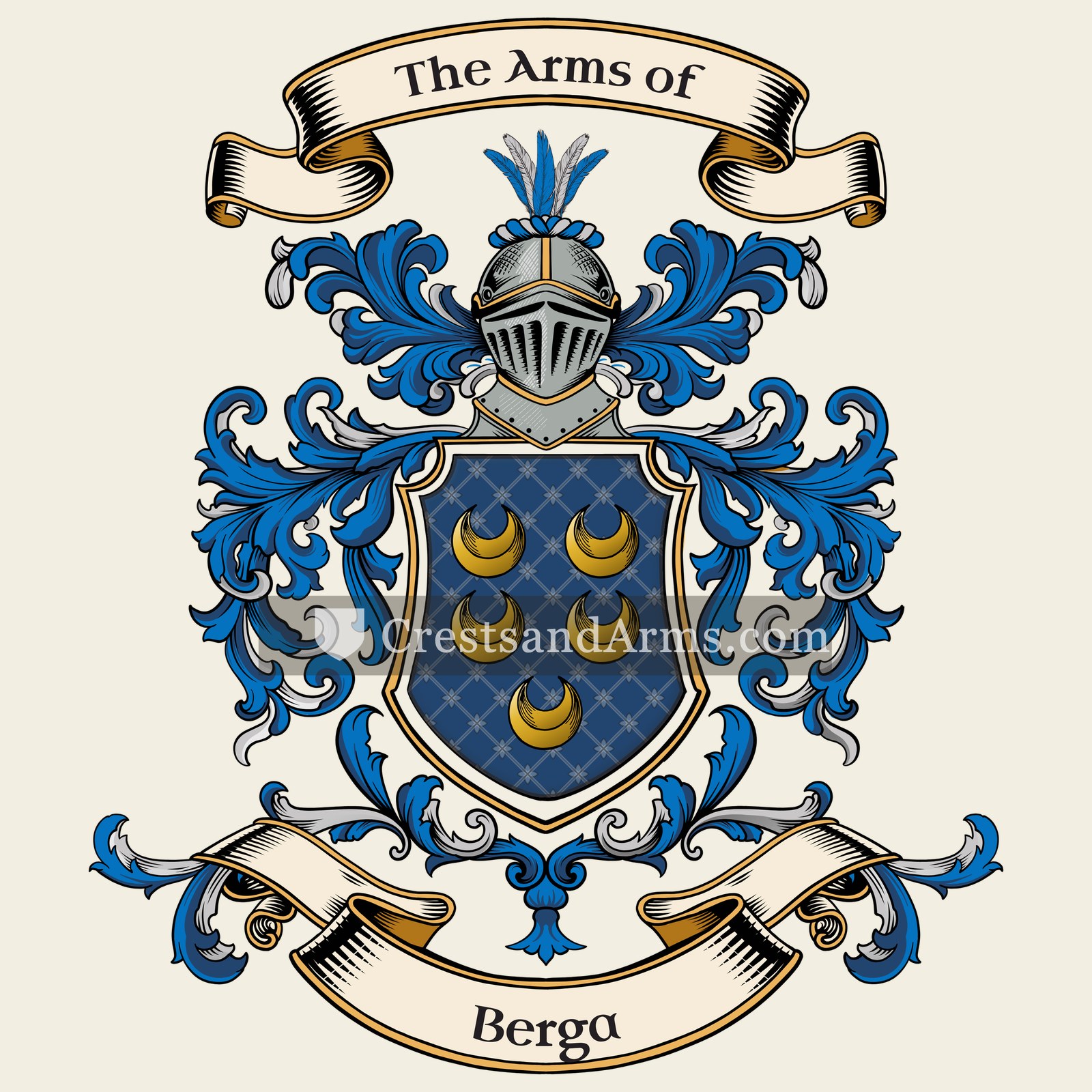
Coat of Arms & Family Crest Details
Symbols on this shield
crescentHonour by the sovereign, and the second son
Colours
Blue (Azure)Means: Loyalty and truth
Gold (Or)Means: Generosity
Historical info
Source
J. B. Rietstap, Armorial Général, Gouda: G. B. van Goor Zonen, 1884–87
Blazon (the actual original written record)
“D'azur à cinq croiss. versés d'or, 2, 2 et 1.”
CataloniaCatalonia, c. 1722
Digital archive packCoat of arms PNG, gold border print PDF, vector SVG and the certificate of authenticity. Sent to your email in minutes.
Map of Spain showing where the Berga arms are recorded
The Berga arms were recorded in Catalonia, c. 1722.
Catalonia lived by sea trade, and its merchant houses were as powerful as its landowners. Both sorts of family took arms, and Barcelona kept records of the houses entitled to bear them.
This is where the arms were entered in the register. Families often moved to other parts of the country, so the same name can turn up in more than one region.
The body that granted and recorded arms in Spain in this period.
Philip V of Spain
Sovereign of the period
Philip V of Spain
1714–1724
Reigning in Germany when the Berga arms are first recorded.
How Arms Worked in Spain
In Spain, a coat of arms was considered a form of property that belonged to the entire family line. These arms were passed down from a father to all his children equally. Younger branches of the family usually kept the original design without needing to add any special marks to distinguish their specific line.
Granting authority
The Cronista Rey de Armas was the official body that regulated and granted coats of arms throughout Spain.
How they got arms
Families often obtained their arms through royal grants or by proving their noble status to the official heraldic authority.
Where arms were recorded
Coats of arms were officially recorded in the registers of the Cronista Rey de Armas starting in 1496.
The family's standing
Recorded among the armigerous families of Catalonia.
Origin & History of the Berga Family in Spain
The family name Berga finds its deep historical roots in the rugged landscape of Catalonia, a region in northeastern Spain known for its distinct cultural identity. By the early eighteenth century, the family was well-established within this territory, living through a time of significant political transition following the War of the Spanish Succession. During this era, families with the surname Berga were often tied to the land and the local administrative structures of the Catalan countryside. The name itself is thought to be topographic, likely originating from individuals who lived near or hailed from the town of Berga, which sits at the foothills of the Pyrenees mountains. As the family grew, they became part of the social fabric of the region, participating in the agricultural and mercantile life that defined Catalan communities in the 1700s. Their presence in the area reflects the broader history of families who maintained deep connections to their ancestral towns while navigating the changing laws and customs of the Spanish crown.
Berga Meaning & Related Branches
Root word
Berg
A mountain, hill, or elevated piece of land.
This name
BergaA topographic name for someone who lived on or near a mountain.
also spelled
Bergah
Bergas
Related arms
van den Bergevariant spelling
Documented Sources
J. B. Rietstap, Armorial Général, Gouda: G. B. van Goor Zonen, 1884–87
Bahlow, Hans, Deutsches Namenlexikon: Familien- und Vornamen nach Ursprung und Sinn erklärt, 1967
Sächsisches Staatsarchiv, Kirchenbücher der evangelisch-lutherischen Landeskirche Sachsens, 1765
Heintze, Albert, Die deutschen Familien-Namen: geschichtlich, geographisch, sprachlich, 1903
Digital archive packCoat of arms PNG, gold border print PDF, vector SVG and the certificate of authenticity. Sent to your email in minutes.


 fessThe military belt, and readiness to serve
 greyhoundCourage, vigilance and loyalty
 fessThe military belt, and readiness to serve
 greyhoundCourage, vigilance and loyalty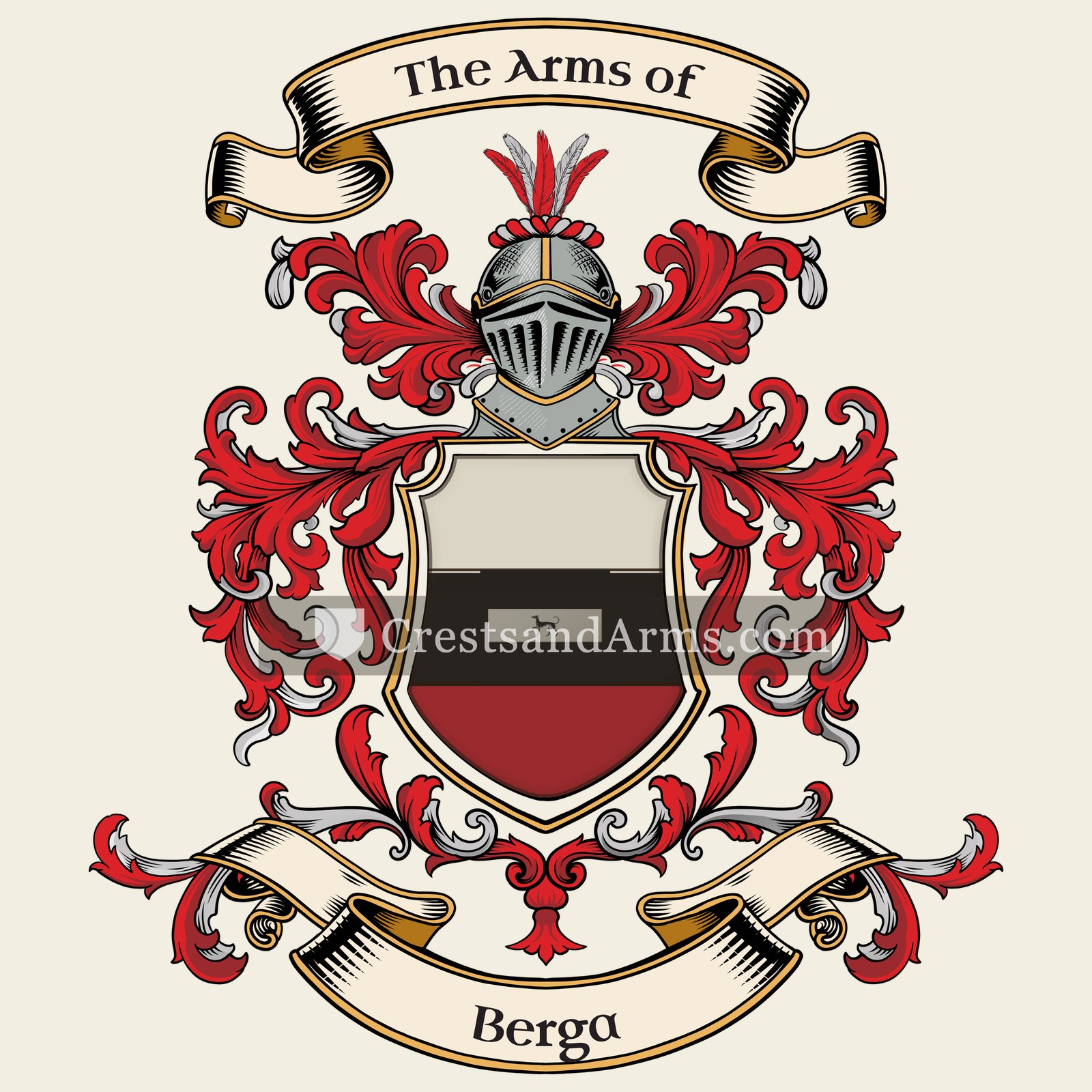


 crescentHonour by the sovereign, and the second son