Map of Germany showing where the Berges arms are recorded
The Berges arms were recorded in Germany, c. 1315.
Arms such as these were typically recorded in Bavaria.
Bavaria was a country of old landed families and walled market towns. Estates passed down the same line for centuries, and both the landowners and the leading townsmen kept arms, which is why so many Bavarian names sit in the registers.
This is where the arms were entered in the register. Families often moved to other parts of the country, so the same name can turn up in more than one region.
The body that granted and recorded arms in Germany in this period.
How Arms Worked in Germany
In the Holy Roman Empire, coats of arms were often granted to individuals by the Emperor or his representatives. These arms were then passed down through the generations to all legitimate descendants of the original holder. Younger branches of a family usually kept the same shield design without needing to change it, as the arms belonged to the entire lineage.
Granting authority
The Holy Roman Emperor held the sole power to grant new coats of arms throughout his vast imperial territories.
How they got arms
Families typically obtained their coats of arms through a formal imperial grant or by proving their noble status to the authorities.
Where arms were recorded
These grants were officially recorded in the Imperial Chancery registers, which began keeping formal records of such honors during the Middle Ages.
The family's standing
Recorded among the armigerous families of Germany.
Origin & History of the Berges Family in Germany
The family name Berges finds its roots in the topographical landscape of medieval Germany, specifically within the southern region of Bavaria. By the year 1315, records indicate that individuals bearing this name were already established in the area, likely identifying themselves by their proximity to prominent hills or mountain ranges. In the German language, the term "Berg" refers to a mountain or a hill, and the suffix "es" often functioned as a possessive or a locative indicator, suggesting that early ancestors were known as people who lived on or near such geographical features. During the fourteenth century, as surnames began to transition from descriptive nicknames to hereditary family markers, the Berges name became a way to distinguish families based on their ancestral home or land. This connection to the Bavarian terrain highlights how early German society organized itself around the natural environment, turning local landmarks into lasting identities for generations to come.
Meaning of the Berges family crest colors & symbols
Symbols on this shield
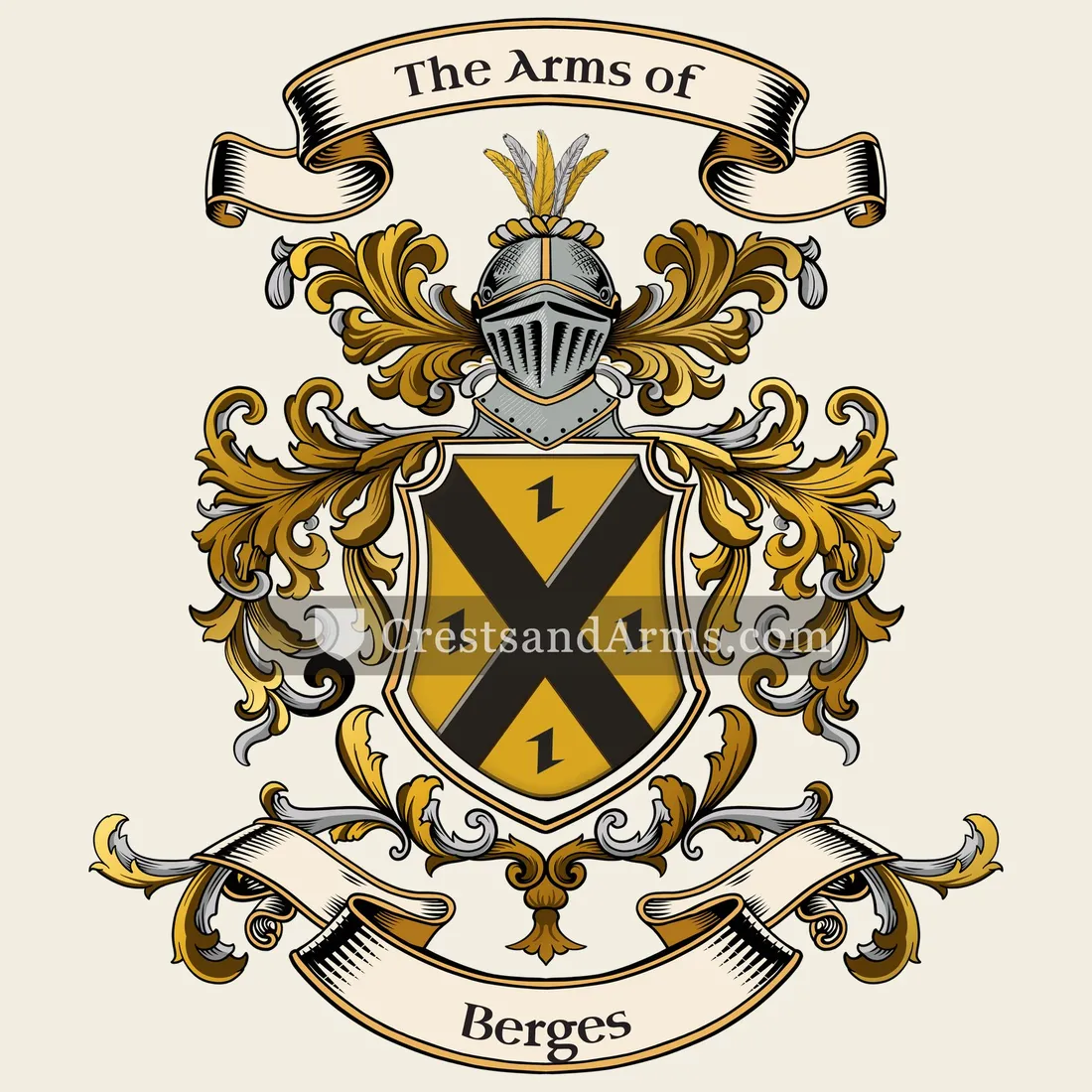
saltireResolution, and St Andrew's cross
cramponFirm hold on what has been gained
Colours
Gold (Or)Means: Generosity
Black (Sable)Means: Constancy
Historical info
Source
J. B. Rietstap, Armorial Général, Gouda: G. B. van Goor Zonen, 1884–87
Blazon (the actual original written record)
“D'or au saut. de sa., cant. de quatre crampons du même (ou, les mêmes armes, moins le saut.) C. cour. C.: un crampon de sa., entre un vol coupé alt. d'arg. et de sa.”
Francec. 1663
Digital archive packCoat of arms PNG, gold border print PDF, vector SVG and the certificate of authenticity. Sent to your email in minutes.
Map of France showing where the Berges arms are recorded
The Berges arms were recorded in France, c. 1663.
Arms such as these were typically recorded in Bretagne.
More families held coats of arms in Bretagne than anywhere else in France. The land was divided into many small estates rather than a few large ones, so far more households counted as gentry, and each needed a shield of its own to be told apart.
This is where the arms were entered in the register. Families often moved to other parts of the country, so the same name can turn up in more than one region.
The body that granted and recorded arms in France in this period.
Louis XIV of France
Sovereign of the period
Louis XIV of France
1643–1715
Reigning in Germany when the Berges arms are first recorded.
How Arms Worked in France
In France, a coat of arms was a mark of honor that passed down through the male line to all legitimate descendants. Families often used the same shield without changes to show their shared heritage. If a branch wanted to stand out, they could add a small mark to their shield to show their specific place in the family tree.
Granting authority
The Juge d'armes de France acted as the official authority that regulated and verified coats of arms across the country.
How they got arms
Families typically inherited their arms from ancestors, though they could also receive them through royal grants or by proving their noble status.
Where arms were recorded
Coats of arms were officially recorded in the Armorial Général de France, which began its main collection in the year 1696.
The family's standing
Recorded among the armigerous families of France.
Origin & History of the Berges Family in France
The surname Berges is deeply rooted in the rugged landscape of France, where it originated as a topographic name for families living near hills or mountains. By the middle of the 17th century, the name was firmly established in the province of Bretagne. Records from 1663 confirm that members of the Berges family were active participants in the local community life of this coastal region. During this era, families in Bretagne were often defined by their connection to the land and their parish records, which served as the primary way to track their movements and social standing. As the family grew, they became part of the complex social fabric of rural France, navigating the agricultural traditions and regional customs that shaped life in the 1600s. The name reflects a long history of resilience and adaptation, as these early ancestors helped build the foundations of their local society long before the modern era.
Meaning of the Berges family crest colors & symbols
Symbols on this shield
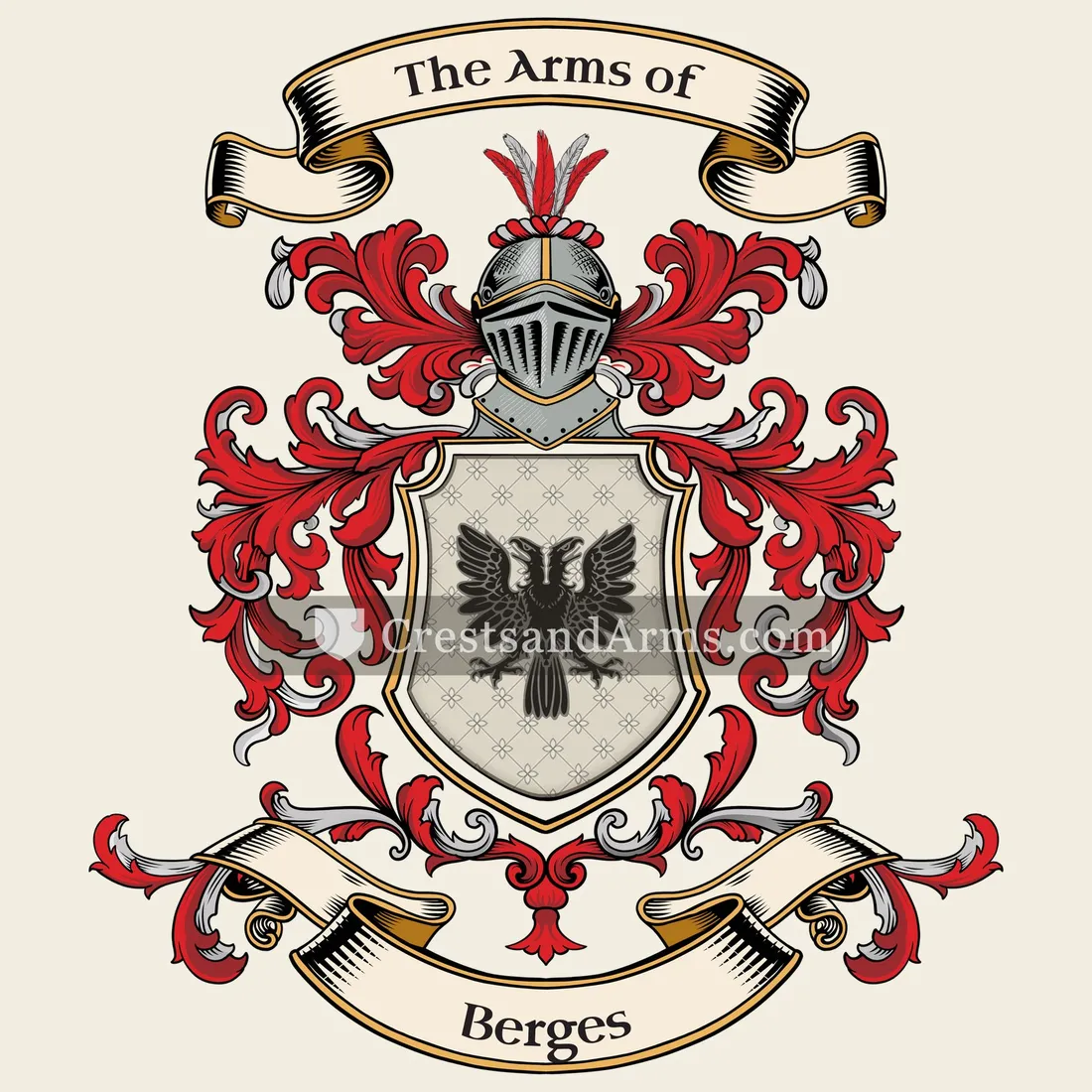
eagleNobility, strength and a keen mind
Colours
Silver (Argent)Means: Peace and sincerity
Black (Sable)Means: Constancy
Historical info
Source
J. B. Rietstap, Armorial Général, Gouda: G. B. van Goor Zonen, 1884–87
Blazon (the actual original written record)
“D'arg. à l'aigle de sa., bq., m. et cour. d'or. C.: un vol de sa.”
Denmarkc. 1722
Digital archive packCoat of arms PNG, gold border print PDF, vector SVG and the certificate of authenticity. Sent to your email in minutes.
Map of Denmark showing where the Berges arms are recorded
The Berges arms were recorded in Denmark, c. 1722.
Arms such as these were typically recorded in Sjaælland.
Zealand held the Danish court, the crown's offices and Copenhagen itself. Families who served the king kept estates within reach of it, and royal service was the ordinary route to a coat of arms.
This is where the arms were entered in the register. Families often moved to other parts of the country, so the same name can turn up in more than one region.
The body that granted and recorded arms in Denmark in this period.
Frederik IV of Denmark
Sovereign of the period
Frederik IV of Denmark
1699–1730
Reigning in Germany when the Berges arms are first recorded.
How Arms Worked in Denmark
Danish heraldry during this period was closely tied to noble status and royal favor rather than being open to all citizens. Arms were typically granted by the monarch to individuals, and these symbols were then shared by all members of the noble house. If a family line died out, the right to use those specific arms ended with them.
Granting authority
The Danish royal chancery held the power to issue and regulate official coats of arms for the kingdom.
How they got arms
Families usually received their arms through a formal royal grant that confirmed their noble status and rights.
Where arms were recorded
These grants were officially recorded in the Danish Royal Chancery records starting in the sixteenth century.
The family's standing
Recorded among the armigerous families of Denmark.
Origin & History of the Berges Family in Denmark
The history of the Berges name in Denmark begins with roots firmly planted in the landscape of Sjælland by the early 18th century. By 1722, records confirm that members of the family were living and working within this region, which served as the cultural and political heart of the Danish kingdom. The name itself is closely tied to the geography of the area, as the term often relates to people who lived near hills or elevated terrain. During this period, families like the Berges were typically part of the agrarian society that defined rural Denmark. They lived through a time of significant social structure where most people were tied to the land under the manorial system. As the family established themselves in Sjælland, they became part of the local community fabric, participating in the daily life and traditions of the island. Their presence in the historical record during the 1720s provides a clear starting point for tracing their long-standing connection to the Danish countryside.
Berges Meaning & Related Branches
Root word
Berg
A mountain, hill, or elevated piece of land.
This name
BergesRefers to someone who lived on or near a mountain or hill.
also spelled
Berge
Berges
Bergee
Documented Sources
J. B. Rietstap, Armorial Général, Gouda: G. B. van Goor Zonen, 1884–87
Bahlow, Hans, Deutsches Namenlexikon: Familien- und Vornamen nach Ursprung und Sinn erklärt, 1967
Heintze, Albert, Die deutschen Familien-Namen: geschichtlich, geographisch, sprachlich, 1903
Bayerisches Hauptstaatsarchiv, Urkunden und Amtsbücher des Herzogtums Bayern, 1315
Digital archive packCoat of arms PNG, gold border print PDF, vector SVG and the certificate of authenticity. Sent to your email in minutes.


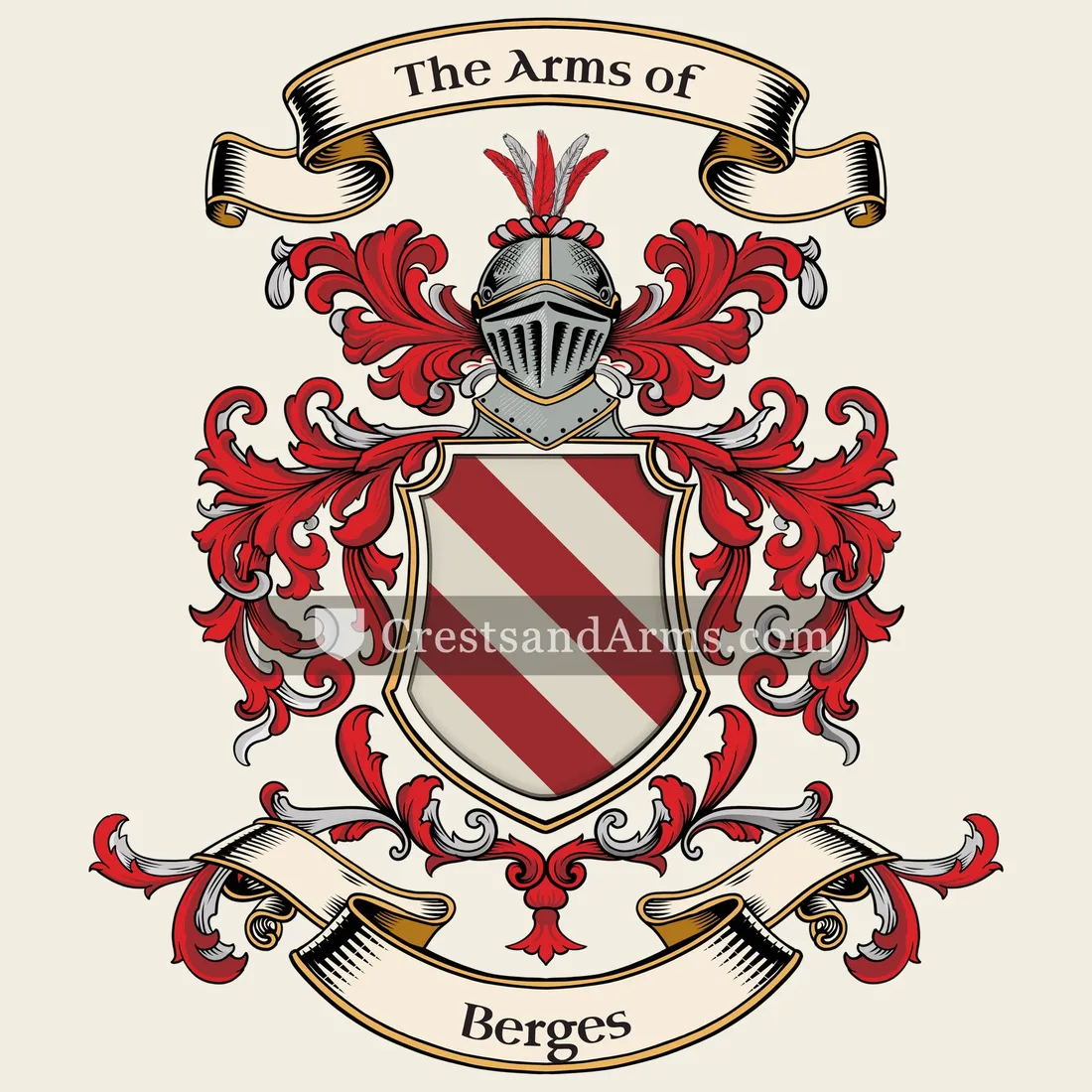
 bendDefence, and the scarf of a commander
 bendDefence, and the scarf of a commander

 saltireResolution, and St Andrew's cross
 cramponFirm hold on what has been gained


 eagleNobility, strength and a keen mind