Map of Germany showing where the Bergh arms are recorded
The Bergh arms were recorded in Germany, c. 1765.
Arms such as these were typically recorded in Bavaria.
Bavaria was a country of old landed families and walled market towns. Estates passed down the same line for centuries, and both the landowners and the leading townsmen kept arms, which is why so many Bavarian names sit in the registers.
This is where the arms were entered in the register. Families often moved to other parts of the country, so the same name can turn up in more than one region.
The body that granted and recorded arms in Germany in this period.
Francis I, Holy Roman Emperor
Sovereign of the period
Francis I, Holy Roman Emperor
1745–1765
Reigning in Germany when the Bergh arms are first recorded.
How Arms Worked in Germany
In the Holy Roman Empire, coats of arms were often granted to individuals by the Emperor or his representatives. These arms were then passed down through the generations to all legitimate descendants of the original holder. Younger branches of a family usually kept the same shield design without needing to change it, as the arms belonged to the entire lineage.
Granting authority
The Holy Roman Emperor held the sole power to grant new coats of arms throughout his vast imperial territories.
How they got arms
Families typically obtained their coats of arms through a formal imperial grant or by proving their noble status to the authorities.
Where arms were recorded
These grants were officially recorded in the Imperial Chancery registers, which began keeping formal records of such honors during the Middle Ages.
The family's standing
Recorded among the armigerous families of Germany.
Origin & History of the Bergh Family in Germany
The surname Bergh is a topographic name that originated in the German-speaking regions of Europe. It comes from the Middle High German word "berg," which translates to mountain or hill. In the early days, people often received this name because they lived near a prominent hill or a mountain range. By the time members of the family were documented in Bavaria in 1765, the name was already well-established as a way to identify individuals by their local landscape. Families with this name were typically associated with rural or mountainous areas where the terrain defined their daily lives and agricultural practices. Over many generations, the name shifted from a simple description of a person’s home to a permanent family identifier that was passed down through the centuries.
Coat of Arms & Family Crest Details
Symbols on this shield
mountThe ground held, and steadfastness upon it
eagleNobility, strength and a keen mind
mulletThe third son, and a divine quality from above
Colours
Gold (Or)Means: Generosity
Blue (Azure)Means: Loyalty and truth
Black (Sable)Means: Constancy
Silver (Argent)Means: Peace and sincerity
Historical info
Source
J. B. Rietstap, Armorial Général, Gouda: G. B. van Goor Zonen, 1884–87
Blazon (the actual original written record)
“Parti: au 1 d'or à la demi-aigle de sa., mouv. du parti; au 2 d'azur au rocher d'arg. en p., surm. de trois étoiles d'or, 2 et 1.”
Netherlandsc. 1815
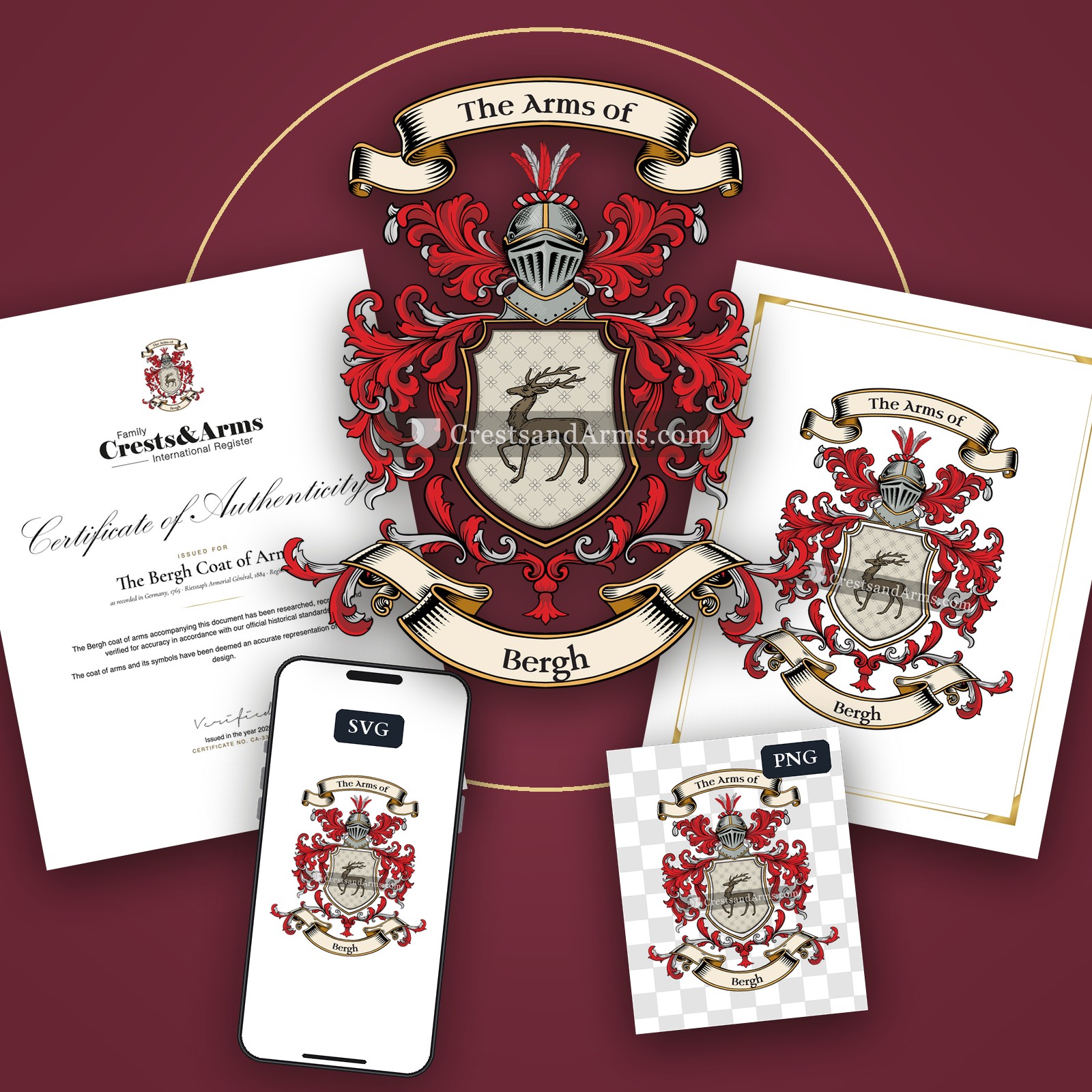
Digital archive packCoat of arms PNG, gold border print PDF, vector SVG and the certificate of authenticity. Sent to your email in minutes.
Map of Netherlands showing where the Bergh arms are recorded
The Bergh arms were recorded in Netherlands, c. 1815.
Arms such as these were typically recorded in Friesland.
Friesland was low, wet country on the northern coast of the Netherlands, farmed by families who had held the same land for centuries. Free landholders were unusually common there, and a free landholder could carry arms.
This is where the arms were entered in the register. Families often moved to other parts of the country, so the same name can turn up in more than one region.
Region
Friesland
First recorded
1815
Granting Authority for the Bergh Arms
Hoge Raad van Adel
Photograph made by me · CC BY-SA 3.0
The body that granted and recorded arms in Netherlands in this period.
William I of the Netherlands
Sovereign of the period
William I of the Netherlands
1815–1840
Reigning in Germany when the Bergh arms are first recorded.
How Arms Worked in Netherlands
In the Netherlands, coats of arms were often used by noble families and those who held specific public offices. These arms were passed down through the generations to legitimate descendants. Younger branches of a family usually kept the original design without needing to add special marks. This system ensured that the family identity remained clear and consistent over many years.
Granting authority
The Hoge Raad van Adel is the official body that regulates and manages noble titles and coats of arms in the Netherlands.
How they got arms
Families typically obtained their coats of arms through official royal grants or by proving their long-standing historical use of the symbols.
Where arms were recorded
Coats of arms are officially recorded in the registers held by the Hoge Raad van Adel, which began its work in 1814.
The family's standing
Recorded among the armigerous families of Netherlands.
Origin & History of the Bergh Family in Netherlands
The surname Bergh is a topographic name, which means it was originally given to people who lived near a prominent hill or a mountain. In the Dutch language, the word "berg" translates directly to hill or mountain. While the Netherlands is famous for its flat landscape, the name likely referred to someone living near a small rise in the terrain or a man-made mound used for protection against flooding. By the early 19th century, records confirm that families bearing the name Bergh were well-established in the northern province of Friesland. During this period, the Dutch government began formalizing civil registrations, which helped solidify surnames as permanent family identifiers. These early members of the Bergh family in Friesland were part of a regional population that was transitioning into a modern system of record-keeping, marking the beginning of a documented lineage that has persisted for over two centuries.
Bergh Meaning & Related Branches
Root word
Berg
A mountain, hill, or elevated piece of land.
This name
BerghA topographic name for someone who lived on or near a mountain or hill.
also spelled
Berg
Related arms
Bergvariant spelling
van den Berchvariant spelling
Documented Sources
J. B. Rietstap, Armorial Général, Gouda: G. B. van Goor Zonen, 1884–87
Bahlow, Hans, Deutsches Namenlexikon: Familien- und Vornamen nach Ursprung und Sinn erklärt, 1967
Heintze, Albert, Die deutschen Familiennamen: geschichtlich, geographisch, sprachlich, 1903


 stagPeace and harmony, and one who will not fight unprovoked
 stagPeace and harmony, and one who will not fight unprovoked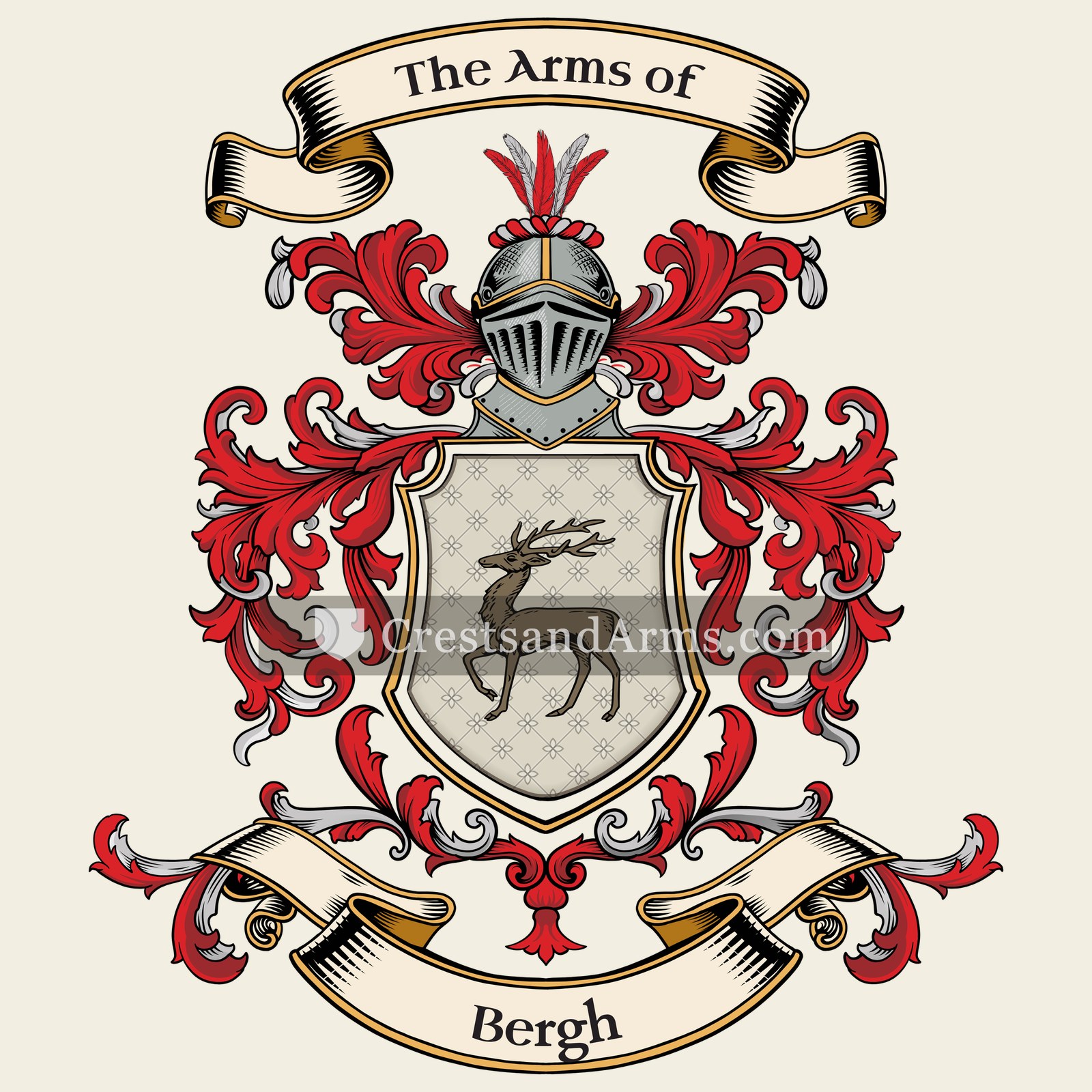


 mountThe ground held, and steadfastness upon it
 eagleNobility, strength and a keen mind
 mulletThe third son, and a divine quality from above