A record of documented arms, meaning and origin, researched for the Bering family lines. Documented in 2 countries.
Reg. 0126 · Danish, A–C
Coat of Arms & Family Crest Details
Symbols on this shield
mountThe ground held, and steadfastness upon it
armA person of action, industrious and laborious
Colours
Gold (Or)Means: Generosity
Green (Vert)Means: Hope
Historical info
Source
J. B. Rietstap, Armorial Général, Gouda: G. B. van Goor Zonen, 1884–87
Blazon (the actual original written record)
“D'or à deux bras arm., au nat., mouv. d'une terrasse de sin., les mains de carn. supp. une couronne de laurier de sin. C.: les meubles de l'écu, moins la terrasse.”
Denmarkc. 1722
Digital archive packCoat of arms PNG, gold border print PDF, vector SVG and the certificate of authenticity. Sent to your email in minutes.
Map of Denmark showing where the Bering arms are recorded
The Bering arms were recorded in Denmark, c. 1722.
Arms such as these were typically recorded in Sjaælland.
Zealand held the Danish court, the crown's offices and Copenhagen itself. Families who served the king kept estates within reach of it, and royal service was the ordinary route to a coat of arms.
This is where the arms were entered in the register. Families often moved to other parts of the country, so the same name can turn up in more than one region.
The body that granted and recorded arms in Denmark in this period.
Frederik IV of Denmark
Sovereign of the period
Frederik IV of Denmark
1699–1730
Reigning in Denmark when the Bering arms are first recorded.
How Arms Worked in Denmark
Danish heraldry during this period was closely tied to noble status and royal favor rather than being open to all citizens. Arms were typically granted by the monarch to individuals, and these symbols were then shared by all members of the noble house. If a family line died out, the right to use those specific arms ended with them.
Granting authority
The Danish royal chancery held the power to issue and regulate official coats of arms for the kingdom.
How they got arms
Families usually received their arms through a formal royal grant that confirmed their noble status and rights.
Where arms were recorded
These grants were officially recorded in the Danish Royal Chancery records starting in the sixteenth century.
The family's standing
Recorded among the armigerous families of Denmark.
Origin & History of the Bering Family in Denmark
The Bering family name has deep roots in the Danish landscape, with historical documentation confirming their presence on the island of Sjælland by the year 1722. During the early eighteenth century, families in this region often lived in close-knit rural communities where surnames were frequently tied to local geography or specific ancestral trades. The name Bering itself carries a strong connection to the northern European linguistic tradition, likely evolving from old regional descriptors that identified where a person lived or the nature of their work. As the family established themselves in Sjælland, they became part of the shifting social fabric of Denmark, a time when the country was transitioning through significant agricultural and administrative reforms. By maintaining their presence in this specific region, the early Bering family members contributed to the local history of the island, leaving behind a legacy that is preserved today through parish registers and regional census records.
Coat of Arms & Family Crest Details
Symbols on this shield
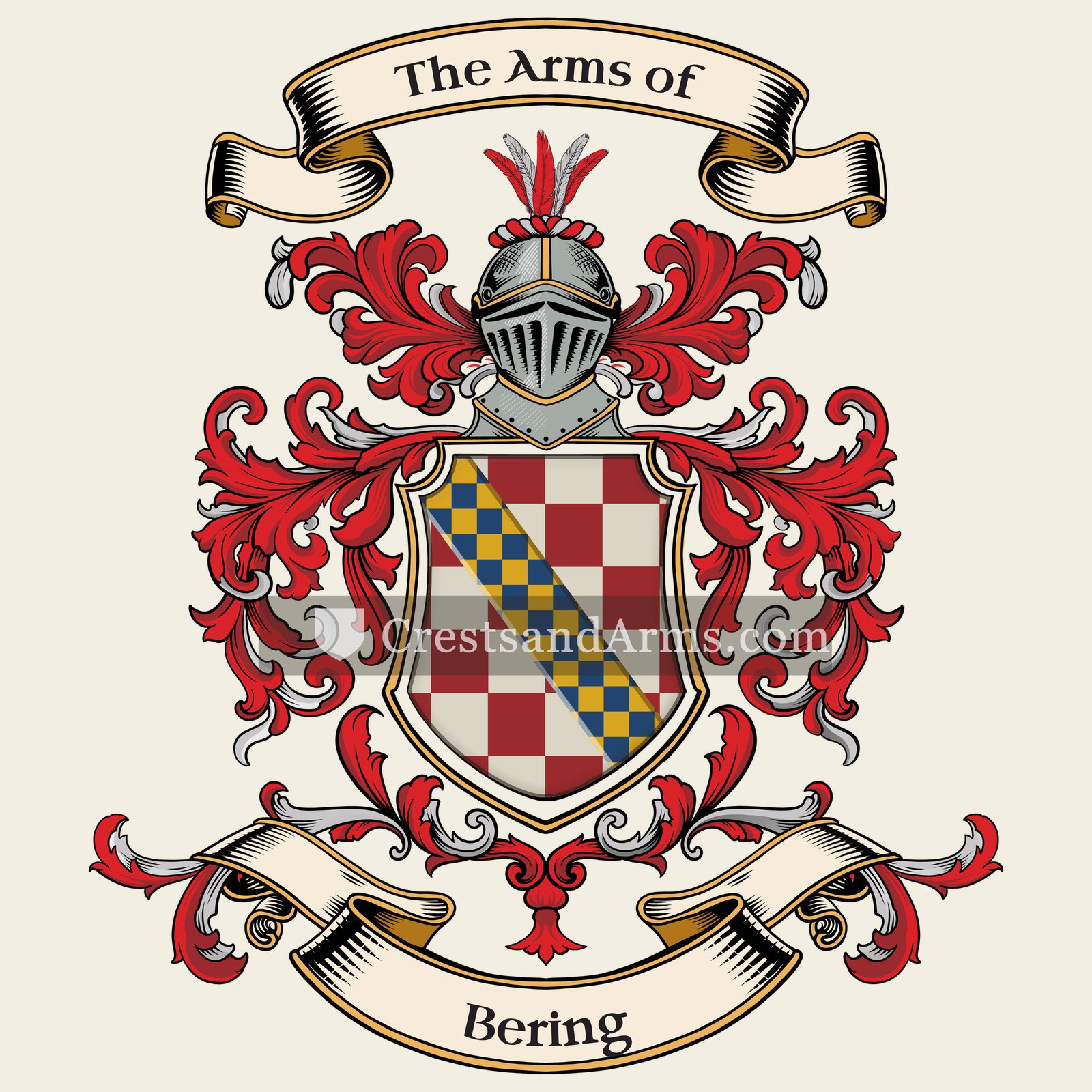
chequyConstancy, and the counting-board
bendDefence, and the scarf of a commander
Colours
Silver (Argent)Means: Peace and sincerity
Gold (Or)Means: Generosity
Historical info
Source
Sir Bernard Burke, The General Armory of England, Scotland, Ireland and Wales, London: Harrison & Sons, 1884
Blazon (the actual original written record)
“Chequy ar. and gu. a bend chequy az. and or”
Englandc. 1620
Digital archive packCoat of arms PNG, gold border print PDF, vector SVG and the certificate of authenticity. Sent to your email in minutes.
Map of England showing where the Bering arms are recorded
The Bering arms were recorded in England, c. 1620.
Arms such as these were typically recorded in York.
Yorkshire is the largest of the English counties, and it held more gentry families than any other. Land there was split among a great many households rather than a few, so a great many of them carried arms.
This is where the arms were entered in the register. Families often moved to other parts of the country, so the same name can turn up in more than one region.
The body that granted and recorded arms in England in this period.
James VI and I
Sovereign of the period
James VI and I
1603–1625
Reigning in Denmark when the Bering arms are first recorded.
How Arms Worked in England
English heraldry allowed arms to be shared by all legitimate descendants of the original owner. These symbols were treated as personal property that moved through the generations to all children. While the eldest son kept the original design, other family members could use the same shield without needing to change it or register their own unique versions.
Granting authority
The College of Arms in London has regulated the use of coats of arms throughout England and Wales since 1484.
How they got arms
Families typically obtained their coats of arms through a formal grant from the Crown or by proving their ancient right to them.
Where arms were recorded
All official coats of arms are recorded in the registers kept at the College of Arms, which date back to the fifteenth century.
The family's standing
Recorded among the armigerous families of England.
Origin & History of the Bering Family in England
The family name Bering traces its roots in England to the early seventeenth century, with documented evidence placing family members in the historic city of York by 1620. During this period, York served as a vital northern hub for trade and administration, attracting families who were often involved in local commerce or specialized crafts. The name itself likely evolved from older Germanic or Old English roots, potentially describing a person who lived near a specific landmark or someone known for their physical strength. As the family established themselves in the North of England, they became part of the growing urban middle class that helped shape the social fabric of Yorkshire. By settling in such a prominent city, the early Bering family members were positioned to participate in the significant cultural and economic shifts that defined England during the reign of King James I.
Bering Meaning & Related Branches
Root word
Bjørn
Old Norse term referring to the large predatory mammal, the bear.
This name
BeringA patronymic surname indicating descent from an ancestor associated with the bear.
also spelled
Beringh
Beringe
Berin
Documented Sources
J. B. Rietstap, Armorial Général, Gouda: G. B. van Goor Zonen, 1884–87
Rigsarkivet (Danish National Archives), Kirkebøger (Parish Registers), Sjælland Stift
Rigsarkivet (Danish National Archives), Folketællinger (Census Records), 1787
Hansen, J. V., Danske Slægtsnavne gennem Tiderne, 1985
Nielsen, O., Sjællandske Stednavne og deres Historie, 1972
Digital archive packCoat of arms PNG, gold border print PDF, vector SVG and the certificate of authenticity. Sent to your email in minutes.


 mountThe ground held, and steadfastness upon it
 armA person of action, industrious and laborious
 mountThe ground held, and steadfastness upon it
 armA person of action, industrious and laborious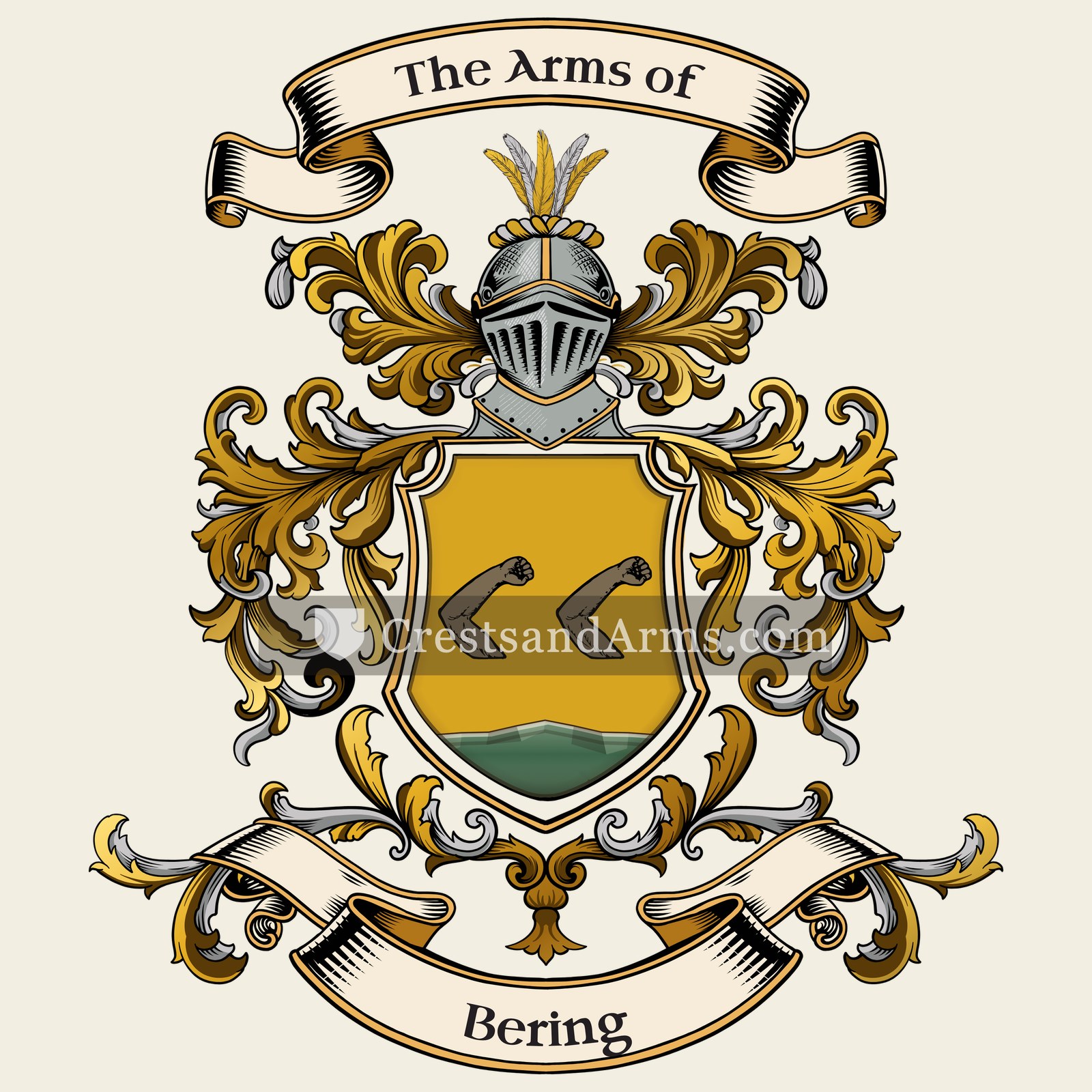


 chequyConstancy, and the counting-board
 bendDefence, and the scarf of a commander