A record of documented arms, meaning and origin, researched for the Bern family lines. Documented in 3 countries.
Reg. 5834 · Swiss, A–C
Meaning of the Bern family crest colors & symbols
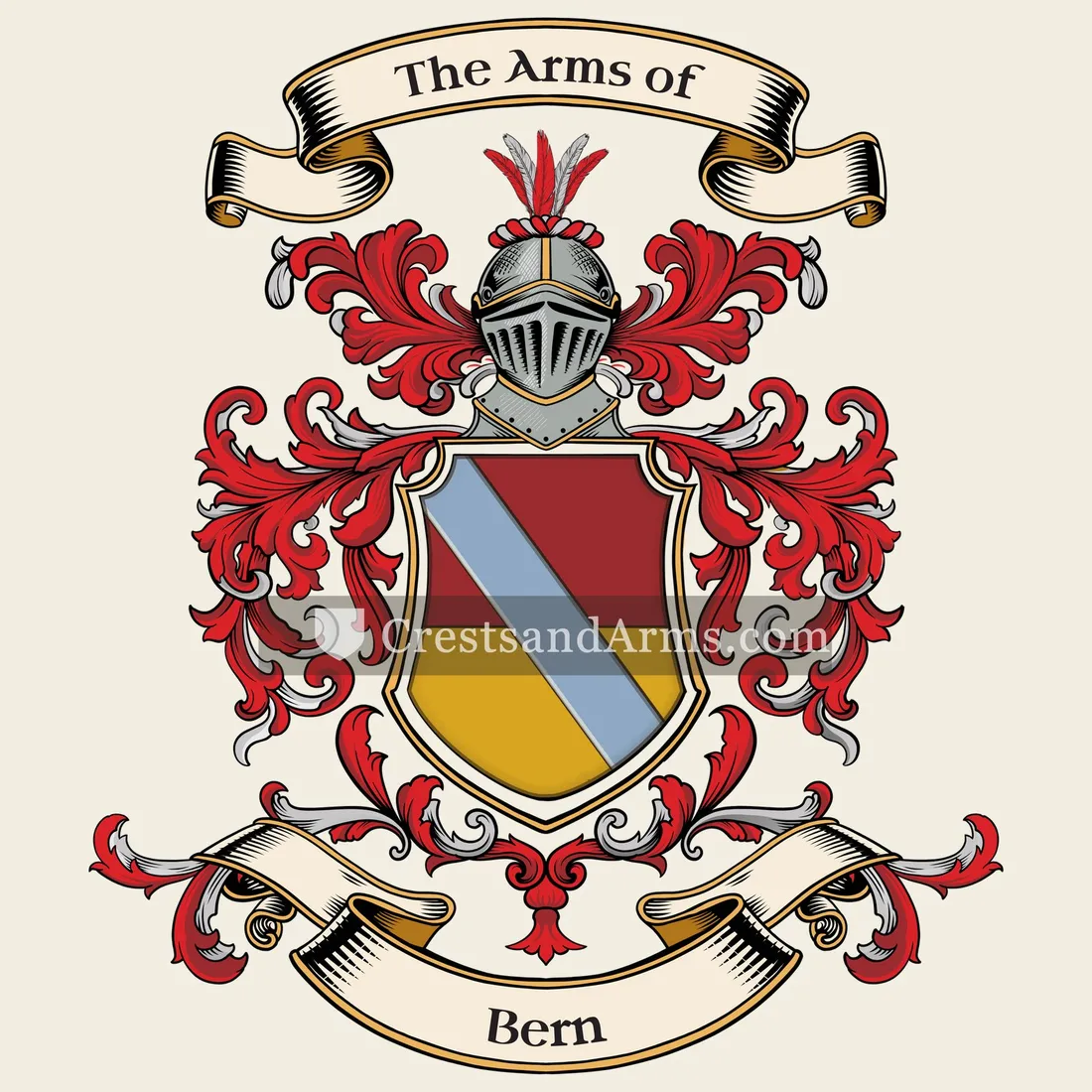
Symbols on this shield
bendDefence, and the scarf of a commander
vairProtection, and the winter fur
Colours
Red (Gules)Means: Military strength
Gold (Or)Means: Generosity
VairMeans: Protection
Historical info
Source
J. B. Rietstap, Armorial Général, Gouda: G. B. van Goor Zonen, 1884–87
Blazon (the actual original written record)
“Coupé de gu. sur or; à la bande de vair, br. sur le tout. C.: une tête et col de cygne d'arg., ornée du long du dos de trois touffes de plumes de coq de sa. L. d'or et de gu.”
Switzerlandc. 1745
Digital archive packCoat of arms PNG, gold border print PDF, vector SVG and the certificate of authenticity. Sent to your email in minutes.
Map of Switzerland showing where the Bern arms are recorded
The Bern arms were recorded in Switzerland, c. 1745.
Arms such as these were typically recorded in Bern.
Bern was the largest of the Swiss cantons and ran itself, with its own council and its own courts. Its governing families held office for generations, and office of that kind carried a shield with it.
This is where the arms were entered in the register. Families often moved to other parts of the country, so the same name can turn up in more than one region.
The body that granted and recorded arms in Switzerland in this period.
How Arms Worked in Switzerland
In Switzerland, coats of arms were not restricted to the nobility and were often adopted by common citizens and families. These symbols were passed down through generations to show family identity. When branches of a family grew, they often changed small details of the design to distinguish their own line from the original group.
Granting authority
Cantonal and civic authorities managed the use of coats of arms within their specific regions and local jurisdictions.
How they got arms
Families typically assumed their own coats of arms based on local custom rather than receiving them from a central monarch.
Where arms were recorded
Arms were recorded in various cantonal and civic registers starting from the fourteenth century throughout the Swiss region.
The family's standing
Recorded among the armigerous families of Switzerland.
Origin & History of the Bern Family in Switzerland
The family name Bern is deeply connected to the geography and administrative history of Switzerland. In the German language, the name is synonymous with the city of Bern, which was founded in the twelfth century. Families who adopted this name often did so to signify their origins as residents or citizens of this prominent urban center. By the year 1745, records confirm that members of the Bern family were well-established within the region. During this era, the city functioned as a powerful city-state, and families living there were frequently involved in the local guilds or agricultural life of the surrounding Swiss cantons. Because the name is tied to a major political hub, it reflects a history of movement and settlement within the Swiss Confederation. These early ancestors likely navigated the complex social structure of the eighteenth century, where one’s family name served as a clear indicator of their home territory and community identity.
Meaning of the Bern family crest colors & symbols
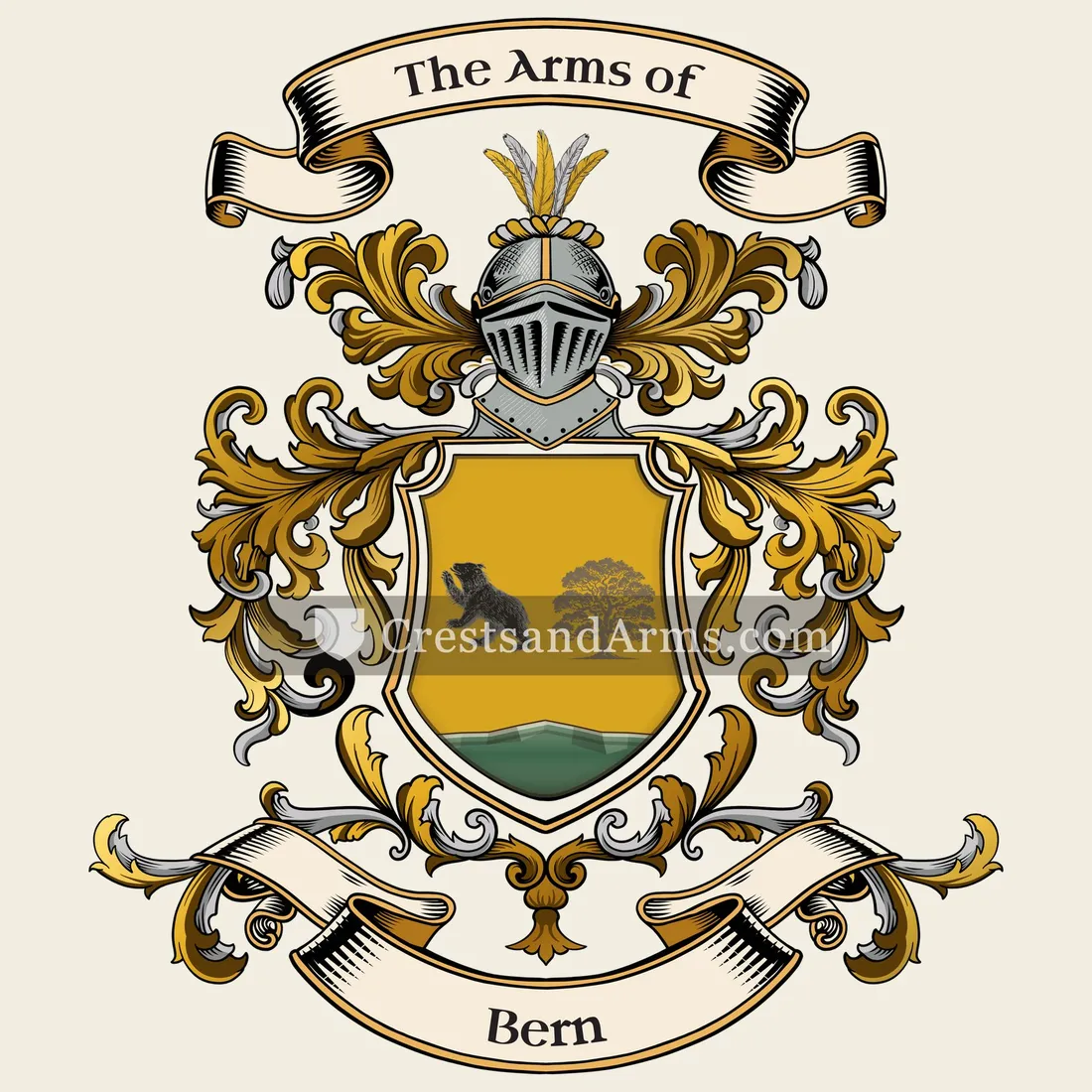
Symbols on this shield
mountThe ground held, and steadfastness upon it
bearStrength, cunning and protection of kin
treeLife, endurance and deep roots
Colours
Gold (Or)Means: Generosity
Green (Vert)Means: Hope
Black (Sable)Means: Constancy
Historical info
Source
J. B. Rietstap, Armorial Général, Gouda: G. B. van Goor Zonen, 1884–87
Blazon (the actual original written record)
“D'or à l'ours de sa., ramp. contre un tronc d'arbre au nat., le tout soutenu d'un tertre de sin.”
GermanyNördlingen Bav, c. 1765
Digital archive packCoat of arms PNG, gold border print PDF, vector SVG and the certificate of authenticity. Sent to your email in minutes.
Map of Germany showing where the Bern arms are recorded
The Bern arms were recorded in Nördlingen Bav, c. 1765.
This is where the arms were entered in the register. Families often moved to other parts of the country, so the same name can turn up in more than one region.
The body that granted and recorded arms in Germany in this period.
Francis I, Holy Roman Emperor
Sovereign of the period
Francis I, Holy Roman Emperor
1745–1765
Reigning in Switzerland when the Bern arms are first recorded.
How Arms Worked in Germany
In the Holy Roman Empire, coats of arms were often granted to individuals by the Emperor or his representatives. These arms were then passed down through the generations to all legitimate descendants of the original holder. Younger branches of a family usually kept the same shield design without needing to change it, as the arms belonged to the entire lineage.
Granting authority
The Holy Roman Emperor held the sole power to grant new coats of arms throughout his vast imperial territories.
How they got arms
Families typically obtained their coats of arms through a formal imperial grant or by proving their noble status to the authorities.
Where arms were recorded
These grants were officially recorded in the Imperial Chancery registers, which began keeping formal records of such honors during the Middle Ages.
The family's standing
Recorded among the armigerous families of Germany.
Origin & History of the Bern Family in Germany
The surname Bern finds its roots in the linguistic traditions of southern Germany, where it likely originated as a topographic or descriptive name. In the Middle Ages, names were often tied to a person’s place of origin or a specific physical trait, and the name Bern is closely linked to the German word for bear. By the time the family was firmly established in the imperial city of Nördlingen in 1765, the name had become a stable identifier for a lineage integrated into the local urban economy. Nördlingen was a significant center for trade and craftsmanship during the eighteenth century, and families living there were often involved in the guilds that governed daily life. Records from this period show that the Bern family was part of a structured society where citizenship was highly valued and carefully documented by city officials. As the family navigated the social and economic shifts of the region, their name served as a consistent link to their history in the Swabian landscape.
Meaning of the Bern family crest colors & symbols
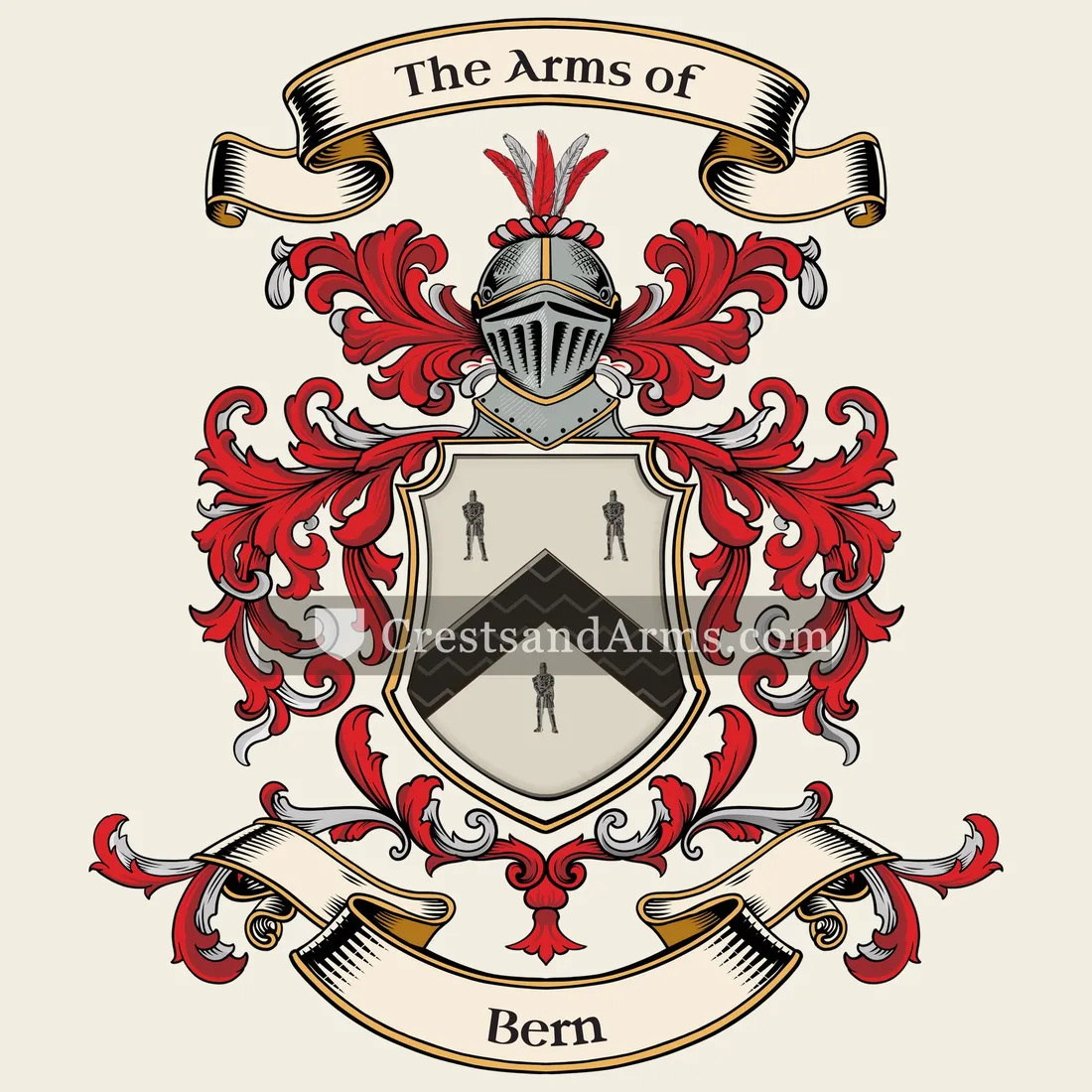
Symbols on this shield
chevronProtection, and faithful service completed
knightChivalry and service in arms
Colours
Silver (Argent)Means: Peace and sincerity
Black (Sable)Means: Constancy
Historical info
Source
Sir Bernard Burke, The General Armory of England, Scotland, Ireland and Wales, London: Harrison & Sons, 1884
Blazon (the actual original written record)
“Ar. a chev. betw. three negroes' heads couped sa”
Englandc. 1620
Digital archive packCoat of arms PNG, gold border print PDF, vector SVG and the certificate of authenticity. Sent to your email in minutes.
Map of England showing where the Bern arms are recorded
The Bern arms were recorded in England, c. 1620.
Arms such as these were typically recorded in York.
Yorkshire is the largest of the English counties, and it held more gentry families than any other. Land there was split among a great many households rather than a few, so a great many of them carried arms.
This is where the arms were entered in the register. Families often moved to other parts of the country, so the same name can turn up in more than one region.
The body that granted and recorded arms in England in this period.
James VI and I
Sovereign of the period
James VI and I
1603–1625
Reigning in Switzerland when the Bern arms are first recorded.
How Arms Worked in England
English heraldry allowed arms to be shared by all legitimate descendants of the original owner. These symbols were treated as personal property that moved through the generations to all children. While the eldest son kept the original design, other family members could use the same shield without needing to change it or register their own unique versions.
Granting authority
The College of Arms in London has regulated the use of coats of arms throughout England and Wales since 1484.
How they got arms
Families typically obtained their coats of arms through a formal grant from the Crown or by proving their ancient right to them.
Where arms were recorded
All official coats of arms are recorded in the registers kept at the College of Arms, which date back to the fifteenth century.
The family's standing
Recorded among the armigerous families of England.
Origin & History of the Bern Family in England
The history of the Bern family in England is deeply connected to the northern city of York, where records confirm their presence by the year 1620. During this period, York served as a vital hub for trade and administration in the north of England. Families living in the city at this time often worked as skilled artisans or merchants who helped shape the local economy. The name itself likely originated as a descriptive term or a reference to a specific location, reflecting the common practice of identifying people by their trade or home region during the seventeenth century. As residents of a historic walled city, the early members of the Bern family would have lived through a time of significant social change as England transitioned toward the modern era. Their documented presence in York suggests they were part of the established community that contributed to the city’s long-standing reputation as a center of northern life.
Bern Meaning & Related Branches
Root word
Bern
Derived from the Germanic word for bear
This name
BernA topographic name for someone living in the city of Bern or a habitational name for someone from that region
also spelled
Bernn
Berne
Bernee
Berny
Related arms
Beernvariant spelling
Beirnevariant spelling
Documented Sources
J. B. Rietstap, Armorial Général, Gouda: G. B. van Goor Zonen, 1884–87
Historisches Lexikon der Schweiz, Bern (Gemeinde), 2004
Staatsarchiv des Kantons Bern, Bürgerrodel der Stadt Bern, 1745
Dubler, Anne-Marie, Stadt und Land in der Schweiz des 18. Jahrhunderts, 1980
Digital archive packCoat of arms PNG, gold border print PDF, vector SVG and the certificate of authenticity. Sent to your email in minutes.


 bendDefence, and the scarf of a commander
 bendDefence, and the scarf of a commander

 mountThe ground held, and steadfastness upon it
 bearStrength, cunning and protection of kin
 treeLife, endurance and deep roots


 chevronProtection, and faithful service completed
 knightChivalry and service in arms