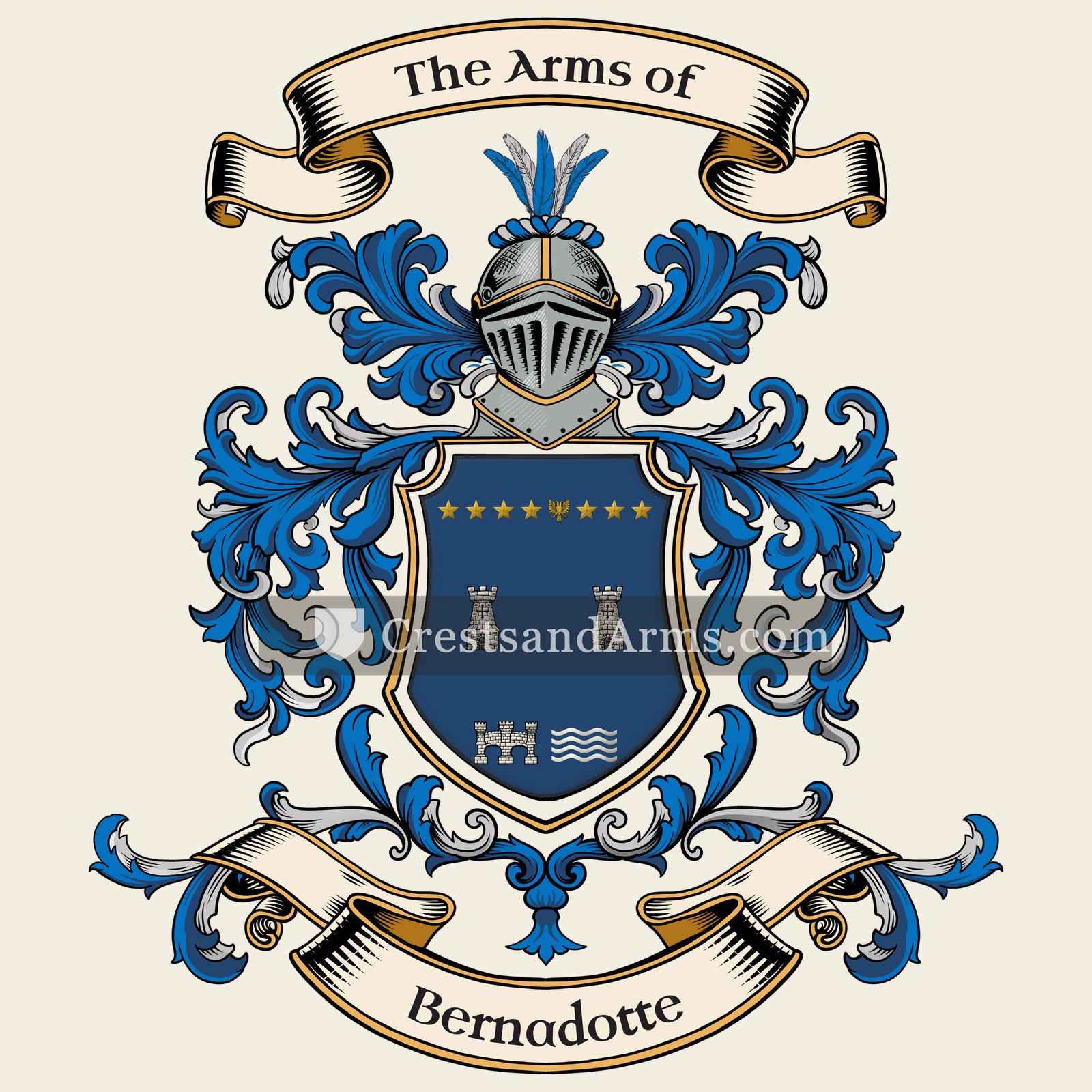
A record of documented arms, meaning and origin, researched for the Bernadotte family of France.
Reg. 8839 · French, A–C
Coat of Arms & Family Crest Details
Symbols on this shield
eagleNobility, strength and a keen mind
towerGrandeur and solidity, and a stronghold defended
mulletThe third son, and a divine quality from above
bridgeOne who joins what was divided
riverThe bounds of a land, and life carried through it
Colours
Blue (Azure)Means: Loyalty and truth
Gold (Or)Means: Generosity
Silver (Argent)Means: Peace and sincerity
Historical info
Source
J. B. Rietstap, Armorial Général, Gouda: G. B. van Goor Zonen, 1884–87
Blazon (the actual original written record)
“D'azur à un pont d'arg., sommé de deux tours du même et jeté sur une rivière aussi d'arg.; à une aigle d'or, cour. du même, posée en chef et surm. de sept étoiles d'or.”
Francec. 1806
Digital archive packCoat of arms PNG, gold border print PDF, vector SVG and the certificate of authenticity. Sent to your email in minutes.
Map of France showing where the Bernadotte arms are recorded
The Bernadotte arms were recorded in France, c. 1806.
Arms such as these were typically recorded in Bretagne.
More families held coats of arms in Bretagne than anywhere else in France. The land was divided into many small estates rather than a few large ones, so far more households counted as gentry, and each needed a shield of its own to be told apart.
This is where the arms were entered in the register. Families often moved to other parts of the country, so the same name can turn up in more than one region.
The body that granted and recorded arms in France in this period.
Napoleon
Sovereign of the period
Napoleon
1804–1814
Reigning in France when the Bernadotte arms are first recorded.
How Arms Worked in France
In France, a coat of arms was a mark of honor that passed down through the male line to all legitimate descendants. Families often used the same shield without changes to show their shared heritage. If a branch wanted to stand out, they could add a small mark to their shield to show their specific place in the family tree.
Granting authority
The Juge d'armes de France acted as the official authority that regulated and verified coats of arms across the country.
How they got arms
Families typically inherited their arms from ancestors, though they could also receive them through royal grants or by proving their noble status.
Where arms were recorded
Coats of arms were officially recorded in the Armorial Général de France, which began its main collection in the year 1696.
The family's standing
Recorded among the armigerous families of France.
Origin & History of the Bernadotte Family in France
The family name Bernadotte originated in the Béarn region of southwestern France, far from the coastal province of Brittany. The name itself is a compound derived from the local Gascon dialect, combining the personal name Bernard with the suffix "otte," which was a common way to denote a smaller or younger version of a person. By the early 17th century, the family had established itself as a line of local artisans and minor officials in the town of Pau. While members of the family eventually traveled and served across various French territories, including regions near Brittany by the early 19th century, their roots remained firmly planted in the Pyrenees mountains. The family gained significant prominence when Jean-Baptiste Bernadotte rose through the ranks of the French military during the revolutionary wars, eventually becoming a Marshal of the Empire before being elected as the Crown Prince of Sweden in 1810.
Bernadotte Meaning & Related Branches
Root word
Bernhard
Derived from the Germanic elements for bear and brave or hardy.
This name
BernadotteA diminutive form indicating a descendant of someone named Bernard, meaning brave as a bear.
also spelled
Bernadott
Bernadottee
Bernadot
Documented Sources
J. B. Rietstap, Armorial Général, Gouda: G. B. van Goor Zonen, 1884–87
Alm, Mikael and Johansson, Britt. Zeladyn: Jean-Baptiste Bernadotte – från fransk revolutionsgeneral till svensk kung, 2010
Dahl, Torsten. Bernadotte: En släkthistoria, 1970
Archives Nationales de France, Série O/1: Maison du Roi
Digital archive packCoat of arms PNG, gold border print PDF, vector SVG and the certificate of authenticity. Sent to your email in minutes.


 eagleNobility, strength and a keen mind
 towerGrandeur and solidity, and a stronghold defended
 mulletThe third son, and a divine quality from above
 bridgeOne who joins what was divided
 riverThe bounds of a land, and life carried through it
 eagleNobility, strength and a keen mind
 towerGrandeur and solidity, and a stronghold defended
 mulletThe third son, and a divine quality from above
 bridgeOne who joins what was divided
 riverThe bounds of a land, and life carried through it